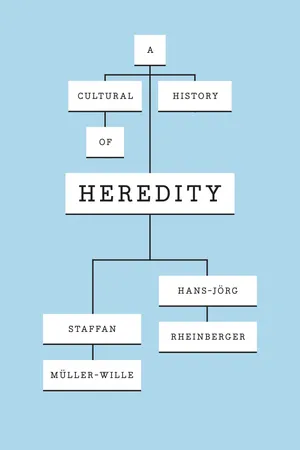
It was only around 1800 that heredity began to enter debates among physicians, breeders, and naturalists. Soon thereafter it evolved into one of the most fundamental concepts of biology. Here Staffan Müller-Wille and Hans-Jörg Rheinberger offer a succinct cultural history of the scientific concept of heredity. They outline the dramatic changes the idea has undergone since the early modern period and describe the political and technological developments that brought about these changes.
Müller-Wille and Rheinberger begin with an account of premodern theories of generation, showing that these were concerned with the procreation of individuals rather than with hereditary transmission. The authors reveal that when hereditarian thinking first emerged, it did so in a variety of cultural domains, such as politics and law, medicine, natural history, breeding, and anthropology. Müller-Wille and Rheinberger then track theories of heredity from the late nineteenth century—when leading biologists considered it in light of growing societal concerns with race and eugenics—through the rise of classical and molecular genetics in the twentieth century, to today, as researchers apply sophisticated information technologies to understand heredity. What readers come to see from this exquisite history is why it took such a long time for heredity to become a prominent concept in the life sciences and why it gained such overwhelming importance in those sciences and the broader culture over the last two centuries.
- 340 pages
- English
- ePUB (mobile friendly)
- Available on iOS & Android
eBook - ePub
A Cultural History of Heredity
About this book
Information
Publisher
University of Chicago PressYear
2012Print ISBN
9780226213484
9780226545707
eBook ISBN
9780226545721
Table of contents
- Cover
- Copyright
- Title Page
- Epigraph
- Contents
- Preface
- 1. Heredity: Knowledge and Power
- 2. Generation, Reproduction, Evolution
- 3. Heredity in Separate Domains
- 4. First Syntheses
- 5. Heredity, Race, and Eugenics
- 6. Disciplining Heredity
- 7. Heredity and Molecular Biology
- 8. Gene Technology, Genomics, Postgenomics: Attempt at an Outlook
- Notes
- Bibliography
- Index
Trusted by 375,005 students
Access to over 1.5 million titles for a fair monthly price.
Study more efficiently using our study tools.
Frequently asked questions
Yes, you can cancel anytime from the Subscription tab in your account settings on the Perlego website. Your subscription will stay active until the end of your current billing period. Learn how to cancel your subscription
No, books cannot be downloaded as external files, such as PDFs, for use outside of Perlego. However, you can download books within the Perlego app for offline reading on mobile or tablet. Learn how to download books offline
Perlego offers two plans: Essential and Complete
- Essential is ideal for learners and professionals who enjoy exploring a wide range of subjects. Access the Essential Library with 800,000+ trusted titles and best-sellers across business, personal growth, and the humanities. Includes unlimited reading time and Standard Read Aloud voice.
- Complete: Perfect for advanced learners and researchers needing full, unrestricted access. Unlock 1.5M+ books across hundreds of subjects, including academic and specialized titles. The Complete Plan also includes advanced features like Premium Read Aloud and Research Assistant.
We are an online textbook subscription service, where you can get access to an entire online library for less than the price of a single book per month. With over 1.5 million books across 990+ topics, we’ve got you covered! Learn about our mission
Look out for the read-aloud symbol on your next book to see if you can listen to it. The read-aloud tool reads text aloud for you, highlighting the text as it is being read. You can pause it, speed it up and slow it down. Learn more about Read Aloud
Yes! You can use the Perlego app on both iOS and Android devices to read anytime, anywhere — even offline. Perfect for commutes or when you’re on the go.
Please note we cannot support devices running on iOS 13 and Android 7 or earlier. Learn more about using the app
Please note we cannot support devices running on iOS 13 and Android 7 or earlier. Learn more about using the app
Yes, you can access A Cultural History of Heredity by Staffan Müller-Wille,Hans-Jörg Rheinberger in PDF and/or ePUB format, as well as other popular books in Biological Sciences & World History. We have over 1.5 million books available in our catalogue for you to explore.