![]()
The Long Wrong Man
And still I saw—but with such an exaggeration!
Poe
Soliloquy of a Spectator
Not long ago, in Paris (where such miracles still happen), I went to see a new print of Hitchcock’s The Wrong Man (1956). It was doubly new to me, who had never before had a chance to see the film on celluloid. In the days before the screening, I primed myself for the revelation that theatrical projection would coax from this great work that I only knew in its debased condition as home entertainment. Already, in my mind’s eye, I beheld the grain—the grandeur—the tremulous luminosity—of the bona fide cinematic images awaiting me. And in the event, I suffered no disappointment on this score: the chalky luster of Robert Burks’s cinematography, formerly hidden from me in the brightness of the digital image, made the silver screen seem literally woven with silver. Yet if I had finally seen Burks’s masterpiece, I perceived almost nothing of Hitchcock’s. His great film, captivating, puzzling, distressing, and which I consider his most intense of all—here, this film seemed to be wearing a cloak of invisibility so ample that I half-suspected the so-called new print of being mutilated. Worse: in place of the masterpiece I anticipated, I saw a rather frigid little work—a bit dull, often sentimental—that I had never seen before and had scant interest in seeing again. After a while, I was able to identify this inferior work; it was, of course, The Wrong Man that I had read about in the critical literature: the film that Hitchcock asked Truffaut to file “among the indifferent Hitchcocks” and to which he claimed to be himself indifferent (“I don’t feel all that strongly about it”); the film that Slavoj Žižek, voicing the opinion of many, proclaimed “leaves us cold”; the film in which Hitchcock is widely believed to have made the mistake of being true to life and hence false to his style.
What barbarism had perpetrated the replacement of that hugely compelling film I would watch at home by this mediocrity being projected under the same name at the Action Écoles? Only one thing: though the screen was now monumentally larger, the film itself was palpably shorter than anything I had ever watched on a monitor. It was not that, as I first thought, the copy being shown at the Action Écoles had curtailed the proper running time; rather, my home viewing practice had distended it, to a length that made this compact little film, when I finally saw it projected, virtually unrecognizable.
Never once, I was now obliged to own, did my home viewing of The Wrong Man come near coinciding with the running time of the Paris screening. Typically, it would extend through several days, sometimes to over a week; on a couple of occasions, it went so slowly that I gave it up in a sort of despair. Of the two main reasons for this lengthiness, one is the hyperattention that I habitually accord to any Hitchcock film, which I play most often at the tempo in music called larghissimo: very, very slowly. I do this because, in the normal procession of images in Hitchcock, I invariably have the frustrating sense of a vision withheld. It is as if there were always something crucial to be seen that somehow, whether through my lapse of attention or by the director’s malice aforethought, has eluded me. At once demoralized and stimulated by the suspicion that I have missed out on this Secret, I find myself yielding to a desire to see more: more films, again and again, in greater detail. And no matter how much more the current state of technology lets me see, and yet how enigmatic the films remain, I persist in my absurd belief that I would understand them perfectly if only I could inspect them at greater length. It has been said, quite reasonably, that no sane person tries to enter the screen, but, with Hitchcock, that is precisely what I want to do: cross through the screen into the story world, to see, touch, possess the people and things there in a reality that, thus completely verified, would be hiding nothing.
Yet with The Wrong Man, I seem to harbor, in addition to this desire to see everything, its very opposite: an impulse to block everything out. In the grip of this impulse, closeness is no longer my eager ambition; it is, from the start, my painful condition. It is as if every frame secretly evinces the thing that eludes me in the other films, and, though I never can exactly state what this thing might be, it feels somehow monstrous—maddening—unbearable. I might say of this vision, as Judy in Vertigo says about the gray suit that fits her like a glove, and with the same emphasis: I don’t like it! Straightaway, The Wrong Man makes me feel there is something wrong—wrong with me! What I see so disturbs me that, again and again, I turn away my eyes. Unsettled in my very person, I become subject to a hallucination far crazier than that of entering the screen: by a kind of reverse projection, what’s on the screen seems to be entering me—and I am forced, by merely ocular means, to give intimate harbor to an obnoxious, but unrepellable, foreign body. In Hitchcock’s less theatrical idiom, The Wrong Man “gets under my skin.”1
Hence, the second reason why The Wrong Man takes me a long time to get through: the numerous and protracted breaks I take from watching it. These breaks have nothing to do with the various summonses—friends ringing, nature “calling”—that commonly extend home viewing time. Watching a Hitchcock, I am too devout to indulge such aesthetic irrelevancies for long—and in any case I should never think that I was leaving Hitchcock’s world by going to objects so prominently featured in it as the telephone or the toilet. Still less do my interruptions have anything to do with the “longueurs” of this particular film. I am not sure I like The Wrong Man—I probably do not; I merely love it—but I am certainly never bored by it. Nor, finally, do these breaks offer merely well-deserved relief from the rigor of paying attention or the stress of bearing the unbearable. Far more aggressive than that, my breaks are inspired by a wish to actually break something: the film itself! With each interruption, as if the remote with its pause button were a revolver with its trigger, I shatter the filmic flow into amorphous pieces that will never, at least not by me, be reassembled. Attempting to save my own skin, I perforate the pellicle that is the image-continuum. After all, as Hitchcock himself acknowledged, the classic Hollywood film asks to be perused in a single sitting no less than the brief tale according to Poe.2 And just as, for Poe, “simple cessation in reading” suffices to destroy the tale’s “true unity,” so the repeated adjournment of my viewing would disable the film’s self-structuring as an aesthetic totality and diffuse its psychic effect as a single irresistible impression. Instead of Poe’s taut short story, The Wrong Man would become a long loose novel that takes forever to finish and of which one is continually losing the thread. That may be the real domestication aimed at by my interminable home viewing: to amortize my distress over a long period of time, during which this overwhelming film would eventually become no more than another irksome but familiar household chore. And yet, to the extent I have succeeded, that chore remains as arduous as all a monk’s austerities. Few things are more exhausting for me than watching a couple of minutes of The Wrong Man.
The following critical essay may be taken by the reader as a derivative of this soliloquy. In it, I will attempt to turn myself from an irresponsible spectator into a credible speculator: “one who engages in occult observations or studies” (OED), that is, a student of secrets. My purpose in becoming this speculator is not to renounce my long-established habits of fragmenting and protracting the film; the few excerpts under analysis are mere snippets, each lasting only a few seconds, and my reading will necessarily unfold at greater length than do its objects—even to the point of seeming to literalize the long-standing fantasy, running through textual criticism from Reuben Brower to Roland Barthes, of “reading in slow motion.”3 No, my purpose is to demonstrate that, for all its eccentricity, this long viewing sees a hidden truth in Hitchcock’s film; specifically, that it lets us observe certain crucial little discords, minute but highly elaborated counterstructures, that are objectively present onscreen, but so well secreted there—by, among other things, normal projection speed—that they have never been recognized at all, much less accounted for. Consider my protracted viewing practice, then, as being akin to the secret vantage point necessary to discern the image in an anamorphosis. In other words, consider “The Long Wrong Man”—for so I call my interminable home movie with its extravagant hostility to formal unity—as a first, “hysterical” record of certain form-destroying discontinuities that, on reflection, can be shown to fracture The Wrong Man tout court. If I am persuasive in my speculation, the long film will have bespoken my intimate apprehension of the thing erratically pulsing through the short one: Hitchcock’s secret style.
X Marks the Spot
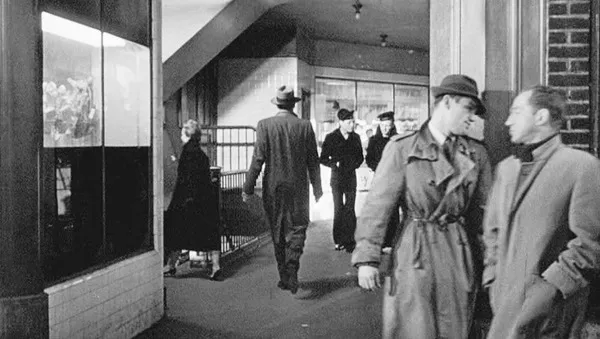
With long, purposeful strides, Manny walks into the Victor Moore Arcade in Queens (12:39–50). He is bound for the office of the Associated Life Insurance Company, where he hopes to borrow money on his wife Rose’s policy, but will instead be mistakenly identified as the man who held up the office a few weeks before. Though neither he nor the first-time viewer can know this yet, he is on his way to becoming the Wrong Man: behind him, his prudently overroutinized world of work and family; ahead of him, the disciplinary gulag of police, prison, and law court. The neorealist authenticity of a location shot does not quite conceal the mythic decor of a Portal. In approaching the infernal space of his ordeal, Manny must traverse a narrow, congested passageway; he is filmed from behind, denied all liminal affect, as though to suggest that he crosses this symbolic threshold without recognizing it as one. And just as, for Manny, this moment of transition would be only “dead time” between his intention and its realization, so, for most theatrical viewers, it is no more than descriptive filler interposed between important narrative articulations.
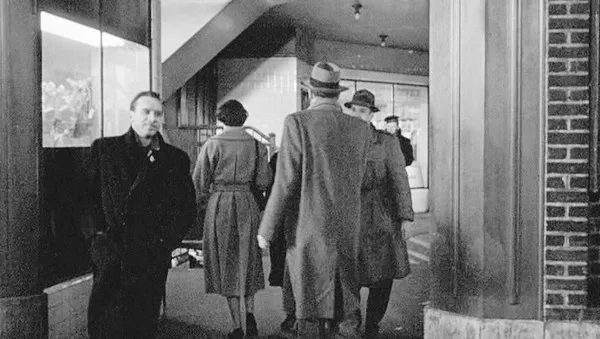
Yet this dead time, this filler, is marked by a slight but suggestive incident. As Manny enters the bottleneck of bodies, he seems about to bump into a man leaving from the opposite direction; in dress, at any rate (hat, gray overcoat, white shirt, black tie), this man is Manny’s mirror image, a “front” that corresponds to the latter’s “back.” To obviate the run-in, the man cedes right-of-way, flattens his back against the wall of the passage, and sidles past Manny’s shoulder. In crossing paths, each man has begun on the other’s left and ends on his right, like figure skaters inscribing an elongated X on the screen surface. We cannot be sure whether they actually touch (like Bruno and Guy in Strangers on a Train) or just miss touching (like Guy and Hitchcock in the same film), but their auras, if not their bodies, have collided; and for one brief moment they are in each other’s face. In acknowledgement of this awkward unexpected intimacy, the stranger flashes Manny a broad smile; and as if there were more to this intimacy than an accidental brush, the smile enigmatically lingers on his face, lapsing into a kind of satisfied grin, well after Manny has passed. When the crossover is complete, there emerges, in between Manny and the Lookalike (who now face in opposite directions), a pair of identically dressed sailors, whose faces, by contrast, are slightly turned toward one another (figure 3.1). And in a still denser patterning, just as we see Manny and the Lookalike begin this elaborate dance on the right side of the passageway, we also see another pair of pedestrians on the left side—a man and woman (neither of whom resembles Manny or each other)—complete the same dance. They too form an X pattern in passing one another. Like Manny, the woman does not acknowledge her partner; he, however, like Manny’s partner, acknowledges her with a long, full smile as he goes on his way. If their synchronization weren’t a bit off, the couples would be performing in mirror symmetry (figure 3.2).
All of this happens in under three seconds. As an early iteration of the film’s theme of the Double, the brief encounter does everything to make itself hardly visible. Most viewers pay it little attention because Hitchcock’s quick, cluttered presentation ob...