![]()
CHAPTER ONE
Cells, Genes, and Evolution
On the Nature and Workings of Life
Men talk much of matter and energy, of the struggle for existence that molds the shape of life. These things exist, it is true; but more delicate, elusive, quicker than the fins in water, is that mysterious principle known as “organization,” which leaves all other mysteries concerned with life stale and insignificant by comparison. For that without organization life does not persist is obvious. Yet this organization itself is not strictly the product of life, nor of selection.—Loren Eiseley, The Immense Journey
The Doctrine of the Cell
Microbes Come on Stage
Prokaryotes and Eukaryotes
Molecular Systems of Daunting Complexity
Genes Rule
Cell Heredity
Cell Evolution: What Nobody Is Sure About
Unlike most husbands, I quite enjoy doing the dishes; it seems to satisfy a need to impose order on my corner of the world, at least for a little while. I begin with the sink piled helter-skelter with soiled plates, cups, and cutlery; twenty minutes later all are clean and neatly ranged in the rack, the large ones in the rear and the small ones in front. I look upon my work and see that it is good, and I have no doubt that the same need to find order in the universe motivates much of science.
Biologists encounter the tension between order and randomness every day, for living things differ from nonliving ones most strikingly in their degree of order. When used in its technical sense, the term “order” refers to regularity, predictability, and conformance to law. Wallpaper is ordered, repeating a particular pattern over and again. The deep blue bird that occasionally visits my garden is called a Steller’s jay. It furnishes a spectacular example of order, for that label immediately implies a host of regular and predictable features: forms and colors, a set of anatomical and biochemical characteristics, even a pattern of behavior. Regularity and predictability are also found in the nonliving world (the solar system comes to mind), but not to the same degree. Besides, the order that living things display is of a special kind, commonly termed “organization”: that jay’s patterns of order have purpose or function. This feature is seen only in living things and their artifacts, such as airplanes, spider webs, or the shells constructed by testate amoebas. Nevertheless, their intricate organization notwithstanding, living things are creatures of contingency. They are not manifestations of physical laws as the solar system is, nor were they designed for a purpose like the airplane, but rather they evolved by the interplay of random variation and natural selection. Living things conform to the laws of physics and chemistry but are not fully explained by those laws; and their existence could not be deduced from physics and chemistry. Despite their familiarity and ubiquity, living things are truly strange objects.
The Doctrine of the Cell
One of the earliest and most profound statements about biological organization is the cell theory, rightly acclaimed in every textbook as a cornerstone of biological science. The theory asserts that all the infinite diversity of living things is constructed on a single architectural plan: every organism is made up of cells, consisting either of a single cell or of a society of many cells. Cells are the atoms of life, and life is what cells do.
The idea of the cell emerged gradually over a period of two centuries.1 Robert Hooke coined the term in 1665, when he examined thin slices of cork through a microscope and saw a pattern of rectangular boxes that reminded him of monks’ cells (we now know that he was not looking at cells in the modern sense, but at their empty rigid walls). As microscopes grew sharper and more powerful others reported similar patterns, and the suspicion grew that cells might be a general feature of living things. It fell to a pair of German scientists, the botanist Matthias Schleiden and the physiologist Theodor Schwann, to articulate the consensus that was waiting to be born (1838 and 1839). Their “cell doctrine” stated that the tissues of plants and animals were not homogenous wholes, but rather composed of innumerable tiny individual cells. Each cell consists of a droplet of jelly, later called protoplasm, enclosing a dense central kernel, or nucleus. And they explicitly recognized that each cell is itself a complex and organized structure and the seat of the organism’s vital activities.
Two decades later the prominent pathologist and physician Rudolf Virchow took the next step. Schleiden held the position that cells formed by aggregation of protoplasm around the nucleus. Virchow knew better: in his textbook of pathology, published in 1858, he insisted that every cell originates by division from a pre-existing cell. His famous aphorism, Omnis cellula e cellula (“every cell from a previous cell”) remains another landmark of biological science. Cellular organization has passed continuously from the dawn of life to the present day. Organization is sometimes transmitted by division, sometimes by the fusion of gametes, but it never arises de novo. With the rise of molecular science, Virchow’s law has been marginalized, but it continues to hold and is central to the present book.
Microbes Come on Stage
The pioneers of the cell doctrine thought entirely in terms of higher organisms, the multicellular animals and plants; of the microbial world the early nineteenth century knew very little. Microscopic organisms had been seen and described by Anton van Leeuwenhoek (1632—1723), merchant and civic official of Delft in Holland and a lens grinder of extraordinary skill. With the aid of what was, in effect, a powerful magnifying glass, Leeuwenhoek observed spermatozoa and red blood cells, capillary vessels, all the major kinds of algae, protozoa, and yeast, and even some bacteria. He reported his discoveries in a stream of letters (in Dutch) addressed to England’s Royal Society, which duly translated and published them. But the pace of discovery slackened after Leeuwenhoek’s death, largely for technical reasons, and quickened only with the advent of more advanced microscopes.
The novel and sometimes peculiar creatures thus revealed posed problems for biologists, whose interests centered on taxonomy. Scientific tradition reaching clear back to Aristotle recognized two kingdoms of living organisms, animals and plants. Some of the microorganisms could be shoe-horned into one or the other kingdom, but that procedure grew increasingly unsatisfactory as microscopists discovered tiny organisms that were neither plants nor animals yet had qualities of both; the alga Euglena, for example, which is both green and motile. There was much argument over whether such organisms should be considered unicellular or noncellular, but the instruments that revealed the internal structure of protozoa and algae also documented their essential affinity with the cells of higher organisms. In 1866, Ernst Haeckel, Darwin’s champion in Germany and one of the most prominent scientists of his day, published a universal classification with three, rather than two, major categories: animals, plants and protists. His kingdom Protista included a grab bag of “lower” creatures: the protozoa, unicellular green algae, fungi, diatoms, and much else besides, including the bacteria. The latter were set apart in a subgroup of their own, the Monera. Among the protists, Haeckel was convinced, would be found not only the ancestors of plants and animals, but also descendants of the primordial organisms with which life began.
The bacteria never nested comfortably among the other protists. The cells of protozoa, algae, and also fungi were organized along the same lines as those of plants and animals, with a nucleus that divides by mitosis, a bounding membrane and various internal organelles and inclusions. Bacterial cells were much smaller and lacked a nucleus, they did not divide by mitosis, and even seemed to do without heredity. As early as 1938, a formal proposal was made to remove bacteria from the protistan realm and assign them a kingdom of their own. Bacteria were clearly fundamentally unlike other cells, but the nature of the difference remained undefined for another quarter of a century.
Prokaryotes and Eukaryotes
By the middle of the twentieth century, microbiology was becoming a hotbed of intense research. Bacteria had been well recognized as a large and diverse group of organisms, the agents of human diseases and industrial processes as well as the grand nutrient cycles, and probably the oldest forms of life. Moreover, thanks to their small size and relatively simple organization, bacteria had become the beacon that would illuminate all of cell physiology, biochemistry and genetics. Escherichia coli reigned as everyone’s favorite model organism. Yet those microbiologists whose interests ran toward natural history often felt frustrated by their inability to achieve an objective classification of the bacteria, or even to define the relationship of bacteria to the rest of the living world.
The question of the essential nature of bacteria was tackled by two of the most respected microbiologists of the time, Roger Stanier (1916–1982) and C. B. van Niel (1897–1985), in a magisterial paper entitled “The Concept of a Bacterium” (1962)2 By then, thanks chiefly to the perfection of the electron microscope, enough had been learned about the ultrastructure of bacteria to differentiate them unambiguously from other kinds of cells. Stanier himself was especially influenced by his mounting interest in the cyanobacteria, photosynthetic organisms familiar to everyone as the green scum that forms on the surface of stagnant ponds. The “blue-green algae” were traditionally considered to be simple plants and studied by botanists; yet their fine structure clearly ranked them with the bacteria and demanded that they be reclassified. To give substance to the concept of bacteria as a separate, kingdom-level class of organisms, Stanier and Van Niel adopted and promoted terminology that had been mooted by the French protozoologist Édouard Chatton thirty years before: eukaryotes and prokaryotes, cells endowed with a true nucleus and cells without.
The tale of how this fundamental distinction came to be naturalized in biology is curious, and illuminates how science actually works. Several generations of students have been taught to credit Chatton with its discovery. But when the historian Jan Sapp reexamined the matter,3 he found that Chatton himself had made little of the distinction between prokaryotes and eukaryotes; to him these were just convenient labels, not an insight into the nature of things. It was really Stanier and Van Niel who drew the bright line across biology, separating two modes of biological organization.
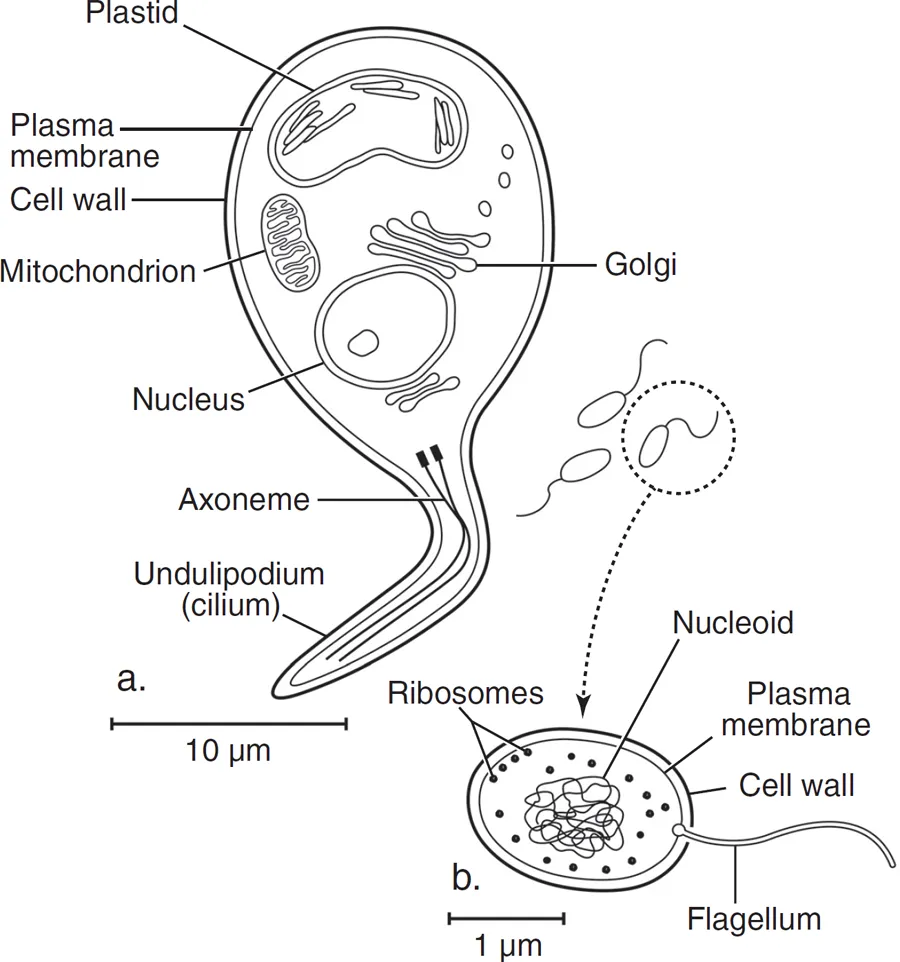
The cells of plants and animals, including our own, display the eukaryotic mode. The same is true of fungi and of protists (fig. 1.1). All possess a membrane-bound nucleus that contains chromosomes and divides by mitosis. They contain organelles such as mitochondria, golgi, and (in photosynthetic organisms) plastids. An intricate system of internal membranes pervades the cytoplasm, and a cytoskeleton can often be made out. They also have cilia and flagella, organs of motility built around microtubules (I like Lynn Margulis’s term “undulipodia” to designate these structures and shall use it hereafter). Prokaryotic cells are much smaller and simpler in structure. They lack a nuclear membrane, chromosomes, and mitosis; there are no organelles and (usually) no internal membranes. Their flagella differ from undulipodia in structure and operation, and their cell walls are chemically different from those of eukaryotes. Stanier and Van Niel defined prokaryotes more in terms of what they lack than by any positive attributes, but those differences sufficed. “The distinctive property of bacteria and blue-green algae is the procaryotic nature of their cells. It is on this basis that they can be clearly segregated from all other protists (namely, other algae, protozoa, and fungi), which have eucaryotic cells.”4 Until very recently, few would have questioned the judgment that “this basic divergence in cellular structure . . . represents the greatest single evolutionary discontinuity to be found in the present day world.”5
FIGURE 1.1. Eukaryotes (a) and prokaryotes (b). Schematic sketches of generalized cells; note the disparity in size and architectural complexity.
The division into two kinds of organisms, eukaryotes and prokaryotes, was quickly and enthusiastically accepted and was soon reflected in the large-scale classification of living things. In 1969, when the ecologist Robert Whittaker revised the scheme he had formulated a decade earlier, he divided up the world among five kingdoms—four eukaryotic and one prokaryotic.6 Animals, plants, fungi and protists (or protoctists, in Margulis’s terminology) compose eukaryotes. All the bacteria—and only bacteria—were placed in the kingdom Monera. The scheme omitted viruses, which are not made of cells. Five kingdoms were never intended as a statement about who begat whom, but came to be taken as such: the presumption was, and commonly still is, that prokaryotes preceded eukaryotes and were the latter’s evolutionary precursors.
Five kingdoms proved to be a practical system for putting in order the overwhelming diversity of life on earth; writers of textbooks, obliged to survey the landscape and make it comprehensible to students, found it indispensable. But it must be said that as a guide to the evolution of life, the scheme is profoundly misleading. It puts all five kingdoms on an equal footing, implying that the difference between prokaryotes and eukaryotes is of the same kind and magnitude as that between animals and plants. It gives no clue to the gulf of time that separates the familiar multicellular creatures from the microbial world. And there is surely something lacking in a scheme that covers all of life but has no place for viruses. It is true that viruses are not cellular in nature and are obligatory parasites upon other organisms; whether viruses should be considered living depends on your definition of life.7 But they are made of the same kinds of molecules as true living things, reproduce with heredity, and evolve all too quickly; they are linked to the great tree of life and must eventually be represented there. Just how drastically our perceptions had to change only became clear with the development of novel, molecular methods to assess relationships among living things and explore the patterns of descent.
But before we go there, let us pause and consider what the concept of the cell means today. A century ago, it meant first and foremost a structural motif: a droplet of cytoplasm, a nucleus, perhaps some organelles, and a plasma membrane to separate inside from outside. The majority of living things is, indeed, constructed upon this plan; but we know so many exceptions and variations that its universality is no longer obvious. The cells of eukaryotes and prokaryot...