" S ets the record straight about the War of 1812's Battle of Fort Dearborn and its significance to early Chicago's evolution ... informative, ambitious" ( Publishers Weekly ). In August 1812, Capt. Nathan Heald began the evacuation of ninety-four people from the isolated outpost of Fort Dearborn. After traveling only a mile and a half, they were attacked by five hundred Potawatomi warriors, who killed fifty-two members of Heald's party and burned Fort Dearborn before returning to their villages. In the first book devoted entirely to this crucial period, noted historian Ann Durkin Keating richly recounts the Battle of Fort Dearborn while situating it within the nearly four decades between the 1795 Treaty of Greenville and the 1833 Treaty of Chicago. She tells a story not only of military conquest but of the lives of people on all sides of the conflict, highlighting such figures as Jean Baptiste Point de Sable and John Kinzie and demonstrating that early Chicago was a place of cross-cultural reliance among the French, the Americans, and the Native Americans. This gripping account of the birth of Chicago "opens up a fascinating vista of lost American history" and will become required reading for anyone seeking to understand the city and its complex origins ( The Wall Street Journal ). "Laid out with great insight and detail... Keating... doesn't see the attack 200 years ago as a massacre. And neither do many historians and Native American leaders." — Chicago Tribune "Adds depth and breadth to an understanding of the geographic, social, and political transitions that occurred on the shores of Lake Michigan in the early 1800s." — Journal of American History
eBook - ePub
Rising Up from Indian Country
The Battle of Fort Dearborn and the Birth of Chicago
- 320 pages
- English
- ePUB (mobile friendly)
- Available on iOS & Android
eBook - ePub
Rising Up from Indian Country
The Battle of Fort Dearborn and the Birth of Chicago
About this book
Information
PART ONE
The United States and the Indian Country of the Western Great Lakes
1
John Kinzie and the Traders in the Indian Country of the Western Great Lakes, 1763–1812
John Kinzie was born in 1763 in Quebec at one of the most significant moments in American colonial history. He would grow up in a world turned upside down by 1763, as new alliances and opportunities emerged in British colonial territory resting uneasily on an Indian Country. His mother, Emily (Anne) Tyne, came to North America as the wife of a British army chaplain, William Haliburton, and mother (or mother-to-be) of an infant daughter, Alice. They were part of the first British force to occupy Quebec after the impressive victory of General James Wolfe over the Marquis de Montcalm in September 1759. While British troops secured their hold on New France in 1760 by capturing Montreal, Kinzie’s mother dealt with the death of her first husband. Alone in a war-besieged land, Emily married a surgeon in the British army in 1861, and John Kinzie was born two years later. The senior John Kinzie (Kenzie) died soon after his son’s birth. Emily Kinzie, with two small children, had little choice but to seek out a third husband.1
John’s mother, widowed twice, married William Forsyth Sr. in 1765. Forsyth was a widower with four young sons (William Jr., Philip, Robert, and George) who had served in the British military and worked in the fur trade. Their blended family included Kinzie and his half-sister, Alice Haliburton, a half-brother, Thomas, born in 1771, and his stepfather’s four older sons.2
Initially, the family lived in New York City, where John Kinzie and two of his stepbrothers attended school. By 1768, however, the family had moved to Detroit, where William Forsyth purchased a tavern next to the fort and set up a thriving business selling liquor and other goods to the hundred-odd British soldiers stationed there. Forsyth and his sons constructed a ball field adjacent to their inn to draw in even more business.
Living at Detroit, the teenage Kinzie was not affected much by the Revolutionary War (1776–83), which was a distant distraction. Detroit, with about three hundred residents, was a British stronghold, “the very center of British military and governmental power in the western country.” As well, Detroit was important to the fur trade in the Indian Country to the west. Traders traveled to Indian villages, but Indians also came to Detroit, where British gifts solidified their colonial hold on the region.3
John Kinzie, seeking to make his way in this world, apprenticed with a silversmith, learning a craft in demand both by British colonists and in the fur trade. Silversmiths made buckles, cups, and other silver items for Euro-American families, as well as reworking silver pieces made in other colonies or in Europe. They also made silver ornaments and trinkets for the fur trade.4 By 1785 the twenty-two-year-old Kinzie was making wristbands, large crosses, armbands, and broaches to Indian tastes, as well as repairing silverwork for leading Detroit families.5
Kinzie’s skills as a silversmith helped him develop relationships with Indian traders and agents, some of whom he probably met as a youth at the Forsyth tavern.6 He made connections with some of the most prominent British traders in town, including Alexander McKee (the British Indian agent), John Hay (deputy Indian agent), Matthew Elliott, and Simon Girty. These men had left western Pennsylvania during the Revolution as Loyalists, and Kinzie allied himself deliberately with them.7
Kinzie could have stayed at Detroit, but his opportunities were limited—the fur trade drew him into Indian Country. The people he would meet along the way shaped his understanding of Indian Country and his place in it.
TRADERS IN THE INDIAN COUNTRY
John Kinzie did not move into an undifferentiated wilderness. The core of the Indian Country in the western Great Lakes was a dense, ever-changing system of tribal villages. Also, several networks of non-Native places including administrative, military, and trade centers operated within (or adjacent to) Indian Country during the colonial period.
In a traditional view of the “wilderness” of the American frontier, there was little room for the systems of villages and towns that served the disparate peoples of the Indian Country of the western Great Lakes. According to this imagined view of the past, only as Americans moved westward were there urban or proto-urban settlements. As historian Richard C. Wade writes, places like Pittsburgh, Lexington, Cincinnati, Louisville, and St. Louis were “planted far in advance of the line of settlement and they held the West for the approaching population . . . through the wilderness.” Wade persuasively argues for a central role for cities in the frontier. However, he ignores the networks of Native and non-Native places that made up Indian Country well before the arrival of American settlers on the scene.8
There was, in fact, a broad range of settlements across the region well in advance of any Americans. Most villages were small, comprising just four or five extended families, but a few reached substantial size. Saukenauk, the summer town of the Sauks along the Mississippi, had a population of over a thousand. To the south along the river, Kaskaskia, long the French administrative center for the Illinois Country, also had a population of over two thousand by 1750. These networks of Native and non-Native villages and outposts ebbed and flowed with the seasons and over time, but remained a vital part of Indian Country.
Over the first half of the eighteenth century, the French established colonial administrative and trade centers in Quebec, Louisiana, and Illinois Country. Forts at Detroit, St. Joseph, Michilimackinac, Ouiatenon, and Vincennes, as well as Fort Chartres and Fort Miami, anchored the French colonial presence in the region between Quebec and Louisiana. Kaskaskia and later St. Louis became important centers along the Mississippi River, connecting the region to New Orleans, while Detroit became the northeast entrepôt, with connections to Montreal and Quebec.
After 1763 the British took nominal control of these administrative and trade centers in Quebec and Illinois, while the Spanish gained colonial control over New Orleans and St. Louis. The British also took over the former French forts across the western Indian Country, eventually abandoning St. Joseph, Ouiatenon, and Fort Chartres. Like the French before them, fewer than a hundred British soldiers staffed the smaller forts, while Detroit grew into several hundred residents.
As well as these deliberately planted colonial settlements, there were dozens of trading posts founded by French, British, and American traders across the western Great Lakes. Without a doubt, the fur trade led most non-Native people into Indian Country.
The fur trade had been an integral part of the western Great Lakes for more than a century. French traders traveled to Indian villages and sold their goods in exchange for beaver, otter, bear, and deerskins. The fur trade brought cloth, blankets, guns, iron implements, and alcohol to Indian tribes. These goods were both utilitarian and ceremonial: they were immediately useful to everyday life, but they also cemented a ceremonial relationship with newcomers.9
French traders sought out Indian women as their wives because their ties to specific Indian villages and tribes were strengthened through marriage to local women. And these Indian women brought their skills as cooks, guides, herbal physicians, farmers, and household managers.10 The mixed-race children of these traders and their Indian wives were known as métis. The métis population grew with the fur trade, where their intermediary role gave them possible advantages over both their Indian and European counterparts. Métis women generally either married other métis men in a village or married incoming Euro-American traders.
Métis played a critical role in the Great Lakes fur trade. While some traders moved into their wife’s Indian village, others established separate settlements that were distinct from those of either their Indian or Euro-American neighbors. Their buildings were often a composite of Indian and French styles, set in a rambling style in contrast to the rectangular grids of the European towns. Land ownership was not significant, with land titles rare in métis villages. Many métis families adhered to Roman Catholicism, but it evolved more as a house religion than a congregational one by the late eighteenth century.11
Dress, language, and food reflected the melding of two distinctive cultural traditions. Métis wore a combination of European and Indian styles that could include the blue pantaloons and capote of their French forebears, coupled with moccasins and feathers drawn from their Indian heritage. Most métis children became fluent in French as well as the Algonquian language of their mothers. Young métis women learned to farm, but the methods and crops reflected both Indian and European traditions. French plows, wheat, and dairy cows were found alongside fields of corn, squash, and beans.
French fur traders continued to trade in the expanding territory of the Potawatomis and their allies long after the official exit of France in 1763. However, British traders also began to make their way to Potawatomi villages, vying for trade that had once been almost exclusively in French hands. After the American Revolution, American traders joined into the mix, in a trade conducted in various Algonquian dialects, French, and English. Those with facility in all these languages had the greatest access across Potawatomi country.
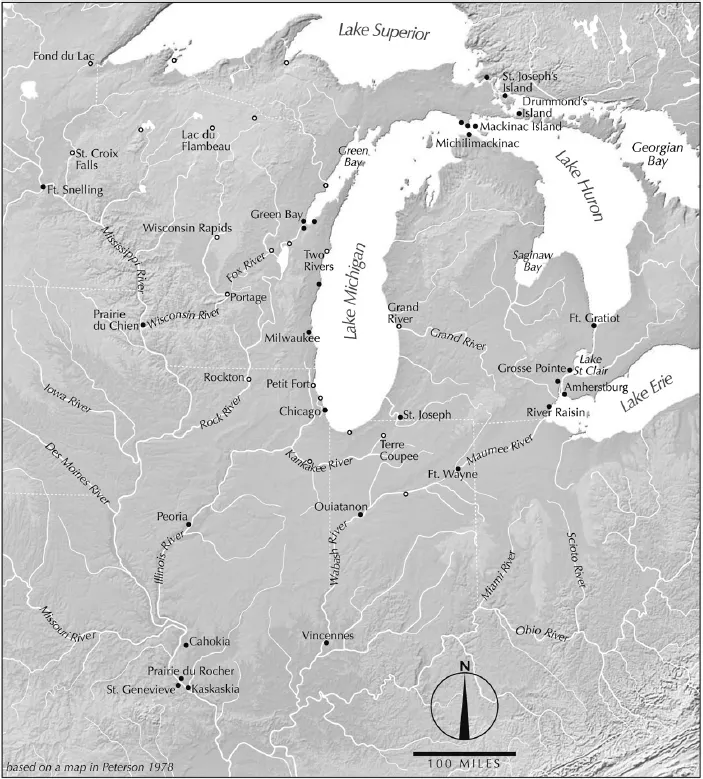
Map 6. Métis Trading Centers in the Western Great Lakes, 1763–1830. (Dennis McClendon, Chicago Cartographics, based on information from Jacqueline Peterson “Prelude to Red River: A Social Portrait of the Great Lakes Metis,” Ethnohistory 25, no. 1 [Winter 1978]: 44.)
By the 1780s, some two dozen villages along the upper Great Lakes and the rivers that fed into them served as centers for the fur trade, including Milwaukee, Peoria, St. Joseph, Chicago, Kekionga, River Raisin, and Sault Sainte Marie. These settlements were near Indian villages but were not Indian villages. They were also closely tied to the larger trading outposts at Michilimackinac, Detroit, and Vincennes, but were not so tightly under colonial administration.12
French, British, and American traders continued to move into Indian Country to seek their fortunes. They gravitated to established fur-trading outposts in the western Great Lakes. Among them was John Kinzie, who would tie his fortune to Indian Country. Kinzie was closely associated with three fur-trading outposts during his career: Kekionga, St. Joseph, and Chicago. As he moved to each of these places, his life would become intertwined not only with local Indians, but also with other traders, most especially with William Burnett and Jean Baptiste Point de Sable.
KEKIONGA
John Kinzie began trading south of Detroit at Kekionga in partnership with John Clark. Kekionga was a political and military outpost in the Indian Country in the western Great Lakes. There were at least six Shawnee, Delaware, Potawatomi, and Miami villages in the vicinity. The Delawares and Shawnees living near Kekionga were refugees from the expansion of the new United States into the trans-Appalachian West as American settlers moved into Kentucky and southern Ohio. The Shawnees, Delawares, and Miamis attacked American farmsteads in the hopes of stanching further migration. Their raiding parties destroyed farms, killed settlers, and took others captive, all with the hope of driving Americans back east.13
While Kinzie was far from most of this fighting, he traded with Shawnee, Miami, and Delaware villages that included young American captives who had been taken as children and raised as members of Indian families. Kinzie no doubt encountered these captives, particularly in the Shawnee and Delaware villages in which he traded. One of these captives was Margaret McKenzie.
Over a decade before, while Margaret’s father was away from their western Virginia farm, a Shawnee war party killed her mother and younger siblings, and took Margaret and her sister Elizabeth as captives. Both sisters grew up together among the Shawnees, and they met John Kinzie and his partner John Clark while they traded at Kekionga. The partners set up households with the sisters, affording them close connections within the Shawnee villages. Kinzie fathered three children (William, Elizabeth, and James) with Margaret McKenzie between 1788 and 1793. They made a life in Indian Country, where their neighbors included other British traders, but also Shawnee, Delaware, Potawatomi, and Miami villagers.
Little Turtle lived almost all of his life just to the west of Kekionga. While his village had traded with the French for generations, his family shifted their allegiance to the British before the Seven Years’ War. During the Revolutionary War, as Little Turtle came to adulthood, he fought alongside the British against the Americans and became a war chief. Little Turtle watched with trepidation as American settlers poured into western Pennsylvania, western Virginia, Kentucky, and southeastern Ohio. Shawnee and Delaware refugees from these areas settled into villages nearby Little Turtle’s village, and the British established Kekionga as a trading outpost in this increasingly dense and heterogeneous Indian Country. Like Kinzie, Little Turtle maintained his alliance with the British as he raised a family that included his daughter Sweet Breeze. He no doubt knew Kinzie and perhaps traded with him, although Kinzie had stronger ties to the Shawnees than to the Miamis around Kekionga.
ST. JOSEPH
To the northwest of Kekionga, St. Joseph flourished near the eastern shore of Lake Michigan. The French established a fort and Catholic mission in the area, drawing people to the area. When they relinquished the fort in 1761, Pontiac and his allies took it until the British negotiated for control. For the next two decades, the British held the fort, while the remaining French traders prospered in trade with area Potawatomi villages. After the American Revolution, the British abandoned the fort—leaving the region to Potawatomi villagers and their traders.
Kakima was a Potawatomi woman born near the St. Joseph River around 1763, the year of John Kinzie’s birth and the year that Pontiac’s forces attacked nearby Fort St. Joseph. She was the sister of two Po...
Table of contents
- Cover
- Copyright
- Title Page
- Contents
- John Kinzie Timeline
- General Timeline
- A Mobile Cast of Characters
- List of Maps
- Preface: John Kinzie’s World
- Acknowledgments
- Introduction Chicago in the Indian Country of the Western Great Lakes
- Part One The United States and the Indian Country of the Western Great Lakes
- Part Two Fort Dearborn and Tippecanoe, 1803–1811
- Part Three In the Wake of the Battle of Tippecanoe, Late Spring 1812
- Part Four in the Aftermath of August 15, 1812
- Part Five After the War of 1812
- Epilogue Why It Was Not a Massacre
- Notes
- Index
Trusted by 375,005 students
Access to over 1.5 million titles for a fair monthly price.
Study more efficiently using our study tools.
Frequently asked questions
Yes, you can cancel anytime from the Subscription tab in your account settings on the Perlego website. Your subscription will stay active until the end of your current billing period. Learn how to cancel your subscription
No, books cannot be downloaded as external files, such as PDFs, for use outside of Perlego. However, you can download books within the Perlego app for offline reading on mobile or tablet. Learn how to download books offline
Perlego offers two plans: Essential and Complete
- Essential is ideal for learners and professionals who enjoy exploring a wide range of subjects. Access the Essential Library with 800,000+ trusted titles and best-sellers across business, personal growth, and the humanities. Includes unlimited reading time and Standard Read Aloud voice.
- Complete: Perfect for advanced learners and researchers needing full, unrestricted access. Unlock 1.5M+ books across hundreds of subjects, including academic and specialized titles. The Complete Plan also includes advanced features like Premium Read Aloud and Research Assistant.
We are an online textbook subscription service, where you can get access to an entire online library for less than the price of a single book per month. With over 1.5 million books across 990+ topics, we’ve got you covered! Learn about our mission
Look out for the read-aloud symbol on your next book to see if you can listen to it. The read-aloud tool reads text aloud for you, highlighting the text as it is being read. You can pause it, speed it up and slow it down. Learn more about Read Aloud
Yes! You can use the Perlego app on both iOS and Android devices to read anytime, anywhere — even offline. Perfect for commutes or when you’re on the go.
Please note we cannot support devices running on iOS 13 and Android 7 or earlier. Learn more about using the app
Please note we cannot support devices running on iOS 13 and Android 7 or earlier. Learn more about using the app
Yes, you can access Rising Up from Indian Country by Ann Durkin Keating in PDF and/or ePUB format, as well as other popular books in History & Military & Maritime History. We have over 1.5 million books available in our catalogue for you to explore.