"A valuable history [and] a stark warning to Washington policy and strategy makers." —James Stejskal, former US Army Special Forces and CIA officer
In 2002, Sam Faddis was named to head a CIA team that would enter Iraq to facilitate the deployment of follow-on conventional military forces numbering over 40,000 American soldiers. This force, built around the 4th Infantry Division, would, in partnership with Kurdish forces and with the assistance of Turkey, engage Saddam's army in the North as part of a coming invasion. Faddis expected to be on the ground in Iraq within weeks, the entire campaign likely to be over by summer. Over the course of the next year, virtually every aspect of that plan for the conduct of the war in northern Iraq fell apart.
The 4th Infantry Division never arrived, nor did any other conventional forces in substantial number. The Turks not only refused to provide support, they worked overtime to prevent the United States from achieving success. And an Arab army that was to assist US forces fell apart before it ever made it to the field.
Alone, hopelessly outnumbered, short on supplies, and threatened by Iraqi assassination teams and Islamic extremists, Faddis's team, working with Kurdish peshmerga, miraculously paved the way for a brilliant and largely bloodless victory in the North and the fall of Saddam's Iraq. That victory, handed over to Washington and the Department of Defense on a silver platter, was then squandered. The decisions that followed would lead to catastrophic consequences that continue to this day.
This is the story of the brave and effective team of men and women who overcame massive odds to help end the nightmare of Saddam's rule. It is also the story of how incompetence, bureaucracy, and ignorance threw that success away and condemned Iraq and the surrounding region to chaos
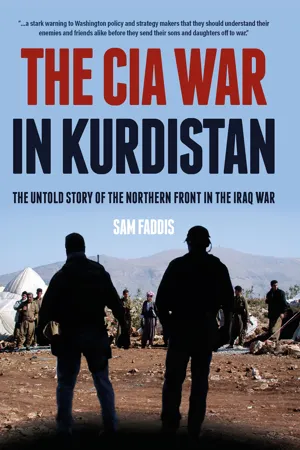
eBook - ePub
The CIA War in Kurdistan
The Untold Story of the Northern Front in the Iraq War
- 242 pages
- English
- ePUB (mobile friendly)
- Available on iOS & Android
eBook - ePub
About this book
Information
CHAPTER 1
9/11
I found out about the 9/11 terrorist attacks the way everyone else did: I watched it on TV.
I was sitting in my office at CIA Headquarters in Langley riding a desk and hating life. I had been back in country for 60 days, and already I couldn’t wait to go overseas again. No real case officer wants to be stateside. He wants to be in the field where the ops are.
It was morning. I was reading traffic coming in from field stations around the world. Outside my office at the entrance to our group area there was a television mounted on the wall. I heard a number of people crowding around the television. I heard them say something about a plane striking the World Trade Center in New York. I got up and walked out of my office to see what was going on, and just as I did so I saw on the television screen a second aircraft hit the World Trade Center.
It was instantaneously clear to me, as it was to everyone else watching the broadcast around the world, that what we were seeing was not an accident but a deliberate act of terror. It felt like I had been punched in the gut, not just because of the loss of life and the brutality of the act, but because I knew it was all so preventable.
I had been working for CIA for 13 years by the time 9/11 happened. I had spent all of that time as a case officer. From day one I had spent the overwhelming majority of my time working counterterrorism and weapons of mass destruction. I had—like everybody else that I knew who was working the problem—by the late 1990s an overwhelming sense that the terrorist threat to the United States was increasing daily, and we were doing virtually nothing to combat it.
One case will illustrate precisely what I mean.
Three years before 9/11 I was assigned to a Middle Eastern station. “Station” is the CIA office in a particular country. That’s old terminology borrowed from the British, like virtually everything else that pertains to our human intelligence collection apparatus. I was a case officer in the station. That meant it was my job to handle assets and produce intelligence. But it also meant, more than anything else, that it was my job to hunt for new sources. Case officers are like sharks; they have to swim and hunt continuously. In the trade everybody knows how to write an intel report and securely handle an asset. If you don’t know how to do those kind of baseline things you get sent home.
What defines case officers is their ability to bring on new blood. In the trade they say, “ten percent of the officers recruit ninety percent of the sources.” Some people can do it. Many can’t. Some can but don’t, because the ethical baggage is too heavy. Sometimes sources you recruit end up dead. Sometimes they end up in jail. If you can’t handle that fact, you need to find another line of work. Bottom line: if you want to be a case officer and get promoted, you hunt.
I made contact one day with an individual who was an Islamic extremist and who was heavily involved with ongoing Al Qaeda activity and terrorism. I won’t go into the details here of exactly how I made contact with this individual. That’s the kind of stuff that, no matter how you spin it, comes down to sources and methods that can’t be talked about. In any event I was successful in making contact with this individual. He had by this point been involved in Islamic terrorist activity for many years. He had attained a relatively senior position wherein his primary function was moving money and support to those individuals actually doing the fighting.
His next assignment was to go to Africa and work on establishing infrastructure there. This was less than a year before the 1998 embassy bombings in Nairobi and Dar es Salaam.
My contact was ferociously anti-American. He was absolutely convinced that Western materialistic influence was destroying the Islamic world. He had, however, by this point begun to have some serious misgivings about the amount of blood that was being spilled, the justification for violence, and the taking of innocent life. His experience had led him to believe that Al Qaeda’s methodology could not be justified under the teachings of Islam. He was torn. He was willing to talk. He was not sure what he needed or wanted to do now.
He and I spent many days together. We debated. We philosophized. I worked overtime to help him reach the point at which he could accept that cooperating with CIA was justifiable and that it would mean saving lives. In the end he remained in many ways an enemy of the United States, but he agreed to a clandestine relationship with CIA and became an asset of ours. He agreed to provide us information on the plans and intentions of the group to which he belonged. He agreed to work with us against his former associates.
I set up follow-on meetings with him outside the country in which he had been recruited. It was, I thought, an extremely important case. I had barely finished the write-up on the recruitment, however, when I received a devastating series of messages from Washington. They had reviewed the case. They had decided that since this individual was technically a citizen of an allied nation they did not believe we should continue the relationship with him. They had made the determination that it was more important to avoid offending this Middle Eastern government than it was to have a spy inside Al Qaeda.
Those messages almost floored me. They weren’t completely out of character with what I knew already about Headquarters and our counterterrorism efforts; nonetheless, to have brought on a source with that degree of access and then be told to cut him away was completely demoralizing.
Just to complete the picture, a few days after 9/11 an officer from CIA Counterterrorism Center (CTC) came to find me at Headquarters. We were now in a desperate rush to recruit penetrations of Al Qaeda. Somebody had done a file search and tripped across my case. The officer from CTC wanted to know if I knew where my old source was now and whether I could help them make contact with him.
It was one of those moments when you don’t know whether to laugh or to cry. I reminded the officer from CTC that the source in question was a highly dangerous, anti-American Islamic extremist. I reminded him that I had met with the source, always under a false name and only in very carefully controlled meetings. In short, I reminded him that we had not kept in touch, that we did not exchange Christmas cards, and that I did not have him over for family barbecues. I had no idea where he was, although I was very confident that having been cut loose from us, by us, he was still out there working to our detriment.
After 9/11 CTC went into overdrive. Nobody in Washington had a plan for what to do next. The Department of Defense locked up.
The bureaucracy spun in circles, useless. It fell to a handful of individuals in CIA, like Hank Crumpton and Cofer Black (true names), to craft a strategy, sell the White House on it, and start deploying teams.
At Headquarters I was still going crazy. I was pushing paper and attending meetings and working issues nobody cared about. Meanwhile my fellow case officers, my peers, began choppering into Afghanistan, organizing native forces, and taking the fight to the enemy. I was in agony.
Then the rumors started. This would have been around January 2002. We were going into Iraq. The decision had been made by the White House that we were going to do what we had threatened to do for years: we were going to take out Saddam. Step one in that plan was for CIA to put a team into Northern Iraq to work with the Kurds and prepare the battlefield for the subsequent deployment of American military forces.
I went upstairs to the floor where Iraqi Operations Group was located. I walked into the office of the chief of operations, who was a friend. I didn’t volunteer for the job of leading the team that would go into Iraq—I demanded it.
I had by this time in my career more experience in Kurdistan than virtually any other officer in CIA. I can’t and won’t go into all the details of how I acquired that experience. Many of those are operations we still can’t talk about, even in general terms. Suffice it to say that I knew the area and the people well.
I had led a number of different small teams on operations in the area over the course of several years. I had spent significant time in the mountains and villages of the area. I had worked with and knew the Kurdish people.
I had spent years working the Iraqi problem as well. I had run assets cross-border into Saddam’s Iraq, collecting on all of the top intelligence priorities. I knew well the history of Iraqi weapons of mass destruction (WMD) efforts and had personally written hundreds of intelligence reports on the topic. I knew all too well how difficult an environment Kurdistan could be and how formidable the Iraqi security apparatus was. A great number of our Iraqi assets over the years were captured, tortured, and killed. Some of those had been men I recruited and sent into harm’s way.
Going into Iraq was not just getting back into the fight; it was personal. If we were finally going to finish Saddam and make him pay for his atrocities, I was not going to watch from the sidelines.
I also knew the Turks and spoke Turkish. I had worked with them in the field closely, often deploying to remote areas for months at a time with Turks and special operations personnel.
Any deployment of personnel into Northern Iraq was going to go through Turkey, and having experience in dealing with that nation would be critical. The Turks can be great people, and they are fierce fighters. They are not always the easiest to deal with. More than once in the field I had butted heads with Turkish commanders who wanted to dictate terms to me rather than work with the men on my team as partners and allies.
I laid all of this and more out for my friend the chief of operations. He confirmed what I had heard. The White House had made the call. We were going to invade Iraq, and we were going to do it soon. It was January 2002. The White House wanted a CIA presence inside Iraq by March. A few officers from Headquarters had already made a quick visit to Iraqi Kurdistan and met with senior members of the Barzani and Talabani clans. The Kurds were generally onboard.
The plan was to arm the Kurdish Democratic Party and Patriotic Union of Kurdistan forces in the north and then bring in Special Forces to work with them and train them. Eventually, conventional US military forces would flow in as well, but the Kurds would be the force multiplier that, once armed with modern weapons, would tie down the Iraqi military in the north while the American military launched its primary invasion from Kuwait in the south.
My friend the chief of operations said he would talk to his boss, the group chief. A couple of days later we met again. I had the job. I was now the head of the team that would spearhead the invasion of Iraq. The team itself did not exist yet, but it would be formed up as fast as possible. Some of the likely members were already on hand at Headquarters. Some others would be coming in shortly. Members of 10th Special Forces Group from Fort Carson would be included.
I was psyched. I had a real-world mission, and I would be in on the ground floor of a massive, and in my opinion long overdue, military effort to unseat one of the world’s most horrible and sadistic rulers.
Only then did I ask what should have been one of my first questions. Since the key to this operation was arming the Kurds, since all arms to the Kurds had to transit Turkey, and since the Turks and the Kurds hated each other—what did Ankara think about our plan to send state-of-the-art weapons into Northern Iraq?
The response was not encouraging.
“We have not told the Turks yet, but we don’t think it will be a problem.”
I sat dumbfounded. All I could think was, Then you don’t know anything about the Turks.
CHAPTER 2
The Plan
Just before my first meeting with the chief of operations of the Iraqi Operations Group, CIA sent a small team, no more than four individuals, into Northern Iraq. They were in country for a matter of days, just long enough to have meetings with senior Kurdish leaders.
These leaders included heads of the two principal Kurdish factions that had control of the Kurdish area in Northern Iraq. These were the Kurdish Democratic Party (KDP) and the Patriotic Union of Kurdistan (PUK). These two parties had divided Northern Iraq into two roughly equal areas, which operated effectively as independent nations.
In the wake of the First Gulf War (1990–91), the United States imposed a no-fly zone over Northern Iraq, which roughly corresponded to the mountainous northern part of the country historically inhabited by the Kurdish people. With the US flying air cover, the Kurds effectively governed Northern Iraq. On a map it was still Iraq. On the ground it was Kurdistan.
In the simplest possible terms, the KDP was built around the Barzani family, and the PUK was built around the Talabani family. The Barzanis were based in a family compound in the mountains above Irbil. The Talabanis were based in a similar compound in the mountains near Sulymaniah.
Both families prized loyalty. Both families operated every day with the sure knowledge that they had to fight to survive and that, as the saying goes, their only friends were the mountains. Both families could be decisive and deadly when necessary. It was a tough neighborhood.
When the Headquarters team met with members of the Barzani and Talabani families in Iraq in the winter of 2002, they faced a great deal of skepticism. The United States did not have a great track record with the Kurds. We had on multiple occasions made noises about taking out Saddam and then walked away, leaving them to face the consequences. The Kurdish leaders who met with our team members posed some very direct, and very pointed, questions. They wanted to know if we were serious this time.
To their questions, the Kurds received some very direct responses. Unfortunately, for American foreign policy in general and for me in particular, many of the responses they received were at best misleading. We wrote a great many checks. It would remain to be seen whether or not we could cash all of them.
The most immediate concern of the Kurds was armament. If the United States started making noises about taking out Saddam there was a very real chance Baghdad might preemptively move into Kurdistan. The Iraqi Army was large and heavily armed. The Kurds were a light infantry force. If they had to stand against the Iraqis on their own they were going to have to head for the hills, literally, very quickly.
In short, the Kurds wanted to see something concrete from us. Words were great, but they didn’t kill Iraqis.
The Headquarters team assured the Kurds we understood. They told them we would give them all the arms they could handle. In particular, they promised to give them Javelin anti-tank missiles. These were state-of-the-art weapons. Giving them to the Kurds would dramatically enhance their ability to stand up to Iraqi armor and hold their own.
The Kurds asked all the predictable questions. Specifically, they wanted assurances that we would handle the Turks. They were told we would. They were also told that the weapons in question would be coming in very soon. The President wanted to invade Iraq within a few months. CIA wanted a team on the ground by March. That team would then begin right away to bring in weapons in large numbers. The US Army would not be far behind.
Like I said, we wrote a lot of checks. I wou...
Table of contents
- Cover
- Title
- Contents
- Preface
- Dedication
- Preface
- Introduction
- 1 9/11
- 2 The Plan
- 3 The Team
- 4 Getting In
- 5 Why Are You Here?
- 6 Khurmal
- 7 Missing the Shot
- 8 The Return
- 9 Base Life, Drills, and Plans for Escape
- 10 Recruiting Sources—Getting Tough
- 11 Hunting WMD
- 12 The Boneyard—Chem and Radiation
- 13 Management/Leadership and Base Life
- 14 The Turks and Tension—Border Closed—Supply Runs
- 15 Fishing for Assassins
- 16 One Team, One Fight
- 17 Propaganda, Transmitters, and Country Music
- 18 Chalabi and the Pentagon—Badr Corps, Marines, Supply from Space
- 19 Mutiny and Training Kurdish Teams
- 20 10th Group, Deploying Kurdish Teams, Air War and Hunting Fedayeen
- 21 The 173rd Takes Harir, Losing the Surrender
- 22 Kirkuk and Mosul
- 23 Coming Home
- 24 Lessons
- Copyright
Trusted by 375,005 students
Access to over 1.5 million titles for a fair monthly price.
Study more efficiently using our study tools.
Frequently asked questions
Yes, you can cancel anytime from the Subscription tab in your account settings on the Perlego website. Your subscription will stay active until the end of your current billing period. Learn how to cancel your subscription
No, books cannot be downloaded as external files, such as PDFs, for use outside of Perlego. However, you can download books within the Perlego app for offline reading on mobile or tablet. Learn how to download books offline
Perlego offers two plans: Essential and Complete
- Essential is ideal for learners and professionals who enjoy exploring a wide range of subjects. Access the Essential Library with 800,000+ trusted titles and best-sellers across business, personal growth, and the humanities. Includes unlimited reading time and Standard Read Aloud voice.
- Complete: Perfect for advanced learners and researchers needing full, unrestricted access. Unlock 1.5M+ books across hundreds of subjects, including academic and specialized titles. The Complete Plan also includes advanced features like Premium Read Aloud and Research Assistant.
We are an online textbook subscription service, where you can get access to an entire online library for less than the price of a single book per month. With over 1.5 million books across 990+ topics, we’ve got you covered! Learn about our mission
Look out for the read-aloud symbol on your next book to see if you can listen to it. The read-aloud tool reads text aloud for you, highlighting the text as it is being read. You can pause it, speed it up and slow it down. Learn more about Read Aloud
Yes! You can use the Perlego app on both iOS and Android devices to read anytime, anywhere — even offline. Perfect for commutes or when you’re on the go.
Please note we cannot support devices running on iOS 13 and Android 7 or earlier. Learn more about using the app
Please note we cannot support devices running on iOS 13 and Android 7 or earlier. Learn more about using the app
Yes, you can access The CIA War in Kurdistan by Sam Faddis in PDF and/or ePUB format, as well as other popular books in History & Middle Eastern History. We have over 1.5 million books available in our catalogue for you to explore.