- 372 pages
- English
- ePUB (mobile friendly)
- Available on iOS & Android
eBook - ePub
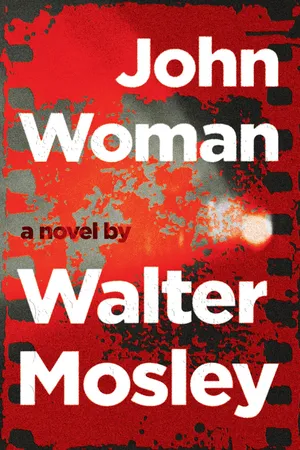
John Woman
About this book
The New York Times bestselling author of the Easy Rawlins novels delivers "a taut, riveting, and artfully edgy saga" of one man's self-transformation ( Kirkus).
At twelve years old, Cornelius Jones, the son of an Italian-American woman and a black man from Mississippi, secretly takes over his father's job at a silent film theater in New York's East Village—until the innocent scheme goes tragically wrong. Years later, his dying father imparts this piece of wisdom to Cornelius: The person who controls the narrative of history controls their own fate.
After his father dies and his mother disappears, Cornelius sets about reinventing himself—becoming Professor John Woman, a man who will spread his father's teachings through the classrooms of an unorthodox southwestern university and beyond. But there are other individuals who are attempting to influence the narrative of John Woman, and who might know something about the facts of his hidden past.
Engaging with some of the most provocative ideas of recent intellectual history, John Woman is a compulsively readable, deliciously unexpected novel about the way we tell stories, and whether the stories we tell have the power to change the world
Trusted by 375,005 students
Access to over 1 million titles for a fair monthly price.
Study more efficiently using our study tools.
Information
Part One
PROFESSOR WOMAN
1
FAR OUT IN THE HIGH DESERT, fifty miles or so from Phoenix, stands a very large and circular five-story structure, the walls of which are plated with tile-like strips of white marble and broad panes of dark blue glass; its round, domed, and transparent roof is fashioned from thick, green-tinted, unbreakable polymer. This is Prometheus Hall, the main academic building of the New University of the Southwest.
There are twelve equally spaced double doors around Prometheus; opposite pairs of these doors open onto hallways that cut diagonally across the first floor of the building. Each of these pathways is paved with tiles of one of six colors: the three primary hues and their secondary complements. The tiled paths meet in and cross the Great Rotunda at the center of the huge building. This central chamber is the hollow heart of the desert university: where students, faculty, staff and visitors are welcome to stop and sit on one of eighty-six white marble benches—to read, contemplate or discuss, or merely to rest.
The four upper floors each consist of twelve equally sized pie-shaped classrooms. These forty-eight lecture halls are only eleven feet wide at the entrance but broaden to four times that width at the blue glass windows that look out over the Arizona desert.
Professor John Woman arrived at Prometheus fifteen minutes before one o’clock on the first Tuesday in September. He entered the building through Door Eleven, progressed down North Violet Lane to the periphery of the Great Rotunda where he ascended the zigzagging north stairwell to the fifth floor. He stopped, leaning his back against the triple-barred chrome rail overlooking the rotunda. There he watched as students went through the broad red-rimmed doorway of Lecture Hall Two.
The young associate professor stood exactly six feet tall with thick, curly brown hair; medium-brown skin; and generous, friendly features. Despite his slender build he gave the impression of quiet physical strength.
Professor Woman studied the young people entering his classroom. Some carried briefcases while others lugged big purses, shoulder bags, and backpacks. Three students carried nothing at all, just walked through the door to sit and listen, maybe trying to figure out whether or not to drop John’s challenging INTRODUCTION TO DECONSTRUCTIONIST HISTORICAL DEVICES. If they weren’t history majors, they might switch to a pottery class or Felton Malreaux’s POETRY APPRECIATION. History majors might transfer to Gregory Tracer’s HISTORY OF THE CIVIL WAR or Annette Eubanks’s FEMINIST OR REVISIONIST HISTORY?
John checked his father’s Timex wristwatch at one minute to one. He took a deep breath and strode toward Lecture Hall Two feeling both excitement and confidence.
He stopped at the doorway, blocked by a willowy young woman with fairly short auburn hair. Motionless at the threshold she seemed to be lost, as if maybe this was the wrong class. Her flimsy gold jacket was more like a shirt with sleeves that didn’t quite achieve the wrists. Likewise the legs of her turquoise-colored trousers hovered a few inches above the ankles. She wore straw sandals and the bag slung across her shoulder was white Naugahyde marked by a solitary blue ink spot, a few abrasions and a black skid-mark that ran along the bottom.
The young woman was tall but John was taller. Over her shoulder he could see the twenty or so students who had staked out the first three rows of the classroom that could have easily seated two hundred.
“Excuse me,” John said.
The young woman gasped and turned. While not pretty, she was, at least to his eye, handsome in the extreme. With butterscotch skin, a strong jaw and tawny eyes the crystalline hue of topaz marbles; she had the long fingers of a pianist. The eyes slanted up just a bit. Her thick hair was crinkled.
“Sorry,” she said taking half a step to the side. “You trying to get in?”
“Yes I am,” John said with a smile.
“You’re taking this class too?”
He shrugged, tilting his head to the side. It was no surprise the undergraduate hadn’t identified him as a professor. He was only a few years past thirty. His Asian-cut, soft-milled black cotton jacket and loose coal gray trousers were not professorial—neither was his slightly faded scarlet T-shirt.
“I heard it was hard,” the young woman said, anxiety eeling its way across her lips.
“New ideas seem hard at first,” he said, “but challenge is why we’re here.”
With that John crossed the red doorsill and went to the semitransparent emerald green polymer lectern at the front of the class. Any talking that had been going on petered out and, a few seconds later, the uncertain young woman made her way to a seat in the third row.
Professor Woman waited for the last gangly student to be seated before he started talking.
“I am Associate Professor John Woman,” he announced, “and this class is Introduction to Deconstructionist Historical Devices.”
A hand went up in the second row.
“You will be able to ask questions in a few minutes,” he said and the hand went down. “But first I’d like to explain what will happen, what you might learn and what you cannot learn, in this seminar.
“It is my position that history is an unquestionable certainty, the absolute outcome of an incontrovertible string of ontological events. It, history, reaches all the way back to the origin of the race and beyond through the chaotic unfolding of existence. In our history, our one indisputable history, are contained assassinations, inspiration, instinctual urges, friendships, conflicts, the multiplicities of gravity and material, black holes and supernovas. Our bodies are formed from the fabric of the universe and so consequently there is a touch of the divine in each of us. You and I are part and parcel of history, slaves of history, playing out our willing and unwilling roles—and so it has been for every living being, every species on earth and, quite possibly, life elsewhere.
“Accepting, for a moment, this position as accurate it is easy to see that the true understanding of history, or any major aspect thereof, requires knowledge that is currently beyond human ken. We are like the blind prophets guessing at the nature of an elephant—only the elephant is in another room, situated on the opposite side of the globe, while we still believe the world is flat.”
John stopped for a moment. He had not planned this lecture. He hardly ever worked from notes or predetermined arguments.
Our lives are just one long series of ad hoc debates, Herman Jones used to say. In the end everybody loses the argument.
“We cannot comprehend the vastness that is history,” the man called Woman continued. “Our capacity for knowledge is mortal even if our bodies are deified. We are incapable of knowing with certainty what has happened while at the same time we are unable to stop ourselves from wondering why we are here and from whence we have come. This is the stimulus, the incentive for the study of and the belief in history.
“We, you and I, have been propelled to this moment by nothing less than the conspiracy of eternity. The attempt to understand this scheme is the object of our study like a carrot is the goal of the work-weary mule dragging the plow and imagining something sweet.
“Those of us who crave the carrot of historical knowledge must be aware that we will never achieve this goal but that in our wake we will create something beautiful, fertile and, quite possibly, terrible. We must, as scholars of an impossible study, realize that while history is definite, the human investigation of the past can only be art, the one truly deconstructionist art—because the only way to capture the essence of history is to make it up.”
John stopped at that point not so much for dramatic effect as a natural pause in this improvised discourse.
“My first lecture is often brief. Later on we may go overtime. That said, are there any questions so far?”
Five or six hands went up. John studied the faces of his students. They seemed engaged.
“When you speak,” he said, “I’d like you to give us your name and any other information you deem pertinent. In this way I’ll get to know you and you will further identify yourself with your query.
“Yes,” he said, pointing. “The woman in the red blouse.”
“Star Limner,” said a twentysomething white woman whose black hair was heavy and damp from a recent shower. She sat in the second row on John’s right. “Second-year poli-sci major.”
“What’s your question, Ms. Limner?”
“Excuse me, Professor Woman, but it sounds like you’re saying that nothing has ever happened in the past and that we can’t believe anything we study.”
“Yeah,” a brutish young man from the third row chimed in.
“And your name is?” John asked the heavy-muscled student who was clad in overalls and a black-and-white-check T-shirt.
“Pete.”
“Pete what?”
“Tackie.”
Pete Tackie was also white with straight brown hair that came down to his ears. He wasn’t fat but rather beefy with small eyes and a frown that John imagined never relaxed, even in sleep.
“And what would you like us to know about you, Mr. Tackie?”
“I wasn’t askin’ a question,” the dour young man complained.
“I asked,” John said, “for anyone speaking to give us their name and anything else we should know.”
Pete Tackie rubbed his face with broad, strong fingers.
“I play rugby,” he said. “I came here from Dearborn.”
“Michigan?”
“Yeah.”
Smiling, the young associate professor held Pete Tackie’s gaze for a few seconds. He had learned how to keep order by sticking to the promises and requests he made.
“No to the first part of your question, Ms. Limner,” John said, still looking at the rugby player. Then he turned to her. “Quite the opposite—everything has happened. This much is apparent. So you’re right, I’m saying you cannot believe anything you study because it is, necessarily, incomplete speculation … albeit, sometimes quite convincing speculation.”
“But how can that be?” another young woman asked. When John turned toward her she shrugged and said, “Beth Weiner from Santa Monica, California. I haven’t declared a major yet but it’ll probably be business or maybe economics.”
“You were saying, Ms. Weiner?” John asked.
“We know that there was a Civil War, that all those people died.”
“Excuse me, but why was that war fought?”
“Over slavery,” a student in the front row said.
This was the only male student who was formally dressed. He wore a blue blazer, tan slacks and a white dress shirt. The only thing missing, John thought, was a tie. His hair was black and his eyes might have been green.
The young man smiled and said, “Jack Burns. I’m from right up the highway in Phoenix.”
“So, Mr. Burns,” John said. “You don’t subscribe to the notion that the war was waged over a disagreement concerning ec...
Table of contents
- Cover
- Also by Walter Mosley
- Title Page
- Copyright
- Epigraph
- Table of Contents
- Before the Beginning
- Part One: Professor Woman
- Part Two: The Guerrilla War of History
- Part Three: The Trial
- Part Four: The Last Class
- Back Cover
Frequently asked questions
Yes, you can cancel anytime from the Subscription tab in your account settings on the Perlego website. Your subscription will stay active until the end of your current billing period. Learn how to cancel your subscription
No, books cannot be downloaded as external files, such as PDFs, for use outside of Perlego. However, you can download books within the Perlego app for offline reading on mobile or tablet. Learn how to download books offline
Perlego offers two plans: Essential and Complete
- Essential is ideal for learners and professionals who enjoy exploring a wide range of subjects. Access the Essential Library with 800,000+ trusted titles and best-sellers across business, personal growth, and the humanities. Includes unlimited reading time and Standard Read Aloud voice.
- Complete: Perfect for advanced learners and researchers needing full, unrestricted access. Unlock 1.4M+ books across hundreds of subjects, including academic and specialized titles. The Complete Plan also includes advanced features like Premium Read Aloud and Research Assistant.
We are an online textbook subscription service, where you can get access to an entire online library for less than the price of a single book per month. With over 1 million books across 990+ topics, we’ve got you covered! Learn about our mission
Look out for the read-aloud symbol on your next book to see if you can listen to it. The read-aloud tool reads text aloud for you, highlighting the text as it is being read. You can pause it, speed it up and slow it down. Learn more about Read Aloud
Yes! You can use the Perlego app on both iOS and Android devices to read anytime, anywhere — even offline. Perfect for commutes or when you’re on the go.
Please note we cannot support devices running on iOS 13 and Android 7 or earlier. Learn more about using the app
Please note we cannot support devices running on iOS 13 and Android 7 or earlier. Learn more about using the app
Yes, you can access John Woman by Walter Mosley in PDF and/or ePUB format, as well as other popular books in Literature & Literature General. We have over one million books available in our catalogue for you to explore.