"A splendid gallimaufry of the eminent Canadian's talks and essays, mostly about literature and the creative life . . . a thought-filled and amusing book."—
The Washington Post
For devotees of Davies and all lovers of literature and language, here is the "urbanity, wit, and high seriousness mixed by a master chef," vintage delights from an exquisite literary menu (
Cleveland Plain Dealer).
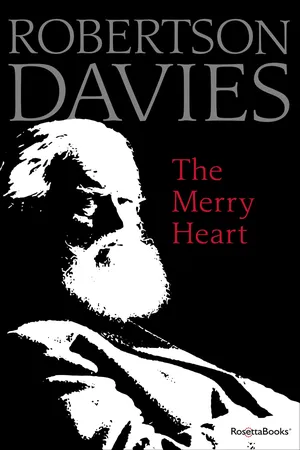
Robertson Davies's rich and varied collection of writings on the world of books and the miracle of language captures his inimitable voice and sustains his presence among us. Coming almost entirely from Davies's own files of unpublished material, these twenty-four essays and lectures range over themes from "The Novelist and Magic" to "Literature and Technology," from "Painting, Fiction, and Faking," to "Can a Doctor Be a Humanist?" and "Creativity in Old Age." Davies himself says merely: "Lucky writers . . . like wine, die rich in fruitiness and delicious aftertaste, so that their works survive them."
"Splendid—wise, witty, wide-ranging."—
The New York Times Book Review
"Some of Davies's ideas are iconoclastic, and will delight those who share them while stimulating those who do not. All his judgments are interesting, steeped in humanism, and most elegantly put."—
The Atlantic Monthly
"The inimitable novelist gives an exuberant posthumous performance in this eclectic collection of (mostly) previously unpublished addresses, talks, and incidental pieces . . . Davies diffuses his opinions entertainingly, if occasionally superficially, but never loses his audience."—
Kirkus Reviews
- 382 pages
- English
- ePUB (mobile friendly)
- Available on iOS & Android
eBook - ePub
About this book
Trusted by 375,005 students
Access to over 1.5 million titles for a fair monthly price.
Study more efficiently using our study tools.
Information
1
A Rake at Reading
A Rake at Reading
Robertson Davies’ interesting account of a lifetime’s encounter with books – ranging in sophistication from The Little Red Hen to Ulysses – encompasses his philosophy of reading before moving on to the provocative assertion that “we who are committed readers may appear to choose our books, but in an equally true sense our books choose us.”
Davies chose the University of Manitoba in Winnipeg to deliver these thoughts as the 1980 Warhaft Memorial Lecture. The event had initially been arranged for October 16, 1980, but Davies came down with flu and the lecture was rescheduled for November 20. In his diary he deals frankly not only with the reaction to his talk, but also with his own reaction to hearty prairie fare at the residence breakfast table. The diary records: Then my lecture at University College to over 500 people: hall full. Goes extremely well and lots of people want to talk afterward. I like the pretty girls who say “Oh, you’re wonderful!” – Vain old ass that I am, but what one could not attain in youth one savours in age.
The next day: Get some breakfast this morning, but ate Shredded Wheat as apparently the students eat three fried sausages partnered with three great stovelids of wheatcakes, drenched in maple syrup: my soul yearned after this dish, but I knew that my senile gut would never put up with it. …
People say that life is the thing, but I prefer reading.” Did I say that? No, Logan Pearsall Smith said it, but I have thought it so many times that sometimes I mistake it for my own. However, as you will know by the time I have done, that is not my final, most carefully considered opinion. All my life long, reading has been my great refuge and solace, and in those words I have given myself away. What, you are thinking, does he not read for information, for enrichment, in order to acquaint himself with the best which has been thought and said in the world? Is he admitting that he reads for escape?
Alas, though necessity has driven me to read much that even Matthew Arnold would have approved, and a mountain of rubbish that nobody could approve – I mean mediocre journalism, government publications, the essays of students, and all that sort of thing – when I read for my own satisfaction, I read just as I please. That is why I have called this address “A Rake at Reading.” The phrase comes from a letter written to a friend by Lady Mary Wortley Montagu: “I have been a rake at reading,” says she. The word rake, in the middle of the eighteenth century when Lady Mary made her confession to the Countess of Bute, still meant to roam or stray, but I think she also meant it to have a hint of what was dissolute and irresponsible. So – I confess I have been a rake at reading. I have read those things which I ought not to have read, and I have not read those things which I ought to have read, and there is no health in me – if by health you mean an inclusive and coherent knowledge of any body of great literature. I can only protest, like all rakes in their shameful senescence, that I have had a good time.
It occurred to me on my last birthday that I have been reading for sixty years. Before that time people read to me. My parents chose books they supposed would be good for me. My father read from Kingsley’s The Heroes and Hawthorne’s Tanglewood Tales, and these adventures into classic myth frightened me out of my wits and marked me forever as a lover, and victim, of myth. My mother read Ruskin’s The King of the Golden River and Grimm’s Fairy Tales, and I have been devoted to both ever since. But my brothers read to me, as well. On the sly, they read the comics for me – in those days we called them the Funny Papers – and I had a powerful urge to live in the exciting, slangy, violent world of Mutt and Jeff and Mr. and Mrs. Jiggs. Like so many small children I longed to impress myself on the adult world – that world of gods, ogres, monsters, and inexplicable forces. I should have liked to possess one of those weapons that every hero of the mythic past called his own – a great bow or a magic sword – but I would have been just as much thrilled by the power to throw spittoons and rolling pins with the deadly accuracy displayed in the Funny Paper world. You see I had no taste, no discrimination. I have developed a little of those qualities since then, but vulgarity and rough stuff still have a strong appeal for me.
Best of all, perhaps, were what may be called Family Stories – reminiscences by my parents of their own life in childhood. My mother recalled visits to her native city by Sir John A. Macdonald, when children whose parents were not of Sir John’s political colour danced along the streets beside his carriage, singing –
I wish I were in the land of cotton
Sticking pins in Old John’s bottom.
My father, who was born in North Wales, spent his childhood in a town dominated by a Castle, inhabited by a real Earl and his beautiful Countess, and these were figures of fable. But even more fascinating were the characters from Welsh low-life – his nurse Liz Duckett and her husband, John Jones, known in Welsh fashion as Jack the Jockey – to distinguish him from Jack the Skinner, who was also a Jones. These inherited memories peopled my world of fantasy, where the Earl of Powys was a hero as authentic as Hercules, and Sir John A. was a monster in no way less terrifying than the Minotaur. Thus narrative and fable entered my life much earlier than education, or reading. And so I think it must be for all lucky children.
I did not learn to read until I was six, which I believe is considered rather late. But with people ready to read to me, what inducement had I to learn? I must have had a queer notion of what reading involved, for I remember that the first day I went to school, I returned home, took a volume of the encyclopaedia from the shelf, opened it, and waited for it to tell me something. I knew that reading was a skill that came of going to school, and I was humiliated to find that it involved a tedious encounter with a creature called the Little Red Hen.
Have you ever met the Little Red Hen? Hers was the first story in the Ontario Primer, and it was printed not in the Latin alphabet, but in the debased calligraphy which was taught to children at that time, ruining their handwriting forever. Why it was thought that children could read this script more easily than print, I do not know. In the pictures illustrating the story, the Little Red Hen was larger than the cat, the dog, and the pig with whom she shared the farmyard. Much later in life, when I became interested in the ikons of the Orthodox church, I discovered the reasoning behind this apparent absurdity; the Little Red Hen was morally bigger than the cat, the dog, and the pig, so she was drawn larger, just as saints in ikons are drawn larger than pagans or people of mere ordinary virtue.
The story was that the Little Red Hen found some wheat; she called on the cat, the dog, and the pig to help her plant, reap, grind, and make bread from the wheat, but they refused. But when the Little Red Hen said, “Who will help me eat the bread?” they were eager for a share. This was the Little Red Hen’s finest hour. She declared: “You would not plant the wheat, you would not cut the wheat, you would not grind the wheat, you would not bake the bread; you shall not eat the bread. My little chicks shall eat the bread.” And they did.
This is unexceptionable doctrine. Not Karl Marx, not Chairman Mao at his finest, not even Mrs. Thatcher could have improved on the political doctrine of the Little Red Hen. Yet – somehow I did not like it. During my life I have met a great many Little Red Hens, and they are quick to point out that they are the salt of the earth; they are always working for the good of somebody else. They are morally superior; they know best. It never occurred to the Little Red Hen that the dog had been guarding the farmyard for her; that she had been free to enjoy the physical beauty and music of the cat; that barnyard culture owed an immeasurable debt to the philosophy and general dignity of the pig; no, in the conduct of her life she was confined within the world-view of a hen, and she asked no more.
Once out of the toils of the Little Red Hen things got better in the Primer. That group of little pigs who went to market, stayed at home, had roast beef, went hungry, and said “Wee, wee” (and what child ever failed to put his whole heart into reading “Wee, wee”?) came next, then Humpty Dumpty, then Jack and Jill, and then – wonder of wonders – Christina Rossetti’s poem Who Has Seen the Wind? which was our first glimpse of poetic beauty, and to meet it at the age of six, and to be able to read it for oneself, was an adventure. Of course I did not know that it was a fine lyric, but I felt its grace, and I knew it came from a source very far away from the Little Red Hen.
Here I should like to speak in praise of the committee, as I suppose it must have been, who chose the material for those old Ontario School Readers. These were graded to meet the reading ability of children between six and twelve, but they were not confined to somebody’s notion of what children at that time of life might most easily understand. The Readers contained a good deal of what was commonplace, and much that was of a narrowly moral tendency, because in the course of time the Little Red Hen changed her name to Benjamin Franklin, and we were confronted with samples of his cautious, cynical, mean-spirited attitude toward life – the boy who was warned against adults who wanted him to turn the grindstone, and the boy who paid too much for his whistle – as if the price of a really fine, heart-lifting whistle could be estimated in money. This was in the vein of the Little Red Hen, whose influence is strong. It is not commonly known that two of her chicks went into the Reader business for themselves, under the names of Dick and Jane. But there were splendid, life-enhancing things, as well. There was Aesop, whose fables were gold, whereas the Little Red Hen and Benjamin Franklin were gilded tin. There was somebody of whom I know nothing, called F. W. Bourdillon, who, when we were eight, told us that –
The night has a thousand eyes,
And the day but one;
Yet the light of the bright world dies
With the dying sun.
The mind has a thousand eyes,
And the heart but one;
Yet the light of a whole life dies
When love is done.
There’s a mind-stretcher for children! There is what I think of as an educational time-bomb, for it reaches its target, and explodes later. I suppose it was fifteen years after I read that poem in school before I really understood what it meant, but when I needed it, there it was, ready to mind.
Who put these time-bombs in those Readers? Some unknown teacher who would not have agreed with the later educational psychologists who were so earnest in their desire that a child should not be confronted with anything it could not fully comprehend, and who were astonishingly sure that they knew what children could comprehend, and who never understood how warmly intelligent children respond to what they partly comprehend. Another of these time-bombs for me was this –
It is not growing like a tree
In bulk, doth make man better be;
Or standing long an oak, three hundred year,
To fall a log at last, dry, bald and sere:
A lily of a day
Is fairer far in May,
Although it fall and die that night;
It was the plant and flower of light.
In small proportions we just beauty see;
And in short measures life may perfect be.
Nobody told us that was a Pindaric, and a great one. Nobody said anything about the author, Ben Jonson. They simply said that it meant that you could lead a good life even as a child. That was enough for us at the time. But the splendour of expression is for a lifetime.
Of course the Readers did not always move on that high level. There was much in them that was commonplace, much that would now be hopelessly out of fashion, telling of heroic deeds and impossible aspirations, but there was very little downright trash. Even the trash had a romantic glow about it, like a bad lobster in a dark cellar. An example is a dreadful story which told how Beethoven, walking through the streets of Bonn one night, heard someone playing his Sonata in F; he investigated and found that the player was a blind girl, poor and despairing because she wanted to go to Cologne to hear the great master play in person. Rushing in, Beethoven cried, “I am a musician; I will improvise a Sonata to the Moonlight,” and he did, then and there, and rushed off at once to write down the Moonlight Sonata while he could still remember it. This did not impress me, because my family was musical and I knew that composers didn’t work like that; I also knew that Beethoven had been about as kindly and charitable as a bear with a thorn in its paw. Nevertheless, the romance of the story appealed to me. Not so much, however, as the romance of Don Quixote’s fight with the windmills, which was in the same Third Reader.
I must not detain you over these Readers of my Ontario childhood, but I think they are worth some time as evidence of what was offered, not in a school for advanced children, or children from wealthy homes, but to all the children of the province, in its public schools. Nowadays such selections would probably be condemned as élitist, for they gave children hard nuts to crack, and it is certain that not every child cracked them. But I think that behind the selection there stood a fine ideal, which was nothing less than to create, on however modest a scale, a coherent body of literary knowledge in which everybody could share, so that in future every citizen of Ontario would know who Don Quixote was, and who Mr. Pickwick was, and Ali Baba and his Old Man of the Sea, and that Sir Walter Scott and R. L. Stevenson had written stirring ballads and romances, and that we had in Canada writers whose work was fit to stand in this distinguished company. There is an idea prevalent today that Canadian writing was scorned and neglected until quite recently, but that is not true. The Readers contained Canadian poems and tales of historic adventure, and although the bias was certainly toward English writers, and then toward American writers, with Longfellow, Lowell, and Whittier well to the fore, Canadian writers, and especially Canadian poets, were not neglected.
Later, in high school, we used a fine anthology compiled by Professor W J. Alexander of the University of Toronto, called simply Shorter Poems, divided into four parts for use over four years; each part contained a generous selection of Canadian verse, and to encounter Wilfred Campbell’s How One Winter Came in the Lake Region –
That night I felt the winter in my veins,
A joyous tremor of the icy glow;
And woke to hear the north’s wild vibrant strains,
While far and wide, by withered woods and plains,
Fast fell the driving snow.
– that was literary adventure, for there was our own weather and our own landscape transformed into poetry.
I spoke of élitism a few minutes ago; Professor Alexander seems to have been an élitist, for in his preface he writes: “Here are to be found some poems of very slight poetic merit; because something in them – their dash, their fun, even their didactic content or moralizing vein – may give them a hold upon those whose imaginative and aesthetic sensibilities are dull or undeveloped.” You see, he did not expect every pupil to understand everything in his anthology at the same level of intensity. Or was he not simply a realist? I often wonder if the elitists are not those who, like the Little Red Hen, assert their judgements on the basis of what they themselves think best, relying on some inborn grace, rather than an acquaintance with a broad culture.
Permit me to refer just once more to the school Readers of my childhood, for there was a selection in the Fourth Reader, which I suppose I encountered at the age of eleven or twelve; it has remained with me through the years, not because of its romance or richness of style, but because of the chill it cast upon me then and which it casts to this day. If you wanted something for children of that age, would it occur to you to choose the 159th number of Addison’s Spectator? It is called The Vision of Mirzah, and its tells of an Eastern sage who climbs into the mountains above Baghdad, and there meets the Genius of the Rocks, who shows him a vision: far in the valley below he sees a great sea, and the Genius tells him that it is the Vale of Misery, and that the water is the great Tide of Eternity. At both ends of the water is mist, and between stretches the bridge of human life; the bridge has seven entire arches, and after that a few broken arches, and over this bridge, which is beset with many perils, Mirzah sees the procession of mankind making its stumbling way until, worn out with the journey, each figure falls into the waters below. When Mirzah grieves that the fate of man should be so wretched, the Genius dispels some of the mist at the further end of the bridge and shows him the islands where the blessed ones find peace; but the fate of those who are not among the blessed the Genius refuses to reveal. As Mirzah eagerly seeks to gain the secret of time and eternity, the Genius vanishes and the allegory of life vanishes as well, and Mirzah sees only Baghdad in the valley below.
Now, isn’t that a dainty dish to set before a child of eleven? There is a good deal of Biblical material in the Readers as a whole, but this is a cold blast from the eighteenth century, and none the worse for that. When I meet contemporaries today I sometimes ask them...
Table of contents
- Title Page
- Copyright Page
- Contents
- Introduction
- 1 A Rake at Reading
- 2 A Chapter of Autobiography
- 3 Literature in a Country Without a Mythology
- 4 Painting, Fiction, and Faking
- 5 Can a Doctor Be a Humanist?
- 6 Reviewing Graham Greene
- 7 The Novelist and Magic
- 8 My Early Literary Life
- 9 Literature and Technology
- 10 A Canadian Author
- 11 Literature and Moral Purpose
- 12 The McFiggin Fragment
- 13 Reading
- 14 Whiting
- 15 Christmas Books
- 16 World of Wonders
- 17 Convocation Address
- 18 The Peeled Eye
- 19 A View in Winter: Creativity in Old Age
- 20 Honouring Mavis Gallant
- 21 An Unlikely Masterpiece
- 22 A Christmas Carol Re-Harmonized
- 23 Fiction of the Future
- 24 A Ghost Story
Frequently asked questions
Yes, you can cancel anytime from the Subscription tab in your account settings on the Perlego website. Your subscription will stay active until the end of your current billing period. Learn how to cancel your subscription
No, books cannot be downloaded as external files, such as PDFs, for use outside of Perlego. However, you can download books within the Perlego app for offline reading on mobile or tablet. Learn how to download books offline
Perlego offers two plans: Essential and Complete
- Essential is ideal for learners and professionals who enjoy exploring a wide range of subjects. Access the Essential Library with 800,000+ trusted titles and best-sellers across business, personal growth, and the humanities. Includes unlimited reading time and Standard Read Aloud voice.
- Complete: Perfect for advanced learners and researchers needing full, unrestricted access. Unlock 1.5M+ books across hundreds of subjects, including academic and specialized titles. The Complete Plan also includes advanced features like Premium Read Aloud and Research Assistant.
We are an online textbook subscription service, where you can get access to an entire online library for less than the price of a single book per month. With over 1.5 million books across 990+ topics, we’ve got you covered! Learn about our mission
Look out for the read-aloud symbol on your next book to see if you can listen to it. The read-aloud tool reads text aloud for you, highlighting the text as it is being read. You can pause it, speed it up and slow it down. Learn more about Read Aloud
Yes! You can use the Perlego app on both iOS and Android devices to read anytime, anywhere — even offline. Perfect for commutes or when you’re on the go.
Please note we cannot support devices running on iOS 13 and Android 7 or earlier. Learn more about using the app
Please note we cannot support devices running on iOS 13 and Android 7 or earlier. Learn more about using the app
Yes, you can access The Merry Heart by Robertson Davies in PDF and/or ePUB format, as well as other popular books in Literature & Literary Essays. We have over 1.5 million books available in our catalogue for you to explore.