The celebrated novelist and poet presents his philosophy of literature and art through an in-depth analysis of Thomas Hardy in this restored edition.
Though D. H. Lawrence was one of the great writers of the twentieth century, his works were severely corrupted by the stringent house-styling of printers and the intrusive editing of timid publishers. A team of scholars at Cambridge University Press has worked for more than thirty years to restore the definitive texts of D. H. Lawrence in The Cambridge Editions.
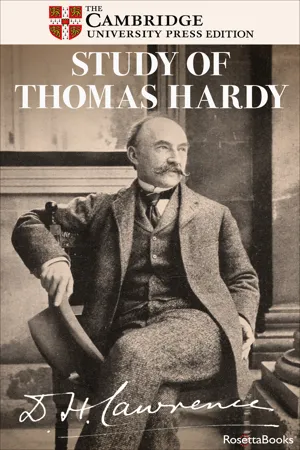
Originally intended to be a short critical work on fellow English novelist Thomas Hardy's characters, D. H. Lawrence's
Study of Thomas Hardydeveloped into a sweeping articulation of his views on literature and art. Though Lawrence destroyed the original manuscript, the work was published posthumously. This restored and authoritative edition also includes essays spanning the whole of Lawrence's writing career, with an introduction contextualizing them within Lawrence's life and work.
- 327 pages
- English
- ePUB (mobile friendly)
- Available on iOS & Android
eBook - ePub
About this book
Information
Subtopic
Literary EssaysIndex
LiteratureSTUDY OF THOMAS HARDY AND OTHER ESSAYS
STUDY OF THOMAS HARDY [LE GAI SAVAIRE]
Note on the text
The base-text for this edition is the composite ribbon and carbon copy typescript (TS) entitled 'Le Gai Savaire', located at UCB. S. S. Koteliansky typed TS from DHL's manuscript (unlocated), but DHL did not correct it.
The apparatus records all textual variants between TS and the first publication of chap. III in the Book Collector's Quarterly, No. 5 (January–March 1932), 44–61 (Per); the posthumous carbon copy typescript (TCC), located at UT, which was made from TS and used as the setting-copy for Phoenix; and the first complete publication in Phoenix (1936), pp. 398–516 (AI).
Inconsistencies of punctuation arise from either DHL's idiosyncrasies or Kot's mistyping in TS or from both. DHL's practice has been checked against the manuscripts of his 'Foreword to Sons and Lovers' (1913) and essays IV to VI of 'The Crown' (1915), particularly in the matter of punctuation and capitalisation of the first word in a quotation. The text has been lightly emended in this respect; all emendations are recorded.
Square brackets in the text are used for words that have been provided editorially (i) to fill a blank space left in TS, (ii) to supply an omitted word required by the sense or the grammar or (iii) to substitute for a probable misreading in TS. In most cases an Explanatory note supplements the evidence of the Textual apparatus.
The apparatus records all textual variants, except for the following silent emendations:
1TS contains numerous mistypings. In cases where these have given rise to later misreadings – 'decr ee' becomes 'door' in TCC (32:17) – or in cases where the identification of a mistyping might be disputed – 'improductive' for 'unproductive' (120:16) – the full information is recorded; otherwise they have been silently emended.
2Incomplete quotation marks and missing full stops at the ends of sentences have been supplied.
3'Dr.' and 'Mrs.' in TS are normalised to the majority usage, 'Dr' and 'Mrs'; TCC and A1 have the full stop.
4Obvious spelling errors are corrected, e.g. 'utterly' for 'uterly'.
5The preferred forms are 'judgement' in TS and Per (for 'judgment' in TCC and A1); 'mediaeval' (for 'medieval' in A1); 'Tolstoi' (for 'Tolstoy' in Per); 'Michel Angelo' in TS (for 'Michelangelo' in A1); 'Nirvana', the majority practice in TS (for 'nirvana'); 'Dürer' in A1 (for 'Durer' in TS and TCC); the rejected forms are not recorded.
6The spelling 'Shakespeare', which appears only once among several variants in TS, is adopted throughout. Hyphens in the following compound terms are majority usage in TS and have been added where TS omits them: 'Will-to-Motion', 'Will-to-Inertia', 'Two-in-One' and 'two-in-one', 'God-Idea' and 'God-idea'. 'Colour', 'honour', 'labour', etc. are preferred to occasional 'color', 'honor', 'labor' in TS.
7The titles of Hardy's novels are italicised. In TS these are underlined, put in inverted commas or, frequently, not signalled. The titles of paintings, sculptures, poems and plays are placed within inverted commas, following the practice of TS, where it gives any indication at all. Later states of the text italicise all titles.
8'D'Urberville', 'De Stancey' (unless they occur at the beginning of a sentence) and 'Philtotson' in TS are corrected to 'd'Urberville', 'de Stancy', 'Phillotson'.
9TCC presents chapter numbers and titles on one line with a colon separating them; A1 printed them on two lines with the titles in italics; TS's form has been restored.
Study of Thomas Hardy [Le Gai Savaire]*
Chapter I.
Of Poppies and Phoenixes and the Beginning of the Argument.
- I - *
Man has made such a mighty struggle to feel at home on the face of the earth, without even yet succeeding. Ever since he first discovered himself exposed naked betwixt sky and land, belonging to neither, he has gone on fighting for more food, more clothing, more shelter, and though he has roofed-in the world with houses and though the ground has heaved up massive abundance and excess of nutriment to his hand, still he cannot be appeased, satisfied. He goes on and on. In his anxiety he has evolved nations and tremendous governments to protect his person and his property, his strenuous purpose, unremitting, has brought to pass the whole frantic turmoil of modern industry, that he may have enough, enough to eat and wear, that he may be safe. Even his religion has for the systole of its heart-beat,* propitiation of the Unknown God who controls death and the sources of nourishment.
But for the diastole of the heart-beat, there is something more, something else, thank heaven, than this unappeased rage of self-preservation.* Even the passion to be rich is not merely the greedy wish to be secured within triple walls of brass, along with huge barns of plenty.* And the history of mankind is not altogether the history of an effort at self-preservation which has at length become over-blown and extravagant.
Working in contradiction to the will of self-preservation, from the very first man wasted himself begetting children, colouring himself and dancing and howling and sticking feathers in his hair, in scratching pictures on the walls of his cave, and making graven images of his unutterable feelings. So he went on, wildly and with gorgeousness taking no thought for the morrow, but, at evening, considering the ruddy lily.*
In his sleep, however, it must have come to him early that the lily is a wise and housewifely flower, considerate of herself, laying up secretly her little storehouse and barn, well under the ground, well tucked with supplies. And this providence on the part of the lily, man laid to heart. He went out anxiously at dawn to kill the largest mammoth, so that he should have a huge hill of meat, that he could never eat his way through.
And the old man at the door of the cave, afraid of the coming winter with its scant supplies, watching the young man go forth, told impressive tales to the children of the ant and the grasshopper;* and praised the thrift and husbandry of that little red squirrel, and drew a moral from the gaudy, fleeting poppy.
"Don't, my dear children," continued the ancient palaeolithic man as he sat at the door of his cave, "don't behave like that reckless, shameless scarlet flower. Ah, my dears, you little know the amount of labour, the careful architecture, all the [physics]* and chemistry, the weaving and the casting of energy, the business of day after day and night after night, yon gaudy wreck has squandered. Pfff!—and it is gone, and the place thereof shall know it no more.* Now, my dear children, don't be like that."
Nevertheless, the old man watched the last poppy coming out, the red flame licking into sight; watched the blaze at the top clinging around a little tender dust, and he wept, thinking of his youth. Till the red flag fell before him, lay in rags on the earth. Then he did not know whether to pay homage to the void, or to preach.
So he compromised, and made a Story about a phoenix.* "Yes, my dears, in the waste desert, I know the green and graceful tree where the phoenix has her nest. And there I have seen the eternal phoenix escape away into flame, leaving life behind in her ashes. Suddenly she went up into red flame, and was gone, leaving life to rise from her ashes."
"And did it?"
"Oh yes, it rose up."
"What did it do then?"
"It grew up, and burst into flame again."
And the flame was all the story and all triumph. The old [man] knew this. It was this he praised, the red outburst at the top of the poppy, in his innermost heart* that had no fear of winter. Even the latent seeds were secondary, within the fire. No red; and there were just a herb, without name or sign of poppy. But he had seen the flower in all its evanescence and its being.
When his educated grandson told him that the red was there to bring the bees and the flies, he knew well enough that more bees and flies and wasps would come to a sticky smear round his grandson's mouth, than to yards of poppy red.
Therefore his grandson began to talk about the excess which always accompanies reproduction. And the old man died during this talk, and was put away. But his soul was uneasy, and come back from the shades to have the last word, muttering inaudibly in the cave door. "If there is always* excess accompanying reproduction, how can you call it excess? When your mother makes a pie, and has too much paste, then that is excess. So she carves a paste rose with her surplus, and sticks it on the top of the pie. That is the flowering of the excess. And children, if they are young enough, clap their hands at this blossom of pastry. And if the pie bloom not too often with the rose of excess, they eat the paste blossom-shaped lump with reverence. But soon they become sophisticated, and know that the rose is no rose, but only excess, surplus, a counterfeit, a lump, unedifying and unattractive and they say 'No thank you mother: no rose.'
"Wherefore, if you mean to tell me that the red of my shed poppy was no more than the rose of the paste on the pie, you are a fool. You mean to say, that young blood had more stuff than he knew what to do with. He knocked his structure of leaves and stalks together, hammered the poppy-knob safe on top, sieved and bolted the essential seeds, shut them up tight, and then said 'Ah!' And whilst he was dusting his hands, he saw a lot of poppy-stuff to spare. 'Must do something with it—must do something with it—mustn't be wasted!' So he just rolled it out into red flakes, and dabbed it round the knobby seed-box, and said 'There, the simple creatures will take it in, and I've got rid of it.'
"My dear child, that is the history of the poppy and of the excess which accompanied his reproduction, is it? That's all you can say of him, when he makes his red splash in the world?—that he had a bit left over from his pie with the five and twenty blackbirds in, so he put a red frill round? My child, it is good you are young, for you are a fool."
So the shade of the ancient man passed back again, to foregather with all the shades. And it shook its head as it went, muttering "Conceit, conceit of self-preservation and of race-preservation, conceit!" But he had seen the heart of his grandson, with the wasteful red peeping out, like a poppy bud. So he chuckled.
- 2 -
Why, when we are away for our holidays, do we exclaim with such rapture "What a splendid field of poppies!" or "Isn't the poppy sweet, a red dot among the camomile flowers!",—only to go back on it all, and when the troubles come in, and we walk forth in heaviness, taking ourselves seriously, later on, to cry, in a harsh and bitter voice: "Ah, the gaudy treason of those red weeds in the corn"; or when children come up with nosegays: "Nasty red flowers, poison, darling, make baby go to sleep," or when we see the scarlet flutter in the wind: "Vanity and flaunting vanity,"* and with gusto watch the red bits disappear into nothingness, saying: "It is well such scarlet vanity be cast to nought."
Why are we so rarely away on our holidays? Why do we persist in taking ourselves seriously, in counting our money and our goods and our virtue? We are down in the end. We rot and tumble away. And that without ever bursting the bud, the tight economical bud of caution and thrift and self-preservation.
The phoenix grows up to maturity and fulness of wisdom, it attains to fatness and wealth and all things desirable, only to burst into flame and expire in ash. And the flame and the ash are the be-all and the end-all, and the fatness and wisdom and wealth are but the fuel spent. It is a wasteful ordering of things, indeed, to be sure:—but so it is, and what must be must be.
But we are very cunning. If we cannot carry our goods and our fatness, at least our goodness can be stored up like coin. And if we are not sure of the credit of the bank, we form ourselves into an unlimited liability company to run the future. We must have an obvious eternal deposit in which to bank our effort. And because the red of the poppy and the fire of the phoenix are contributed to no store, but are spent with the day and disappear, we talk of vanity and foolish mortality.
The phoenix goes gadding off into flame, and leaves the future behind, unprovided* for, in its ashes. There is no prodigal poppy left to return home in repentance, after the red is squandered in a day. Vanity, and vanity, and pathetic [transience]* of mortality. All that is left us to call eternal is the tick-tack of birth and death, monotonous as time. The vain blaze flapped away into space and is gone, and what is left but the tick-tack of time, of birth and death.
But I will chase that flamy phoenix that gadded off into nothingness. Whoop and halloo and away we go into nothingness, in hot pursuit. Say, where are the flowers of yesteryear? Où sont les neiges de l'antan?* Where's Hippolita, where's Thais, each one loveliest among women? Who knows? Where are the snows of yesteryear.
That is all very well, but they must be somewhere. They may not be in any bank or deposit, but they are not lost for ever. The virtue of them is still blowing about in nothingness and in somethingness. I cannot walk up and say "How do you do, Dido?" as Aeneas* did in the shades. But Dido—Dido!—the robin cocks a scornful tail and goes off, disgusted with the noise. You might as well look for your own soul as to look for Dido. "Didon dina dit-on du dos d'un dodu dindon",* comes rapidly into my mind, and a few frayed scraps of Virgil, and [a] vision of fair, round, half globe breasts and blue eyes with tears in them; and a tightness comes into my heart: all forces rushing into me through my consciousness. But what of Dido my unconsciousness has, I could not tell you. Something, I am sure, and something that has come to me without my knowledge, something that flew away in the flames long ago, something that flew away from that pillar of fire,* which was her body, day after day whilst she lived, flocking into nothingness to make a difference there. The reckoning of her money and her mortal assets may be discoverable in print. But what she is in the roomy space of somethingness, called nothingness, is all that matters to me.
She is something, I declare, even if she were utterly forgotten. How could any new thing be born unless it had a new nothingness to breathe. A new creature breathing old air, or even renewed air: it is terrible to think of. A new creature must have new air, absolutely bran-new air to breathe. Otherwise, there is no new creature, and birth and death are a tick-tack.
What was Dido was new, absolutely new. It had never been before, and in Dido it...
Table of contents
- Cover
- Title Page
- Copyright Page
- CONTENTS
- General editors' preface
- Acknowledgements
- Chronology
- Cue-titles
- Introduction
- STUDY OF THOMAS HARDY AND OTHER ESSAYS
- Appendixes
- Explanatory notes
Trusted by 375,005 students
Access to over 1.5 million titles for a fair monthly price.
Study more efficiently using our study tools.
Frequently asked questions
Yes, you can cancel anytime from the Subscription tab in your account settings on the Perlego website. Your subscription will stay active until the end of your current billing period. Learn how to cancel your subscription
No, books cannot be downloaded as external files, such as PDFs, for use outside of Perlego. However, you can download books within the Perlego app for offline reading on mobile or tablet. Learn how to download books offline
Perlego offers two plans: Essential and Complete
- Essential is ideal for learners and professionals who enjoy exploring a wide range of subjects. Access the Essential Library with 800,000+ trusted titles and best-sellers across business, personal growth, and the humanities. Includes unlimited reading time and Standard Read Aloud voice.
- Complete: Perfect for advanced learners and researchers needing full, unrestricted access. Unlock 1.5M+ books across hundreds of subjects, including academic and specialized titles. The Complete Plan also includes advanced features like Premium Read Aloud and Research Assistant.
We are an online textbook subscription service, where you can get access to an entire online library for less than the price of a single book per month. With over 1.5 million books across 990+ topics, we’ve got you covered! Learn about our mission
Look out for the read-aloud symbol on your next book to see if you can listen to it. The read-aloud tool reads text aloud for you, highlighting the text as it is being read. You can pause it, speed it up and slow it down. Learn more about Read Aloud
Yes! You can use the Perlego app on both iOS and Android devices to read anytime, anywhere — even offline. Perfect for commutes or when you’re on the go.
Please note we cannot support devices running on iOS 13 and Android 7 or earlier. Learn more about using the app
Please note we cannot support devices running on iOS 13 and Android 7 or earlier. Learn more about using the app
Yes, you can access Study of Thomas Hardy by D. H. Lawrence in PDF and/or ePUB format, as well as other popular books in Literature & Literary Essays. We have over 1.5 million books available in our catalogue for you to explore.