"The elder statesman of Canadian letters continues to explore the themes of sin, guilt, and self-discovery . . . A masterful effort."—Library Journal
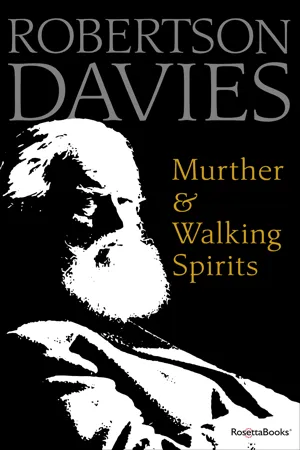
Connor Gilmartin's inauspicious, but much beloved, mortal life comes to an untimely end when he discovers his wife in bed with one of his more ludicrous associates, theater critic Randall Allard Going. Death becomes a bit complicated when Gilmartin's out-of-body experience stays an out-of-body experience.
Enraged at being so unceremoniously cut down by his wife's lover, Gil vows revenge against the now panic-stricken Going. But first, Gil must spend his afterlife seated next to his killer at a film festival, where he views the exploits of his ancestors from the Revolutionary era to his parents' time, an experience that changes the way he views his life—and death.
"Mr. Davies is a tremendously enticing storyteller, whether his characters are cajoling in Welsh brogue or portaging a canoe through the northern wilderness, but it's possible to ask now and then just how such and such an incident fits in the master plan of the book. On most occasions, however, the author, as if sensing our restiveness, provides an answer."—
The New York Times
"Davies's depiction of how the descendants of Samuel Gilmartin came to emigrate to British North America convincingly blends gritty humor—including a hilarious Welsh cursing contest—with sympathetic portrayals of his characters."—
Kirkus Reviews
"The unexpected conceit devised by the author of the Deptford trilogy will surprise but likely not disappoint his fans."—
Publishers Weekly
- 453 pages
- English
- ePUB (mobile friendly)
- Available on iOS & Android
eBook - ePub
Murther & Walking Spirits
About this book
Information
III
Of Water and the Holy Spirit
I have never visited Wild Wales, that northern part of the Principality which I had heard of, vaguely, as the land of my Gilmartin forebears. Only the Welsh Border is known to me, and that from a weekend visit in childhood. How, then, do I recognize the mountain country at once, and with the familiarity I might feel if the screen showed some part of France or Italy, countries I know well? But as the third film in Going’s Festival, and the second in what now seems to be a Festival meant for me alone, appears on the screen, I know at once that I am looking at Wild Wales. I am next to Going, impalpable and invisible, eager for more about Anna Gage and her children. This must be a fairly modern film, for scenes of action are to be seen behind the title and the necessary preliminaries. But, as with The Spirit of ’76, this is beyond question a film peculiar to me, for the Sniffer is watching something different; his film is a prodigious affair called Shadows of Our Forgotten Ancestors, the work of the great Soviet film director (and dissident) Sergei Paradzhanov. But there is nothing Russian about what I see. Wales, beyond a doubt. Is there some hidden connection? Am I really the witness to films addressed to my posthumous needs? It must be so. Is there any other explanation?
(2)
The action appears at first to be concerned with some horribly bad weather. Here is a mountain pass, through cliffs of the blackest slate, lashed by fierce rain driven hither and thither by capricious gusts of riotous wind. It is dusk above the mountains but in the pass it is already night. There is music; the composer has been given his head, but his orchestral fury is merely an accompaniment to the meteorological tumult. Thunder crashes and echoes from the slate sides of the declivity through which there appears to be a track better accommodated to mountain sheep than to travellers. But – yes – I can just make out the figure of one traveller, a man on foot, stumbling through the darkness, searching for a foothold where the water has washed away the scant soil and the sharp stones that once marked the road. From time to time he loses the path, but he cannot stray far because the way is too narrow and its sides are so steep that only a goat could climb them.
The traveller is drenched. His frieze cloak is sodden and his broad hat, which he has fastened to his head with a long scarf, pours water from all three of its cocks. He wears leather gaiters and strong boots, but they are as heavy with water as the cloak. Is he a brave man, or merely a desperate one? If he does not find shelter soon he will certainly die in this storm.
Has he found shelter? This must be a village, or a hamlet, a single street of perhaps nine houses, the most miserable this widely experienced traveller has ever seen in all his tramping through Wales. In hovel after hovel the windows are broken, where windows have ever pierced those stone walls, and not a sign of life is to be seen.
Not a sign, but does he hear a sound? From one miserable pile of tumbledown masonry there is a sound, and as he draws near, he knows what it is. It is the sound of a harp.
I sigh. Is this to be yet another film in which the Welsh people are shown as unremittingly musical and poetic, assuaging the harshness of their destiny with songs of love and valour and dreams? No, God be praised, it is not. The harp thrums and tinkles, and to its accompaniment somebody is singing a bawdy song, a song of shameful lust and filthy desire, and there is laughter at every evil hint and dirty word. I am astonished that I understand the ancient tongue, even in this disgraceful dunghill stretch of its vocabulary, but I reflect that death is full of surprises. The traveller pauses, to my astonishment, for he seems to be wondering if he can endure such company as this song could please. But a sharp gust almost throws him on his face, and he knows that he has no choice. He finds the leather string that lifts the wooden latch of the door, and as the wind drives it open with a crash he steps inside.
(3)
It is, apparently, an inn and the rudest inn that man has known since the inn that, so long ago, refused shelter to Mary and Joseph. The room is not a large one, and the only light is from a poor fire, but the place is full, and warm as much from the heat of the bodies of the guests as from the hearth.
The harper, who is also the singer, stops his ribald tale in mid-verse; he is old, filthy and apparently blind, for a leather shade hangs over his eyes like a penthouse. The other guests, who may number ten or a dozen, are big men who look at the traveller with sour mistrust. They are Welsh mountain men; nothing about them is remarkable except that they all have red hair. Not ginger hair, which is common enough in all Celtic countries, but a darker red which, if it were washed, might be called auburn.
“May I take shelter here?” asks the traveller in courteous Welsh. “The night is very bad.”
“You may, or you may not,” says one man, after a long and inhospitable pause. “Who may you be?”
“I am a traveller, bound on my Master’s work. My name is Thomas Gilmartin.”
“And who is your master, that he sends you to such a place as this, on such a night as this?” says the biggest man, a giant even among these mountain men.
“My Master is Our Lord Jesus Christ, and I am here and everywhere on His work, which never ends,” says the traveller. He shows no fear.
“Never heard of him,” says the big man. “He has no land here.” The other red-haired men guffaw, and repeat the joke among themselves – Never heard of him.
“Then I must tell you of Him. But first may I dry myself a little? I am wet through. Can I buy anything to eat here? I have had no food since morning, and I have been walking all day.”
“Oh, you can pay, is it? Too proud to ask for a bite, is it? Where do you think you are, little man?”
“I hoped to reach Mallwyd tonight, but I do not know where I am. Am I near there?”
“You are two miles or so from Mallwyd, and you will never get there tonight, or perhaps ever. You are at Dinas Mawddwy. Does the name of Dinas Mawddwy mean anything to you?”
“The blessing of God be on Dinas Mawddwy, then. May I stop here till morning?”
“The blessing of God has no meaning in Dinas Mawddwy. You must be a fool not to know that.”
“I only know that I have come from Dolgellau and I am making my way to Llanfair Caereinion – Shining Llanfair, as it is called – to carry on my work. Have I taken a wrong road? And I must tell you that the blessing of God is as powerful here as it is everywhere, say what you will.”
It is the blind harper who speaks now. Scarecrow though he is in outward appearance, his voice is finely deep and melodious. “Dinas Mawddwy is not a place of blessings, but of curses, master,” says he. “You do not know who is talking to you. That is Cursing Jemmy, the blackest curser and swearer even in this cursing place. So you may stick your blessing up your arse so far that when you want it next it will pop into your mouth all brown and stinking.”
The red-headed men are much pleased with this witticism, and the harper bobs his head in acknowledgement of their laughter. The harper goes on; plainly he is Cursing Jemmy’s toady.
“Jemmy can curse for five minutes without a pause or taking fresh breath. Jemmy can curse the black out of a parson’s coat. The last parson came here ran off with his fingers in his ears.”
“That is formidable cursing indeed,” says the traveller. “I don’t suppose you would oblige me with a sample of it? I have heard some very fine cursing in my time, and though I now preach against it as the Devil’s work, I have a right to consider myself a judge.”
“You, a judge?” says the harper. “A Methodist preacher? What way would you be a judge, if I may be so bold as to ask?”
“You clearly know nothing of Methodist preachers,” says the traveller. “We are not your Church parsons, who have been to college and live snug in grand houses from birth to death. Most of us are saved men – brands snatched from the burning – and before we took up Our Lord’s work some of us were very great sinners, I may tell you. Now – you men of Dinas Mawddwy have not travelled far. I can tell, because you say you have never heard of Our Lord Jesus Christ, whose name resounds throughout the whole world. Your ears are stopped against Him. I know. My ears were stopped against Him, too, but He can shout louder than you can stop your ears, and He will. He shouted till I had to hear him. Now, am I to hear your fine curser?”
Cursing Jemmy leaned forward, with his hands on his knees and his elbows spread. He took a great breath, and launched into his aria of finely burnished abuse and blasphemy.
Welsh, like Irish and Scottish Gaelic, is an apt language for scurrilous abuse and bitter condemnation, as it is for poetry and prayer. It is in its heart a language of the Middle Ages, when speech was well-salted and frank, but the Celts brought poetry and rhetorical splendour to it, and an ear for rhyme and assonance that makes Welsh poetry an untranslatable marvel of ingenuity and subtle music. So much I had known, but at a distance, because I know no Welsh and had to take on credit what I heard about it in books. Notice that I heard books, I did not scan them with the eye alone, and I think this is what made me a good, and often idiosyncratic, critic. But now, as I watch this film, I understand; the Welsh tongue, after – I don’t know how many generations – is mine again. I feel, and I marvel not merely at the sense but at the overtone, the suggestion, of Cursing Jemmy’s diatribe. With brutal force he suggests what the traveller might do with his Lord, and he develops fanciful details that could only have been carefully arranged beforehand in his mind. This is no extemporaneous blasphemy. It is the creation of a powerful imagination. Jemmy is long-winded, too. He delivers his blast in a single breath, and he has the lungs and control of a great singer.
(4)
The traveller, leaning back in his chair, listens with appreciation, and when Jemmy closes with a fine coda he taps on the floor appreciatively with his staff.
“Well done, Jemmy,” he says, in a gentle voice. “Well done for a mountain man and an unimproved intellect. If you can find an eisteddfod that offers a crown for cursing, you might well chance your luck. I could not have done much better than that in my own best days, and I was a notable curser, let me tell you, before I found my salvation.”
“Let us hear you, then,” says the harper. “You cannot speak to Jemmy in that voice without proving yourself. Curse, preacher! Curse, you braggart! You shall not eat or rest here till you have made good your boast.”
“Nay,” says the traveller. “I have forsworn cursing, for it is the Devil’s work. Though, I tell you, cursing is also the Devil’s poetry, as Jemmy has shown us. I will gladly go without food, and I will go out again into the storm, before I will swear and blaspheme as Jemmy has done. But perhaps I may offer you a real eisteddfod judge’s opinion on Jemmy’s style. Would you like to hear it?”
“You would not dare,” says the harper. A stir and a murmur among the men told of their agreement.
“Indeed, I will dare anything in my pursuit of Our Lord’s work,” says the traveller.
“Let him speak,” says Jemmy. “To find fault with my cursing – it is very great impudence, and impudence too may be a form of poetry if it is bold. Speak, damn you, you black-coated turd from Jesus’ arse. Say your say, and then I shall kill you. At a blow! I shall kill you!”
“So I shall, for it is always a pleasure to bring light into darkness and improvement into ignorance. Now, listen to me, all of you. What Jemmy has spoken – with eloquence, I grant you – is not true cursing at all. It is naught but blasphemy and filthy abuse. Jemmy is a mere mountain-cacafuego and no more, good as he is. Do you not know what a curse is? Abuse is trivial sport, for women and children – unless the woman be a witch, in which case her abuse may well be feared, for she has given her soul to Satan and rails in his name – which is no foolish or feeble name, let me tell you. But I wander from my point. A curse is an imprecation, in which the curser outlines and details the future of the accursed, under which he must suffer forever, in this life and perhaps in the next until the curse be lifted. Who taught us to curse, think you? It was God himself who laid the first curse on Cain, the evil-doer and murderer. What did Great Jehovah say to Cain? ‘Now art thou cursed from the earth – a fugitive and vagabond shalt thou be in the earth.’ And is it not so? Does not Cain walk abroad still, bringing war and rape and villainy and every cruelty to unredeemed mankind? You tell me that you know not Christ, but I am sure upon my soul that you know Cain, for he speaks loud and clear in your filthy songs and your un-Welsh want of hospitality to the stranger among you. Cain is raised here in Dinas Mawddwy, but you are so sunk in your evil that you know it not. God’s curse upon Cain was the primal curse, and every curse since then has been in its pattern. Truly to curse is to call down the Divine vengeance, and those who have no light of the Divine, or the blackness of Satan, in their natures cannot curse. They can only spew filth, which Jemmy does very well indeed. Seek the Divine, men of Dinas Mawddwy, if you would learn to curse, but be assured that the better you know the Divine, the less you will be inclined to curse.”
There is silence. Neither the harper nor Cursing Jemmy has a word to say. They want time to think about what the traveller has said. But after a few minutes a voice is raised, and it is that of a lad of about fourteen or fifteen who has sat on the floor in a corner. He is the pot-boy of this miserable inn and he has the dark red head of Dinas Mawddwy; he does not look as though his life has been a happy one.
“Tell us more about cursing, master,” he says. “Your Bible curse is well enough, but we are Welsh. Do you know of a Welsh curse?”
Some of the men murmur. Yes, tell us of a Welsh curse. They know of the Bible. They have heard of Bishop Morgan’s Welsh Bible, though it is doubtful if any one of them has seen it, or could read it if he had done so. These men are as Welsh as Welsh mountaineers could be. For them it is as though the Romans had never brought four hundred years of European culture to their remote land. Their Wales is an area of perhaps two miles in all directions from the hovel in which they sit. A Welsh curse! Now that would be a fine thing, a comprehensible thing.
The traveller is caught in his own net. He has talked too much, his old fault, against which John Wesley himself has warned him. He will have to pray hard for correction of that flaw in his nature. Meanwhile he must keep his hold over these troglodytes, if he hopes to preach God’s Word to them before the night is over. He temporizes.
“For a truly Welsh curse, a curse uttered before there was any knowledge of the Curse of Cain in this land, I should have to go back very far into history,” he says.
“Go back as far as you please and we shall be at ease wherever you lead us. We are Welsh history, preacher.”
“You are? What do you mean?”
“You have not recognized us?” says the harper. “You have not seen that we are the living Gwylltiaid Cochion Mawddwy? You must have heard of us. We are very famous. Even in England we are known.”
“The Red Banditti?” says the traveller. “I did not know that I had fallen into such distinguished company. But surely that was in olden times.”
“It was in the days of King Henry the Eighth – and that was a very, very long time ago – that we were heard of in England. The King sent his black devil Lewis Owen to hunt us down and it was on a very famous Christmas Eve he seized eighty of us, and hanged us from trees like the carcasses of sheep. It was then that we forswore Christmas and all it means, because it is the worst day in the year for us. But it was many months after that those who had escaped met with him on the road to Mallwyd – the road you are taking, preacher – and they dragged him from his horse and put more than thirty stabs into him. They still call that place The Baron’s Gate, and indeed it was his gate to hell. We are t...
Table of contents
- Title Page
- Copyright Page
- Dedication
- Contents
- I Roughly Translated
- II Cain Raised
- III Of Water and the Holy Spirit
- IV The Master Builder
- V Scenes from a Marriage
- VI The Land of Lost Content
- VII … To the Wind’s Twelve Quarters I Take My Endless Way
Trusted by 375,005 students
Access to over 1.5 million titles for a fair monthly price.
Study more efficiently using our study tools.
Frequently asked questions
Yes, you can cancel anytime from the Subscription tab in your account settings on the Perlego website. Your subscription will stay active until the end of your current billing period. Learn how to cancel your subscription
No, books cannot be downloaded as external files, such as PDFs, for use outside of Perlego. However, you can download books within the Perlego app for offline reading on mobile or tablet. Learn how to download books offline
Perlego offers two plans: Essential and Complete
- Essential is ideal for learners and professionals who enjoy exploring a wide range of subjects. Access the Essential Library with 800,000+ trusted titles and best-sellers across business, personal growth, and the humanities. Includes unlimited reading time and Standard Read Aloud voice.
- Complete: Perfect for advanced learners and researchers needing full, unrestricted access. Unlock 1.5M+ books across hundreds of subjects, including academic and specialized titles. The Complete Plan also includes advanced features like Premium Read Aloud and Research Assistant.
We are an online textbook subscription service, where you can get access to an entire online library for less than the price of a single book per month. With over 1.5 million books across 990+ topics, we’ve got you covered! Learn about our mission
Look out for the read-aloud symbol on your next book to see if you can listen to it. The read-aloud tool reads text aloud for you, highlighting the text as it is being read. You can pause it, speed it up and slow it down. Learn more about Read Aloud
Yes! You can use the Perlego app on both iOS and Android devices to read anytime, anywhere — even offline. Perfect for commutes or when you’re on the go.
Please note we cannot support devices running on iOS 13 and Android 7 or earlier. Learn more about using the app
Please note we cannot support devices running on iOS 13 and Android 7 or earlier. Learn more about using the app
Yes, you can access Murther & Walking Spirits by Robertson Davies in PDF and/or ePUB format, as well as other popular books in Literature & Literature General. We have over 1.5 million books available in our catalogue for you to explore.