"Stunningly crafted and constantly surprising . . . An utterly convincing love story about two people destined to be together somehow, no matter what."—
The Times
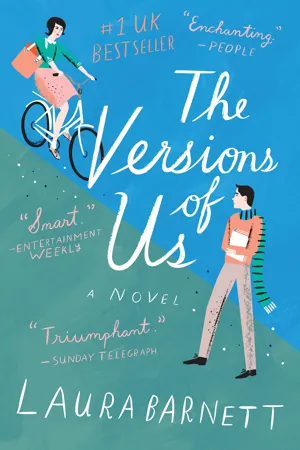
A dazzling novel about the ways the smallest decisions give shape to our lives, The Versions of Us charts a relationship through three possible futures. Cambridge, 1958. Late for class, Eva Edelstein swerves to miss a dog and crashes her bike. Jim Taylor hurries to help her. In that brief moment, three outcomes are born for Eva and Jim. As the strands of their lives weave together and apart across the decades from college through wildly different successes and disappointments, seductions and betrayals, births and funerals, joys and sorrows, the only constant is the power of their connection. A #1 UK bestseller, The Versions of Us is a tour de force of storytelling.
"One Day meets Sliding Doors."—
Elle
"I simply adored this wonderful novel."—Jessie Burton,
New York Times bestselling author of
The Miniaturist
"A joy."—
The Guardian
"Enchanting."—
People
"Imagines the delicious prospect of romantic do-overs, cleverly negotiating the tricky and often dizzying terrain of three versions of first love . . . A masterly romantic study of love's choices and consequences."—
Publishers Weekly (starred review)
"Triumphant."—
The Sunday Telegraph
"Barnett renders an irresistible concept in sweet, cool prose—a bit like a choose-your-own-adventure book in which you don't have to choose."—Observer
"Reading this ambitious first novel is like putting together the pieces of a complex puzzle. The challenge pays off—only when the puzzle is complete can readers see the whole panoramic picture."—
Library Journal
- 434 pages
- English
- ePUB (mobile friendly)
- Available on iOS & Android
eBook - ePub
The Versions of Us
About this book
Information
Subtopic
Literature GeneralIndex
LiteraturePart One
VERSION ONE
Puncture
Cambridge, October 1958
Later, Eva will think, If it hadn’t been for that rusty nail, Jim and I would never have met.
The thought will slip into her mind, fully formed, with a force that will snatch her breath. She’ll lie still, watching the light slide around the curtains, considering the precise angle of her tyre on the rutted grass; the nail itself, old and crooked; the small dog, snouting the verge, failing to heed the sound of gear and tyre. She had swerved to miss him, and her tyre had met the rusty nail. How easy—how much more probable—would it have been for none of these things to happen?
But that will be later, when her life before Jim will already seem soundless, drained of colour, as if it had hardly been a life at all. Now, at the moment of impact, there is only a faint tearing sound, and a soft exhalation of air.
‘Damn,’ Eva says. She presses down on the pedals, but her front tyre is jittering like a nervous horse. She brakes, dismounts, kneels to make her diagnosis. The little dog hovers penitently at a distance, barks as if in apology, then scuttles off after its owner—who is, by now, a good deal ahead, a departing figure in a beige trench coat.
There is the nail, lodged above a jagged rip, at least two inches long. Eva presses the lips of the tear and air emerges in a hoarse wheeze. The tyre’s already almost flat: she’ll have to walk the bicycle back to college, and she’s already late for supervision. Professor Farley will assume she hasn’t done her essay on the Four Quartets, when actually it has kept her up for two full nights—it’s in her satchel now, neatly copied, five pages long, excluding footnotes. She is rather proud of it, was looking forward to reading it aloud, watching old Farley from the corner of her eye as he leaned forward, twitching his eyebrows in the way he does when something really interests him.
‘Scheiße,’ Eva says: in a situation of this gravity, only German seems to do.
‘Are you all right there?’
She is still kneeling, the bicycle weighing heavily against her side. She examines the nail, wonders whether it would do more harm than good to take it out. She doesn’t look up.
‘Fine, thanks. It’s just a puncture.’
The passer-by, whoever he is, is silent. She assumes he has walked on, but then his shadow—the silhouette of a man, hatless, reaching into his jacket pocket—begins to shift across the grass towards her. ‘Do let me help. I have a kit here.’
She looks up now. The sun is dipping behind a row of trees—just a few weeks into Michaelmas term and already the days are shortening—and the light is behind him, darkening his face. His shadow, now attached to feet in scuffed brown brogues, appears grossly tall, though the man seems of average height. Pale brown hair, in need of a cut; a Penguin paperback in his free hand. Eva can just make out the title on the spine, Brave New World, and she remembers, quite suddenly, an afternoon—a wintry Sunday; her mother making Vanillekipferl in the kitchen, the sound of her father’s violin drifting up from the music room—when she had lost herself completely in Huxley’s strange, frightening vision of the future.
She lays the bicycle down carefully on its side, gets to her feet. ‘That’s very kind of you, but I’m afraid I’ve no idea how to use one. The porter’s boy always fixes mine.’
‘I’m sure.’ His tone is light, but he’s frowning, searching the other pocket. ‘I may have spoken too soon, I’m afraid. I’ve no idea where it is. So sorry. I usually have it with me.’
‘Even when you’re not cycling?’
‘Yes.’ He’s more a boy than a man: about her own age, and a student; he has a college scarf—a bee’s black and yellow stripes—looped loosely round his neck. The town boys don’t sound like him, and they surely don’t carry copies of Brave New World. ‘Be prepared and all that. And I usually do. Cycle, I mean.’ He smiles, and Eva notices that his eyes are a very deep blue, almost violet, and framed by lashes longer than her own. In a woman, the effect would be called beautiful. In a man, it is a little unsettling; she is finding it difficult to meet his gaze.
‘Are you German, then?’
‘No.’ She speaks too sharply; he looks away, embarrassed.
‘Oh. Sorry. Heard you swear. Scheiße.’
‘You speak German?’
‘Not really. But I can say “shit” in ten languages.’
Eva laughs: she shouldn’t have snapped. ‘My parents are Austrian.’
‘Ach so.’
‘You do speak German!’
‘Nein, mein Liebling. Only a little.’
His eyes catch hers and Eva is gripped by the curious sensation that they have met before, though his name is a blank. ‘Are you reading English? Who’s got you on to Huxley? I didn’t think they let any of us read anything more modern than Tom Jones.’
He looks down at the paperback, shakes his head. ‘Oh no—Huxley’s just for fun. I’m reading law. But we are still allowed to read novels, you know.’
She smiles. ‘Of course.’ She can’t, then, have seen him around the English faculty; perhaps they were introduced at a party once. David knows so many people—what was the name of that friend of his Penelope danced with at the Caius May Ball, before she took up with Gerald? He had bright blue eyes, but surely not quite like these. ‘You do look familiar. Have we met?’
The man regards her again, his head on one side. He’s pale, very English-looking, a smattering of freckles littering his nose. She bets they gather and thicken at the first glance of sun, and that he hates it, curses his fragile northern skin.
‘I don’t know,’ he says. ‘I feel as if we have, but I’m sure I’d remember your name.’
‘It’s Eva. Edelstein.’
‘Well.’ He smiles again. ‘I’d definitely remember that. I’m Jim Taylor. Second year, Clare. You at Newnham?’
She nods. ‘Second year. And I’m about to get in serious trouble for missing a supervision, just because some idiot left a nail lying around.’
‘I’m meant to be in a supervision too. But to be honest, I was thinking of not going.’
Eva eyes him appraisingly; she has little time for those students—men, mostly, and the most expensively educated men at that—who regard their degrees with lazy, self-satisfied contempt. She hadn’t taken him for one of them. ‘Is that something you make a habit of?’
He shrugs. ‘Not really. I wasn’t feeling well. But I’m suddenly feeling a good deal better.’
They are silent for a moment, each feeling they ought to make a move to leave, but not quite wanting to. On the path, a girl in a navy duffel coat hurries past, throws them a quick glance. Then, recognising Eva, she looks again. It’s that Girton girl, the one who played Emilia to David’s Iago at the ADC. She’d had her sights set on David: any fool could see it. But Eva doesn’t want to think about David now.
‘Well,’ Eva says. ‘I suppose I’d better be getting back. See if the porter’s boy can fix my bike.’
‘Or you could let me fix it for you. We’re much closer to Clare than Newnham. I’ll find the kit, fix your puncture, and then you can let me take you for a drink.’
She watches his face, and it strikes Eva, with a certainty that she can’t possibly explain—she wouldn’t even want to try—that this is the moment: the moment after which nothing will ever be quite the same again. She could—should—say no, turn away, wheel her bicycle through the late-afternoon streets to the college gates, let the porter’s boy come blushing to her aid, offer him a four-bob tip. But that is not what she does. Instead, she turns her bicycle in the opposite direction and walks beside this boy, this Jim, their twin shadows nipping at their heels, merging and overlapping on the long grass.
VERSION TWO
Pierrot
Cambridge, October 1958
In the dressing-room, she says to David, ‘I almost ran over a dog with my bike.’
David squints at her in the mirror; he is applying a thick layer of white pan-stick to his face. ‘When?’
‘On my way to Farley’s.’ Odd that she should have remembered it now. It was alarming: the little white dog at the edge of the path hadn’t moved away as she approached, but skittered towards her, wagging its stump of a tail. She’d prepared to swerve, but at the very last moment—barely inches from her front wheel—the dog had suddenly bounded away with a frightened yelp.
Eva had stopped, shaken; someone called out, ‘I say—look where you’re going, won’t you?’ She turned, saw a man in a beige trench coat a few feet away, glaring at her.
‘I’m so sorry,’ she said, though what she meant to say was, You should really keep your damn dog on a lead.
‘Are you all right there?’ Another man was approaching from the opposite direction: a boy, really, about her age, a college scarf looped loosely over his tweed jacket.
‘Quite all right, thank you,’ she said primly. Their eyes met briefly as she remounted—his an uncommonly dark blue, framed by long, girlish lashes—and for a second she was sure she knew him, so sure that she opened her mouth to frame a greeting. But then, just as quickly, she doubted herself, said nothing, and pedalled on. As soon as she arrived at Professor Farley’s rooms and began to read out her essay on the Four Quartets, the whole thing slipped from her mind.
‘Oh, Eva,’ David says now. ‘You do get yourself into the most absurd situations.’
‘Do I?’ She frowns, feeling the distance between his version of her—disorganised, endearingly scatty—and her own. ‘It wasn’t my fault. The stupid dog ran right at me.’
But he isn’t listening: he’s staring hard at his reflection, blending the make-up down onto his neck. The effect is both clownish and melancholy, like one of those French Pierrots.
‘Here,’ she says, ‘you’ve missed a bit.’ She leans forward, rubs at his chin with her hand.
‘Don’t,’ he says sharply, and she moves her hand away.
‘Katz.’ Gerald Smith is at the door, dressed, like David, in a long white robe, his face unevenly smeared with white. ‘Cast warm-up. Oh, hello, Eva. You wouldn’t go and find Pen, would you? She’s hanging around out front.’
She nods at him. To David, she says, ‘I’ll see you afterwards, then. Break a leg.’
He grips her arm as she turns to go, draws her closer. ‘Sorry,’ he whispers. ‘Just nerves.’
‘I know. Don’t be nervous. You’ll be great.’
He is great, as always, Eva thinks with relief half an hour later. She is sitting in the house seats, holding her friend Penelope’s hand. For the first few scenes, they are tense, barely able to watch the stage: they look instead at the audience, gauging their reactions, running over the lines they’ve rehearsed so many times.
David, as Oedipus, has a long speech about fifteen minutes in that it took him an age to learn. Last night, after the dress, Eva sat with him until midnight in the empty dressing-room, drilling him over and over, though her essay was only half finished, and she’d have to stay up all night to get it done. Tonight, she can hardly bear to listen, but David’s voice is clear, unfaltering. She watches two men in the row in front lean forward, rapt.
Afterwards, they gather in the bar, drinking warm white wine. Eva and Penelope—tall, scarlet-lipped, shapely; her first words to Eva, whispered across the polished table at matriculation dinner, were, ‘I don’t know about you, but I would kill for a smoke’—stand with Susan Fletcher, whom the director, Harry Janus, has recently thrown over for an older actress he met at a London show.
‘She’s twenty-five,’ Susan says. She’s brittle and a little teary, watching Harry through narrowed eyes. ‘I looked up her picture in Spotlight—they have a copy in the library, you know. She’s absolutely gorgeous. How am I meant to compete?’
Eva and Penelope exchange a discreet glance; their loyalties ought, of course, to lie with Susan, but they can’t help feeling she’s the sort of girl who thrives on such dramas.
‘Just don’t compete,’ Eva says. ‘Retire from the game. Find someone else.’
Susan blinks at her. ‘Easy for you to say. David’s besotted.’
Eva follows Susan’s gaze across the room, to where David is talking to an older man in a waistcoat and hat—not a student, and he hasn’t the dusty air of a don: a London agent, perhaps. He is looking at David like a man who expected to find a penny and has found a crisp pound note. And why not? David is back in civvies now, the collar of his sports jacket arranged just so, his face wiped clean: tall, shining, magnificent.
All through Eva’s first year, the name ‘David Katz’ had travelled the corridors and common rooms of Newnham, usually uttered in an excitable whisper. He’s at King’s, you know. He’s the spitting image of Rock Hudson. He took Helen Johnson for cocktails. When they finally met—Eva was Hermia to his Lysander, in an early brush with the stage that confirmed her suspicion that she would never make an actress—she had known he was watching her, waiting for the usual blushes, the coquettish laughter. But she had not laughed; she had found him foppish, self-regarding. And yet David hadn’t seemed to notice; in the Eagle pub after the read-through, he’d asked about her family, her life, with a degree of interest that she began to think might be genuine. ‘You want to be a writer?’ he’d said. ‘What a perfectly wonderful thing.’ He’d quoted whole scenes from Hancock’s Half Hour at her with uncanny accuracy, until she couldn’t help but laugh. A few days later, after rehearsals, he’d suggested she let him take her out for a drink, and Eva, with a sudden rush of excitement, had agreed.
That was six months ago now, in Easter term. She hadn’t been sure the relationship would survive the summer—David’s month with his family in Los Angeles (his father was American, had some rather glamorous connection to Hollywood), her fortnight scrabbling around on an archaeological dig near Harrogate (deathly dull, but there’d been time to write in the long twilit hours between dinner and bed). But he wrote often from America, even telephoned; then, when he was back, he came to Highgate for tea, charmed her parents over Lebkuchen, took her swimming in the Ponds.
There was, Eva was finding, a good deal more to David Katz than she had at first supposed. She liked his intelligence, his knowledge of culture: he took her to Chicken Soup With Barley at the Royal Court, wh...
Table of contents
- Title Page
- Contents
- Copyright
- Dedication
- Epigraph
- 1938
- Part One
- Puncture Cambridge, October 1958
- Pierrot Cambridge, October 1958
- Fall Cambridge, October 1958
- Rain Cambridge, November 1958
- Mother Cambridge, November 1958
- Cathedral Cambridge & Ely, December 1958
- Home London, August 1960
- Gypsophila London, August 1960
- Tide London, September 1960
- Bridge Bristol, September 1961
- Face Bristol, July 1961
- Pink house London, October 1962
- Hostess London, December 1962
- Dancer New York, November 1963
- Algonquin New York, November 1963
- Algonquin New York, November 1963
- Part Two
- Exhibition London, June 1966
- Warehouse Bristol, September 1966
- Sandworms Suffolk, October 1966
- Miracle London, May 1968
- Leaving London, July 1968
- Frost Cornwall, October 1969
- Thirty London, July 1971
- Thirty London, July 1971
- Thirty London, July 1971
- Invitation London, July 1971
- Invitation London, July 1971
- Expecting Bristol, September 1972
- Montmartre Paris, November 1972
- Interview Cornwall, February 1973
- Island Greece, August 1975
- Homecoming Paris & London, April 1976
- Geraniums Worcestershire, May 1976
- Poets Yorkshire, October 1977
- Gingerbread Cornwall, December 1977
- Afterglow Los Angeles, December 1977
- Ground Bristol, February 1979
- Breakfast Paris, February 1979
- Ground Bristol, February 1979
- Part Three
- Bella London, September 1985
- Pronto soccorso Rome, May 1986
- Landing Sussex, July 1988
- Man Ray London, March 1989
- Father Cornwall, November 1990
- Hamlet London, September 1995
- Snowball London, January 1997
- Advice London, July 1998
- Missing Sussex, April 2000
- Sixty London, July 2001
- Detour Cornwall, July 2001
- Sixty London, July 2001
- Rescue London, November 2005
- Pines Rome & Lazio, July 2007
- Beach Cornwall, October 2008
- Kaddish London, January 2012
- Kaddish London, January 2012
- Kaddish London, January 2012
- 2014
- Acknowledgements
- Reading Group Guide
- About the Author
- Connect with HMH
Trusted by 375,005 students
Access to over 1.5 million titles for a fair monthly price.
Study more efficiently using our study tools.
Frequently asked questions
Yes, you can cancel anytime from the Subscription tab in your account settings on the Perlego website. Your subscription will stay active until the end of your current billing period. Learn how to cancel your subscription
No, books cannot be downloaded as external files, such as PDFs, for use outside of Perlego. However, you can download books within the Perlego app for offline reading on mobile or tablet. Learn how to download books offline
Perlego offers two plans: Essential and Complete
- Essential is ideal for learners and professionals who enjoy exploring a wide range of subjects. Access the Essential Library with 800,000+ trusted titles and best-sellers across business, personal growth, and the humanities. Includes unlimited reading time and Standard Read Aloud voice.
- Complete: Perfect for advanced learners and researchers needing full, unrestricted access. Unlock 1.5M+ books across hundreds of subjects, including academic and specialized titles. The Complete Plan also includes advanced features like Premium Read Aloud and Research Assistant.
We are an online textbook subscription service, where you can get access to an entire online library for less than the price of a single book per month. With over 1.5 million books across 990+ topics, we’ve got you covered! Learn about our mission
Look out for the read-aloud symbol on your next book to see if you can listen to it. The read-aloud tool reads text aloud for you, highlighting the text as it is being read. You can pause it, speed it up and slow it down. Learn more about Read Aloud
Yes! You can use the Perlego app on both iOS and Android devices to read anytime, anywhere — even offline. Perfect for commutes or when you’re on the go.
Please note we cannot support devices running on iOS 13 and Android 7 or earlier. Learn more about using the app
Please note we cannot support devices running on iOS 13 and Android 7 or earlier. Learn more about using the app
Yes, you can access The Versions of Us by Laura Barnett in PDF and/or ePUB format, as well as other popular books in Literature & Literature General. We have over 1.5 million books available in our catalogue for you to explore.