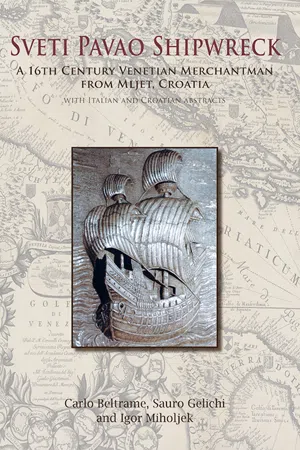
Between 2007 and 2012 the Department for Underwater Archaeology of the Croatian Conservation Institute from Zagreb and the Department of Humanistic Studies of the Ca' Foscari University of Venice collaborated in the recording, underwater excavation and analysis of the unusually well-preserved wreck of a 16th century Venetian merchantman in the Svetti Pavao shallow off the southern shore of the island of Mljet, Croatia. The shipwreck preserved many personal possessions of the crew as well as a number of bronze artillery pieces and the remains of a cargo of luxury and richly decorated ceramic material from Iznik and other oriental workshops.
Although the excavation is not complete, this volume presents the results of the project so far. The methodological and technical aspects of the underwater investigation of the site, mainly by photogrammetry, are described; the historical and archaeological context of navigation in the late Medieval period in the eastern Mediterranean discussed; and the recovered artefacts described and catalogued in detail, together with the remains of the ship and its equipment that, because of depth and of problems of conservation, have been left in situ. The conservation and restoration of the finds are described in an appendix.
eBook - ePub
Sveti Pavao Shipwreck
A 16th century Venetian merchantman from Mljet, Croatia
- 200 pages
- English
- ePUB (mobile friendly)
- Available on iOS & Android
eBook - ePub
Sveti Pavao Shipwreck
A 16th century Venetian merchantman from Mljet, Croatia
About this book
Information
Subtopic
ArchaeologyIndex
Social SciencesChapter 1 Introduction
1. Introduction
Abstract
Le coste croate hanno restituito numerosi relitti di ogni epoca tra cui un consistente numero di relitti di età post-medievale. Tra questi, i più importanti e meglio studiati sono quelli delle isole di Gnalic e di Sipan. I relitti scoperti negli ultimi anni sono quelli di Brsečine, Catvat, Mijoka e Lastovo. Quello dello scoglio di Sv. Pavao (San Paolo) localizzato a poche decine di metri dalla costa occidentale dell’isola di Mljet (Meleda), vicino alla località di Saplunara, però è uno dei pochi ad essere stato oggetto di un’indagine sistematica e a non essere stato saccheggiato dai clandestini. Oggetto della prima campagna di ricerche organizzata dal Dipartimento di Archeologia Subacquea dell’Istituto Croato per il Restauro di Zagabria, sulla secca di San Paolo, è stato il recupero dei pezzi di artiglieria in bronzo a rischio di trafugamento. Nel 2008 e 2009 sono seguite altre campagne finalizzate allo scavo e al recupero del carico costituito da vasi di ceramica di Iznik. Nel 2010, grazie ad un finanziamento della Regione del Veneto, è iniziata anche la collaborazione con il Dipartimento di Studi Umanistici dell’Università Ca’ Foscari di Venezia incaricato di studiare i resti dello scafo. Altre missioni sono state organizzate nel 2011 e nel 2012. Dal relitto provengono, oltre alla ceramica ottomana, anche bottiglie di vetro, una campana di bronzo con la data 1567, monete ottomane e sassoni, ceramica impiegata a bordo di produzione veneziana, parti dell’attrezzatura della nave e alcuni oggetti personali oltre a dei manufatti in bronzo. Nel sito sono state individuate anche tre ancore lasciate al loro posto. Le indagini di scavo non si possono dire completate ma, data la grande profondità a cui giace il giacimento che arriva fino a m 46, il proseguimento delle ricerche sarà possibile solo con una disponibilità di fondi sufficiente per organizzare un cantiere adeguato alle esigenze tecniche.
Jadransko more i obala Republike Hrvatske skrivaju mnoge brodolome iz različitih perioda od kojih velik broj pripada novovjekovnima. Među njima su najvažniji i ujedno detaljno istraženi brodolomi kod Gnalića i Šipana. Osim njih u posljednjih su 20 godina pronađeni i brodolomi kod Brsečina, Cavtata, Mijoke i Lastova. Brodolom kod Pličine Sv. Pavao nalazi se u blizini južne obale otoka Mljeta, pokraj Saplunare, i jedan je od rijetkih sistematski istraživanih brodoloma koji prije otkrića nije bio opljačkan ili devastiran. Cilj prve sezone istraživanja pod vodstvom Odjela za podvodnu arheologiju pri Hrvatskom restauratorskom zavodu bio je podići s dna brončane topove koji su predstavljali lak plijen brojnim tragačima za blagom. Cilj istraživačkih etapa iz 2008. i 2009. godine bio je otkriti, dokumentirati in situ i prikupiti brodski teret pronađenog Iznik posuđa. Zahvaljujući sponzorstvu Regije Veneto započela je 2010. suradnja između Dipartimento di Studi Umanistici pri Università Ca’ Foscari u Veneciji i Hrvatskog restauratorskog zavoda. Uloga talijanskog dijela tima bila je proučiti i detaljno dokumentirati ostatke brodske konstrukcije. Istraživanja su produžena u 2011. i 2012. godini. Uz otomansku keramiku pronađene su i staklene boce, brončano zvono s natpisom 1567, otomanski i saksonski novac, keramika venecijanskog porijekla, elementi brodske opreme, neki osobni te raznovrsni brončani predmeti. Tri otkrivena sidra ostavljena su in situ. Istraživanje nije u potpunosti dovršeno ponajviše radi velike dubine nalazišta koja na nekim dijelovima doseže i 46 metara. Nastavak će istraživanja biti moguć uz dostatna financijska sredstva koja bi osigurala najviše standarde istraživanja.
Croatian heritage is richer for one more valuable archaeological site, the remains of a merchant ship from the 16th century that, in unlucky circumstances, ended its voyage at the bottom of the sea in the Mljet archipelago. The find is unique and extremely valuable in the sense that it represents the only archaeological site discovered in a perfectly intact state in the Croatian sea. The significance of the site rests in the fact that it gave the archaeologists a chance to explore a totally preserved modern shipwreck, after many years of working on completely or partially devastated and looted sites.
Before the discovery of the shipwreck in the shallows of Sveti Pavao (a shortened version of the same name is Sv. Pavao used throughout the publication, which is the equivalent of English name St Paul), little information was available regarding the traces of the intense passage of Venetian ships, ships of the Dubrovnik republic, British vessels (HMS) and others, from the 10th to the 18th century, along the Eastern coast of the Adriatic. Post-Medieval shipwrecks have already been investigated in the past. The most famous among them are the shipwrecks from the second half of the 16th century near the island of Gnalić (Radulić, 1970) and island Šipan (Kisić, 1987). The most important wreck of the 17th century is the site at Drevine in the channel of Koločep near Dubrovnik (Kisić, 1982), and the most important one from the 18th century was found on Vis (Frka and Mesić, 2002). It is important to mention that the sites were excavated with modest financial resources and that further research is planned. Except from the shipwrecks investigated in the 1970s and 1980s, new research conducted over the last ten years has yielded three new post-Medieval shipwrecks. Two are located in the Dubrovnik aquatorium, near Brsečine (Jurišić and Mihajlović, 2010) and in front of Cavtat, and the third was found near the Mijoka shallow close to Murter. Both sites in the Dubrovnik aquatorium were surveyed, their condition documented, and the only items which were taken out were the ones which could be easily taken out by looters. According to the retrieved cannon parts, the shipwreck near Brsečine can be dated to the end of the 16th century (Ridella, 2011) or later, and the site in front of Cavtat to the time of the Napoleonic wars. Detailed research into these sites is planned and, hopefully, under way soon. The shipwreck near the Mijoka shallow near Murter is, on the basis of material similar to one part of the material found at Gnalić, dated to the beginning of the 17th century (Zmaić, 2009). The seabed around the island of Lastovo also contains a post-Medieval shipwreck from the 16th century. The site was discovered in the early 1990s and is legally protected although it was never systematically investigated. It was dated to the 15th century, a date which has proved erroneous. A new survey conducted in 2007 provided new insight about the site and a completely new dating. A ceramic jug characteristic of the 16th century, with a motif of the face of an angel, was found during that survey, and it defined a completely new datation (Bradara, 2006b). Regarding the fact that other finds from the site indicate an earlier date of the site, further research is necessary in order to establish a more exact date of the shipwreck.
Although post-Medieval wrecks are not a rarity in the Croatian seabed, they are seldom found in such an intact state, and we can rarely talk about systematically investigated post-Medieval wrecks. The researches carried out on the Mljet wreck from 2007 to 2012 are just the initial part of the systematic salvage excavations which, with the drawn, photographic and video records of the site and the finds, will be used in an attempt to obtain an as wide as possible view of the circumstances of this shipwreck, and provide knowledge about production, economic conditions, commercial navigation routes and the dangers of sailing during the turbulent 16th, 17th and 18th centuries.
The favourable winds and the indented coast with a multitude of islands and islets have always been the main pre-condition for navigating along the eastern Adriatic seaboard, ever since ancient times. These islands, indeed, offered both easily recognisable land marks and possibilities of refuge in case of storm, while the strong winds allowed efficient sailing. Nonetheless, navigation in the eastern Adriatic sea has never been completely safe. The same winds that facilitated the traffic and cultural development of the coast, the same islands and bays that provided the seafarers with safe anchorages, would occasionally play rough with the destinies of ships and their sailors. For this reason, a large number of shipwrecks lie hidden at the bottom of the eastern side of the Adriatic sea. Most of them are shipwrecks from the period of antiquity (4th century BC–6th century AD), only six of those identified thus far belong to Byzantium (11th–14th century), and about a dozen are post-Medieval shipwrecks (16th–18th century). In addition, there are also shipwrecks from the two World Wars, but most of those fell victim to the whirlwinds of war in naval battles, or they ran into anti-shipping mines.
The Sv. Pavao shallow is situated on the southern side of the island of Mljet and around 200 m from the shore. Since the name for the shallow does not exist in sea charts and maps, the shallows were initially named after the closest island of Preč. It was later found out that the local inhabitants call the shallow Sv. Pavao (Fig. 1.1). The position of the shallow is fully opened to southern winds and rough sea (Figs 1.2 and 1.3). The island of Preč is situated to the west, along with cape Dugi rat with its inlet. The mentioned island and cape form a natural hiding place and a good anchorage point on the route towards the southern part of Mljet, from the area of Mljet lakes to Saplunara bay.
The objective of the first research campaign conducted in 2007 was to bring together the whole drawn and photographic records of the condition and situation of the site. Because of the great value of the bronze artillery pieces and the other preserved objects, it was decided that all the objects that had been documented would be retrieved in order to prevent possible devastation. On this occasion, seven bronze artillery pieces and about 30 additional items were recovered.

Fig. 1.1. Position of the Sv. Pavao shallow in relation to the Adriatic and island of Mljet
Because of the great value of this material and the intact state of the site, research was continued in 2008 and 2009. The material that emerged was related to that from 2007, and among the many objects, one more artillery piece was discovered, recovered together with an iron breech and an iron swivel; the artillery piece would have been mounted on the rail with this swivel. Before conservation and cleaning, the artillery piece which, in the recovered encrusted part, had a partially preserved breech chamber, and of course the last cannon found, were X-rayed in order to take a better look and clearly see and study the breech mechanism, and ultimately to be able to make a theoretical reconstruction of the ordnance. As for the newly discovered items, seven large luxury Iznik plates, fitted one on top of the other, were of particular interest as well as several bowls packed for transportation, confirming the hypothesis that the ship contained oriental commercial cargo meant for the western market.
In 2009, Igor Miholjek and I...
Table of contents
- Cover
- Title Page
- Copyright
- Contents
- List of contributors
- Preface
- Foreword
- Chapter 1. Introduction
- Chapter 2. Methodological and technical aspects
- Chapter 3. The historical and archaeological maritime context
- Chapter 4. The shipwreck of Mljet
- Chapter 5. Conclusions
- Appendix. The conservation and restoration of the finds
- Bibliography
Trusted by 375,005 students
Access to over 1.5 million titles for a fair monthly price.
Study more efficiently using our study tools.
Frequently asked questions
Yes, you can cancel anytime from the Subscription tab in your account settings on the Perlego website. Your subscription will stay active until the end of your current billing period. Learn how to cancel your subscription
No, books cannot be downloaded as external files, such as PDFs, for use outside of Perlego. However, you can download books within the Perlego app for offline reading on mobile or tablet. Learn how to download books offline
Perlego offers two plans: Essential and Complete
- Essential is ideal for learners and professionals who enjoy exploring a wide range of subjects. Access the Essential Library with 800,000+ trusted titles and best-sellers across business, personal growth, and the humanities. Includes unlimited reading time and Standard Read Aloud voice.
- Complete: Perfect for advanced learners and researchers needing full, unrestricted access. Unlock 1.5M+ books across hundreds of subjects, including academic and specialized titles. The Complete Plan also includes advanced features like Premium Read Aloud and Research Assistant.
We are an online textbook subscription service, where you can get access to an entire online library for less than the price of a single book per month. With over 1.5 million books across 990+ topics, we’ve got you covered! Learn about our mission
Look out for the read-aloud symbol on your next book to see if you can listen to it. The read-aloud tool reads text aloud for you, highlighting the text as it is being read. You can pause it, speed it up and slow it down. Learn more about Read Aloud
Yes! You can use the Perlego app on both iOS and Android devices to read anytime, anywhere — even offline. Perfect for commutes or when you’re on the go.
Please note we cannot support devices running on iOS 13 and Android 7 or earlier. Learn more about using the app
Please note we cannot support devices running on iOS 13 and Android 7 or earlier. Learn more about using the app
Yes, you can access Sveti Pavao Shipwreck by Carlo Beltrame,Sauro Gelichi,Igor Miholjek, Sauro Gelichi, Igor Miholjek in PDF and/or ePUB format, as well as other popular books in Social Sciences & Archaeology. We have over 1.5 million books available in our catalogue for you to explore.