This acclaimed biography of 19th century scientist Gregor Mendel is "a fascinating tale of the strange twists and ironies of scientific progress" (
Publishers Weekly).
A National Book Critics Circle Award finalist
In
The Monk in the Garden, award-winning author Robin Marantz Henig vividly chronicles the birth of genetics, a field that continues to challenge the way we think about life itself. Tending to his pea plants in a monastery garden, the Moravian monk Gregor Mendel discovered the foundational principles of genetic inheritance. But Mendel's work was ignored during his lifetime, even though it answered the most pressing questions raised by Charles Darwin's revolutionary book,
On the Origin of Species.
Thirty-five years after his death, Mendel's work was saved from obscurity when three scientists from three different countries nearly simultaneously dusted off his groundbreaking paper and finally recognized its profound significance. From the perplexing silence that greeted his discovery to his ultimate canonization as the father of genetics, Henig presents a tale filled with intrigue, jealousy, and a healthy dose of bad timing. Though little is known about Mendel's life, she "has done a remarkable job of fleshing out the myth with what few facts there are" (
Washington Post Book World).
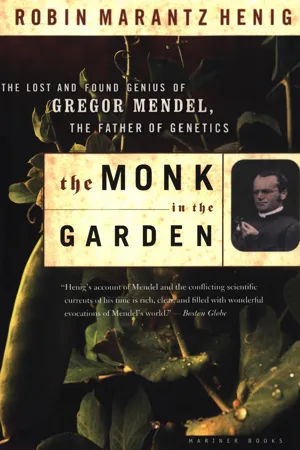
eBook - ePub
The Monk in the Garden
The Lost and Found Genius of Gregor Mendel, the Father of Genetics
- 308 pages
- English
- ePUB (mobile friendly)
- Available on iOS & Android
eBook - ePub
The Monk in the Garden
The Lost and Found Genius of Gregor Mendel, the Father of Genetics
About this book
Information
Index
A | B | C | D | E | F | G | H | I | J | K | L | M | N | O | P | Q | R | S | T | U | V | W | X | Y | Z
A
A:2Aa:a ratio, 91
AABB hybrid, 128
AaBb hybrid, 127–28, 129
aAbB hybrid, 129
aAbb hybrid, 129
aabb hybrid, 129
Aa hybrid, 86–87
acquired traits, inheritance of, 115–16
Agricultural Society, Brünn, 22–23
alleles, 230
allelomorph, 230, 238
Alt, Antonin, 135
Amsterdam Botanical Institute, 183
ancestral inheritance, law of, 114
animal experimentation, 203
Anlage, Correns’s use of term, 191
anthers, 71–72
apomixis, 159
Aristotle, 96
artificial selection, 109; natural selection and, 210–11
atavism, 204
Augustine, St., 30
Augustinians, 13, 23, 30
Auspitz, Josef, 121, 136
B
backcross, 83, 127–29; recessive, 128–29; double-recessive, 128–29, 191, 274
Balanoglossus, 206, 207
Balfour, Francis Maitland, 208
Barina, Franciscus Salesius, 250
barnacles, Charles Darwin and, 111
Bateson, Beatrice Durham, 199–200, 209–10, 278, 280; marriage of, 211–13; as husband’s assistant, 217–19; and “Dead Book,” 219
Bateson, Gregor, 214
Bateson, John, 213
Bateson, Martin, 213
Bateson, William, 1–4, 5, 7, 186–88, 194–98, 199–233, 236–40, 245–49, 259, 279–80; discovers Mendel’s article, 1–2, 195, 196; and rediscovery of Mendel, 1–4, 5, 7, 186–88, 194–98; travels to Brünn, 3–4; coins term “genetics,” 4, 226–27, 239, 250; and Hugo De Vries, 186, 187–88, 194–95, 197–98, 217, 228; and discontinuous variation, 186–87; critique of biometricians, 196, 200–204, 220, 229; Mendel’s Principles of Heredity: A Defence, 196; presidential address to British Association for Advancement of Science, 200–202, 219–20, 29; and W. F. R. Weldon, 203, 204, 205–11, 221–24, 225–26; Materials for the Study of Variation, 209; marriage of, 211–13; at Merton House, 213–14; and R. C. Punnett, 214–16; assistants of, 216–19; and Hurst’s research data, 221–24; advocacy of genetics as field, 227–30; at International Conferences on Hybridization and Plant Breeding, 228–29; and terminology for genetics, 229–30, 239; modification of Mendel’s terminology, 230; lectures in the United States, 231–32; and Thomas Hunt Morgan, 231–33, 237–38; and chromosome theory,...
Table of contents
- Title Page
- Contents
- Copyright
- Dedication
- Epigraph
- Prologue: Spring 1900
- Act One
- In the Glasshouse
- Southern Exposure
- Between Science and God
- Breakdown in Vienna
- Back to the Garden
- Crossings
- First Harvest
- Eves Homunculus
- The Flowering of Darwinism
- Garden Reflections
- Full Moon in February
- Interlude
- The Silence
- “My Time Will Come”
- Act Two
- Synchronicity
- Mendel Redux
- The Monk’s Bulldog
- A Death in Oxford
- Inventing Mendelism
- A Statue in Mendelplatz
- Epilogue: Another Spring
- Acknowledgments
- Notes and Selected Readings
- Index
- About the Author
- Connect with HMH
Trusted by 375,005 students
Access to over 1.5 million titles for a fair monthly price.
Study more efficiently using our study tools.
Frequently asked questions
Yes, you can cancel anytime from the Subscription tab in your account settings on the Perlego website. Your subscription will stay active until the end of your current billing period. Learn how to cancel your subscription
No, books cannot be downloaded as external files, such as PDFs, for use outside of Perlego. However, you can download books within the Perlego app for offline reading on mobile or tablet. Learn how to download books offline
Perlego offers two plans: Essential and Complete
- Essential is ideal for learners and professionals who enjoy exploring a wide range of subjects. Access the Essential Library with 800,000+ trusted titles and best-sellers across business, personal growth, and the humanities. Includes unlimited reading time and Standard Read Aloud voice.
- Complete: Perfect for advanced learners and researchers needing full, unrestricted access. Unlock 1.5M+ books across hundreds of subjects, including academic and specialized titles. The Complete Plan also includes advanced features like Premium Read Aloud and Research Assistant.
We are an online textbook subscription service, where you can get access to an entire online library for less than the price of a single book per month. With over 1.5 million books across 990+ topics, we’ve got you covered! Learn about our mission
Look out for the read-aloud symbol on your next book to see if you can listen to it. The read-aloud tool reads text aloud for you, highlighting the text as it is being read. You can pause it, speed it up and slow it down. Learn more about Read Aloud
Yes! You can use the Perlego app on both iOS and Android devices to read anytime, anywhere — even offline. Perfect for commutes or when you’re on the go.
Please note we cannot support devices running on iOS 13 and Android 7 or earlier. Learn more about using the app
Please note we cannot support devices running on iOS 13 and Android 7 or earlier. Learn more about using the app
Yes, you can access The Monk in the Garden by Robin Marantz Henig in PDF and/or ePUB format, as well as other popular books in Technology & Engineering & Science & Technology Biographies. We have over 1.5 million books available in our catalogue for you to explore.