The Ruffhouse Records founder tells how he overcame poverty, abuse, and addiction to start a label that launched some of music's biggest stars: "Gripping."—
Philadelphia Magazine
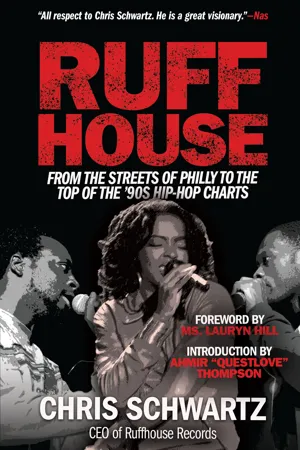
As a struggling musician trying to catch a break in 1980s Philadelphia, Chris Schwartz navigated the crime-infested, morally bankrupt music industry to found and build one of the most successful hip-hop record labels in the world. That label was Ruffhouse, which launched the careers of Nas, The Fugees, Cypress Hill, and others, dominating the charts and generating global revenues of over a billion dollars.
Schwartz and his partner, Joe Nicolo, built Ruffhouse from one desk and a phone to one of hip-hop's most revered record companies while simultaneously struggling with drug addiction and alcoholism. A story of money, greed, envy, betrayal, violence, addiction, loss, and redemption, not to mention a whole lot of music,
Ruffhouse reveals the inside story of the record companies, recording studios, tour buses, private jets, mansions, radio stations, and concert halls at the height of hip-hop's 1990s heyday while also uncovering the darker side of the business, from police stations to rehab clinics, courtrooms to prisons. Told in Schwartz's own candid, searing prose,
Ruffhouse is a portrayal of hip-hop culture at its tipping point, as it transitioned from urban curiosity to global phenomenon.
"[A] story of adversity and perseverance…Fans of these artists will love the insider information on the recording process and the trials and tribulations of getting this music out into the world."?
Library Journal
"All respect to Chris Schwartz. He is a great visionary."—Nas
eBook - ePub
Ruffhouse
From the Streets of Philly to the Top of the '90s Hip-Hop Charts
- 224 pages
- English
- ePUB (mobile friendly)
- Available on iOS & Android
eBook - ePub
About this book
Information
Subtopic
Music BiographiesCHAPTER TWELVE
AFTER
THE GOLD
RUSH
The Miseducation of Lauryn Hill was released in August of 1998 and was the first album by a female to enter the Billboard chart at the number one position. It sold close to half a million copies over the counter in the first week. The biggest challenge was the onslaught of press, which was ravenous. We went to London and did a massive press conference, as well as select interviews with some of the more important magazines and television shows. At this point Ms. Hill was pregnant with her second child, making this trip especially arduous. The reception of the album among the fans was something beyond anything I had yet to experience. The throngs of kids who fawned over Kris Kross during their massive tours and appearances were one thing, but this was a whole new level. What struck me was how this record seemed to touch every generation.
I jumped into a cab in London, and the track “Doo Wop” was playing on the stereo. I assumed it was the radio, which was no real surprise as radio in London was very pop, and the stations played everything. They did not have multiformat programming at the time in England. The stations played the current hit songs, no matter what genre. You could hear a Fugees song followed by an Oasis song, and so forth. There was no black radio format. However, there were influential DJs who had their own playlists. The cab driver was in his mid-sixties, and when “Doo Wop” ended and “Superstar” played, I realized he was listening to a CD. I asked him about it, and he said he had just bought it and had been listening to it nonstop. He also had The Score and The Carnival CDs, which he bought after he purchased the Mis-Ed CD. He said these were the only hip-hop CDs he owned and the rest of his music collection was rock and jazz.
Ms. Hill was on the cover of Time magazine as the figurehead for an article about how big hip-hop had become and how it was considered to be its own defined genre, along with rock, country, classical, R&B, and jazz. At that moment, Ruffhouse was considered one of the top purveyors of this newly recognized phenomenon.
There was also something else happening at the time for Ruffhouse that was significant: The company’s contractual agreement with Sony was coming to an end.
I had a great relationship with Donnie Ienner at Sony, but I was not so sure about Tommy Mottola. Ms. Hill was scheduled to go to Japan, where she was scheduled to perform at a special event for the heads of Sony Corporation. I was scheduled to go with her. After this event was planned, I received a phone call from Tommy’s office saying that Tommy wanted me to come up for a meeting with him and Danny DeVito about a Jersey Films project. The date for the meeting was on the same day as Ms. Hill’s scheduled performance in Japan for Sony. I told Tommy’s assistant I was going to Japan with Ms. Hill. Tommy’s assistant went on to tell me how important this meeting was and how Tommy really wanted me to be there. So, I acquiesced and canceled my trip to Japan. Months earlier, after I did a TV interview on CNBC about the hip-hop business, I received a strange phone call from an executive at Columbia Records.
This executive went on to tell me how I was endangering my relationship with Tommy by doing press. I knew this executive, and while he talked to me, I thought his whole demeanor was very uncharacteristic. I suspected he was sitting in front of Tommy because he said things like, “Tommy should be the one talking to the press.” When I told Kevon Glickman about my scheduled meeting with Danny DeVito and Tommy and how I had to cancel my trip to Japan, Kevon responded with an exasperated chuckle. I did not get it.
“I will bet you a hundred bucks the meeting gets canceled after Ms. Hill’s plane takes off,” Kevon said. I did not want to believe this, but, low and behold, the day after the scheduled departure for Japan and the night before the scheduled meeting with Tommy and Danny DeVito, Tommy’s office called and canceled the meeting.
“Danny had to do some reshoots on a production and needs to reschedule.”
The entire thing could be interpreted as somebody did not want me going to Japan and talking to the press, but I will never know for sure.
Up to this point, all of my dealings with Sony were with Donnie, and I was very happy with the partnership. But at this point I thought it was going to be difficult to move ahead with Joey. I think he just wanted to be in the studio and did not want the responsibility of managing a label.
The simple truth was that I would have traded places with Joe any day of the week. To be able to come in, make records for other companies, and get paid as a co-owner of one of the biggest hip-hop labels in the world? Who would not want that gig? I did not begrudge him in the least. There was not anything said between us, but a few times he said things to other people that I found actually very hurtful. A lot of it centered around press.
Ruffhouse was a real player in this game, and the press wanted to talk about it. I did not solicit this. I was at Sony one day when I got a call saying one of the senior editors of Vibe magazine wanted to meet with me. We set up a time to meet at Nobu for drinks. I called my publicist to meet me there. The restaurant was surrounded by limousines and Lincoln Navigators. I went in and met the editor. We sat down, and within five minutes, he was showing off a diamond wrist bracelet given to him by either Andre Harrell or Puffy. This led to the mention of other gifts from label heads, mainly very expensive jewelry. The implication was not so subtle to be lost on me. If I wanted coverage in Vibe, I needed to drop some coin at Harry Winston. I thought it was completely absurd. We went upstairs, and within a few minutes, I found myself in a very animated conversation with future president Donald Trump.
Donald was apparently friends with a lot of the big hip-hop artists and went on to tell me that he was also very good friends with Russell Simmons. I found him to be a very amicable guy. He congratulated me repeatedly on the success of the company. I was called on the phone the next morning saying my encounter with Trump was mentioned in the New York Daily News. I did not solicit that moment.
The press I received only fueled speculation about the future of the label. I had a meeting with Donnie who proposed I take over RED distribution and become a Sony executive. I was initially excited about this and even started to think about getting a house in Connecticut or moving into NYC as Myrna and I did not have children. The idea was intriguing in that I would run one of the biggest independent distributors, and I would report directly to Donnie.
Not surprisingly, Tommy nixed the idea, as I think he did not want to see Donnie getting any more powerful than he was. But there was also a forthcoming event that would change everything.
The Mis-Ed album was nominated for a staggering ten Grammy Awards, which was the most amount of nominations for a female artist in the history of the Grammys. Popular music culture had Lauryn Hill on the brain, and there was no stopping it. I would be lying if I said I was not going to use this situation to raise the stakes. The Grammys were being held in L.A. I booked the L’Eermitage in Beverly Hills, where I had been staying as of late. As it turned out, Ms. Hill and her family were also staying there, so it worked out quite nicely. And Kevon had set up some meetings while we were out there. I had a number of major labels interested in bringing me over to create a new company.
We went to EMI chairman Ken Berry’s house to meet with him about coming over to EMI. I was interested at the time, but I also wanted to hear what two other companies had to say. Paul Schindler from the Grubman firm had set up a meeting with David Geffen. David had set up a new company with Steven Spielberg and Jeffrey Katzenberg, called DreamWorks. It was a new major motion picture studio with an adjoining record company. The record company was run by Mo Ostin, another industry legend who had started with Reprise Records and gone on to head Warner Brothers Records.
I first had a meeting with David Geffen at his house in Beverly Hills. I drove a rental car to the address, which I found painted on the curb in front of a long line of hedgerow. But there was no driveway, just the address numbers painted on the curb like they do in L.A. I sat in the car, and after about three minutes, the hedgerow opened up, revealing a guardhouse. An attendant approached the car wearing a windbreaker and a Desert Eagle handgun. (This was not long after the assassination of Gianni Versace, so it was understandable.) The house was formerly the estate of Jack Warner, and David’s purchase of it was at the time the largest private purchase of a home in U.S. history. I drove up an approach road that went for at least a mile into the courtyard of a beautiful mansion. I had lunch with David, and he took me on a tour of the house, showing me his art collection, which I was later told was worth three hundred million dollars.
After a short tour of the grounds outside, David walked me to my car, and ...
Table of contents
- Cover Page
- RUFFHOUSE
- Copyright
- Dedication
- Contents
- Foreword
- Introduction
- Prologue
- ONE Fractured Fairy Tales
- TWO Haze Gray and Underway
- THREE 1618 N. Broad Street
- FOUR Gucci Time
- FIVE The Big Red Machine
- SIX Hand on the Pump
- SEVEN Tricks of the Shade
- EIGHT Fu-Gee-La
- NINE Ready or Not
- TEN Gone Til November
- ELEVEN 1998: Bath, England
- TWELVE After the Gold Rush
- Acknowledgments
- About the Author
Trusted by 375,005 students
Access to over 1.5 million titles for a fair monthly price.
Study more efficiently using our study tools.
Frequently asked questions
Yes, you can cancel anytime from the Subscription tab in your account settings on the Perlego website. Your subscription will stay active until the end of your current billing period. Learn how to cancel your subscription
No, books cannot be downloaded as external files, such as PDFs, for use outside of Perlego. However, you can download books within the Perlego app for offline reading on mobile or tablet. Learn how to download books offline
Perlego offers two plans: Essential and Complete
- Essential is ideal for learners and professionals who enjoy exploring a wide range of subjects. Access the Essential Library with 800,000+ trusted titles and best-sellers across business, personal growth, and the humanities. Includes unlimited reading time and Standard Read Aloud voice.
- Complete: Perfect for advanced learners and researchers needing full, unrestricted access. Unlock 1.5M+ books across hundreds of subjects, including academic and specialized titles. The Complete Plan also includes advanced features like Premium Read Aloud and Research Assistant.
We are an online textbook subscription service, where you can get access to an entire online library for less than the price of a single book per month. With over 1.5 million books across 990+ topics, we’ve got you covered! Learn about our mission
Look out for the read-aloud symbol on your next book to see if you can listen to it. The read-aloud tool reads text aloud for you, highlighting the text as it is being read. You can pause it, speed it up and slow it down. Learn more about Read Aloud
Yes! You can use the Perlego app on both iOS and Android devices to read anytime, anywhere — even offline. Perfect for commutes or when you’re on the go.
Please note we cannot support devices running on iOS 13 and Android 7 or earlier. Learn more about using the app
Please note we cannot support devices running on iOS 13 and Android 7 or earlier. Learn more about using the app
Yes, you can access Ruffhouse by Chris Schwartz in PDF and/or ePUB format, as well as other popular books in Media & Performing Arts & Music Biographies. We have over 1.5 million books available in our catalogue for you to explore.