"A richly detailed and critically penetrating overview . . . from the plucky adventures of Captain Video to the postmodern paradoxes of
The X-Files and
Lost." —Rob Latham, coeditor of
Science Fiction Studies
Exploring such hits as
The Twilight Zone,
Star Trek,
Battlestar Galactica, and
Lost, among others,
The Essential Science Fiction Television Reader illuminates the history, narrative approaches, and themes of the genre. The book discusses science fiction television from its early years, when shows attempted to recreate the allure of science fiction cinema, to its current status as a sophisticated genre with a popularity all its own. J. P. Telotte has assembled a wide-ranging volume rich in theoretical scholarship yet fully accessible to science fiction fans. The book supplies readers with valuable historical context, analyses of essential science fiction series, and an understanding of the key issues in science fiction television.
- 368 pages
- English
- ePUB (mobile friendly)
- Available on iOS & Android
eBook - ePub
The Essential Science Fiction Television Reader
About this book
Information
Subtopic
TelevisionPART I
BACKGROUND
Lifting Off from the Cultural Pad
LOST IN SPACE
Television as Science Fiction Icon
Before science fiction television (SFTV) could come into being, the medium itself had to be created (both physically and imaginatively), find an audience, and establish its own identity. This historical emergence corresponds most obviously to a series of key developments that made television both a technical possibility and a potential component of the domestic environment. However, it also involves a cultural context that enabled those developments, inflected television’s early reception, and produced an incubation space for SFTV. For at its inception, television was seen not simply as one more new technology among the many others that were ushered in by the machine age, that period from the turn of the century to the beginning of World War II; it was, for many, something that seemed to have sprung forth from the pages of that newly popular genre—science fiction. Before becoming a fixture in American homes and a purveyor of its own brand of science fiction, television was itself, quite simply, an icon of science fiction, and that character inevitably conditioned both its reception and that of the texts it offered audiences.
Paul Virilio notes that, during World War II, what he terms the “vision machine” rapidly emerged as a significant, perhaps even the most important, weapon for all combatants, opening the way for the ongoing “cinematization” of the contemporary world. Yet the “new industrialization of vision” (Vision 59) that has often been linked to the emergence of television was already well under way prior to the war, with early developments during the machine age. In fact, the popular perception of television was taking shape even while the technology itself was still largely a futuristic fantasy, a science fiction. For in this period we find the popular imagination already conceptualizing television in various roles—optimistically, as a kind of ultimate communication device, but also more darkly, as a means of surveillance, a tool of deception, even a potentially deadly force. I want to examine that early conceptualization as it took shape in another component of the larger “vision machine,” our popular science fiction films. By looking at how television functions iconically in such movies—works like Metropolis (1927), The Tunnel (a.k.a. Transatlantic Tunnel, 1935), Murder by Television (1935), The Phantom Empire (1935), The Invisible Ray (1936), and S.O.S.—Tidal Wave (1939)—we can better understand both these varied perceptions and the context that was being created for the later introduction of regular broadcast television. In isolating this point at which one type of fantasy glimpses another’s arrival, we see reflected not only what Cecelia Tichi, in her study of technology in the era, describes as “the alternating attitudes” and mixed responses “of people whose culture is in rapid transition” (Shifting 29) but also signs of a deep-seated cultural resistance to the work of that emerging vision machine, and particularly to its impact on our sense of public and private space.
This particular element of the larger vision machine was certainly very much in the headlines throughout the machine age, although television was hardly ready to take its eventual place as a competitor to the cinema, much less as a generator of its own influential science fiction texts. In the late nineteenth century, conditions were in place for the fusion of two constituent technologies, photography and the telephone, and by the turn of the century the term “television” had already been coined by the Russian scientist Constantin Perskyi. The mid-1920s saw the appearance of two primary television technologies: Vladimir Zworykin and Philo Farnsworth demonstrated systems based on the cathode ray tube, and John Logie Baird exhibited his Televisor, a mechanical system based on rotating metal disks. Both systems made headlines in the late 1920s and early 1930s with a series of well-publicized firsts, mostly centered on the transmission of images over ever greater distances: broadcasting from one city to another, from one country to another, from one continent to another, and, in Baird’s case, even from England to an ocean liner in the mid-Atlantic (Moseley and Chapple 17). The BBC had begun regular broadcasts early in the decade using the Baird equipment, and German, French, and American transmissions soon followed, although few sets were available in any of these countries to receive the broadcasts. By the time of that signal machine age event, “Building the World of Tomorrow,” the 1939 New York World’s Fair, television had clearly entered the popular consciousness if not popular use. As David Gelernter notes, “TV was all over the fair” (37), featured in the Westinghouse, General Electric, Ford, RCA, and Crosley Appliance exhibits, in various demonstration kiosks that allowed fairgoers to see their own televised images, and in President Roosevelt’s opening speech, beamed by NBC from atop another machine age icon, the Empire State Building. Yet despite this showcasing of the new technology as an essential part of “the world of tomorrow,” a survey of fairgoers found fewer than one in seven “expressed an interest in buying a set in the near future” (Corn and Horrigan 27). Even after World War II, Fortune speculated that “television could conceivably turn into the biggest and costliest flop in US industrial history” (Miner 107). Apparently, many people remained reluctant to embrace this new technology, in part because of what William Boddy terms the “larger cultural ambivalence regarding [all] new communications technologies” (1).
Despite its being ballyhooed in repeated newspaper reports, showcased in national magazines like Life, and explained in specialized journals like Modern Mechanics, Television Today, and Radio and Television,1 television remained more a cultural idea than a practical appliance. Or rather, we might describe it as a series of ideas, for as Joseph Corn and Brian Horrigan suggest, in the 1920s and 1930s, “the idea of television in our future heated the popular imagination as few technologies ever have,” producing a wide spectrum of predictions that were also a bit “outlandish,” even for this highly speculative era (24). In keeping with the headlines noted above, those who tried to shape the idea of television focused mainly on its ability to revise our sense of distance and thus on one of the technology’s key characteristics: as Boddy puts it, “the technical indifference of broadcast signals to national boundaries” (4). Speaking to this spatial dimension, RCA’s David Sarnoff envisioned a future with obvious science fiction overtones, as he noted how “physical limitation” would be “swept away” by television, leaving as humanity’s only “boundaries . . . the limits of the earth itself,” thereby helping to foster a new era of global understanding (16).
On a more practical level, television’s boosters suggested that doctors would abandon home visits in favor of diagnosing patients from their offices, that the military would adopt it to watch our skies and borders to detect far-off invaders, that spouses would use it to keep track of each other, and that parents would employ it like an electronic nanny to monitor their children’s activities.2 Like most new technologies, television was the subject of great speculation, albeit speculation that typically saw it in a science fictional context, like other popular speculations of the era: rocket ships, death rays, life-prolonging machines. Only over much time would it, like many other, older icons of science fiction, become “annexed by the everyday” (173), as Gwyneth Jones nicely describes the process, and eventually settle into the role that Tichi, responding to its later pervasiveness, terms the new “electronic hearth”—a metaphor reflecting not just television’s domestication but also the shift from its early association with the conquest of distance to a new sense of intimacy.
Of course, today, many of these promises no longer seem quite as outlandish as they did then. Television has not only become ubiquitous but has come to exert an influence on our sense of space, particularly its very real potential for intrusiveness and surveillance, that has made it the subject of public debate and legislation, as well as the latest fashion in military acquisition as surveillance becomes the key component of deterrence. For better or worse, with its annexation by the everyday, television has surrendered its iconic science fictional status to become part of the common cultural landscape—and arguably the most popular purveyor of science fiction. Yet Mark Crispin Miller has suggested that this commonness disguises a lingering fantastic dimension of the technology, that in modern times television has “itself become the environment,” an electronic atmosphere from which we seem to draw life. As he offers, television’s aim is “to be everywhere: not just to clutter our surroundings, but to become them,” in fact, to become the electronic “air we breathe” (8). This notion is akin to Virilio’s description of the various technologies that have helped shape the contemporary visual regime as having delivered us to a Matrix-like world, “a realm of fictitious topology in which all the surfaces of the globe are directly present to one another.” Replacing the older sense of distance—and our amazement, even unease, at how easily we traverse it—is “the imposture of immediacy” (War 46), a situation in which our sense of real space dissolves into a new experience of mediated space, into a “cinematized” or video world that holds itself out as intimately available to us. Film and now television have not just become our primary access to the world but insinuated themselves as the very world in which we live.
We can trace out some of the steps in this gradual shift—a shift by which contemporary existence has come to seem the stuff of science fiction and the genre’s icons have been normalized—in these early efforts to envision television, that is, as one component in that cinematizing process contemplates another. Certainly, even within the science fiction context, television was not always depicted as extraordinary. In fact, it was, with some prescience, often viewed as a common appliance and thus just a part of the futuristic trappings for many of these narratives. Just Imagine (1930), for example, shows it used to monitor apartment doors, enabling those inside to quite literally screen visitors. In Just Imagine, The Tunnel, and Things to Come (1936), among other films, the television is also mated to the telephone as a device for personal communication. Additionally, Things to Come shows the video screen, linked to a database of historical images, as a tool for instructing children. And, perhaps most nearly anticipating contemporary use, all of the films cited above, as well as Men Must Fight (1932) and S.O.S.—Tidal Wave, depict television as a primary purveyor of news. But such films typically present these rather commonplace applications as parts of a world still in the offing, a world that is finally not like our own, so even under domestic disguise, television remains an icon of distance,3 another semantic element of science fiction narrative.
The Tunnel, a film about technological efforts to conquer physical space, fittingly offers one of the more striking analyses of the effects built into this new medium that advertised itself as dissolving distance. The film’s protagonist, the engineer Mack McAllan, who is spearheading the construction of a transatlantic tunnel, is repeatedly shown flying back and forth across the Atlantic to resolve political problems, secure additional funding, and maintain enthusiasm for his project. And throughout these flights we see him resort to the videophone to connect to family and friends, explaining why he has, once again, missed his son’s birthday or had to cancel an engagement with his wife, or asking a friend to stand in for him with his family. The device thus becomes an ironic measure of the great personal distances and strained relationships that his work is producing. In fact, television chronicles the gradual disintegration of his marriage for us, as his wife, in London, finds she can keep track of her husband’s activities only through the news accounts of his appearances in New York society, where he is accompanied by the beautiful daughter of one of the tunnel’s key backers. Repeatedly, his wife sees these images that suggest romantic connections and assumes that the TV reports accurately measure changes in his emotional life. While both television and videophone serve as electronic versions of the narrative’s larger concern with the transatlantic tunnel as a device for linking people over vast distances, they also inject a heavy irony into those technological efforts, suggesting how much of human relationships, of our most private connections, might become lost in space despite television’s promises of telepresence and electronic intimacy.
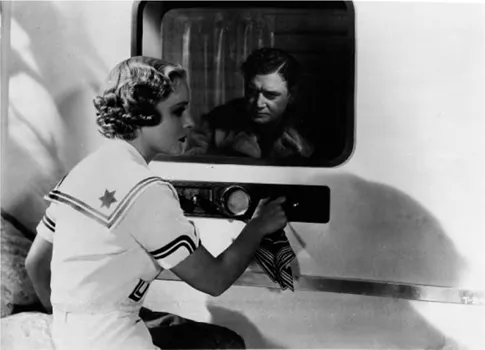
In The Tunnel (1935), the television measures out personal and emotional distance.
Another and perhaps more immediately unsettling version of that effect shows up in the more frequent depiction of television as a component in a panopticon culture. Joh Frederson, the master of Metropolis’s dystopian city, can readily summon the workers’ foreman or watch as he hurries about his tasks by dialing him in on the monitor in his office overlooking the city. However, that monitor simply underscores the point made by Frederson’s lofty positioning and the quickness with which he fires his assistant Josephat for not properly surveilling the workers’ activities: that both his control and the workers’ subjection are tied to his technological ability to see everywhere and everything. And his own failure to empathize with the workers, his own intellectual and emotional distance from them, is again ironically measured by his very intrusive surveillance. The point is, of course, also made comically in Chaplin’s Modern Times (1936), wherein we see the modern factory monitored at all key points by the factory president, who can suddenly appear on a television screen even in the restroom, admonishing the Little Tramp to “get back to work.” In this case the television is simply presented as a logical extension of the modern factory system, serving to ensure the efficient operation of the assembly line by governing it—and the workers, who become components of the line—from a distance. But the possibility of television’s intruding a distant eye into our most intimate spaces, of turning its voyeuristic potential back on the viewer, was certainly one of the most common concerns that clustered around this icon.
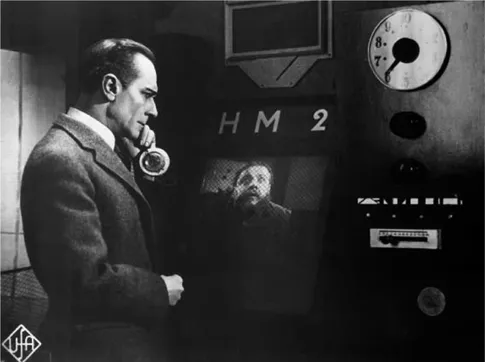
The master of Metropolis sends orders to his foreman via television in Metropolis (1927).
This surveillance mode is a particularly common element of the period’s serials, as we see in works like The Phantom Empire, Undersea Kingdom (1936), Buck Rogers (1939), and The Phantom Creeps (1939). The Phantom Empire is perhaps the...
Table of contents
- Cover
- Title
- Copyright
- Contents
- Acknowledgments
- Introduction: The Trajectory of Science Fiction Television
- Part I. Background: Lifting Off from the Cultural Pad
- Part II. The Shape of the Ship: Narrative Vehicles and Science Fiction
- Part III. What Fuels These Flights: Some Key Concerns of Science Fiction Television
- Part IV. The Best Sights “Out there”: Key Series
- Part V. The Landing Zone: Where Does Science Fiction Television Go from Here?
- Further Reading
- Selected Videography
- List of Contributors
- Index
Trusted by 375,005 students
Access to over 1.5 million titles for a fair monthly price.
Study more efficiently using our study tools.
Frequently asked questions
Yes, you can cancel anytime from the Subscription tab in your account settings on the Perlego website. Your subscription will stay active until the end of your current billing period. Learn how to cancel your subscription
No, books cannot be downloaded as external files, such as PDFs, for use outside of Perlego. However, you can download books within the Perlego app for offline reading on mobile or tablet. Learn how to download books offline
Perlego offers two plans: Essential and Complete
- Essential is ideal for learners and professionals who enjoy exploring a wide range of subjects. Access the Essential Library with 800,000+ trusted titles and best-sellers across business, personal growth, and the humanities. Includes unlimited reading time and Standard Read Aloud voice.
- Complete: Perfect for advanced learners and researchers needing full, unrestricted access. Unlock 1.5M+ books across hundreds of subjects, including academic and specialized titles. The Complete Plan also includes advanced features like Premium Read Aloud and Research Assistant.
We are an online textbook subscription service, where you can get access to an entire online library for less than the price of a single book per month. With over 1.5 million books across 990+ topics, we’ve got you covered! Learn about our mission
Look out for the read-aloud symbol on your next book to see if you can listen to it. The read-aloud tool reads text aloud for you, highlighting the text as it is being read. You can pause it, speed it up and slow it down. Learn more about Read Aloud
Yes! You can use the Perlego app on both iOS and Android devices to read anytime, anywhere — even offline. Perfect for commutes or when you’re on the go.
Please note we cannot support devices running on iOS 13 and Android 7 or earlier. Learn more about using the app
Please note we cannot support devices running on iOS 13 and Android 7 or earlier. Learn more about using the app
Yes, you can access The Essential Science Fiction Television Reader by J.P. Telotte in PDF and/or ePUB format, as well as other popular books in Media & Performing Arts & Television. We have over 1.5 million books available in our catalogue for you to explore.