"Excellent essays" on a business empire, a cultural phenomenon, and the nature of the extraordinary bond between Oprah Winfrey and her fans (
Journal of Social History).
Oprah Winfrey has built an empire on her ability to connect with and inspire her audience. No longer just a name, "Oprah" has become a brand representing a unique style of self-actualizing individualism. The cultural and economic power wielded by Winfrey merits critical evaluation.
The contributors to
The Oprah Phenomenon examine the origins of her public image and its substantial influence on politics, entertainment, and popular opinion. Contributors address praise from her supporters and weigh criticisms from her detractors. Winfrey's ability to create a feeling of intimacy with her audience has long been cited as a foundation of her popularity. She has made headlines by engaging and informing her audience with respect to her personal relationships to race, gender, feminism, and New Age culture.
The Oprah Phenomenon explores these relationships in detail. At the root of Winfrey's message is her assertion that anyone can be a success regardless of background or upbringing. The contributors scrutinize this message: What does this success entail? Is the motivation behind self-actualization, in fact, merely the hope of replicating Winfrey's purchasing power? Is it just a prescription to buy the products she recommends and heed the advice of people she admires, or is it a lifestyle change of meaningful spiritual benefit?
The Oprah Phenomenon asks these and many other difficult questions to promote a greater understanding of Winfrey's influence on the American consciousness.
"Identifies the common threads that run through Oprah's empire, the demographics of her audience, how she brings together women of diverse backgrounds, and her use of empathy and encouragement to foster self-improvement." ?
Library Journal
With a foreword by Robert J. Thompson
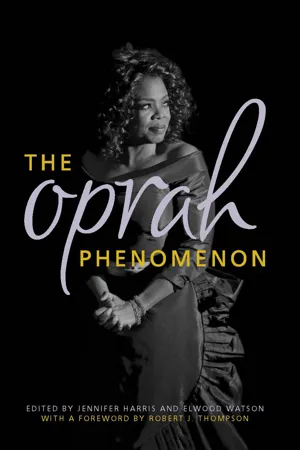
- 295 pages
- English
- ePUB (mobile friendly)
- Available on iOS & Android
eBook - ePub
The Oprah Phenomenon
About this book
Information
Topic
Scienze socialiSubtopic
Scienze della comunicazionePart I
Oprah Winfrey and Race
The Specter of Oprah Winfrey
Critical Black Female Spectatorship
Tarshia L. Stanley
Theorists of black visual spectatorship have long considered the spectacular modes of observation practiced by African Americans with regard to popular representations of themselves. Whether black people’s engagement with their imagery has been acquiescent or resistant, reconstructive or revisionary, critics agree that black people are experts at looking for themselves and at themselves in visual media. In the case of Oprah Winfrey—talk-show host, actress, producer, bibliophile, and businesswoman—critical black spectators have either absented themselves from serious critiques of her iconographic presence and function or dismissed her presence as one constructed for white audiences. This essay examines the provocative position from which critical black female spectators see the icon of Oprah Winfrey and is informed by the theories of bell hooks and Deborah Willis. It explores the ambivalence inherent in a “looking relationship” that identifies Winfrey as the most successful black businesswoman while combating a peripheral suspicion that she may be, among other things, fodder for a white cultural imagination adept at swilling the physical and visual bodies of black women.1Key to this consideration is the way the iconography of Oprah Winfrey intersects with historically powerful and racially laden controlling images—most notably, those that relate to black maternity and mothering and the emotional labor of black women.
In Reel to Real: Race, Sex, and Class at the Movies, cultural critic extraordinaire bell hooks contends that black women in particular have had to engage in complex self-reflective looking relationships. She describes the historical looking relationships that black women developed with regard to the racist and sexist images presented to them in Hollywood race films. As hooks notes, although most black women were (and are) aware of the racist constructions inherent in screen imagery, that awareness did not translate into active engagement in a critique positioned beyond race and encompassing issues of sex, sexuality, or class. Yet there are many black women whose spectatorial analyses are quite complex, even if they do not couch them in academic language.
In fact, hooks explains that many black women engage in looking relationships so complex that “alternative texts” are formed on screen. She writes, “We do more than resist … black women participate in a broad range of looking relations, contest, resist, revision, interrogate, and invent on multiple levels.”2 Consequently, critical black female spectatorship often comprehends the historical, patriarchal, cultural, commercial, racial, sexual, and gendered reproductions of their own imagery. What is fascinating about hooks’s critique is that her multipositioning of the black woman’s sight can be perceived as a strength rather than a fragmentation. Critical black female spectatorship is a conscious creativity that can be co-opted as a weapon of both deconstruction and revision and allows a black woman to read well beyond the composition on the screen.
This ability to read (see) the presentation of the body she occupied was one of the survival skills passed on from black woman to black woman in this society. African American women had to be adept at perceiving how others viewed them and their surroundings in lightning-quick montages. For many years, the black woman’s existence and safety in certain situations were dependent on her ability to know how she would be interpreted—that is, as wife, mother, sister, maid, bitch, or whore. Although some of the categories made her less available within a tradition of coercion and rape, some made her more so. Yet, no matter how sophisticated her interpretive skills, a black woman in this society was unsafe.
In the Beginning Was the Image
Since the inception of mass media, black female imagery has been used to maintain the status quo and fuel the capitalist machine. Deborah Willis writes in Picturing Us: African American Identity in Photography that the first images of black women in mass distribution were of black female bodies either naked or at work. The images of black women at work often showed them caring for white children or reprimanding their own. Willis highlights a set of lantern slides called “Trouble Ahead, Trouble Behind.” These slides, which were circulated in the 1880s, depict a black woman dressed in what looks to be faded calico; the trappings of ultrapoor working-class blackness surround her. There are two children: one asleep, the other drawing on the wall. The boy has written the word “mamy” as a title for his picture. In the next slide the mother spanks the child, and we understand the caption “Trouble Behind” in its full context. Willis reports that these images, called “Black Americana … were produced for the amusement of a white audience” and “now exist as frozen racial metaphors from a time when images of African Americans were rarely produced by or for African Americans.”3
Although it is understood that such imagery—a black mother whipping her child and the child’s depiction of his mother as a mammy—is fraught with derisive assumptions about black life, it is important to note that what hooks deems “black looks” could both resist and reconstruct this imagery. Intellectuals such as Ida B. Wells-Barnett wrote extensively about the ways that this kind of imagery reinforced stereotypes for both the white viewer and the uncritical black viewer. At the 1893 Columbia Exposition in Chicago, she passed out a tract that she had authored, titled “The Reason Why the Colored American Is Not in the World’s Columbia Exposition.”4 It is significant that while Wells-Barnett was fashioning a public discourse about representations of black people, the Davis Milling Company was inculcating the American psyche with the image of Aunt Jemima. The company paid a black cook named Nancy Green to be the living embodiment of its new pancake mix. Wholesalers were so intrigued by Green’s demonstration at the exposition that more than “50,000 merchant orders” were placed.5
Even as Wells-Barnett was practicing resistance to popular iconography, W. E. B. DuBois’s looking relationships were focused on reconstructing black imagery, as exemplified by the American Negro Exhibit, a collage of photos depicting black life that he assembled for display at the Paris Exposition of 1900.6 DuBois conceived of the exhibit as way to directly combat the negative images of black people prevalent at the turn of the twentieth century. Thus there is a long history of black people developing intricate looking relationships that range from participation in to resistance of such pernicious imagery. This history, which includes black women’s ability to reconfigure presentations of themselves, has never been simple and uncomplicated. And regardless of how practiced the critical black female spectator was, the ability to negotiate manifestations of her imagery became increasingly convoluted in the last decades of the twentieth century.
In the late twentieth century, the advent of multiple cable channels, the capacity to record television programs and rent videos, the ability to access the Internet, and the production of music television represented significant possibilities for black women’s looking relationships. Images that were previously inaccessible to the average viewing audience became more easily available. Yet, as history demonstrates, an increase in media genres or productions does not necessarily translate into an improvement in the representation of African Americans. Purposeful strides made during the 1950s and 1960s to create multidimensional, if distinctly middle-class, media images of black women gave way first to caricatures of the blaxploitation era and then to the almost complete erasure of black female imagery in film and television in the mid-to late 1970s (with the exception of a few television situation comedies). The response by African Americans to the creation of The Cosby Show in the early 1980s was further evidence of how concerned black people were with combating stereotypical depictions of themselves on screen.
When The Oprah Winfrey Show became nationally syndicated in 1986, black female iconography entered a decidedly new stage. In the ensuing two decades, Oprah Winfrey has become a billion-dollar corporation. From Oprah’s Book Club, which is credited with increasing recreational reading in America, to co-ownership in the Oxygen Network and the creation of O magazine, Winfrey demonstrates her multimedia power. It would seem that the multidimensional representation of black womanhood that countless nameless black women had been waiting for had finally arrived in the body and enterprises of Oprah Winfrey. Yet, for the critical black female spectator adept in self-assessment—or, rather, at assessing the self that has often been re-created for her by others—there is tension when looking at Oprah Winfrey.
The question that asserts itself is: To what degree is Winfrey understood as African American by a white viewing audience? And to what degree is she representative for a black one? In the essay “Black Bodies/ American Commodities,” Robyn Wiegman notes that the presentations of the black mother and daughter in the first of the Lethal Weapon films (1987) were not liberating or indicative of a society ready to embrace African American women as equals; rather, they were dangerously dismissive of black women’s history by foregrounding the patriarchal, racist, sexist society that routinely shut them out. Citing the use of the mother as a space for heterosexual masculinity to rework itself, and the virgin daughter (who, coincidentally, has a crush on the white hero) as a site of nonsexual, noncompetitive interaction between the black male and white male protagonists, Wiegman points out the film’s reinforcement of and aspiration to a bourgeois ideal for the black family that ignores connotative associations with blackness. She writes:
The black woman’s homogenization into categories traditionally occupied by the white woman is part of a broader program of hegemonic recuperation, a program that has as its main focus the reconstruction of white masculine power in the face of feminist and civil rights discourses of the 1960s. So strong was this recuperation in the Reagan era that even affirmative action programs were challenged for “depriving” white men of their civil right.7
Wiegman’s argument is useful for looking at Oprah Winfrey. For Wiegman, simply replacing what would have traditionally been white female characters with black female characters is problematic. In this way, Wiegman calls into question any paradigm that would ignore the racism and sexism simultaneously ingrained in the history and experience of black women. By ignoring these markers, which have shaped the way black women live their lives, the film is guilty of a “program of hegemonic recuperation … that has as its main focus the reconstruction of white masculine power.”8
We might think of Winfrey’s rise to iconic and economic power in the midst of the Reagan era as another way of negating challenges to a racist, sexist power structure. Certainly it has been suggested that part of Winfrey’s success is rooted firmly in a system of hegemonic recovery that, in the end, takes the teeth out of critiques of what hooks calls a patriarchal, white supremacist, capitalist power structure. After all, there was never a better example of the American Dream realized—minus the spouse and the 2.5 children—than Winfrey. Winfrey’s humble beginnings, her establishment of a media empire, and her penchant for philanthropy seemingly offer resolute proof of the Horatio Alger ethos. It is worth noting that Winfrey established her empire at the commencement of the information age, just as Alger’s literature launched the rhetoric of bootstraps and self-determination at the dawn of the Industrial Revolution.
Chained Memories
Oprah Winfrey is our mammy, according to Laurie L. Haag.9 The mammy is one of the oldest archetypal images of African American women. Part of the mammy icon’s usefulness to antebellum society was that she conveyed a black mothering that privileged its relationship with white children while negating the black mother’s love and commitment to her own children. This iconic figure was not meant to accurately reflect the black woman’s feelings about mothering; rather, it was generated out of a white desire for affirmation, as well as slave owners’ practical need to create surrogate mother-nurturers, both real and ideological, for their legal and out-of-wedlock children. These black women were expected and encouraged to care for their white charges not only at the expense of their own families but also at the expense of their individuality. According to Trudier Harris, the black serving woman’s role became more important than the woman herself; “she should cook, clean, take care of the children—and be invisible or self-effacing.”10 The mammy figure retains cultural currency because she represented, and continues to represent, the eradication of black maternal competency and black female autonomy, as well as the lasting effect of the exploitation of black female labor.
In addition to being a supernurturer, the mammy was best known for being disconnected from her community. Historically, mothering in the black community has been under siege. From children being taken away from their mothers and sold under slavery, to the Moynihan report in the 1960s, to the highly publicized welfare queens and crack babies of the 1980s, it seems that black women are most frequently represented as failures at mothering their own. The mammy is the quintessential example of this. In her critique of such dominant forms in American literature Harris writes, “Features inherent in the job made it necessary for the black mammy to deny her own family in order to rear generation after generation of whites who would, ironically, grow up to oppress blacks yet further.”11 This denigration of herself, her family, and her community is inherently painful for critical black readers of mammy figures. Popular literature and film have always portrayed the mammy from the dominant society’s perspective. Seen from that viewpoint, it was good and even desirable to spend one’s life in service to another’s family and another’s community without compensation or acknowledgment. However, from the viewpoint of the mammy’s natural children, the iconography further denigrated black family and community.
The language associated with the mammy serving the needs of a dominant white society resonates in the public commentary that surrounds Winfrey. And it does so in ways that black female spectators find troubling. As recently as 2003, a sociological study of audience responses to talk shows titled “Viewer Aggression and Attraction to Television Talk Shows” praised The Oprah Winfrey Show as genuine and sincere. According to the investigators—who identified Winfrey’s viewership as still largely female and middle class—“They felt comfortable with Oprah Winfrey as they would a friend and found her to be a natural, down-to-earth person.”12 For the black female spectator already harboring ambivalent feelings about Winfrey, the words “natural” and “down-to-earth” set off alarms, because this is the same language used to describe the mammy in literature, advertising, and visual media since the mid-nineteenth century. In fact, since The Oprah Winfrey Show’s inception, the fan base has described its relationship to Winfrey much as white society did to the mammy. Winfrey’s audiences saw her, at least initially, as their friend and confidant, but usually in the most one-sided terms. Winfrey’s shows were cited as informative, but they rarely made viewers feel as if they were being forced to think about inequities in society. Instead, shows were about finding oneself and one’s dream job, decorating one’s home, throwing wonderful part...
Table of contents
- Cover
- Title Page
- Copyright
- Contents
- Foreword
- Introduction
- Part I. Oprah Winfrey and Race
- Part II. Oprah Winfrey on the Stage
- Part III. Oprah Winfrey on the Page
- List of Contributors
- Index
Trusted by 375,005 students
Access to over 1.5 million titles for a fair monthly price.
Study more efficiently using our study tools.
Frequently asked questions
Yes, you can cancel anytime from the Subscription tab in your account settings on the Perlego website. Your subscription will stay active until the end of your current billing period. Learn how to cancel your subscription
No, books cannot be downloaded as external files, such as PDFs, for use outside of Perlego. However, you can download books within the Perlego app for offline reading on mobile or tablet. Learn how to download books offline
Perlego offers two plans: Essential and Complete
- Essential is ideal for learners and professionals who enjoy exploring a wide range of subjects. Access the Essential Library with 800,000+ trusted titles and best-sellers across business, personal growth, and the humanities. Includes unlimited reading time and Standard Read Aloud voice.
- Complete: Perfect for advanced learners and researchers needing full, unrestricted access. Unlock 1.5M+ books across hundreds of subjects, including academic and specialized titles. The Complete Plan also includes advanced features like Premium Read Aloud and Research Assistant.
We are an online textbook subscription service, where you can get access to an entire online library for less than the price of a single book per month. With over 1.5 million books across 990+ topics, we’ve got you covered! Learn about our mission
Look out for the read-aloud symbol on your next book to see if you can listen to it. The read-aloud tool reads text aloud for you, highlighting the text as it is being read. You can pause it, speed it up and slow it down. Learn more about Read Aloud
Yes! You can use the Perlego app on both iOS and Android devices to read anytime, anywhere — even offline. Perfect for commutes or when you’re on the go.
Please note we cannot support devices running on iOS 13 and Android 7 or earlier. Learn more about using the app
Please note we cannot support devices running on iOS 13 and Android 7 or earlier. Learn more about using the app
Yes, you can access The Oprah Phenomenon by Jennifer Harris, Elwood Watson, Jennifer Harris,Elwood Watson in PDF and/or ePUB format, as well as other popular books in Scienze sociali & Scienze della comunicazione. We have over 1.5 million books available in our catalogue for you to explore.