"This lively collection of essays on the ideas underpinning his films enriches and enlarges our understanding of Spielberg's complex body of work." —Joseph McBride, author of
Steven Spielberg: A Biography
Few directors have had as powerful an influence on the film industry and the movie-going public as Steven Spielberg. Whatever the subject—dinosaurs, war, extra-terrestrials, slavery, the Holocaust, or terrorism—one clear and consistent touchstone is present in all of Spielberg's films: an interest in the human condition. In movies ranging from
Jaws to
Schindler's List to
Amistad to
Jurassic Park, he has brought to life some of the most popular heroes—and most despised villains—of all time.
In
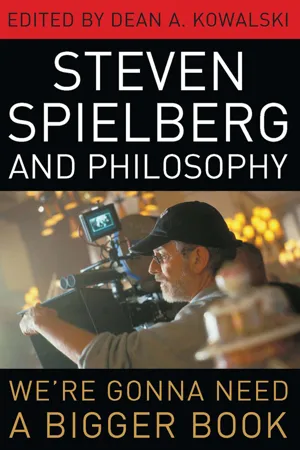
Steven Spielberg and Philosophy, Dean A. Kowalski and some of the nation's most respected philosophers investigate Spielberg's art to illuminate the nature of humanity. The book explores rich themes such as cinematic realism, fictional belief, terrorism, family ethics, consciousness, virtue and moral character, human rights, and religion in Spielberg's work. Avid moviegoers and deep thinkers will discover plenty to enjoy in this collection.
- 288 pages
- English
- ePUB (mobile friendly)
- Available on iOS & Android
eBook - ePub
About this book
Information
Topic
PhilosophySubtopic
Film & VideoPart I
Philosophy, the Filmmaker, and the Human Condition
The “Big-Little” Film and Philosophy
Two Takes on Spielbergian Innocence
Gary Arms and Thomas Riley
Film—at least good film—can be assessed in a myriad of ways. In this essay we attempt to help the reader better understand and appreciate Steven Spielberg’s choices as a filmmaker. Part I conveys pertinent literary and psychological insights, and part II offers relevant philosophical assessments. Through this combination, we intend to offer the reader an enriched conception of what Spielberg’s movies have in common and how one goes about mining their surprising philosophical depths.
Part I
Steven Spielberg’s favorite kind of film (the modern world’s favorite, too) is the melodrama, especially that variety of melodrama known as the “action film.” Melodramas portray the struggle between good and evil; the two forces violently contend, and good always wins. Spielberg’s fondness for this sort of material has often attracted criticism. As Mark Kermode remarks at the beginning of his TV documentary An Interview with Steven Spielberg, “there are those who find Spielberg showy, melodramatic and, worst of all, sentimental.”1 Lester Friedman in his book Citizen Spielberg notes that “even sympathetic commentators routinely liken the energetic director to Peter Pan or Huck Finn, lumping him with archetypal figures who refuse to grow up.”2 In the minds of some critics, the melodrama seems a low form of narrative, one designed to appeal to the childish. The melodrama seems juvenile and artificial when compared to realism or tragedy.
Spielberg is America’s most commercially successful maker of cinematic melodramas. In his most famous films (E.T.[1982], Jurassic Park [1993], Jaws [1975]), virtuous protagonists flee from, and eventually triumph over, terrifying villains. In E.T., an alien from outer space, assisted by a brave boy, escapes from a variety of faceless adult officials (most of the time we see only their legs and flashlights). In Jaws, three men fight an enormous shark. In Jurassic Park, two children successfully escape the jaws of a T-rex and a pair of velociraptors. Asked to describe his 2005 film War of the Worlds, Spielberg told an interviewer: “It’s about a family trying to survive and stay together, and they’re surrounded by the most epically horrendous events you could possibly imagine.”3
The formula for many of Spielberg’s most famous films is innocence in great jeopardy. Normally, innocence is represented by children and their families. The parents are often separated or divorced. Spielberg’s fondness for broken families seems connected to the divorce of his own parents, which occurred when he was sixteen. In an interview with Stephen Schiff, Spielberg described his parents’ marriage as never a very happy one: “My dad was of that World War II ethic. . . . He brought home the bacon, and my mom cooked it, and we ate it. I went to my dad with things, but he was always analytical. I was more passionate in my approach to any question, and so we always clashed.”4 Arnold Spielberg is often described as a preoccupied, hard-working, rather distant man who caused his son to feel neglected.
Spielberg’s films are full of missing or neglectful fathers and lonely children; this sort of material often provides the emotional heart of his films. “There is nothing wrong with being sentimental,” Spielberg told interviewer Kermode. Defending his use of children and broken families, he stated: “Without these more personal emotional subconscious themes, these films wouldn’t be as successful with audiences.”5 For Spielberg, the intact, loving family is a primary value; the story that his films often tell is that of the endangered broken family, the family that must struggle to survive terrifying peril. The happy ending at the conclusion of many of his films occurs when the enemy of the family is destroyed and the family returns to health.
As Spielberg’s comment implies, there is a sound commercial reason that so many of his films focus on broken families and children. Films are extremely expensive to make. A modern action film will cost anywhere between $100 million and $200 million. According to the Internet Movie Database (www.imdb.com), Spielberg’s War of the Worlds cost $132 million. Peter Jackson’s King Kong (2005) cost more than $200 million. Films this expensive are risky to finance and must be aimed at the widest possible audience. It helps if they focus on children. They should either have children in central roles, as with the Harry Potter films (2001, 2002, 2004, 2005, 2007), or tell melodramatic adventure stories designed to appeal to young people, like the X-Men series (2000, 2003, 2006) or the Lord of the Rings trilogy (2001, 2002, 2003). This strategy makes commercial sense because spectacle-oriented melodramas that focus on young people can be appreciated by adults and children. Most modern adults proudly retain a remnant of their child self, their inner child. The reverse is not true of children. What child contains an inner adult? Most children, if forced to watch a film for “grown-ups” (e.g., Munich [2005], Crash [2004]) will soon grow bored. For this reason, an exciting film aimed at young people potentially will gain a much larger audience than a film with a complicated adult problem at its center. There is a way, however, to combine realistic family problems with sensational and fantastic material, to combine the emotional upheavals experienced by the members of a broken family with the thrills of melodrama. Spielberg is the master of this mixture.
Filmmakers often refer to films that focus only on realistic emotional and social problems as “little films.” Such films (e.g., Little Miss Sunshine [2006]) feature the acting and writing and have few special effects; they are made with relatively low budgets. Action films with huge budgets, full of special effects, explosions, and monsters, are called “big films.” Talking about Spielberg’s War of the Worlds, its star, Tom Cruise, described the film as “the biggest, smallest movie that we’ve made.”6 Spielberg compared the film to David Lean’s Lawrence of Arabia (1962) and added, “I thought that [Lawrence] was the biggest smallest movie I’d ever seen. It has the most intimate, sensitive, personal, up-close story, and yet it was told against some of the greatest [scenes] we’d ever beheld in 70 mm.”7 Spielberg has mastered this particular art, the art of making big-budget thrillers that also contain realistic family conflict, the art of “big-little” films.
In Spielberg’s case, we may suspect that the commercially sensible focus on broken families caught up in exciting melodrama is supported by a psychological need to explore and revisit his personal trauma. At least, there seems little doubt that psychologically Spielberg remains intimately connected to the intense feelings he experienced in his adolescence, and that he has become adept at exploiting such feelings in order to make gripping films.
The topic of the broken family provides a filmmaker with enormously sympathetic material. In the United States, we often hear, something like one half of marriages end in divorce. Those of us who work with college students are highly aware that a great many of our students are the children of divorced couples. They are often affected emotionally by these divorces. Almost all of us are touched by divorce; we are divorced ourselves, or the children of divorce, or have somehow witnessed the effects of divorce at close hand. Spielberg’s remembered trauma, the divorce of his parents, is very similar to the experience of huge numbers of modern filmgoers.
ADAPTING MINORITY REPORT
In the film Minority Report (2002), the source material, the original novella by sci-fi writer Philip K. Dick, is altered in significant ways. The screenplay was written by Scott Frank and Jon Cohen, but it had to meet with Spielberg’s approval. Spielberg hesitated about making the film until he found the right script; not until then did he call his star, Tom Cruise, and tell him, “Yeah, I’ll do this version of the script.”8 There are numerous differences between the Dick novella and the screenplay, but the most noticeable is the script’s inclusion of a highly personal story about a broken family. It is this that transforms Minority Report from a typical “big” film to a trademark Spielbergian “big-little” film.
From the Dick version of the story comes the concept of Precrime (criminals are captured before they commit murder), as well as the idea of precogs (humans who are able to predict the future). Potential murderers are identified by the precogs; these “criminals” are arrested by the enforcers of Precrime and then imprisoned. In both versions of the story, the protagonist, Anderton, who works for the Precrime organization, discovers that he is suspected of a murder that has yet to happen; he must flee to save his life while struggling to learn why he is being set up. (As is typical of Hollywood adaptations, the middle-aged and out-of-shape protagonist of Dick’s story is transformed by the film into a handsome and youthful movie star [Tom Cruise].) In the Dick version of the story, Anderton has a wife who he fears is cheating on him, but there is no mention of any children. His primary motivation is to save his own life, and to save his invention, Precrime. The screenplay contains several revealing alterations.
In the film, the protagonist’s psychological profile is dominated by the fact that his beloved son Sean, a child who appears to have been no more than five years old, was kidnapped and then almost certainly abused and murdered by a human monster who was never captured. We learn that the loss of his son became Anderton’s primary professional motivation. He joined the Precrime unit in order to prevent similar murders. Anderton has become a superb professional in his role as an investigator and enforcer of Precrime, but the loss of his son remains an open wound. In his spare time, he gets high on an illegal drug known as “Clarity” and watches holograms of his lost son. He so badly needs to reconnect with the missing child that he has become addicted not only to the drug but also to these holograms. Anderton’s marriage dissolved after the kidnapping, and he seems to have nothing to live for except his job. The screenplay of Minority Report also provides the protagonist with a boss, the director of Precrime, Lamar Burgess (Max von Sydow), who ruthlessly exploits Anderton’s emotional vulnerability in order to set him up for murder. Anderton is tricked into believing he has discovered the man who kidnapped his son and, upon finding the man, fills with murderous rage. This material about the missing son provides the film’s story its emotional core. The protagonist of Spielberg’s version seems vastly more sympathetic than the protagonist of the Dick story because we witness the suffering he must endure from the loss of his beloved child. Any parent can relate to this sort of subject matter; it is every parent’s nightmare.9
While attempting to clear himself of his alleged future murder, Anderton kidnaps the precog Agatha (Samantha Morton). The film makes Agatha vastly more sympathetic than does Dick’s novella. In Dick’s story, the precogs are described as repulsive, “retarded” creatures able to do nothing but sit strapped to chairs and mumble their visions. In the film, they are described as “the innocents we now use to stop the guilty”; they float in a large, womblike pool and are cared for by an attentive babysitter who seems almost in love with Agatha. Once Anderton frees Agatha from the pool, she emerges as a genuine human being, a hypersensitive innocent afflicted with terrifying visions, exploited by the Precrime organization, and deprived of anything resembling an ordinary life. Constantly pursued by the Precrime officers (dressed very like storm troopers), the two of them flee from place to place. Although so weak she can barely stand upright, Agatha begins to talk and actually helps Anderton escape. Using her power of precognition, the fragile and innocent victim proves resourceful enough to save her rescuer.10
At the climax of the film, we learn that Agatha was taken from her mother by one of the founders of Precrime, the director Lamar Burgess. Since Agatha and the twins are the only functioning precogs in the country, Precrime could not exist without them. Although it is unclear whether or not Agatha is sister to the twins, several times we hear that Agatha is the best of the three precogs and are told the twins cannot function well in their role by themselves. Burgess, we learn, fearing he might lose control of the invaluable precogs, lured Agatha’s mother, Ann Lively, to a lake by promising her he would return her child to her; in fact he lured her there only to murder her. The mystery of the set-up is finally solved when Anderton learns that Director Burgess, the founding father of Precrime, has ruthlessly destroyed a family, murdered an innocent mother, and kidnapped a helpless child in order to protect his organization. Adding these broken or endangered families to the Dick novella provides the film version of Minority Report its emotional power and allows it to be both a “big” and a “little” film.
At the conclusion of Minority Report, Spielberg shows us his two main families restored to health. The murderous Director Burgess is dead. Precrime is shut down forever. The three precogs live in an isolated cabin far from other human beings, where they read a great many books and seem happy and content. Although Anderton failed to save his lost son from the kidnapper, he has saved Ann Lively’s innocent child, Agatha, from Director Burgess. Our last glimpse of Anderton reveals that he has reunited with his wife, and that she is eight months pregnant. We see the husband and wife in a tender embrace and feel confident that the happy family unit (father, mother, and child) will soon exist again.
ADAPTING WELLS’S WAR OF THE WORLDS
We find intriguingly similar characters in the film that Spielberg made three years after Minority Report, his adaptation of H. G. Wells’s War of the Worlds. When asked to describe the film, Spielberg told an interviewer: “It’s nothing you can really describe. The whole thi...
Table of contents
- Cover
- Title
- Copyright
- Contents
- Acknowledgments
- Introduction
- Part I: Philosophy, the Filmmaker, and the Human Condition
- Part II: Values, Virtue, and Justice
- Part III: Realism, Mind, and Metaphysics
- Appendix: Discussing Five Spielberg Films
- Contributors
- Index
Trusted by 375,005 students
Access to over 1.5 million titles for a fair monthly price.
Study more efficiently using our study tools.
Frequently asked questions
Yes, you can cancel anytime from the Subscription tab in your account settings on the Perlego website. Your subscription will stay active until the end of your current billing period. Learn how to cancel your subscription
No, books cannot be downloaded as external files, such as PDFs, for use outside of Perlego. However, you can download books within the Perlego app for offline reading on mobile or tablet. Learn how to download books offline
Perlego offers two plans: Essential and Complete
- Essential is ideal for learners and professionals who enjoy exploring a wide range of subjects. Access the Essential Library with 800,000+ trusted titles and best-sellers across business, personal growth, and the humanities. Includes unlimited reading time and Standard Read Aloud voice.
- Complete: Perfect for advanced learners and researchers needing full, unrestricted access. Unlock 1.5M+ books across hundreds of subjects, including academic and specialized titles. The Complete Plan also includes advanced features like Premium Read Aloud and Research Assistant.
We are an online textbook subscription service, where you can get access to an entire online library for less than the price of a single book per month. With over 1.5 million books across 990+ topics, we’ve got you covered! Learn about our mission
Look out for the read-aloud symbol on your next book to see if you can listen to it. The read-aloud tool reads text aloud for you, highlighting the text as it is being read. You can pause it, speed it up and slow it down. Learn more about Read Aloud
Yes! You can use the Perlego app on both iOS and Android devices to read anytime, anywhere — even offline. Perfect for commutes or when you’re on the go.
Please note we cannot support devices running on iOS 13 and Android 7 or earlier. Learn more about using the app
Please note we cannot support devices running on iOS 13 and Android 7 or earlier. Learn more about using the app
Yes, you can access Steven Spielberg and Philosophy by Dean A. Kowalski in PDF and/or ePUB format, as well as other popular books in Philosophy & Film & Video. We have over 1.5 million books available in our catalogue for you to explore.