Essays about the famed fictional detective and the mysteries of life: "Both elegantly erudite and consistently entertaining" (E. J. Wagner, Edgar Award–winning author of
The Science of Sherlock Holmes).
Sir Arthur Conan Doyle's detective has stood as a unique figure for more than a century with his reliance on logical rigor, his analytic precision, and his disregard of social mores. A true classic, the Sherlock Holmes character continues to entertain twenty-first-century audiences on the page, stage, and screen.
In
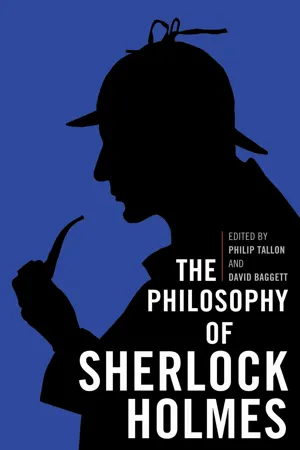
The Philosophy of Sherlock Holmes, a team of leading scholars uses the beloved character as a window into the quandaries of existence, from questions of reality to the search for knowledge. The essays explore the sleuth's role in revealing some of the world's most fundamental philosophical issues, discussing subjects such as the nature of deception, the lessons enemies can teach us, Holmes's own potential for criminality, and the detective's unique but effective style of inductive reasoning. Emphasizing the philosophical debates raised by generations of devoted fans, this intriguing volume will be of interest to philosophers and Holmes enthusiasts alike.
eBook - ePub
The Philosophy of Sherlock Holmes
- 214 pages
- English
- ePUB (mobile friendly)
- Available on iOS & Android
eBook - ePub
The Philosophy of Sherlock Holmes
About this book
Information
Topic
LetteraturaSubtopic
Critica letterariaWATSONS, ADLERS, LESTRADES, AND MORIARTIES
On the Nature of Friends and Enemies
In his Nicomachean Ethics, Aristotle praises friendship with powerful words. “For without friends no one would choose to live,” he asserts, “though he had all other goods.”1 Friendship is helpful in nearly every stage and station in life (though Aristotle does pause to mention that bitter people and the elderly have a hard time making friends). Friendship comforts, protects, and corrects, and perhaps most beneficially, Aristotle writes, “those in the prime of life it stimulates to noble actions—‘two going together’—for with friends men are more able both to think and to act.”2 Friendship can bring the best out of us.
Given the importance of friendship in Aristotle's mind, it makes sense that he would discuss it in his main treatise on ethics. It's still a bit of a surprise, however, that two out of the ten chapters in Nicomachean Ethics are devoted to friendship. For Aristotle (and others in the ancient world), friendship was a big deal. C. S. Lewis, writing in The Four Loves, notes that for the ancients “friendship seemed the happiest and most human of all the loves; the crown of life and the school of virtue.”3
Yet in Lewis's estimation, the modern world ignores friendship and what is most unique about it: “Very few modern people think Friendship a love of comparable value or even a love at all.”4 As Lewis suggests, we often understand friendship as a kind of watered-down romantic love or perhaps displaced family affection. Lewis uses literature to make his point. Whereas romantic and parental love have been star players in the literature of the last few centuries (especially romantic love), friendship is lucky to get a part in the chorus. He writes, “I cannot remember that any poem since In Memoriam, or any novel, has celebrated it. Tristan and Isolde, Antony and Cleopatra, Romeo and Juliet, have innumerable counterparts in modern literature: David and Jonathan, Pylades and Orestes, Roland and Oliver, Amis and Amile, have not.”5 Lewis's observation was astute fifty years ago and is still relevant today: since Lewis's death, the lovers' stories mentioned have all been portrayed in major Hollywood movies. The friendships have not.
Although Lewis is fundamentally correct here—friendship is often overlooked—I must strain to point out one pairing in modern literature that bucks the trend: Holmes and Watson. In fact, with the exception of Romeo and Juliet, the friendship of Holmes and Watson is surely better known now than the rest of the great romances of the Elizabethan stage. Furthermore, the names Holmes and Watson are so deeply connected with friendship that they have come to be synonymous with the idea. To be a Sherlock means to be a detective. But to be someone's Watson means being a supportive and loyal friend—the kind who cares enough about you to tolerate your annoying quirks and yet also refuses to tolerate your drug habit. If friendship is as important as Aristotle suggests, then we might want to investigate it, learning about its philosophical dimension and also seeing some examples of true friendship. In this chapter we will examine the friends and enemies of Sherlock Holmes as a way of recovering this ancient virtue, which is under-praised and often misunderstood.
As a bonus, Holmes's relationships can teach us more than just about friendship. Holmes is a man known for his enemies as well. Though perhaps slightly less of a household word than Watson, to be someone's Moriarty means to be an archenemy. The figure of Moriarty, though introduced and killed within the span of a single story (“The Final Problem”), looms large in our memories. To imagine Holmes without Moriarty is almost as difficult as imagining Holmes without Watson. I will thus conclude with an examination of the nature of enemies.
The Baker Street Irregulars and the Diogenes Club: Two Preliminary Kinds of Friendship
The word friend is much vaguer than son, daughter, husband, wife, or lover. We sometimes call someone a friend when we really mean an acquaintance. We probably have online friends whom we have never met. It's likely that we have work friends we see all the time, but we would not attend their funeral. In the age of Facebook, the word friend has been watered down to such a point that it implies little more than you know someone's name and don't actively hate him.
What defines a friend? How and how much do you have to like someone for him to count? Even in Aristotle's day, there were different levels of friends, and friendship could encompass drinking buddies, coworkers, teammates, and close intimates. All friendship is a form of knowing “reciprocated goodwill,” Aristotle indicates in the Nicomachean Ethics, but he quickly moves on to distinguish between three kinds of friends: friends of use, friends of pleasure, and friends of virtue.6
The first is based in mere usefulness, like needing a ride to school or someone to help you with precalculus. Friends of use are essentially people you get on with for some benefit that comes from an amiable relationship. This might be your office mate, the guy who cuts your lawn, or your nutritionist. You chitchat when you see them but never think of them when they aren't around. Many work relationships are friendships of utility.
Holmes certainly has friends of use. In fact, most of his lasting relationships were of this type. One notable example is Holmes's working relationship with the Baker Street Irregulars, the street urchins who perform surveillance and run legally questionable errands on behalf of Holmes. He pays them for this, of course, but their relationship is amiable. They treat Holmes with respect, calling him “sir” and “guv'nor,” and Holmes is likewise polite and generous with his pay.7
Mrs. Hudson, Holmes and Watson's landlady, also seems to be this kind of friend. For Holmes at least, their relationship is always defined by business (he pays a goodly rent, she puts up with his nonsense). Once Holmes moves out, we can hardly imagine him bothering to send Mrs. Hudson a Christmas card (if he did so for anyone, that is)—though it's worth noting that according to Watson, Mrs. Hudson is far fonder of Holmes than he apparently is of her.8
The second type of friendship Aristotle describes is based on the pleasure of each other's company. Aristotle notes that this is closer to real friendship because it is less about some extrinsic benefit and more about mutual enjoyment. This friendship is based in emotional, social, or perhaps sexual pleasure (that is, friends with benefits, as young people say). This could involve hanging out with the class clown just to laugh at his jokes, spending time with a popular person because of the whirl of excitement that surrounds her, or hooking up with someone at band camp just because you are bored. But this kind of friendship can be fleeting as well because it is only based on witty conversation or some other pleasurable activity. If the class clown becomes depressed and therefore less funny, a friend of pleasure will stop hanging out with him. Likewise, if the popular girl or boy suddenly becomes a pariah, the friend of pleasure moves on. When the pleasure stops, the friendship stops.
It is hard to say that Holmes had many friendships of this sort. Describing his university days, Holmes describes himself like this: “I was never a very sociable fellow, Watson, always rather fond of moping in my rooms…so that I never mixed much with the men of my year.”9 Holmes does mention one friend, Victor Trevor, a classmate with whom he bonded, mostly over their mutual friendlessness.
Despite this one blip on the radar, it is still clear that Holmes did not value socializing for conversation for its own sake, and apparently he never sought out mere chums—though he didn't go as far as his brother Mycroft did, founding a special establishment, the Diogenes Club, where conversation was forbidden. In “The Greek Interpreter,” Holmes describes this club to Watson:
There are many men in London, you know, who, some from shyness, some from misanthropy, have no wish for the company of their fellows. Yet they are not averse to comfortable chairs and the latest periodicals. It is for the convenience of these that the Diogenes Club was started, and it now contains the most unsociable and unclubable men in town. No member is permitted to take the least notice of any other one. Save in the Stranger's Room, no talking is, under any circumstances, allowed, and three offences, if brought to the notice of the committee, render the talker liable to expulsion. My brother was one of the founders, and I have myself found it a very soothing atmosphere.10
Given that Holmes enjoyed this atmosphere, and given the scarcity of other friends besides Watson in his life, it is easy to assume that Holmes had little use for friends of pleasure. Though not shy, Holmes was clearly not a clubable man.
Watson: Friend of Virtue
This brings us to the third kind of friendship, which is the truest for Aristotle. This friendship is based on mutual appreciation and respect for the friend's good character:
Perfect friendship is the friendship of men who are good, and alike in virtue; for these wish well alike to each other [as] good, and they are good themselves. Now those who wish well to their friends for their sake are most truly friends; for they do this by reason of own nature and not incidentally; therefore their friendship lasts as long as they are good—and goodness is an enduring thing.11
Two criteria jump out immediately from Aristotle's description of perfect friendship: being “alike in virtue” and “wish[ing] well of one another” Translating this a bit, we might call these two criteria shared virtue and shared support. True friends, then, are equals in terms of character and wish the good of each other. This is fine and sensible.
But are Holmes and Watson friends of this sort? It might seem on the surface that Watson and Holmes are not alike in virtue, but rather are quite unlike in a certain sense. Watson is the marrying type (being married either once or twice, depending on whom you ask), whereas Holmes has a more monkish temperament. Moreover, Watson is less inquisitive and slower-witted than Holmes. Holmes can be snappish and rude, while Watson behaves like the well-bred British subject that he is. These latter two differences show themselves in nearly every Conan Doyle mystery when Holmes stingingly criticizes his friend's poor detective skills. Do these differences prevent their friendship from being perfect?
As an eminently sensible philosopher, Aristotle of course does not imply that the likeness that friendship needs should be confused with sameness. Nor does occasional conflict rule out working for the good of the other. In the next section, we will see how a deeper examination of Aristotle's criteria (and Holmes and Watson's relationship) reveals how exemplary their friendship was.
Shared Virtue
Watson and Holmes are alike in virtue in that they are both matched in having a high level of character. They're both educated and thoughtful, and they care deeply about justice. Further, they both have highly developed skills. Watson is a crack shot and a medical man. Holmes is a skilled boxer and the greatest detective in the history of the world. Perhaps most importantly, they both have a taste for setting off on adventures and they have the courage (another virtue of Aristotle's) to carry them through to the end.
Though Holmes seems the greater of the two men because of his skill in detection (and in many senses he is, though he's also prone to some darker vices than Watson), it is worth noting that Watson's greatest skill is apparent on virtually every page of the Holmes stories. Because of Conan Doyle's fictional framing device, we hear of Holmes's greatness through the excellent prose of Dr. Watson. Though Holmes dismisses Watson's stories as melodramatic, a true fan likes them just the way they are. In this sense, Watson, together with Holmes, cocreates the greatest detective stories ever written.
As indicated above, together with a matched level of excellence, friends must also recognize and acknowledge each other's virtue. Friends know they appreciate the virtue in the other, or else they could not be true friends. Mutual admiration is crucial for friends of virtue. Watson clearly admires Holmes, saying Holmes was “the best and wisest man whom I have ever known.”12 Here, though, more than any other area, Holmes nearly fails at friendship. Perhaps because Holmes so often chides Watson's purple prose style and slowness of detection, or because of Holmes's cold manner, it seems that Watson is sometimes unsure of the mutuality of appreciation. However, when Watson is shot, this reveals to him, once and for all, that even to this most calculating of men, Watson is not a mere friend of use:
It was worth a wound; it was worth many wounds; to know the depth of loyalty and love which lay behind that cold mask. The clear, hard eyes were dimmed for a moment, and the firm lips were shaking. For the one and only time I caught a glimpse of a great heart as well as of a great brain. All my years of humble but single-minded service culminated in that moment of revelation.13
Shared Support
A certain level of equality is necessary for the highest form of friendship. Yet it is possible for two people to have equal virtue and not be friends. Friendship is about more than similarity in character. As Aristotle indicates, friends also actively support one another, doing good for the other. This element is also picked up by Thomas Aquinas (whose philosophy sometimes has a Watsonish quality in relation to Aristotle, whom he calls simply “The Philosopher”). Aquinas states that living a happy human life requires friends, because friends help each other to flourish:
If we speak of the happiness of this life, the happy man needs friends, as the Philosopher says (Ethic. ix, 9), not, indeed, to make use of them…[but] that he may do good to them; that he may delight in seeing them do good; and again that he may be helped by them in his good work. For in order that man may do well, whether in the works of the active life, or in those of the contemplative life, he needs the fellowship of friends.14
Watson's eventual success at getting Holmes off cocaine is one shining example of this kind of helping.15 Plus, in nearly every story Watson supports Holmes by acting as a sounding board for Holmes's theories. As Watson recounts in one of the later stories, “The Creeping Man”:
[Holmes] was a man of habits, narrow and concentrated ha...
Table of contents
- Cover Page
- Title Page
- Copyright Page
- Contents
- Introduction
- Sherlock Holmes as Epistemologist
- Not the Crime, but the Man: Sherlock Holmes and Charles Augustus Milverton
- A Case of Insincerity: What does it Mean to Deceive Someone?
- Sherlock's Reasoning Toolbox
- Watsons, Adlers, Lestrades, and Moriarties: On the Nature of Friends and Enemies
- Eliminating the Impossible: Sherlock Holmes and the Supernatural
- Was it Morally Wrong to Kill Off Sherlock Holmes?
- Sherlock Holmes: Artist of Reason
- Sherlock Holmes and the Ethics of Hyperspecialization
- Passionate Objectivity in Sherlock Holmes
- The Industrious Sherlock Holmes
- The Dog that did not Bark: Learning how to Read “The Book of Life”
- Aristotle on Detective Fiction
- The Grim Reaper on Baker Street
- Acknowledgments
- List of Contributors
- Index
Trusted by 375,005 students
Access to over 1.5 million titles for a fair monthly price.
Study more efficiently using our study tools.
Frequently asked questions
Yes, you can cancel anytime from the Subscription tab in your account settings on the Perlego website. Your subscription will stay active until the end of your current billing period. Learn how to cancel your subscription
No, books cannot be downloaded as external files, such as PDFs, for use outside of Perlego. However, you can download books within the Perlego app for offline reading on mobile or tablet. Learn how to download books offline
Perlego offers two plans: Essential and Complete
- Essential is ideal for learners and professionals who enjoy exploring a wide range of subjects. Access the Essential Library with 800,000+ trusted titles and best-sellers across business, personal growth, and the humanities. Includes unlimited reading time and Standard Read Aloud voice.
- Complete: Perfect for advanced learners and researchers needing full, unrestricted access. Unlock 1.5M+ books across hundreds of subjects, including academic and specialized titles. The Complete Plan also includes advanced features like Premium Read Aloud and Research Assistant.
We are an online textbook subscription service, where you can get access to an entire online library for less than the price of a single book per month. With over 1.5 million books across 990+ topics, we’ve got you covered! Learn about our mission
Look out for the read-aloud symbol on your next book to see if you can listen to it. The read-aloud tool reads text aloud for you, highlighting the text as it is being read. You can pause it, speed it up and slow it down. Learn more about Read Aloud
Yes! You can use the Perlego app on both iOS and Android devices to read anytime, anywhere — even offline. Perfect for commutes or when you’re on the go.
Please note we cannot support devices running on iOS 13 and Android 7 or earlier. Learn more about using the app
Please note we cannot support devices running on iOS 13 and Android 7 or earlier. Learn more about using the app
Yes, you can access The Philosophy of Sherlock Holmes by Philip Tallon, David Baggett, Philip Tallon,David Baggett in PDF and/or ePUB format, as well as other popular books in Letteratura & Critica letteraria. We have over 1.5 million books available in our catalogue for you to explore.