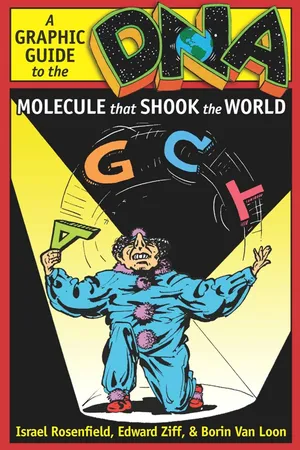
A graphic portrayal of a complicated science for a wide range of readers, full of humor, depth, and philosophical and historical insight.
Suitable for use in and out of the classroom, this volume covers DNA's many marvels, from its original discovery in 1869 to early-twentieth-century debates on the mechanisms of inheritance and the deeper nature of life's evolution and variety.
Even readers who lack a background in science and philosophy will learn a tremendous amount from this engaging narrative. The book elucidates DNA's relationship to health and the cause and cure of disease. It also covers the creation of new life forms, nanomachines, and perspectives on crime detection, and considers the philosophical sources of classical Darwinian theory and recent, radical changes in the understanding of evolution itself. Already these developments have profoundly affected our notions about living things. Borin Van Loon's humorous illustrations recount the contributions of Gregor Mendel, Frederick Griffith, James Watson, and Francis Crick, among other biologists, scientists, and researchers, and vividly depict the modern controversies surrounding the Human Genome Project and cloning.
"A unique, richly detailed, and fun biography of DNA grounded in deep historical and philosophical knowledge . . . Everything we need to know about biology's most important molecule." —Olive Sacks, author of
Everything In Its Place
"A remarkable book . . . Novel, easy to read, and fun . . . I spent many years mastering genetics yet learned new and valuable things from this book." —Robert Trivers, author of
Wild Life: Adventures of an Evolutionary Biologist
eBook - ePub
DNA
A Graphic Guide to the Molecule that Shook the World
- 272 pages
- English
- ePUB (mobile friendly)
- Available on iOS & Android
eBook - ePub
DNA
A Graphic Guide to the Molecule that Shook the World
About this book
Information
GLOSSARY

AMINO ACID
The fundamental building block of proteins. There are twenty different amino acids (for example, glycine, alanine, and lysine), which are linked during protein synthesis on the ribosome according to the coded genetic information in messenger RNA. The link that joins one amino acid to the next in the protein chain is called a peptide bond.
The fundamental building block of proteins. There are twenty different amino acids (for example, glycine, alanine, and lysine), which are linked during protein synthesis on the ribosome according to the coded genetic information in messenger RNA. The link that joins one amino acid to the next in the protein chain is called a peptide bond.
ANTICODON A triplet of bases in transfer RNA that pairs with a codon in messenger RNA. See codon.
ARM (OF CHROMOSOME)
A segment of a chromosome that projects from the centromere, either the long arm or the short arm.
A segment of a chromosome that projects from the centromere, either the long arm or the short arm.

BACTERIOPHAGE (PHAGE) A virus that infects bacteria. Bacteriophage consist of a double- or single-stranded DNA or RNA genome wrapped in a protective protein coat. The name comes from the Greek word phagos, which means “one that eats.”
BIOTECHNOLOGY The use of genetic engineering and other new biology techniques for commercial purposes.

CENTROMERE DNA region where sister chromatids make contact.
CHROMATIN The complex of DNA with protein that resides in the living cell. In eukaryotes, the fundamental structural unit of chromatin is the nucleosome. See nucleosome.
CHROMOSOME A large chromatin structure that consists of a highly folded DNA chain, complexed with basic proteins. In eukaryotes, chromatin condenses during mitosis into distinct X-shaped structures that independently segregate, as the cell divides, between the daughter cells.
CLONE A population of cells that arises from a single mother cell and thus are genetically identical to one another.
CODON A triplet of bases in messenger RNA that codes for an amino acid. See anticodon.
COMPLEMENTARITY The relationship of the DNA sequence of one strand of a double helix to the sequence of the other strand. When the base guanine in one strand faces cytosine in the other, and adenine faces thymine, as dictated by the base-pairing rules, the two chains are said to have complementary sequences.
CONSTITUTIVE MUTANT
A class of mutants of a regulated gene that synthesizes the gene product, whether or not the inducer is present. See inducer and repressor.
A class of mutants of a regulated gene that synthesizes the gene product, whether or not the inducer is present. See inducer and repressor.
CORE PROCESSES
Genetic, biochemical, or other processes that are conserved through evolution, making the rapid development of new organism possible.
Genetic, biochemical, or other processes that are conserved through evolution, making the rapid development of new organism possible.

DEEP HOMOLOGY
A similarity that underlies the genetic control of body pattern in two organisms that is not evident on morphological or phylogenic grounds.
A similarity that underlies the genetic control of body pattern in two organisms that is not evident on morphological or phylogenic grounds.
DIPLOID As applied to a cell, possessing two complete sets of chromosomes. See haploid.
DNA HELIX: A, B, and Z FORMS DNA can assume different double-helical structures, depending on the solvent conditions and the nucleotide sequence. These structures were originally seen when DNA fibers were analyzed under different states of hydration by X-ray diffraction. In the A form, which is favored at low humidity, the helix is right-handed, but the plane of the bases is inclined with respect to the axis of the helix. At higher humidity, and most likely in the living cell as well, the prevailing structure is the B form, also a right-handed helix, but with the plane of the bases nearly perpendicular to the helix’s axis. When the DNA sequence alternates between purines and pyrimidines (such as GCGCGCG …), a lefthanded helix called the Z form is stable.
DNA METHYLATION
The addition of a methyl group (CH3) to a DNA base, often to cytosine.
The addition of a methyl group (CH3) to a DNA base, often to cytosine.
DOMAIN A structural segment of a protein molecule that is created when the peptide chain folds.

ENZYME A protein molecule that catalyzes biochemical reactions. Examples are betagalactosidase, which catalyzes the hydrolysis (cleavage with the addition of water) of specific bonds in sugars called beta-galactosides, and RNA polymerase, which catalyzes the linkage of ribonucleotides to one another to make an RNA chain. Enzymes differ from synthetic catalysts in that they exhibit exquisite specificity in the reactions that they catalyze and that they function under physiological conditions.
EPIGENESIS The doctrine that the development of the body is determined by the interaction of the genes with the environment.
EPIGENETICS Heritable changes in an organism that do not involve changes in the sequences of DNA. In epigenetic mechanisms, environmental factors may alter DNA base structure (such as methylation of cytosine), and hence DNA function, but the base sequence itself is not changed..
EUKARYOTES Organisms – including plants, animals, protozoa, and fungi – whose cells have nuclei. See prokaryotes.
EXON A continuous segment of a eukaryotic gene whose sequence is retained in mRNA and that usually encodes protein. Many eukaryotic genes are “split” and have exons interspersed with nonsense DNA called introns. See intron.
EXPLORATORY BEHAVIOR
A random behavior that, when useful features are selected, can give rise to a precise behavioral pattern.
A random behavior that, when useful features are selected, can give rise to a precise behavioral pattern.

FERTILIZATION The fusion of the sperm and the egg.
F-FACTOR (FERTILITY FACTOR) A piece of DNA that confers “maleness” on a bacterium.
FRAME-SHIFT The deletion or insertion of one or more bases in the coding region of a gene that causes incorrect triplets of bases to be read as codons.

GENE A sequence of DNA that codes for a functional product. Most genes encode proteins, but genes also encode such RNAs as transfer RNA. Genes are the basic units of heredity.
GENETIC CODE The code used by living organisms to store genetic information, by which triplets of bases in DNA (or messenger RNA) represent amino acids in proteins.
GENOME The total genetic information of a cell or virus as represented by the DNA. Some viruses have RNA genomes.
GENOTYPE The genetic constitution of an organism. See phenotype.
GERM CELLS Cells that give rise to the gametes (sperm and eggs) and thus transmit genetic information to succeeding generations. They are formed early during the development of the embryo and eventually divide through meiosis to yield the gametes.
GRADUALISM
The Darwinian view that evolution takes place though the accumulation of small changes over extremely long periods of time.
The Darwinian view that evolution takes place though the accumulation of small changes over extremely long periods of time.

HAPLOID The genetic content of one set of chromosomes. Sex cells (gametes) are haploid, and in some organisms (bees and wasps) somatic cells are also haploid. Upon fertilization, the haploid egg receives a second set of chromosomes from the haploid sperm, producing a diploid cell. See diploid.
HIGH THROUGHPUT SEQUENCING The modern method of DNA sequencing that can analyze millions of nucleotides in a single session and that is often massively parallel – that is, with ...
Table of contents
- Cover
- Half title
- Title
- Copyright
- Dedication
- Contents
- Preface
- Introduction
- A Brief History of Genetics
- What is DNA?
- The New Biology
- DNA Replication
- What Information is Stored in a Gene?
- Where Did the Notion of Messenger RNA Come From?
- Transcription
- Translation
- Genetic Code
- PaJaMo and the Operon
- The Diversity of Gene Expression
- A Brief Reminder of Relative Size
- A Brief Reminder of Genes in Humans
- Prokaryotes versus Eukaryotes
- Restriction Enzymes and Genetic Engineering
- Cloning and Sequencing Genes
- Exons, Introns, and Splicing
- Chromatin and Histones
- Gene Families
- Controlling Genes for Antibodies
- Chromosomes
- Telomeres
- Imprinting and Micro RNAs:
- Epigenetics
- Prions
- The Human Genome Project
- The Human Genome Unveiled
- High Throughput Sequencing
- SNPs
- Manipulating the Genome
- Cloning the Organism – The History
- From the Nucleus of an Intestinal Cell to a Whole Frog
- Making Tissues from Stem Cells
- Going in the Other Direction: Changing Mature Cells to Stem Cells
- The Impact of New Genetics on Medical Research
- Diagnosis
- DNA and the Judicial System
- PCR
- The Impact of DNA
- Biotechnology
- The Origin of Life
- Tinkering
- Selfish Genes
- Evolving Evolution – Sources of Darwinian Theory
- The Big Gene Bet of the Last Millennium (1999 A.D.)
- Epilogue to the First Edition
- Glossary
- Reading List
Trusted by 375,005 students
Access to over 1.5 million titles for a fair monthly price.
Study more efficiently using our study tools.
Frequently asked questions
Yes, you can cancel anytime from the Subscription tab in your account settings on the Perlego website. Your subscription will stay active until the end of your current billing period. Learn how to cancel your subscription
No, books cannot be downloaded as external files, such as PDFs, for use outside of Perlego. However, you can download books within the Perlego app for offline reading on mobile or tablet. Learn how to download books offline
Perlego offers two plans: Essential and Complete
- Essential is ideal for learners and professionals who enjoy exploring a wide range of subjects. Access the Essential Library with 800,000+ trusted titles and best-sellers across business, personal growth, and the humanities. Includes unlimited reading time and Standard Read Aloud voice.
- Complete: Perfect for advanced learners and researchers needing full, unrestricted access. Unlock 1.5M+ books across hundreds of subjects, including academic and specialized titles. The Complete Plan also includes advanced features like Premium Read Aloud and Research Assistant.
We are an online textbook subscription service, where you can get access to an entire online library for less than the price of a single book per month. With over 1.5 million books across 990+ topics, we’ve got you covered! Learn about our mission
Look out for the read-aloud symbol on your next book to see if you can listen to it. The read-aloud tool reads text aloud for you, highlighting the text as it is being read. You can pause it, speed it up and slow it down. Learn more about Read Aloud
Yes! You can use the Perlego app on both iOS and Android devices to read anytime, anywhere — even offline. Perfect for commutes or when you’re on the go.
Please note we cannot support devices running on iOS 13 and Android 7 or earlier. Learn more about using the app
Please note we cannot support devices running on iOS 13 and Android 7 or earlier. Learn more about using the app
Yes, you can access DNA by Israel Rosenfield,Edward Ziff,Borin Van Loon in PDF and/or ePUB format, as well as other popular books in Biological Sciences & Genetics & Genomics. We have over 1.5 million books available in our catalogue for you to explore.