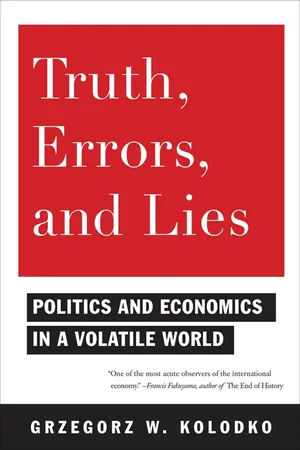
An approach to the challenges of globalism that rejects simplistic solutions, from "one of the most acute observers of the international economy" (Francis Fukuyama,
New York Times-bestselling author of
Identity).
Deploying a novel mix of scientific evaluation and personal observation, Grzegorz W. Kolodko, one of the world's leading authorities on economics and development policy, begins
Truth, Errors, and Lies with a brief discussion of misinformation and its perpetuation in economics and politics. He criticizes the simplification of complex economic and social issues and investigates the link between developments in the global economy and cultural change, scientific discoveries, and political fluctuations.
Kolodko, who was a key architect of Poland's successful reforms, offers a provocative study of globalization and the possibility of coming out ahead in an era of worldwide interdependence. Deeply critical of neoliberalism, which sought to transfer economic control exclusively to the private sector, Kolodko explores the virtues of social-economic development and the new rules of the economic game. He concludes with a look at our near and distant future, questioning whether we have a say in its making.
"One of the heavyweight economic thinkers of post-communist Europe."—
The Economist
Nominated for the Michael Harrington Book Award
- 474 pages
- English
- ePUB (mobile friendly)
- Available on iOS & Android
eBook - ePub
About this book
Information

CHAPTER ONE
The World, Words, and Meaning

Where Truth, Errors, and Lies in Economics and Politics Come from and What to Do to Make Truth Come First
Difficult economics is best explained through simple, meaningful words.
ECONOMISTS are supposed to describe and explain what’s happening. The best ones know what’s going on and can convince us. Problems begin to crop up when they
- Know, but cannot convince us.
- Don’t know but try to convince us anyway.
- Know that things are different from what they are trying to convince us of.
In the first case, there is nothing to do except to try to help them get the message across. Appearances notwithstanding, this is no easy task. The effort needs to be supported by publications, informational programs, teaching, the independent media, progressive nongovernmental organizations, and people of good will—who are never in short supply. First, however, they need to know how things stand.
In the second case, when people don’t know how things really stand but try to convince us of their concept, they’re just plain wrong. Then it’s necessary to argue calmly with them and to pay attention to the other side, because anyone can be wrong—including us. We can tell that the people propounding the mistaken views have good intentions. As they see it, they are trying to get at the truth and to share it with others. Therefore, they are allies in the struggle for truth, and all it takes to bring them (or ourselves) into line is to make them aware of their mistakes and work out a common position.
The worst case is the third one, when people deliberately proclaim falsehoods. In politics, this is an everyday occurrence—politics is about results, not truth. Evading the latter sometimes serves the former, which is why veracity and lying are treated instrumentally in politics. This explains why many of the economists who enter politics become enmeshed in falsehood. Truth is a fine thing at a scientific conference, but not at political rallies, which, in our day, usually take place in front of the spotlights and the TV cameras. After all, it would have been unthinkable in Polish government policy at the turn of 1989–90 to announce that the national income would fall by almost 20 percent over the next two years and that there would be 3 million unemployed within four years. The public would not have accepted such policies, or those responsible for them. Honest economists issued warnings,1 only to be shouted down by their more obeisant colleagues. In Russia, similarly, it would have been political suicide to declare in 1992 that neoliberal policies would lead to seven lean years in which production fell by more than half and a vast part of the population would face social exclusion.
It is too easy to dodge the truth in economics, and the tolerance for prevarication—despite its evident harmfulness—is much greater than in other branches of knowledge. Another reason for this is that it is easier to hoodwink people in economics and to convince them of relationships that do not actually exist in economic processes like saving, accumulation, investment, production, trade, and finance. When economists make statements that sooner or later turn out to be false, we are left facing a dilemma: Were they wrong, or lying? There are no other possibilities, except perhaps that they were partially wrong and partially lying. These arguments and examples—and it is not difficult to find more of them on the basis of the experience of many countries in many different periods—should help in understanding why bad things are sometimes read as good, and should provide some of the material needed to avoid mistakes.
In the struggle for truth in real science, with a capital S, it is necessary to cultivate a critical attitude. The approach to the truth also often requires an honest public debate, despite the frequent risk that the distinction between truth and untruth is sometimes impossible to attain in common discourse. Nevertheless, this is a way to win allies for the truth. In the social sciences, including economics, this is very important, because the dissemination and popularization of research results are important in implementing them. People were occasionally burned at the stake for defending the scientific truth in public, because a conservative and brutal Inquisition wanted it that way. Nowadays, portions of the media willingly stand in for that physical, psychological, and political terror which, we should remind ourselves, was cruel in the short term but ineffective in the long term.
Public debate and its instrument, the media, constitute a two-edged sword. On the one hand, it is impossible to pass the torch of knowledge to a wider audience without them. On the other, they enable demagogues and liars to reach that same audience. There is no alternative but to pick up the cudgels and swing the sword—the word—so as to deliver blows while suffering as few as possible oneself. This is not easy by any means.
The best way to fight is to call things by their proper names. One must understand the essence of irrationality—its sources, mechanisms, and dynamics—in order to proceed rationally. This can sometimes be more difficult than surrendering to intellectual laziness and going along with the arguments of charlatans or simple fools. Carl Sagan wrote that “one of the saddest lessons of history is this: If we’ve been bamboozled long enough, we tend to reject any evidence of the bamboozle. We’re no longer interested in finding out the truth. The bamboozle has captured us. It is simply too painful to acknowledge—even to ourselves—that we’ve been so credulous.”2 This kind of deception can influence important processes that affect great numbers of people. Much has been written about how people are led astray in science and how they can persist in error for long periods, placing their trust in nonsense, falsehoods, pseudoscience, myths, and demagogy.3 Seldom is the subject written about in economics, unfortunately.
In his book How Mumbo-Jumbo Conquered the World,4 Francis Wheen writes somewhat mockingly, somewhat ironically, and above all insightfully about this. Perhaps mumbo-jumbo should be treated as a special category in sociology and political science; it plays no small role in economics.
The recipe for economic mumbo-jumbo is an easy one: First, simplify as much as possible, and then exaggerate. For example: If you privatize everything, then everything will improve rapidly. Or the converse: Nationalize everything, and then everything will get better and better. It all depends on the epoch in which the mumbo-jumbo is intended to addle our brains. Wheen refers to the far-reaching consequences (or the nonsensical interpretations) of such statements as the neoliberal Thatcherite TINA (“There Is No Alternative”) or Fukuyama’s “the end of history”5—although in the latter case there was a great deal of misinterpretation of Fukuyama’s original thought.
It is a truism that there was no shortage of alternative paths to development even when neoliberal Thatcherism was flourishing and refused to notice or accept any alternatives to its dream of hegemony. Nor is there any shortage of them now, when neoliberalism is beginning to wither away. As for history, it goes on, as does humanity with all the problems that, even on the historical scale, remain abundant.
Another example of mumbo-jumbo is the slogan “Innovate or Die!” Recently, this has been a popular credo in management schools. Although no reasonable person would doubt the enormous significance of innovation both for increased productivity and for economic progress in general, we know that growth has been possible for whole centuries without any particular innovative capacities. Even today the majority of countries (national economies) and the great majority of companies are hardly dying from a lack of innovative talent. They do quite well and earn a decent living, thanks to imitation.
The ones that die are not those incapable of thinking and acting innovatively in terms of introducing new production methods and products, but rather those incapable of competing. It is perfectly possible to compete without innovation. The repetition of such an empty slogan by the media, governments, business leaders, business school professors, consultants of all kinds, and management gurus encourages mistakes by diverting attention from the authentic requirements for and sources of success in business.6 Innovation is for those who are good at innovating, but not for everyone.
Unfortunately, these and other examples of mumbo-jumbo have done immeasurable harm, in material as well as intellectual terms. After all, we exist in a world not only of words, but also of actions, including erroneous and harmful actions. Many of them are irreversible. The costs and the damage have already been suffered, and the possibility of any gains belongs to the past. Time is always a factor. Even if some good finally comes out of the sacrifices made and the burdens borne, the generational process is such that many of those who paid the price will already be in the next world.
In the postsocialist world, older people remember the effort at making them happy through the forced collectivization of agriculture, while the young still bear the burden of the naïve and injurious neoliberal idée fixe known as “shock therapy.” The failed efforts to carry it out led to enormous costs that could have been avoided, and yielded far fewer therapeutic benefits than could have been achieved by choosing changes of a different kind.7 The fact that some people prefer to forget such rubbish as “shock therapy” (or would like to convince themselves and others that it somehow succeeded) makes it necessary to get to the heart of the matter—just as in the case of the unfortunate collectivization of two-and-a-half generations earlier. This necessity has to do not only with historical truth—always badly falsified in regard to eras that have just ended—and the facile accuracy of economic interpretation in hindsight. It also has significance before the fact, because the historical process of development is at different stages in various parts of the world, and it is still not too late to avoid many mistakes. All that is needed is to draw the appropriate conclusions from other people’s experiences, and the lessons of accomplishments and failures in other countries.8
Iran is now attempting to implement a program called “Justice Shares,” which consists of the distribution for free of part of the state assets to the poorest segment of the populace. It would be far better to sell these assets for the highest possible price on the capital markets and use the income from denationalization for responsibly targeted social programs to limit the causes and symptoms of poverty. The Iranians had a chance to avoid the mistake of economically senseless, ideologically motivated free distribution—a mistake that was not avoided in some postsocialist countries.
In Poland, we also had an experience with mumbo-jumbo in the form of the “Universal Privatization Program,” a term that once dominated the front pages, especially the front page of one particular newspaper. When it later became clear to everyone that the economic payoff was not worth the ideological exertion, we had already entered the domain of consequences. Neither the goal of microeconomic transformation nor the social aim of the accelerated formation of a middle class was achieved. The ambitions of the instigators of this and similar programs were satisfied, as were the hardly inconsiderable interests of the financial and legal intermediaries who profited handsomely.
In Poland, we now have a chance to avoid another bad idea—the so-called flat tax. Some of our neighbors have put the notion into practice, where economic mumbo-jumbo has triumphed over common sense. At some point, they will have to reverse themselves, if for no other reason than because they will be unable to maintain the aging segment of their societies without a progressive tax. With a growing proportion of retirees, the working part of the society will have to pay higher taxes than the retirees and disability recipients, because otherwise the social support system will be unbalanced. Wealthier people must pay higher taxes, because otherwise the social system suffers from disequilibrium. The flat tax is not as simple as claimed by its advocates (and potential beneficiaries). Rather, it is indecently simplistic enough to seduce large numbers of people. Classical mumbo-jumbo on the basis of a classic recipe: a simple and overhyped panacea for something that seems to upset many people. Who likes paying taxes? In fact, it is a matter of accommodating the few. Some people have already been taken in, and naïvely place their trust in a concept that is intrinsically harmful to them. That’s the purpose of this kind of economic rubbish—deceiving some to the benefit of others.
Economics is like a path through the woods: It’s easy to get lost. When you turn around and go back, what seems to be the same path is in fact not the same. The process of change in economic relations is something natural and completely obvious, at least past a certain level in the development of civilization. Change is an economic category unto itself, and it can be very profound, extending far into the substance of the phenomena or processes being described. Sometimes change occurs very rapidly on the historical scale—even more quickly than the change from one generation of economists to the next. This is one of the reasons that they sometimes find themselves unable to keep up. They cannot get a theoretically accurate grip on the present because they are looking at it through yesterday’s eyes. Even worse, they are sometimes peering at an image of times already past, different from the here and now. When they cling too tightly to their obsolete interpretations, they begin getting things wrong. They don’t know what the truth is—and how can they proclaim the truth if they don’t know it? It has faded away, along with the times in which it was adequate. Times change. Views must change.
Unfortunately, instead of adjusting to change, economists often turn to more advanced countries with different cultures, superior technologies, and more mature institutions. They borrow interpretations, elements of theory, and even whole schools of thought that they then have trouble adapting to local conditions, because the adaptations fit their own conditions like two left shoes. This has become especially prevalent in recent years under the influence of domination by a single way of thinking—neoliberalism, which has been imposed on others by the most powerful interest groups connected with big international capital. More than one country has paid a high price for disdaining regional and national differences under the widely proclaimed but naïve neoliberal slogan “one size fits all,” which is a call for ignoring local differences in the application of economic policy. Even when countries pay a high price, however, it is always good business for someone.
A fixation on the most developed economies leads to the uncritical importing of the ideologies that are popular and regarded as mainstream social science there. In economics, this is an epidemic. If they shine at all, local analysts and commentators shine with a reflected light. No one demands that they shine like the sun, but let them at least have a decent lamp, or even a candle, of their own.
It is a real event when a Nobel Prize winner who is an outstanding economist (the two do not always go hand in hand) singles out a local economist for praise. This is what happened when Joseph E. Stiglitz of Columbia, perhaps the most cited authority in the field, referred to theories advanced by a Polish economist who had obtained positive real-world results.9 What happened? The facts of the matter notwithstanding, the Polish economist’s local adversaries were infuriated. An ideological activist of neoliberal tendencies with pretensions to an academic career attempted to discredit the Nobel Prize winner and called for a boycott (sic!) of his works, all because he quoted the innovative, proven views of a Polish economist who is unpopular with the neoliberal extremists. The strident advocate of the “party line” (where do we know that from?) wrote that
the fact that it is not worth paying attention to Stiglitz may be shown from the passage in his book Globalization and Its Discontents devoted to Poland: “Poland introduced a gradualist privatization policy, while at the same time building the basic institutions of a market economy, such as banks that actually lend money, and a legal system that demands respect for contracts and honest bankruptcy proceedings.” Quoting Grzegorz W. Kolodko as an authority, [Stiglitz] states that our country “did not engage in rapid privatization and did not place the lowering of inflation above other macroeconomic considerations. Instead, it emphasized such matters as achieving democratically expressed support for reform, which resulted in efforts to keep unemployment low. . . and to create the institutional infrastructure needed for the functioning of a market economy.”. . . it is hard to resist the impression that these lovely words must be about some other country. This is why Stiglitz and what he writes about other countries and their problems cannot be taken seriously.10
As can be seen, there is no limit to folly—or to destructive emoti...
Table of contents
- Cover
- Half title
- Title
- Copyright
- Dedication
- Contents
- The Navigator
- Chapter One: The World, Words, and Meaning
- Chapter Two: How Things Happen
- Chapter Three: A Brief History of the World and What We Can Learn from It
- Chapter Four: Globalization—and Then What?
- Chapter Five: The World As It Is
- Chapter Six: The Withering of Neoliberalism and Its Tattered Legacy
- Chapter Seven: What Development Is and What It Depends On
- Chapter Eight: Stagnation and Development—Institutions, Policy, and Culture
- Chapter Nine: The Coincidence Theory of Development and the New Pragmatism
- Chapter Ten: The Uncertain Future
- A Letter
- Notes
- Index
Trusted by 375,005 students
Access to over 1.5 million titles for a fair monthly price.
Study more efficiently using our study tools.
Frequently asked questions
Yes, you can cancel anytime from the Subscription tab in your account settings on the Perlego website. Your subscription will stay active until the end of your current billing period. Learn how to cancel your subscription
No, books cannot be downloaded as external files, such as PDFs, for use outside of Perlego. However, you can download books within the Perlego app for offline reading on mobile or tablet. Learn how to download books offline
Perlego offers two plans: Essential and Complete
- Essential is ideal for learners and professionals who enjoy exploring a wide range of subjects. Access the Essential Library with 800,000+ trusted titles and best-sellers across business, personal growth, and the humanities. Includes unlimited reading time and Standard Read Aloud voice.
- Complete: Perfect for advanced learners and researchers needing full, unrestricted access. Unlock 1.5M+ books across hundreds of subjects, including academic and specialized titles. The Complete Plan also includes advanced features like Premium Read Aloud and Research Assistant.
We are an online textbook subscription service, where you can get access to an entire online library for less than the price of a single book per month. With over 1.5 million books across 990+ topics, we’ve got you covered! Learn about our mission
Look out for the read-aloud symbol on your next book to see if you can listen to it. The read-aloud tool reads text aloud for you, highlighting the text as it is being read. You can pause it, speed it up and slow it down. Learn more about Read Aloud
Yes! You can use the Perlego app on both iOS and Android devices to read anytime, anywhere — even offline. Perfect for commutes or when you’re on the go.
Please note we cannot support devices running on iOS 13 and Android 7 or earlier. Learn more about using the app
Please note we cannot support devices running on iOS 13 and Android 7 or earlier. Learn more about using the app
Yes, you can access Truth, Errors, and Lies by Grzegorz W. Kolodko in PDF and/or ePUB format, as well as other popular books in Economics & Business General. We have over 1.5 million books available in our catalogue for you to explore.