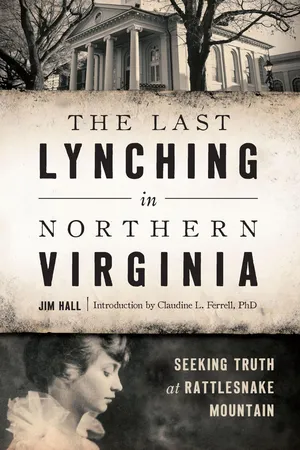
This true crime history reveals the harrowing story of a black man brutally murdered by a lynch mob in 1932 Virginia.
In 1932, a black man was found hanging on Rattlesnake Mountain in Fauquier County, Virginia. Though a mob set fire to his body, officials were able to identify him as Shedrick Thompson, who had been wanted for the abduction and rape of a local white woman. Some claimed Thompson killed himself, framing his gruesome death as the final act of a desperate fugitive. But residents knew better. Thompson had been the victim of a lynching—the last one known in Virginia.
In
The Last Lynching in Northern Virginia, author Jim Hall pieces together Thompson's life, the weeks-long manhunt to find him, and his final hours. He also details the lawless practice of lynching in Fauquier County. This true crime chronicle takes an in-depth look at Thompson's case to expose a complex and disturbing chapter in Virginia history.
- 147 pages
- English
- ePUB (mobile friendly)
- Available on iOS & Android
eBook - ePub
About this book
Information
Print ISBN
9781467135658
Subtopic
North American HistoryChapter 1
THE ATTACK AT EDENHURST
Henry and Mamie Baxley were asleep in their upstairs bedroom when Shedrick Thompson attacked them. Their two-year-old son, Henry Jr., was sleeping in the adjoining bedroom. Thompson knew the Baxleys and Edenhurst, their home. He and his wife, Ruth, lived next door in a tenant house. He had worked as a farmhand for Henry and Henry’s father, and Ruth was their cook. He moved confidently in the dark, entering the house through the back door into the kitchen, where he picked up a stick of stove wood. It was about ten o’clock on a Sunday night, unbearably hot, even for July in rural Virginia.
Thompson crossed the wooden floor of the foyer and then crept upstairs to the bedroom. Henry must have heard something because he was out of bed when Thompson reached him. Thompson was on him quickly, using the stick as a club. The two struggled in the dark, amid the sounds of confusion and pain. Thompson hit Henry on the arm and head and finally knocked him unconscious to the bedroom floor.
Thompson grabbed Mamie and pulled her from the bed. He dragged her past her downed husband, out of the bedroom and down the stairs. Together, the two stumbled through the door, across the porch and into the moonlit night. The date was July 17, 1932, in Fauquier County, Virginia. Thompson was black, thirty-nine and the Baxleys’ employee. They were white, landed and, as one newspaper said later, “one of the most popular young couples in the county.”
Inside the home, only silence followed the shouts and groans of the attack. Thompson and Mamie were gone, and Henry was unconscious. Henry Jr. slept through the attack, unaware that his father was injured and his mother was missing. Whatever fury drove Thompson to attack the Baxleys that night did not involve their child.

Mamie and Henry Baxley. Courtesy of Tom Davenport.

Edenhurst. Author’s collection.

Alphonso Washington. Author’s collection.
Henry Sr. regained consciousness to find himself sitting by his son’s bed. He said later that he had only the vaguest recollection of covering his head with his arms to protect himself against Thompson’s blows. He called for his wife but got no answer. His head and arms were swollen and painful, but he moved quickly through the house, searching each room. Downstairs, the front door stood open. Henry peered into the darkness, the empty pastures and stillness. Nothing. He scooped up Henry Jr. and hurried outside to his pickup, an old Reo. It was after 3:00 a.m. as he drove to the main road and then south, past Hume, to the Cove, Mamie’s childhood home.1
Alphonso Washington was a teenager then and had been working as a “houseboy” for Mamie’s family at the Cove for about a month. He saw Henry pull up the driveway, park his truck and, with his son in his arms, run into the house. Henry told his in-laws of the attack and Mamie’s abduction. He was “bleeding freely” and still dazed, one newspaper reported, and the family was surprised that he had been able to drive.2 He said he thought Thompson had shot him. But his in-laws examined him and said instead that it looked like he had been beaten. Washington, now 102 years old, is a retired preacher, living in Culpeper, Virginia. In an interview in 2014, he recalled what it was like when Henry arrived at the Cove and told of the attack. “He didn’t know nothing about where [Mamie] was,” he said. “He didn’t know nothing.”3

Buck Mountain, as seen from the Edenhurst driveway. Author’s collection.
The abduction from her bedroom was just the beginning of Mamie’s nightmare. Thompson grabbed her under the arm, pushing, dragging, almost carrying her down the hill and the dirt driveway outside her home. They made an unlikely pair as they hurried west through the night. He was six feet, 190 pounds and labor-strong; she was tiny, so small that she had to use a pillow to reach the pedals when she drove.
At the end of the driveway, they crossed Route 688, now known as Leeds Manor Road, and entered the rocky pasture on the other side. They had not gone far into the field when a car approached. It was Lucian Moss on his way home from Hume, where he had been playing bridge. His window was down, and he was singing. Mamie knew Moss from their choir at Leeds Episcopal Church and recognized his beautiful voice. She tried to pull away from Thompson; surely Moss would see them and stop. But the car did not slow, and the headlights moved away. If Mamie had any hopes of rescue, they faded then, leaving her with the fear of what was to come, the possibility that she might never see her husband and child again.4
Thompson pulled her through the pasture, across a creek and past the thickets of briars and redbuds. The land was too rugged for crops. Instead, the Baxleys grazed cattle there and produced apples. Everyone knew the place as Locust Shoots. After a hundred yards, they reached the foot of Buck Mountain, out of sight of the road. Mamie was scared and sore from Thompson’s rough handling. But she told her family later that of all the injuries she suffered that night, among the worst were the cuts to her bare feet from the rocks and briars.
No one but Mamie knows how long she was Thompson’s prisoner. No one knows what, if anything, he said to her. Was this some sort of drunken payback for something he thought she had done? Was he angry at her husband? Two days later, when Stanley Woolf, sheriff of Fauquier County, prepared a wanted poster for Thompson, he used technical language to describe the incident as a “criminal assault on a white woman, a capital offense.” The members of a Fauquier County grand jury were less delicate. They said Thompson raped her, a charge she later confirmed.5
Thompson also knocked Mamie unconscious and pulled the rings from her finger—her diamond white gold engagement ring and her wedding ring, white gold with orange blossom engraving. Carved inside the wedding ring were her and her husband’s initials and their wedding date: “H.L.B.—M.M.Y.—6-2-23.” She and Henry had just celebrated their ninth anniversary. Now, like her husband, she had been beaten senseless and left for dead.
Mamie came to at about seven o’clock that morning. She stumbled north through the field to the dirt road, where she collapsed in the front yard of the Jackson house. James and Georgie Jackson, a black couple, lived in a tenant house owned by the Baxleys; he worked for Mamie’s father-in-law. James picked up Mamie in the front yard and carried her into the house, where Georgie tended her bleeding wounds. Groups of men were already searching for Mamie, and Jackson found one group and took them back to his home. Soon, family members were there and drove Mamie and Henry to Fauquier County Hospital in Warrenton.
The Baxleys were a farm family and apple growers. Henry was a protégé of former governor Harry F. Byrd and chairman of the county Democratic Party. Mamie was the granddaughter of one of the largest and wealthiest landowners in the region and the stepdaughter of the chairman of the county school board. Thompson, too, was from a longtime Virginia family. He was an army veteran who’d served in France during World War I. Yet now he was traveling a path from which he could not return. He had sneaked into the Baxley home, assaulted Henry and abducted, raped and beaten Mamie. He was doomed.

Thompson’s attack on the Baxleys was frontpage news in many newspapers, including the Strasburg News. Author’s collection.
Thompson fled north toward the mountains where he grew up. As he crashed through thistle and goldenrod, he must have known that he was running for his life. Rape was a capital offense in Virginia in 1932, punishable by electrocution. Two months before Thompson assaulted the Baxleys, the state executed Sam Pannell, an eighteen-year-old black man from Halifax County, who was charged in January 1932 with the rape of a white woman. A Halifax County Circuit Court jury deliberated for eight minutes before sentencing him to death.6 Throughout the state, the rape of a white woman by a black man was punished harshly. From 1868 to 1932, Virginia executed fifty-five people for rape and attempted rape—all of them were black.7
The search for Thompson was the largest in the county’s history, lasting for weeks and involving law enforcement and hundreds of volunteers. Day after day, groups of armed men, some organized by the sheriff and others self-assigned, combed the mountain paths. Some of these men invaded the homes of local black residents, accusing them of hiding Thompson in their cellars or behind cabin doors. Suspected sightings of the fugitive came from as far away as Culpeper, thirty miles to the south. Yet despite these efforts, the searchers found nothing and eventually returned to their everyday lives.
Then, nearly two months after the assault, a farmhand checking a fence line at the foot of Rattlesnake Mountain, a few miles from the Baxley house, found Thompson’s body hanging from an apple tree. Word spread and a crowd gathered. Despite the presence of a deputy sheriff, members of the mob set fire to the body, destroying everything but the skull. They also removed Thompson’s teeth as souvenirs. The county coroner ruled that night that Thompson had climbed into the tree, attached a rope to his neck and jumped out. A few days later, a county grand jury confirmed his verdict. In the community and elsewhere, the two rulings seemed hasty, part of a clumsy coverup. Soon local newspapers reported the details of what they said was a lynching, and national civil rights groups added Thompson’s name to their lists of lynch victims. But former governor Harry F. Byrd, among others, argued for suicide, and with no trial and no public explanation, the official verdict stood.
And so began the Depression-era mystery of Shedrick Thompson. Thompson had worked for the Baxleys for more than fifteen years. He, his wife and his stepson lived next door to them. The two families were of separate worlds: one black, the other white; one poor, the other rich. They were neighbors, perhaps even neighborly. Yet Thompson had tried to kill them. Why? And what happened to him on Rattlesnake Mountain? The county coroner and a county grand jury ruled his death a suicide, the final act of a desperate fugitive. Because of this, some historians do not include his case among Virginia’s lynchings. To them, lynching in Virginia ended years earlier with passage of a state anti-lynching law. But the evidence points to another conclusion: murder. Thompson did not commit suicide on Rattlesnake Mountain. He was captured and killed by a posse of his neighbors, the victim of Virginia’s last lynching.
Chapter 2
THE HUNT FOR THOMPSON
The book of Daniel in the Old Testament tells the story of Shadrach, Meshach and Abednego, three devout young Jews captured by the Babylonians and sentenced to die by fire when they would not worship the Babylonian god. The three were spared when an angel of God delivered them from the flames. For Thompson, namesake of the biblical Shadrach, there was no divine intervention, no angel sent from heaven to save him. He was on his own.
Searchers suspected that Thompson would flee northwest from Locust Shoots, where he abandoned Mamie Baxley, across Buck Mountain, toward his family’s home on Rattlesnake Mountain, three miles away. There, in the notch called Africa Mountain, lived the Rectors, Blues, Fords, Pendletons, Johnsons and Thompsons. The community dated to the 1850s, and sixty black families sent their children to its one-room Cherry Hill School.8
This was a rugged and remote corner of Fauquier, little touched by logging or development. Thompson fled through dense stands of oak, locust, poplar and sycamore. He crossed fallen trees and stone fences, gaining elevation one minute, descending into rocky hollows the next. But these many obstacles also offered sanctuary. He could hide in the old-growth forests or beside pastures with their grazing sheep. The temperature that day reached ninety once again. The region and the nation had suffered through a terrible heat wave that had ruined crops and killed livestock. “It might not be getting any hotter, but one thing is sure and certain, it is not getting one bit cooler,” the local...
Table of contents
- Front Cover
- Half Title
- Title Page
- Copyright
- Contents
- Introduction, by Claudine L. Ferrell
- Acknowledgements
- 1. The Attack at Edenhurst
- 2. The Hunt for Thompson
- 3. Henry and Mamie Baxley
- 4. Shedrick Thompson
- 5. The Discovery of Thompson’s Body
- 6. Suicide Doubted
- 7. Willing to Use Violence
- 8. Death on Rattlesnake Mountain
- Notes
- Bibliography
- About the Author
Trusted by 375,005 students
Access to over 1.5 million titles for a fair monthly price.
Study more efficiently using our study tools.
Frequently asked questions
Yes, you can cancel anytime from the Subscription tab in your account settings on the Perlego website. Your subscription will stay active until the end of your current billing period. Learn how to cancel your subscription
No, books cannot be downloaded as external files, such as PDFs, for use outside of Perlego. However, you can download books within the Perlego app for offline reading on mobile or tablet. Learn how to download books offline
Perlego offers two plans: Essential and Complete
- Essential is ideal for learners and professionals who enjoy exploring a wide range of subjects. Access the Essential Library with 800,000+ trusted titles and best-sellers across business, personal growth, and the humanities. Includes unlimited reading time and Standard Read Aloud voice.
- Complete: Perfect for advanced learners and researchers needing full, unrestricted access. Unlock 1.5M+ books across hundreds of subjects, including academic and specialized titles. The Complete Plan also includes advanced features like Premium Read Aloud and Research Assistant.
We are an online textbook subscription service, where you can get access to an entire online library for less than the price of a single book per month. With over 1.5 million books across 990+ topics, we’ve got you covered! Learn about our mission
Look out for the read-aloud symbol on your next book to see if you can listen to it. The read-aloud tool reads text aloud for you, highlighting the text as it is being read. You can pause it, speed it up and slow it down. Learn more about Read Aloud
Yes! You can use the Perlego app on both iOS and Android devices to read anytime, anywhere — even offline. Perfect for commutes or when you’re on the go.
Please note we cannot support devices running on iOS 13 and Android 7 or earlier. Learn more about using the app
Please note we cannot support devices running on iOS 13 and Android 7 or earlier. Learn more about using the app
Yes, you can access The Last Lynching in Northern Virginia by Jim Hall in PDF and/or ePUB format. We have over 1.5 million books available in our catalogue for you to explore.