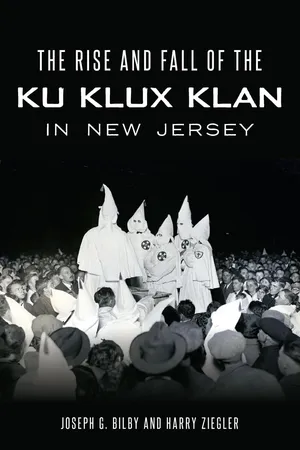
This revealing history chronicles the rise of the KKK in 1920s New Jersey and the backlash it faced from the state's immigrant communities.
As one of the nation's most diverse states, New Jersey is celebrated for its strong communities built across religious and ethnic lines. But the Mid-Atlantic state is not immune to the ills of bigotry and racism. When the Ku Klux Klan began to reemerge in the first half of the twentieth century, it found a home for a time in New Jersey. Arthur H. Bell, a former vaudevillian turned KKK Grand Dragon, used the tactics of public theater to advertise and recruit for the secret society.
In a time of heightened xenophobia during World War I, many white Protestants were already suspicious of their Catholic and Jewish neighbors—a trend Arthur used to his advantage. But the organization's rise was soon met with a forceful backlash. At a massive riot in Perth Amboy, thousands of immigrants besieged a few hundred Klansmen and ran them out of town. This detailed history chronicles the brief rise of the Ku Klux Klan and how brave New Jersey residents collectively stood up to bigotry.
- 147 pages
- English
- ePUB (mobile friendly)
- Available on iOS & Android
eBook - ePub
The Rise and Fall of the Ku Klux Klan in New Jersey
About this book
Information
CHAPTER 1
“A MAN CHRONICALLY ON THE MAKE.”
It made film history and played at theaters across the nation for years. It was the “photo-play” known as The Birth of a Nation. A pioneering film released in 1915, it provided national credence to the fabricated “lost cause” concept of the Civil War—a faux-history fantasy in which noble Confederates fought for independence and were victimized after the conflict by thieving Yankee “carpetbaggers” who callously moved in to plunder them. According to this narrative, carpetbaggers manipulated gullible freed slaves—eager to avenge themselves on their former masters—into assisting them in the creation of a reign of terror. Then came the Ku Klux Klan.
Audiences were understandably impressed by producer/director D.W. Griffith’s massive battle scenes in an artform that was previously limited to minimal action with few actors on small, even cramped, sets. Most newspaper reviews of Griffith’s epic stressed his depiction of the rise of the Klan as an organization that saved southern womanhood and preserved social order, portraying that as the most significant segment of the film.
New Jersey papers were no exception. Across the state, the coverage was laudatory. The Trenton Times noted:
The Ku Klux Klan, which forms such an interesting part of D.W. Griffith’s great production “The Birth of a Nation,” was organized as a secret and social band in the State of Tennessee in May, 1866.…In subsequent years when the Klan went forth to put down the desperadoes who swarmed down from the North to grab everything in sight in the South, the riders adopted the emblem of the fiery cross which the Scotch Highlanders had long used as a call to battle.

D.W. Griffith, director of the film The Birth of a Nation, which inspired the rebirth of the Ku Klux Klan. From Library of Congress.
In 1916, the New Brunswick Home News wrote, “The great deeds of the Civil War and the horrors of Reconstruction are made to live again and the nation reborn is apotheosized.”
In 1918, the Bridgewater Courier News concluded, “From the first scene to the last the film maintains the keenest interest, but it reaches its strongest point in the second part, when the hordes of the Ku Klux Klan are gathering for the rescue of harried whites.”1
One of many inspired by the film, especially its portrayal of the Ku Klux Klan, was thirty-five-year-old William Joseph Simmons. Simmons, described by one historian as “a man chronically on the make,” who could be classified as a middle-class ne’er-do-well, had a varied career. The Alabama-born Simmons was a medical school dropout who had served several months as a private in the First Alabama Infantry in the Spanish-American War and was a failed employee of the Methodist Church. In his most successful effort, as a salesman of memberships in fraternal societies (he was allegedly a member of fifteen), Simmons portrayed himself as a doctor and a minister and promoted himself to “colonel” based on his rank in the Woodmen of the World organization.2
In 1915, while recovering from an auto accident in Atlanta, Simmons apparently saw The Birth of a Nation and, realizing there was money to be made, decided to revive the Ku Klux Klan. Although he offered a dubious alternate explanation—that he had “visions” of resurrecting the Klan since childhood—the date of the resurrection suggests that The Birth of a Nation was the catalyst. Simmons claimed that he consulted an instruction manual from the original Klan to organize his updated version of the order and, with some of his friends and a few elderly men who were allegedly veterans of its first iteration, literally reignited the organization by burning a cross atop Stone Mountain, Georgia, on Thanksgiving night in 1915.3
Given to the aggrandizing harangues that would become a trademark of the revived Klan, Simmons maintained that he had heroically raised the cross in “a temperature far below freezing,” although, in fact, it was around forty-five degrees Fahrenheit that evening. The burning cross was a dramatic image borrowed from the film, which in its turn lifted it from the novel the movie was based on, The Clansman by Thomas Dixon Jr. Dixon claimed Scottish clan members brought the practice to the United States South.

An advertisement for a showing of The Birth of a Nation, which spread a false view of the Reconstruction era across the nation, making heroes out of the Ku Klux Klansmen of the post–Civil War era. From Joseph Bilby.

Actress Lillian Gish, the heroine of The Birth of a Nation, portrays a noble southern woman being leered at by, in this case, a Union soldier. From Library of Congress.
Fraternal orders of all types appealed to late nineteenth-century American middle- and working-class men. The groups helped in-need members’ families in the absence of a government safety net and affordable life insurance. They also provided men with participatory entertainment, a sense of community in an urbanizing society as well as a sense of belonging to something bigger than themselves, which they believed beneficial not only to local interests but to the country at large. Added to that was the benefit of networking for jobs and other economic advantages. Ceremonial claptrap, strange titles, secret passwords and bizarre attire added to the aura of intrigue and exclusivity, connoting a sense of importance to groups of otherwise ordinary men. One survey of Ku Klux Klan members in a county in Michigan in the mid-1920s revealed that 73 percent of them also belonged to other fraternal organizations. As an experienced fraternal order huckster, Simmons was aware of this appeal and, tellingly, advertised his new Klan as a “Classy Order of the Highest Class.”4

William Joseph Simmons, “a man constantly on the make,” who created the second Ku Klux Klan in 1915. From Library of Congress.
With characteristic grandiosity, Simmons dubbed himself the “Imperial Wizard of the Invisible Empire of the Knights of the Ku Klux Klan.” His organization did indeed remain invisible outside the immediate Atlanta region for several years, garnering only a few hundred members at best, although a membership list was never disclosed. Looking to boost adherents, Klansmen claimed they were in patriotic pursuit of World War I draft dodgers, but the only public appearance of the new Klan was at a veterans’ parade in 1919. At one point, ironically, since the Klan later became a major defender of prohibition, Simmons allegedly proposed a private “bottle club,” exempt from the provisions of the Volstead Act, as a recruiting enticement.5
A turnaround occurred when Simmons hired marketing professionals Edward Young Clarke and Elizabeth Tyler of the Southern Publicity Association (providers of public relations to the Anti-Saloon League, among other organizations), who promised they could turn his mediocre local fraternity into a national organization. The duo wrote speeches for Simmons, polishing his presentation and expanding his rhetoric beyond complaints of black people’s racial “heredity handicap.” Under their guidance, Simmons expanded his target list to immigrants, Jews, Catholics, labor agitators, “Bolsheviks” and political radicals of any stripe, along with the cultural aspects of the Jazz Age. Clarke and Tyler launched a public relations blitz of press releases and advertisements and arranged newspaper interviews with Simmons. The Imperial Wizard agreed to pay the couple a sizable portion of the financial returns from an expanded Klan. Clarke later recalled that the necessity of demonizing Catholics and Jews would cost him friends, so he wanted to ensure a good payoff in return.6

Actual KKK members circa 1869. Although they did don masks, the white robes and peaked hoods of the second Ku Klux Klan are mostly theatrical inventions of D.W. Griffith. From Library of Congress.
Such complaints against “outsiders” were nothing new. Clarke, Tyler and Simmons were exploiting a long-standing trait of frightened people— resorting to prejudice. This tendency was exacerbated by the still-prevalent rationalizations for race-based slavery and periodic anti-immigrant outbursts in American society. Racial anxiety had peaked once more in the South in the wake of World War I, as black men returned from Europe, where many had fought, albeit under French command, against the Germans in 1918. These veterans were ready to claim their full rights as citizens, and their protests led to a record number of lynchings—some with soldiers still in uniform— across the South. Perhaps the ultimate result of this paranoia was the horrible race riot of 1921 in Tulsa, Oklahoma. The wealthiest African American neighborhood in the country was ravaged by a white mob, and three hundred people were killed. Klansmen were allegedly involved as members of law enforcement and National Guard units charged with keeping the peace.7
As a bonus, the Clarke/Tyler message was delivered to a public used to the government-sponsored, hyper-patriotic fervor and xenophobia of World War I and its aftermath, as fear of immigrant radicals grew following the Bolshevik Revolution. A bomb exploded on Wall Street in front of the J.P. Morgan Bank in September 1920, killing thirty people and injuring more than one hundred more. Although the case was never solved, the perpetrators are thought to have been Italian anarchists. In the wake of the incident, Attorney General A. Mitchell Palmer rounded up Communists, anarchists and those suspected of any sort of radical tendency, deporting many under dubious legal premises in 1919 and 1920. The new Ku Klux Klan, composed of white Protestants, offered itself as the only solution for the dangers to the United States.
The expanding Klan suffered a public relations setback in a 1921 New York World exposé of the order’s vigilante violence, dubious monetary practices and tax avoidance. The paper added a little spice to the story by reporting that Clarke and Tyler had been arrested while partially clothed in a “disorderly house.” The result was a congressional hearing where “Colonel” Simmons, in his role as pseudo-archetypal southern gentleman, denied the charges. Simmons insisted that his organization did not advocate violence and that its fiscal policies were the same as any other fraternal organization. In the end, no serious investigations were launched, as congressmen wanted to stay out of an allegedly patriotic organization’s business.8
The New York City pro-immigrant, left-wing weekly newspaper Issues of Today, which was dedicated to “Social Decency and Civic Justice,” praised the World’s investigation, calling it “one of the finest achievements in American journalism” and recommending it as “the sort of thing our papers can and should do.” Unfortunately, the result was not, as many had hoped, the downfall of the Klan.9
Despite temporary embarrassment, Clarke and Tyler turned the publicity from the incident into a recruiting opportunity. The World series ironically created nationwide interest in the organization, and newspapers and magazines across the country increased their own Klan coverage as a result. Even though most of the publicity was negative, it succeeded in drawing recruits to the order. What was profitable to the media proved profitable to the Klan as well.10
Clarke and Tyler capitalized on the new notoriety by reaching out to fraternal societies and Protestant churches, offering free membership to ministers. Recruiters, known as “Kleagles,” spread out across the country to uncover which fears made different communities anxious. They tested African American equality, Jewish and Catholic subversion, speakeasies and bootleggers, sexual licentiousness and local political corruption, among other real and/or imagined social ills. All were present in a time of tumultuous cultural change and became convenient excuses to rouse the population. The diversity of the Klan’s enemy list could cover almost anything a self-appointed “100 percent American” was concerned about in the 1920s. The Klan also offered its members the opportunity to serve as reformist enforcers, which were similar to the World War I Bureau of Investigation vigilantes who spied and reported on “slackers” avoiding the draft, German sympathizers, anti-war civilians and taverns serving soldiers. In 1921, the Klan, boasting more than 100,000 members nationwide, began to establish state “Realms,” which oversaw local “Klaverns.”11
The recruiting and expansion proved very profitable to the Klan leadership. Probably the most important aspect of Clarke and Tyler’s operation was the creation of a pyramid-type recruiting scheme in which Kleagles offered memberships for a $10 “Klectoken,” or initiation coin, from which the Kleagle would get $4, the state “King Kleagle” in charge of Realm Recruiting got $1, the Grand Goblin of the Realm got $0.50, Clarke and Tyler got $2.50 and Simmons got $2.
There were other channels of profit as well. The Klan was formally incorporated and engaged in a contract for “official” garb with an Atlanta garment manufacturer and another with a publishing company, allegedly run by Clarke, t...
Table of contents
- Front Cover
- Half Title
- Title Page
- Copyright
- Dedication
- Contents
- Acknowledgements
- Introduction
- Chapter 1: “A Man Chronically on the Make.”
- Chapter 2: “Tar and Feathers for You.”
- Chapter 3: “My God. Don’t Do That. It’s Murder.”
- Chapter 4: “The Charge That a Nude Woman Sat on My Lap Is a Damnable Lie.”
- Chapter 5: “You Will Find Her at Milford, Pennsylvania, with That Scoundrel Ziegler.”
- Chapter 6: “The Klan May Have Thousands of Votes, As It States, but I Cannot Allow Any Body of Citizens to Dictate to Me.”
- Chapter 7: “It’s a Good Fiction Story. I Like Good Fiction Stories.”
- Chapter 8: “We Don’t Want Any More of Them.”
- Chapter 9: “It Was One of My Awful Blunders.”
- Conclusion
- Notes
- Bibliography
- About the Authors
Trusted by 375,005 students
Access to over 1.5 million titles for a fair monthly price.
Study more efficiently using our study tools.
Frequently asked questions
Yes, you can cancel anytime from the Subscription tab in your account settings on the Perlego website. Your subscription will stay active until the end of your current billing period. Learn how to cancel your subscription
No, books cannot be downloaded as external files, such as PDFs, for use outside of Perlego. However, you can download books within the Perlego app for offline reading on mobile or tablet. Learn how to download books offline
Perlego offers two plans: Essential and Complete
- Essential is ideal for learners and professionals who enjoy exploring a wide range of subjects. Access the Essential Library with 800,000+ trusted titles and best-sellers across business, personal growth, and the humanities. Includes unlimited reading time and Standard Read Aloud voice.
- Complete: Perfect for advanced learners and researchers needing full, unrestricted access. Unlock 1.5M+ books across hundreds of subjects, including academic and specialized titles. The Complete Plan also includes advanced features like Premium Read Aloud and Research Assistant.
We are an online textbook subscription service, where you can get access to an entire online library for less than the price of a single book per month. With over 1.5 million books across 990+ topics, we’ve got you covered! Learn about our mission
Look out for the read-aloud symbol on your next book to see if you can listen to it. The read-aloud tool reads text aloud for you, highlighting the text as it is being read. You can pause it, speed it up and slow it down. Learn more about Read Aloud
Yes! You can use the Perlego app on both iOS and Android devices to read anytime, anywhere — even offline. Perfect for commutes or when you’re on the go.
Please note we cannot support devices running on iOS 13 and Android 7 or earlier. Learn more about using the app
Please note we cannot support devices running on iOS 13 and Android 7 or earlier. Learn more about using the app
Yes, you can access The Rise and Fall of the Ku Klux Klan in New Jersey by Joseph G. Bilby,Harry Ziegler in PDF and/or ePUB format, as well as other popular books in History & North American History. We have over 1.5 million books available in our catalogue for you to explore.