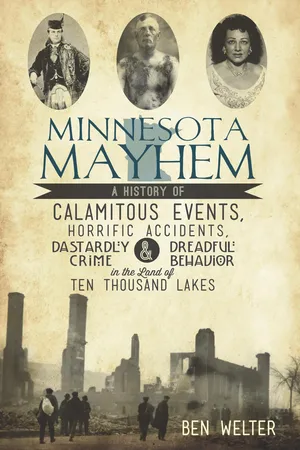
This true crime history recounts more than a century of crime, deviousness, and disaster in the North Star State.
In Minnesota Mayhem, local historian and author Ben Welter explores the best of the state's worst moments. Culled from the archives of the
Minneapolis Tribune and its successor newspapers, these stories and photos range from the catastrophic to the chillingly curious and the simply strange.
Among the true tales told in these pages, Welter recounts the career of a successful con man in 1871; an 1881 fire that destroyed the State Capitol; a flu outbreak that killed more than 10,000 Minnesotans in 1918; the arrest of Frank Lloyd Wright at a Lake Minnetonka cottage in 1926; an arrested stripper who claimed wardrobe malfunction in 1953; and the 1977 murder of a wealthy matron in Duluth.
eBook - ePub
Minnesota Mayhem
A History of Calamitous Events, Horrific Accidents, Dastardly Crime & Dreadful Behavior in the Land of Ten Thousand Lakes
- 162 pages
- English
- ePUB (mobile friendly)
- Available on iOS & Android
eBook - ePub
Minnesota Mayhem
A History of Calamitous Events, Horrific Accidents, Dastardly Crime & Dreadful Behavior in the Land of Ten Thousand Lakes
About this book
Information
Topic
StoriaSubtopic
Storia nordamericanaFIRE DESTROYS THE STATE CAPITOL
MARCH 2, 1881, MINNEAPOLIS TRIBUNE
On a winter’s evening in 1881, a fire broke out at the State Capitol in St. Paul while both houses were in session. Hundreds fled down the building’s single stairway as flames raced overhead and smoke filled the chambers. The building was destroyed. And yet, aside from a “one-armed janitor” who was hit in the head by a burning timber while trying to haul books to safety, no one was injured.
This riveting account appeared on the Tribune’s front page the next day under an exhaustive bank of headlines. Miraculously, the word “miraculously” appears just once in the story.
IN ASHES
THE STATE CAPITOL IN ST. PAUL BURNED LAST EVENING.
THE STRUCTURE TOTALLY DESTROYED, WITH MANY VALUABLE RECORDS.
OVER ELEVEN THOUSAND BOOKS OF THE STATE LIBRARY BURNED.
THE VALUABLE COLLECTION OF THE ACADEMY OF SCIENCES LOST.
THE BUILDING VALUED AT $80,000—OTHER LOSSES BEYOND ESTIMATION.
NARROW ESCAPE FROM A FAR MORE TERRIBLE DISASTER.
BOTH BODIES IN SESSION WHEN THE FIRE BROKE OUT.
SCENES OF GREAT EXCITEMENT—MEMBERS ESCAPING BY WINDOWS.
CAUSE OF THE FIRE UNKNOWN—HINTS AT INCENDIARISM.
AN EXTRA SESSION MADE NECESSARY—SCENES AND INCIDENTS.
ARRANGEMENTS FOR THE MEETING OF THE TWO HOUSES TO-DAY.

In the early days of the Minneapolis Tribune, news headlines competed for attention with ads for furniture, groceries and books.
A CINDERED CAPITOL.
Special Telegram to The Tribune.
ST. PAUL, March 1.—The burning of the state capitol building last evening, upon the very eve of the close of the legislative session, is a misfortune the extent of which cannot at this time be fully appreciated. The calamity is so sudden a one, and the excitement which followed the escape of at least 300 people by a single stairway, from a building suddenly, mysteriously and almost entirely enveloped in flames, is so intense that the coolest reporter cannot measure the calamity.
THE FIRE BROKE OUT
at about a quarter past 9 o’clock. Both branches of the legislature were busy with the immense amount of work which had accumulated, and the galleries and lobbies were crowded with an unusually large number of people. The senate was busily grinding away at house bills, and had almost completed that order, and the attendance in that branch was large in anticipation of reaching the bond bill, the amendments to which had to be concurred in by that branch. With a suddenness which is beyond description, and almost entirely beyond appreciation, the members of both branches were apprised of the fact that
THE BUILDING WAS ON FIRE;
that the flames threatened to shut off escape by the only stairway with which the building is supplied, and that an appalling calamity stared at the lowest estimate 300 people in the face. The scene in the senate, where The Tribune reporter was on duty, was an exciting one, and not soon to be forgotten. The lieutenant-governor was in the chair, and the secretary calling bills upon their third reading, the sawdust memorial just having been reached. The senators were variously occupied in their seats, or lounging about in the smoking-room, when some one burst into the room and shouted “fire,” and
A PERFECT PANDEMONIUM OF SHOUTS
followed. The alarm needed no further proof than was apparent to every person in the room. Through the windows at the back of the gallery it was evident that a great sheet of flame held possession of the hallway or corridor into which the main and only stairway leads. There was a grand rush for the doors, the lieutenant-governor, with admirable coolness, attempting to allay the excitement, which only rose the higher as a body of senators attempted to escape by the door, only to be
BEATEN BACK BY FLAME,
and a cloud of black smoke that threatened to shut off that escape. Brave men blanched with fear. A thousand thoughts rushed through excited minds, and the distance from the windows to the ground was measured with anxious eyes. “Shut the doors!” “Shut the doors!” “Don’t make a draft!” “Act like men!” yelled the excited crowd, who rushed about the room measuring every possible mode of escape. “Some one should
MOVE TO ADJOURN,”
shouted the secretary, and senator Crooks made the motion, which was put and responded to with an unanimity of sentiment not usually encountered. The doors were closed, but a second attempt revealed the fact that the cloud of smoke had raised somehow, and a pell-mell dash was made for the stairs, down which the members of the house and the spectators in the gallery were already passing. Meanwhile some of the occupants of the senate chamber, among them Senators Pillsbury, Officer, Miller, Assistant Clerk Wedge and The Globe and Tribune reporters had escaped, by the window to the veranda at the east end of the building, where they were engaged in
YELLING LUSTILY
for ladders and ropes. The escape was none too soon, for before the last person had left the room a great cloud of flame enveloped the dome of the building, had spread through the tinder-box mansard-roof and great cinders were dropping though the ventilator into the center of the senate chamber, where a fire was kindled in the carpet. A few of the senators had the presence of mind to save their effects, nearly all of them bundled into their wraps, and the clerks with admirable coolness and presence of mind
RESCUED ALL THEIR RECORDS,
the bills in the pigeon-holes of their desks and everything of value upon which they could lay their hands. They were the last to leave the room, carrying with them the uncompleted legislation, the fruit of months of consideration. Several intrepid members returned by the window later and secured other of their effects, but less than three minutes had elapsed before all the upper portion of the building was enveloped in flames and the structure was doomed.
THE SCENE IN THE HOUSE
was even more exciting. The first premonition of danger was the dropping of fire into the gallery, a shout from the resort of the vox populi of Fire! and the bursting into the room of a cloud of black, sickening and forbidding smoke. Two hundred persons rose as one individual, Mr. Rice, who was in the chair, deserting his seat unceremoniously. Those who first attempted it, believed escape by the long narrow hall, more than one hundred feet in length, presented to them what appeared to be
AN INSURMOUNTABLE BARRIER.
Mr. Denny, with more coolness than some others, jumped to the speaker’s desk and cautioned the crowd to go, but to do it with discretion and coolness; that the passage was open; but an unknown influence suddenly, and for a brief interval, cleared the hall of smoke, and the mass of humanity, among who were a number of ladies, poured down the hall an excited, eager and unmanageable crowd. Miraculously no one was hurt, and every person escaped, though more than one occupant of the room counted the cost of a leap for life through the window, and philosophically made up his mind that a great danger was to be met. The scene was
TRAGIC AND HUMOROUS,
and never to be forgotten by the eye-witnesses of it. Men, usually calm, dashed wildly about the room, a thousand terrible fancies flashing through their brains. Only one member, Mr. Schmidt, of Washington county, concluded to jump rather than brave an uncertain battle with the flames, and dropped from one of the windows into a snowbank, with only a few unimportant bruises. The clerks, appreciating their responsibility, gathered together the records and carried them to a place of safety. Speaker Fletcher, with an eye to the danger that threatened the younger pages, took them

Minnesota’s first Capitol, shown here about eight years before the fire, was built in 1853 at Tenth and Cedar Streets in St. Paul. Courtesy of the Hennepin County Library, Minneapolis Collection.
UNDER HIS PERSONAL CARE,
and dragged them with him out of the building. The spectacle which met the eye of the crowd as they escaped into the free air of safety was a building, the roof of which was almost entirely enveloped in flames, and the dome of which was a great beacon of light, spreading a lurid glare over the entire city.
THE ORIGIN OF THE FIRE
is wrapped in some mystery. There were no premonitory evidences of the fire. When it was first discovered it seemed to have gained full sway throughout the range of the entire French roof. It seemed to have gained more headway in the dome of the building, and is variously ascribed to the explosion of gas in that part of the building and to an incendiary. The janitors hold to the latter theory. There was no gas lit or lights of any kind in the garrets, which are apparently nearly ten feet in heighth in the center, and extending over the entire building, a structure nearly 300 feet in length, and of a width ranging from 50 feet to 150 feet. Half an hour had not elapsed before the whole second story was enveloped.
THE LOSS.
The loss is beyond estimation. The structure was worth not less than $80,000, and contained the accumulation of years, which cannot be replaced. On the first or ground floor the valuables were placed in the vaults or removed from the building, the carpets in some of the rooms even being removed. The most serious loss, undoubtedly, is the state library, which contained 12,580 volumes, many of which cannot be replaced. Less than 1,000 of the entire number were saved. The money value of the library was probably $75,000, but it does not express the real value of the property. The treasury vault contained $2,190,000 of state and Missouri bonds, besides other valuable property, and towards this receptacle the
FIRST STREAMS WERE TURNED
and were not permitted to cease. The state’s property is probably safe. The insurance across the hall was supplied with a vault, and the secretary of state’s room and the auditor’s department, with a like safe depository, and nearly all other departments with safes. Such property as could be placed in these receptacles is probably safe, but as soon as it was evident that the lower floor coul...
Table of contents
- Front Cover
- Title Page
- Copyright
- Contents
- Introduction
- A Con Man without Peer: August 1871
- Fire Destroys the State Capitol: March 1881
- Judge Cooley’s Courtroom: December 1882
- A Crowded Steamer Capsizes on Lake Pepin: July 1890
- Cops Break Up a Poker Game: February 1895
- Buggy Rage Flares on Portland Avenue: February 1898
- The Penniless Prima Donna: December 1899
- Twenty-five Years Behind Bars: July 1901
- Ice Yacht Reduced to Kindling: March 1903
- St. Paul’s First Road Fatality: May 1903
- Minnesota’s Last Execution: February 1906
- Killer Wore Jewels in Jail: March 1910
- A Three-Year-Old Stops Traffic: September 1913
- Flu Outbreak Closes Churches, Schools, Theaters: October 1918
- Hundreds Die in Cloquet Fire: October 1918
- Tarred and Feathered: November 1919
- An Organ Grinder’s Despair: January 1922
- Bohemian Flats Women Defy Eviction: May 1923
- Frank Lloyd Wright Jailed in Minneapolis: October 1926
- St. Paul Gang Figure Slain: December 1928
- Race Row in Minneapolis: July 1931
- The Evil that Boys Do: March 1939
- Armistice Day Blizzard: November 1940
- Flower Feud in Excelsior: May 1944
- Aerialist Dies in Fall at State Fair: August 1947
- Jailed Stripper Blames Wardrobe Malfunction: May 1953
- Six Killed as Jet Hits House: June 1956
- Little Boys Tell a Big Lie: February 1960
- Cities Out of Sync: May 1965
- Buried Alive in Bloomington: June 1965
- The Big Lake One: February 1966
- Burning Money to Survive: February 1971
- Skinny-Dipper Lands in Court: August 1975
- The Congdon Murders: June 1977
- About the Author
Trusted by 375,005 students
Access to over 1.5 million titles for a fair monthly price.
Study more efficiently using our study tools.
Frequently asked questions
Yes, you can cancel anytime from the Subscription tab in your account settings on the Perlego website. Your subscription will stay active until the end of your current billing period. Learn how to cancel your subscription
No, books cannot be downloaded as external files, such as PDFs, for use outside of Perlego. However, you can download books within the Perlego app for offline reading on mobile or tablet. Learn how to download books offline
Perlego offers two plans: Essential and Complete
- Essential is ideal for learners and professionals who enjoy exploring a wide range of subjects. Access the Essential Library with 800,000+ trusted titles and best-sellers across business, personal growth, and the humanities. Includes unlimited reading time and Standard Read Aloud voice.
- Complete: Perfect for advanced learners and researchers needing full, unrestricted access. Unlock 1.5M+ books across hundreds of subjects, including academic and specialized titles. The Complete Plan also includes advanced features like Premium Read Aloud and Research Assistant.
We are an online textbook subscription service, where you can get access to an entire online library for less than the price of a single book per month. With over 1.5 million books across 990+ topics, we’ve got you covered! Learn about our mission
Look out for the read-aloud symbol on your next book to see if you can listen to it. The read-aloud tool reads text aloud for you, highlighting the text as it is being read. You can pause it, speed it up and slow it down. Learn more about Read Aloud
Yes! You can use the Perlego app on both iOS and Android devices to read anytime, anywhere — even offline. Perfect for commutes or when you’re on the go.
Please note we cannot support devices running on iOS 13 and Android 7 or earlier. Learn more about using the app
Please note we cannot support devices running on iOS 13 and Android 7 or earlier. Learn more about using the app
Yes, you can access Minnesota Mayhem by Ben Welter in PDF and/or ePUB format, as well as other popular books in Storia & Storia nordamericana. We have over 1.5 million books available in our catalogue for you to explore.