A New Orleans historian and vampire expert uncovers the historic origins of the Southern city's vampire legends from colonial days to the Great Depression.
New Orleans has a reputation as a home for creatures of the night. Popular books, movies and television shows have cemented the city's connection to vampires in the public imagination. But the stories of the Crescent City's undead residents go much deeper than the tales of Sookie Stackhouse and
The Vampire Lestat. In
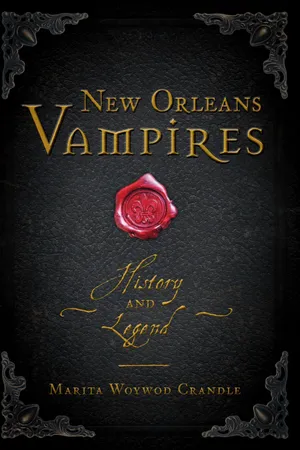
New Orleans Vampires, author Marita Woywod Crandle investigates the most haunting tales of vampirism in New Orleans history.
In the early days of Louisiana's colonization, rumors swirled about the fate of the Casket Girls, a group of mysterious maidens traveling to the New World from France with peculiar casket-shaped boxes. The charismatic Comte St. Germain moved to the French Quarter in the early 1900s, eerily resembling a European aristocrat of one hundred years prior bearing the same name. In the 1930s, the Carter brothers terrorized the town with their desire to feed on living human blood. Strange but true tales mix with immortal legends in this fascinating volume.
- 131 pages
- English
- ePUB (mobile friendly)
- Available on iOS & Android
eBook - ePub
About this book
Information


THE CASKET GIRLS
1
THE PROMISED LAND
Nightly, groups of tourists stand in the dark, across from the Old Ursuline Convent at 1100 Chartres Street, engaged in the legend of French vampire maidens held captive for close to three centuries in the third-floor attic. The third-floor dormer windows hold the fascination for this mystery, as their shutters remain tightly sealed. A unique circumstance, as no other top-floor shutters in the French Quarter can be found closed. Given that heat rises, in a city with intense humid temperatures, sealed windows would create an impossible situation for any source of comfort. A convent, ingénues from France and casket-shaped trousseaus stored in the mysterious attic become the ingredients of a vampire legend with a romantic twist.
Loose interpretation over the years has led to various versions of the legend, which begins in 1727 with a very select group of girls who sailed from France to New Orleans under the care of the Ursuline nuns. The girls were intended to be married off to men who had migrated south, spawning Louisiana’s colonization. It’s said the girls traveled with curious, coffin-shaped trousseaus, which earned them the nickname “Casket Girls.” The hope was that these girls would help tame the city and populate it with a better class of people, as New Orleans had become a cluster of criminals and degenerates. However, on the ship many people became very ill, and several even died. According to the legend, the girls unknowingly smuggled vampires onto the ship in their trousseaus. The dark quarters of the ship kept whatever evil aboard comfortable throughout the journey. One by one, the maidens were being turned into creatures of the night for companionship. The vampires then feasted on the other passengers for survival.

Tour group in front of the Ursuline convent. Author’s collection.
Over the course of the bloody dark, long and gruesome journey to New Orleans, the Ursulines are said to have won the battle against the vampires with the holy power of God. However, they were bound in their responsibilities to protect the girls. Upon their arrival to New Orleans, they are said to have secured the maidens, eternally under their care, in the Ursuline convent attic to ensure mortal safety, as the girls were now fully turned vampire. Every window on the third floor was then sealed shut with a series of blessed screws to further ensure their captivity. Now and then stories are told of a shutter popping open on a gloomy night, possibly from the power of a vampire, longing for a glimpse of reality. However, it’s said the monsignor, who has sole access to the third-floor chambers, immediately secures the shutters once again with more blessed screws, sealing the vampires safely from the world they would surely terrorize and destroy.
A great deal of confusion and mystery surrounds this legend. While the elements are all present in the historical facts, they simply don’t line up. Yes, the convent’s shutters remain closed, and the Ursuline nuns are famous for their great care in teaching and nurturing the development of women throughout the centuries; and yes, girls were sent from France to help populate New Orleans at the dawn of the city’s colonization. However, should someone with interest investigate the story further, the mystery begins to unravel. A flurry of facts flutter unconnected around the legend, lending even more intrigue to this mystery.
The vast confusion stems from the fact that many past historians, in their documentations, writings and notes, were themselves at fault for making several mistakes, assumptions and careless recollections on the topic of the Casket Girls. Later, their documents were referred to and used as facts for future writings until the resulting story could be considered a product of “Chinese whispers” or “the telephone game.” One person says this, and it is embellished to that, which goes on to be considered a different version of this. Historians making careless mistakes, coupled with French to English translation nuances, are at the root of the confusion surrounding the meat of this story. Luckily, ample documentation on the topic still exists, so the truth can be pieced back together.
It all began at the time when explorers were still traveling the world, discovering new territories to claim for their leaders. In these exciting and mysterious times, adventurers used any available means to accomplish their goals, some innovative, some unethical and even ruthless.
Originally from what is now Montreal, Quebec, Canada, French explorer Pierre Lemoyne d’Iberville was destined for priesthood. However, at the age of just twelve, his destiny took a dramatic turn when he secured a job as a cabin boy on his uncle’s ship. This action steered him into a life of an adventurer, which lead to critical contributions to American history, including the founding of Louisiana. It is with his story that the making of our legend begins.
From the time that d’Iberville founded the colony of Le Nouvel Orleans in 1699, on numerous occasions he pleaded with the French government to send marriageable young women, preferably somewhat attractive, to tame and satisfy the tastes of the strong Canadian men who were to help colonize New Orleans. The girls were to be married off to them immediately upon their arrival. Iberville believed, quite wisely, and in the fashion of King Louis XV of France who used similar tactics several years prior, that it was crucial to the successful colonization of the new territory to bring families and women for men to marry, so to help root the men and start real cities in the territory.
Many of the men were Coureur des bois, French-Canadian woodsmen, who engaged in less traditional fur trade. The men would go deep into the woods to trade European items for furs. The original hope had been that these men would colonize with Indian women, but that wish turned out to be futile, as the Indians did not favorably adopt the ways of the French. Rather, the woodsmen adopted the very relaxed lifestyle of the Indian women, inhibiting the growth of the colony. Sending French women became a priority.

Pierre Lemoyne d’Iberville. Public domain.
To appease their needs, forty women were sent on the ship Pelican in 1704. However, the handful of women was little more than a temporary solution to the situation. The competition for the few women sent created a constant pressure for more women. The women were frankly needed not just to populate the colony but to keep the men interested in agriculture and other jobs that required their continual presence in New Orleans, when their nature had them seeking adventures and wandering.
At this time, John Law and his Western Company, which later became the Company of the Indies, were hired to populate the new territory. Ruthless, his men, as noted in Walter Hart Blumenthal’s book Brides from Brideswell,
spared no violence in kidnapping city scourings and unsophisticated peasants. Vagrants, beggars, disorderly soldiers, galley-slaves, gipsies, paupers, prostitutes, political suspects, black sheep of good families, felons, were herded afoot or in carts under vigilant guard to a seaport and crowded aboard a ship in cramped quarters to fill up the then vast void of Louisiana.
Blumenthal’s intent for his book was to draw attention to a primarily overlooked group of individuals who also hold the status of America’s ancestors. While much attention in American history had been given to Mayflower descendants as the foundation for the country, there was a much more diabolical colonization taking place a little farther south.
Several ships were sent to the promised land with a flood of women. While French, they were of a much less desirable nature than those on the Pelican. Some traveled willingly, misled by promises of abundant crops, meat and friendly Indians, expecting a modest but comfortable life. An advertisement was even circulated depicting Louisiana as a paradise of sorts, with lush territory, mountains and opportunity. (See insert.) Others were kidnapped and forced against their will, and some were bound in chains, already planned for deportation from France for their crimes, including murder, prostitution and thievery. Many were also exhibiting the early stages of gonorrhea, among other various diseases. This clan of hoodlum women were anything but desirable, and many died en route or shortly after their arrival. The legend of the Casket Girls cites a high death toll aboard the ship as evidence that the girls were feasting on their fellow passengers, but that rumor likely stems from all the horrid conditions and ill spirits the women who were shipped to New Orleans endured. There is nothing, however, to substantiate that one ship suffered more deaths than any other sent to Louisiana.
Women who did survive the journey were left in shock at the condition of Louisiana. The atmosphere of what was to be their new home was truly devastating. Many lived in hunger, with next to no vegetation, livestock, butter or any nutrition they were familiar with, and even accustomed to, in France. The accommodations were no more than primitive huts, void of most furnishings, utensils or any sign of civilization. Starving and depressed, few survived the experience, proving that the compromising efforts to send just any women were little more than good intentions.
However, shortly thereafter, one more attempt was made with twelve very unattractive girls who had little supervision on the ship during their travels. Their freedom on the ship, coupled with abundant idle time, had them engaged in less desirable behavior for young maidens who were to be ...
Table of contents
- Front Cover
- Title Page
- Copyright
- Dedication
- Contents
- Foreword, by Dacre Stoker
- Preface
- Acknowledgements
- Introduction
- PART ONE: THE CASKET GIRLS
- PART TWO: THE COMTE ST. GERMAIN
- PART THREE: THE CARTER BROTHERS
- PART FOUR: VAMPIRE EVOLUTION OVER THE CENTURIES
- Afterword: The Stranger with a Cane, My New Orleans Vampire Experience
- Bibliography
- About the Author
Trusted by 375,005 students
Access to over 1.5 million titles for a fair monthly price.
Study more efficiently using our study tools.
Frequently asked questions
Yes, you can cancel anytime from the Subscription tab in your account settings on the Perlego website. Your subscription will stay active until the end of your current billing period. Learn how to cancel your subscription
No, books cannot be downloaded as external files, such as PDFs, for use outside of Perlego. However, you can download books within the Perlego app for offline reading on mobile or tablet. Learn how to download books offline
Perlego offers two plans: Essential and Complete
- Essential is ideal for learners and professionals who enjoy exploring a wide range of subjects. Access the Essential Library with 800,000+ trusted titles and best-sellers across business, personal growth, and the humanities. Includes unlimited reading time and Standard Read Aloud voice.
- Complete: Perfect for advanced learners and researchers needing full, unrestricted access. Unlock 1.5M+ books across hundreds of subjects, including academic and specialized titles. The Complete Plan also includes advanced features like Premium Read Aloud and Research Assistant.
We are an online textbook subscription service, where you can get access to an entire online library for less than the price of a single book per month. With over 1.5 million books across 990+ topics, we’ve got you covered! Learn about our mission
Look out for the read-aloud symbol on your next book to see if you can listen to it. The read-aloud tool reads text aloud for you, highlighting the text as it is being read. You can pause it, speed it up and slow it down. Learn more about Read Aloud
Yes! You can use the Perlego app on both iOS and Android devices to read anytime, anywhere — even offline. Perfect for commutes or when you’re on the go.
Please note we cannot support devices running on iOS 13 and Android 7 or earlier. Learn more about using the app
Please note we cannot support devices running on iOS 13 and Android 7 or earlier. Learn more about using the app
Yes, you can access New Orleans Vampires by Marita Woywod Crandle in PDF and/or ePUB format, as well as other popular books in History & North American History. We have over 1.5 million books available in our catalogue for you to explore.