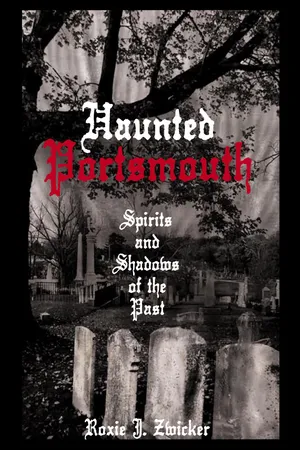
New Hampshire's historic port town is no stranger to ghostly goings-on—from the local TV personality and author of Massachusetts Book of the Dead.
A tour of Portsmouth's back alleys and docksides, filled with the lingering whispers and memories of generations long dead. Venture through the haunted past and present of Portsmouth, New Hampshire, if you dare. Before Portsmouth was a charming seaside community, it was a rough-and-tumble seaport. Hear phantom footsteps in the Point of Pines Burial Ground and mysterious voices at the Portsmouth Harbor Lighthouse, haunted by the ghost of its former keeper. Tour guide and hauntings expert Roxie Zwicker takes readers on a tour of the nation's third-oldest city, where buildings and street corners teem with ghostly stories and legends.
Includes photos!
- 251 pages
- English
- ePUB (mobile friendly)
- Available on iOS & Android
eBook - ePub
About this book
Information
THE DARKER PAST OF 111 STATE STREET
Not all ghostly activity is of the good-natured, playful variety; some encounters feel malevolent and downright evil. One brick building, 111 State Street, dates from approximately 1814 and was built on the foundation of a structure claimed by the Great Fire of 1813. Throughout the years it was the location of many businesses, including a brothel—during the late nineteenth century—and a shoe store. All seemed a bit quiet until the past twenty-five years, and things haven’t been the same since.
During the 1980s, one part of the building was occupied by the bistro Café Petronella, a terrific place for creative souls. The other business in the building was Wally’s, an area biker bar. The juxtaposition of the two businesses was quite interesting, but it seemed to work. Café Petronella was a place of arts and culture with a European flair. The owner himself, William Frank, was explorer of the four corners of the earth. An inspiring and accomplished landscape painter, Frank wanted to promote a place of culture and the arts. Often there were art exhibits from exotic places, and live music was played alongside elegant fashion shows, which helped to differentiate the bistro from others in town.
Wally’s had its own style and culture, too. However, instead of art exhibits there was a line of motorcycles, with fantastic murals and paint schemes, parked out front. The music may have been a little more on the rock-and-roll side, and instead of fashion shows, there were wet t-shirt contests. Wally’s was often in the newspapers because of local fundraising motorcycle rides that ended up there. People watched the spectacle from the sidewalks as bikes arrived one after another, often with American flags waving in the breeze.
After about a dozen or so years, the owner of Café Petronella decided that it was time to retire from the business, so the quaint artist’s hangout was no more. The new business, appropriately named the Old Bridge Café, took its name from the proximity to the oldest of three bridges connecting Portsmouth to Kittery, Maine. The World War I Memorial Bridge was opened for use in 1923. Newspaper and court records mention that almost on a daily basis you could hear mention of the café during someone’s arraignment. Apparently the place attracted the type of clientele prone to creating disturbances—such as being drunk and disorderly, committing assault or using drugs—and arrests were commonplace.

This historic building has undergone many transformations. In 2006, it transformed from an Irish pub, Jack Quigley’s, to a sports bar.
It is said that the upstairs dance floor at the café was so out of control that some locals told me that “good girls” didn’t ever go there. Documented newspaper records show that people openly did drugs while dancing, and sometimes passed out. Because of the unhealthy and lewd acts in the ladies’ bathroom, the door was removed. I have even heard that some bathroom stalls didn’t have doors and that patrons could look right into the room.
In August of 1996, the Old Bridge was the scene of a disappearance of a young city woman. She was last seen at the café in the company of a man she had only known a short time. There has been some conjecture as to whether she left the café willingly with this man and his friend, or if she was drugged and taken out against her will. For nearly a year and a half, her body was not found, despite exhaustive searches by authorities. Her remains were finally discovered in a makeshift grave next to a highway, miles away in Lincoln, New Hampshire. The coroner’s ruling was that she drowned. The story unraveled in court that she was brought down to the waterfront and drowned in the Piscataqua River. The two men she was seen leaving the café with were arrested for her murder. They were also suspects in other unsolved murders. They were eventually convicted and are now serving long sentences in a New Hampshire state prison.
A September of 1998 newspaper story reported a family riot at the café, and a number of New Hampshire state troopers were called in. Backup from surrounding communities was also called in. The family disturbance spilled out onto the street and a large, unruly crowd gathered, preventing police from getting the incident under control. In the end, three people were arrested and a police cruiser was severely damaged.
December of 1999 brought the police back to the Old Bridge Café. Soon thereafter, a jury, brought to the location to investigate another murder, also made its way to the café. A thirty-four-year-old man was stabbed in the heart after meeting a friend at the café, and his body was found lying in the street just around the corner. When the police arrived that night, they knew that he had been in the Old Bridge, so they proceeded to question the patrons inside. While everyone agreed that the man was in the bar, there were no answers as to how he ended up dead. The police closed down the bar—with approximately thirty patrons inside—until 5:30 in the morning. All the while the body remained in the street, which was by then roped off as a crime scene.

Once devastated by the Great Fire of 1813, brick buildings like this one on 111 State Street are now commonplace.
The man’s friend later pled guilty to manslaughter, claiming that he was under the influence of hallucinogenic mushrooms and other illegal drugs. In his plea, he stated that they had left the bar and gone back to his boat to do drugs. They then returned to the bar and argued over the drugs. A fishing knife was brandished and the crime was committed. Moments later the body turned up around the corner on Chapel Street. Some people I’ve spoken with claim that the bartender at the Old Bridge was someone you wouldn’t cross and that he may have known more than he was saying. One frequent patron even claimed that the bartender might have witnessed the stabbing.
The police seemed to visit the café on a fairly regular basis and eventually the business was shut down. Enter entrepreneur Jay Smith. A man with his own vision for the property, his objective was historic preservation. Jay had already owned the Press Room in Portsmouth, a local favorite haunt for many who loved the live music played there seven nights a week. He was a local philanthropist and was instrumental in saving the Music Hall during the 1980s when its fate was most uncertain. He also owned buildings around the site, so his interest in this historic property seemed natural.
Smith purchased the building and leased it to a gentleman who had ambitious intentions of opening the property up as an authentic Irish pub. Jay decided to combine the two buildings and renovate the property to make it attractive and highlight its historical features. In 2001, Jack Quigley’s opened up. It was styled after authentic Irish pubs. Finally, things seemed to be looking up.
Sadly, almost a year to the day after purchasing the property at 111 State Street, Jay Smith unexpectedly passed away at the time of Jack Quigley’s grand opening. Just a very brief walk from the door to the building is a small pocket garden dedicated by local citizens to Jay’s memory. The beautiful roses that grow there surround a simple marker to Jay Smith.
The restaurant was beautifully designed with dark woods and comfortable seating and could hold over three hundred patrons. The colorful Celtic knot stained-glass window in the entryway was a wonderful detail, as was the snug on the first floor. The snug was a wonderful place to bring tour groups, as it had fantastic roots to colonial times. When the patrons in the pub got a little loud cheering for the Red Sox or the Patriots, I simply closed the door and we were in our own little world.
Snugs were secret places in American taverns that allowed women to drink unnoticed. Ladies were forbidden from visiting taverns, but many tavern keepers knew that women could be just as good customers as their male counterparts, so they had these rooms specially designed. Often these rooms appeared to be closets or storerooms. They had their own private entrance so that women could come and go completely unnoticed. The rooms were often built underneath staircases and sat about twelve women. The snug at Jack Quigley’s was quite cozy, and although it didn’t have a hidden door, it did have a beautiful wooden door with a Gothic arch window.
The property soon changed hands. It remained open as Jack Quigley’s and hair-raising stories were now relayed by the staff. The new owners also maintained another area Irish pub, and due to that commitment were not at Jack Quigley’s often. Some locals said that more beer went out the back door than what was served to the patrons. The waitresses who worked there were eager to tell their tales of ghostly encounters.
The second floor of the restaurant was only open on Friday and Saturday nights, so most of the time there was no one up there—or was there? Several of the waitresses I interviewed told me that when they went up to the second floor they felt someone else up there with them. Unnerved by the sensation of this unseen spirit, they did what they liked to call a “drop and run.” Whenever they had to go up to the third-floor offices or pass through the second floor, they would literally run so that they weren’t confronted by this entity. Some of the staff completely refused to go to the upper floors because they were convinced that there was something evil up there.
The bartender at Jack’s described startling incidents on the second floor. He said that on quiet afternoons when the upstairs was closed, you could hear scraping sounds across the ceiling. When a few brave souls went up to investigate, they would find the barstools that normally stood around the bar scattered around the floor. The bartender described an occasion when this scraping went one step further. After hearing the stools dragged across the floor, the sounds were followed by a very loud series of bangs that resonated through the downstairs ceiling. A group of employees ran upstairs to investigate and they were stopped cold in their tracks by the sight before them. Each and every barstool was upended and placed upside down all around the bar. Everyone who witnessed this phenomenon was certain that no one had been upstairs. The large metal door to the stairwell had been completely closed all afternoon.
Another waitress nervously relayed a terrifying story from the second floor. She said that she was on a drop and run mission to the third floor when she passed by the large beer mirrors hanging on the second-floor walls. When she caught a glimpse of her reflection in the mirror, she saw the face of a man reflected right next to hers. She looked around and saw no one else in the room. Frightened by what she described as a horrible face, she shrieked with fear. Employees on the first floor ran up to find her frozen in place, petrified of what she just experienced. She said that she never wanted to go up there again under any circumstances.
Employees were not only scared of the second floor; one waitress was scared of what she felt in the basement. She felt malevolence down there. She thought that someone was following her around and often asked other employees to retrieve things that she needed from the basement.
During one tour that I brought into Jack Quigley’s, one guest had a panic attack inside the restaurant. We sat down in the snug, which wasn’t too far from the bar on the first floor. As soon as we got comfortable, this woman’s face got red and she blurted out, “My God, someone’s been killed here. I can’t stay.” She began gasping and made her way quickly to the front door. I followed her outside to make sure that she was going to be all right, and once out on the sidewalk she seemed to calm down a bit. She told me that she knew someone had died violently in there. She didn’t know who or when but she said she felt it. After convincing her to return to the tour, we went back into the snug. I relayed the location’s dark past and the woman nodded her head in affirmation. For the rest of the tour, this guest seemed a bit unhinged and shaky. When the tour ended, the woman came up to me and said that she knew something followed her from Jack Quigley’s that night and she hoped she wouldn’t take it home. I was surprised to see an e-mail from her the next day telling me that when she returned to the parking garage, she went to pay for her ticket and the attendant told her that the ticket wasn’t working and that it had been demagnetized. According to her, the clerk said that this was the first time that this had ever happened. She said she checked her purse and found nothing that could have caused that to happen. This incident confirmed to her that there was indeed something unearthly happening that night.
On July 3, 2006, the New Hampshire State Liquor Commission shut down Jack Quigley’s for good because of violations. They had been cited twice in the past year for the alleged sale of alcohol to intoxicated persons and for the alleged sale of alcohol to minors. When they were cited in July, the Commission found that they were serving alcohol without having renewed their food-serving license. The owner of Jack’s decided not to renew the license and the building was sold at auction in August.
The windows were dark and the doors closed for several months. Speculation mounted over what might become of the building. Some people thought that the building might become upscale condominiums, making the location inaccessible to the general public. Then in December, a few lights were seen in the building and contractors’ trucks were parked out front. Jack Quigley’s was about to undergo yet another metamorphosis.
A new tenant was ready to go ahead with his own vision for the business, and with that the Irish pub was no more. A sports bar theme was chosen. The new property included flat-screen televisions and a brighter and cozier second floor. The first-floor snug was not in the renovation plans and was quickly demolished. In January 2007, the business opened. It was a little more polished than the last one, but would the ghosts of Jack Quigley’s still linger?
I decided to lead a few very small tours over to the new property and to introduce ourselves to the new owner. This time, whenever I visited this storied building I brought a digital camera and an Electronic Magnetic Field (EMF) reader. The meter detects changes in energy forms and is a standard tool used by ghost investigators. After introductions were over, the new owner stated that there was something “very bad” in the basement, although he would not let us take a closer look. I noticed that on the second floor the EMF reader got erratic readings, which could be interpreted as paranormal activity. I also took notice that the beer mirror—in which the Jack’s waitress saw a man’s face—was hanging on the wall just a couple of inches higher than it used to be. I decided to take three pictures with my digital camera. The first image was taken without a flash and was quite a bit out of focus. The second image was clear and sharp and appeared to have an orb in it. The third picture taken from the same spot was most surprising. In the mirror you could clearly see a white, skeletal face with vacant eye sockets and a twisted mouth. The photo was studied for reflections and light flares and yet there didn’t seem to be anything that could cause this anomaly. In the previous image there was only a round white circle. Could this phantom spirit have been caught on camera? It really looked that way.
This type of activity may be associated with a poltergeist type of haunting where there is some emotional impression. Poltergeists are thought to make themselves known by moving physical objects in their environment. There are some theories as to who the spirit may be. Some folks think that it is Jay Smith, who had spent so much time at the place and had really hoped to turn things around. Many people believe that the spirit may be connected to the 1999 stabbing that allege...
Table of contents
- Front Cover
- Half Title
- Title Page
- Copyright
- Dedication
- Contents
- Introduction
- Point of Graves Burial Ground
- Portsmouth Harbor Lighthouse
- Fort Constitution
- The Music Hall
- Molly Malone’s Irish Pub
- The Unfortunate Tale of Ruth Blay and the South Cemetery
- The Ghostly Huntsman
- Specters and Mysteries of Court Street
- John Paul Jones House
- Frank Jones and the Rockingham Hotel
- The Darker Past of 111 State Street
- Legends of Four Tree Island and the Portsmouth Naval Prison
- Secrets of Water Street
- The Witch Cat
- Wentworth By The Sea Resurrection
- Conclusion
- Bibliography
Trusted by 375,005 students
Access to over 1.5 million titles for a fair monthly price.
Study more efficiently using our study tools.
Frequently asked questions
Yes, you can cancel anytime from the Subscription tab in your account settings on the Perlego website. Your subscription will stay active until the end of your current billing period. Learn how to cancel your subscription
No, books cannot be downloaded as external files, such as PDFs, for use outside of Perlego. However, you can download books within the Perlego app for offline reading on mobile or tablet. Learn how to download books offline
Perlego offers two plans: Essential and Complete
- Essential is ideal for learners and professionals who enjoy exploring a wide range of subjects. Access the Essential Library with 800,000+ trusted titles and best-sellers across business, personal growth, and the humanities. Includes unlimited reading time and Standard Read Aloud voice.
- Complete: Perfect for advanced learners and researchers needing full, unrestricted access. Unlock 1.5M+ books across hundreds of subjects, including academic and specialized titles. The Complete Plan also includes advanced features like Premium Read Aloud and Research Assistant.
We are an online textbook subscription service, where you can get access to an entire online library for less than the price of a single book per month. With over 1.5 million books across 990+ topics, we’ve got you covered! Learn about our mission
Look out for the read-aloud symbol on your next book to see if you can listen to it. The read-aloud tool reads text aloud for you, highlighting the text as it is being read. You can pause it, speed it up and slow it down. Learn more about Read Aloud
Yes! You can use the Perlego app on both iOS and Android devices to read anytime, anywhere — even offline. Perfect for commutes or when you’re on the go.
Please note we cannot support devices running on iOS 13 and Android 7 or earlier. Learn more about using the app
Please note we cannot support devices running on iOS 13 and Android 7 or earlier. Learn more about using the app
Yes, you can access Haunted Portsmouth by Roxie J. Zwicker in PDF and/or ePUB format, as well as other popular books in History & North American History. We have over 1.5 million books available in our catalogue for you to explore.