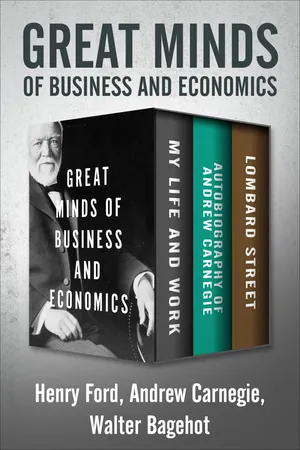
Three classic works on the art of succeeding in business, life, and high finance from three of modern history's most influential thought leaders.
My Life and Work: A legendary inventor and industrialist, Henry Ford pioneered the American automotive industry. In this combination of memoir and business treatise, he describes his early life as a mechanically inclined farmer's son, the inner workings of his eponymous motor company, and the development of the Model T. He also discusses key workplace principles such as compensating workers beyond the prevailing wage and building a diverse workforce.
The Autobiography of Andrew Carnegie: Scottish immigrant Andrew Carnegie worked his way up from bobbin boy to telegraph operator to railroad man, learning lessons along the way that would lead to his unparalleled success in the steel industry. In this acclaimed memoir, he shares his story of living the American dream, as well as insights on education, business, and the need to give back for the common good.
Lombard Street: Written in response to a nineteenth-century banking crisis in England, Walter Bagehot's influential treatise was one of the first to clearly explain complex financial systems in accessible language. As editor in chief of the
Economist, Bagehot also makes proposals for strengthening the economy, such as allowing irresponsible banks to collapse and creating strong central banks to combat inflation. His insights are as relevant today as they were when the book was first published in 1873.
eBook - ePub
Great Minds of Business and Economics
My Life and Work, Autobiography of Andrew Carnegie, and Lombard Street
- 679 pages
- English
- ePUB (mobile friendly)
- Available on iOS & Android
eBook - ePub
Great Minds of Business and Economics
My Life and Work, Autobiography of Andrew Carnegie, and Lombard Street
About this book
Information
Topic
Personal DevelopmentSubtopic
Business Skills
Autobiography of Andrew Carnegie


PREFACE
AFTER RETIRING FROM ACTIVE BUSINESS my husband yielded to the earnest solicitations of friends, both here and in Great Britain, and began to jot down from time to time recollections of his early days. He soon found, however, that instead of the leisure he expected, his life was more occupied with affairs than ever before, and the writing of these memoirs was reserved for his play-time in Scotland. For a few weeks each summer we retired to our little bungalow on the moors at Aultnagar to enjoy the simple life, and it was there that Mr. Carnegie did most of his writing. He delighted in going back to those early times, and as he wrote he lived them all over again. He was thus engaged in July, 1914, when the war clouds began to gather, and when the fateful news of the 4th of August reached us, we immediately left our retreat in the hills and returned to Skibo to be more in touch with the situation.
These memoirs ended at that time. Henceforth he was never able to interest himself in private affairs. Many times he made the attempt to continue writing, but found it useless. Until then he had lived the life of a man in middle life—and a young one at that—golfing, fishing, swimming each day, sometimes doing all three in one day. Optimist as he always was and tried to be, even in the face of the failure of his hopes, the world disaster was too much. His heart was broken. A severe attack of influenza followed by two serious attacks of pneumonia precipitated old age upon him.
It was said of a contemporary who passed away a few months before Mr. Carnegie that “he never could have borne the burden of old age.” Perhaps the most inspiring part of Mr. Carnegie’s life, to those who were privileged to know it intimately, was the way he bore his “burden of old age.” Always patient, considerate, cheerful, grateful for any little pleasure or service, never thinking of himself, but always of the dawning of the better day, his spirit ever shone brighter and brighter until “he was not, for God took him.”
Written with his own hand on the fly-leaf of his manuscript are these words: “It is probable that material for a small volume might be collected from these memoirs which the public would care to read, and that a private and larger volume might please my relatives and friends. Much I have written from time to time may, I think, wisely be omitted. Whoever arranges these notes should be careful not to burden the public with too much. A man with a heart as well as a head should be chosen.”
Who, then, could so well fill this description as our friend Professor John C. Van Dyke? When the manuscript was shown to him, he remarked, without having read Mr. Carnegie’s notation, “It would be a labor of love to prepare this for publication.” Here, then, the choice was mutual, and the manner in which he has performed this “labor” proves the wisdom of the choice—a choice made and carried out in the name of a rare and beautiful friendship.
Louise Whitfield Carnegie
New York, April 16, 1920
EDITOR’S NOTE
THE STORY OF A MAN’S LIFE, especially when it is told by the man himself, should not be interrupted by the hecklings of an editor. He should be allowed to tell the tale in his own way, and enthusiasm, even extravagance in recitation should be received as a part of the story. The quality of the man may underlie exuberance of spirit, as truth may be found in apparent exaggeration. Therefore, in preparing these chapters for publication the editor has done little more than arrange the material chronologically and sequentially so that the narrative might run on unbrokenly to the end. Some footnotes by way of explanation, some illustrations that offer sight-help to the text, have been added; but the narrative is the thing.
This is neither the time nor the place to characterize or eulogize the maker of “this strange eventful history,” but perhaps it is worth while to recognize that the history really was eventful. And strange. Nothing stranger ever came out of the Arabian Nights than the story of this poor Scotch boy who came to America and step by step, through many trials and triumphs, became the great steel master, built up a colossal industry, amassed an enormous fortune, and then deliberately and systematically gave away the whole of it for the enlightenment and betterment of mankind. Not only that. He established a gospel of wealth that can be neither ignored nor forgotten, and set a pace in distribution that succeeding millionaires have followed as a precedent. In the course of his career he became a nation-builder, a leader in thought, a writer, a speaker, the friend of workmen, schoolmen, and statesmen, the associate of both the lowly and the lofty. But these were merely interesting happenings in his life as compared with his great inspirations—his distribution of wealth, his passion for world peace, and his love for mankind.
Perhaps we are too near this history to see it in proper proportions, but in the time to come it should gain in perspective and in interest. The generations hereafter may realize the wonder of it more fully than we of to-day. Happily it is preserved to us, and that, too, in Mr. Carnegie’s own words and in his own buoyant style. It is a very memorable record—a record perhaps the like of which we shall not look upon again.
John C. Van Dyke
New York, August, 1920
CHAPTER I: PARENTS AND CHILDHOOD
IF THE STORY OF ANY MAN’S LIFE, truly told, must be interesting, as some sage avers, those of my relatives and immediate friends who have insisted upon having an account of mine may not be unduly disappointed with this result. I may console myself with the assurance that such a story must interest at least a certain number of people who have known me, and that knowledge will encourage me to proceed.
A book of this kind, written years ago by my friend, Judge Mellon, of Pittsburgh, gave me so much pleasure that I am inclined to agree with the wise one whose opinion I have given above; for, certainly, the story which the Judge told has proved a source of infinite satisfaction to his friends, and must continue to influence succeeding generations of his family to live life well. And not only this; to some beyond his immediate circle it holds rank with their favorite authors. The book contains one essential feature of value—it reveals the man. It was written without any intention of attracting public notice, being designed only for his family. In like manner I intend to tell my story, not as one posturing before the public, but as in the midst of my own people and friends, tried and true, to whom I can speak with the utmost freedom, feeling that even trifling incidents may not be wholly destitute of interest for them.
To begin, then, I was born in Dunfermline, in the attic of the small one-story house, corner of Moodie Street and Priory Lane, on the 25th of November, 1835, and, as the saying is, “of poor but honest parents, of good kith and kin.” Dunfermline had long been noted as the center of the damask trade in Scotland. My father, William Carnegie, was a damask weaver, the son of Andrew Carnegie after whom I was named.
My Grandfather Carnegie was well known throughout the district for his wit and humor, his genial nature and irrepressible spirits. He was head of the lively ones of his day, and known far and near as the chief of their joyous club—“Patiemuir College.” Upon my return to Dunfermline, after an absence of fourteen years, I remember being approached by an old man who had been told that I was the grandson of the “Professor,” my grandfather’s title among his cronies. He was the very picture of palsied eld;
“His nose and chin they threatened ither.”
As he tottered across the room toward me and laid his trembling hand upon my head he said: “And ye are the grandson o’ Andra Carnegie! Eh, mon, I ha’e seen the day when your grandfaither and I could ha’e hallooed ony reasonable man oot o’ his jidgment.”

ANDREW CARNEGIE’S BIRTHPLACE
Several other old people of Dunfermline told me stories of my grandfather. Here is one of them:
One Hogmanay night an old wifey, quite a character in the village, being surprised by a disguised face suddenly thrust in at the window, looked up and after a moment’s pause exclaimed, “Oh, it’s jist that daft callant Andra Carnegie.” She was right; my grandfather at seventy-five was out frightening his old lady friends, disguised like other frolicking youngsters.
I think my optimistic nature, my ability to shed trouble and to laugh through life, making “all my ducks swans,” as friends say I do, must have been inherited from this delightful old masquerading grandfather whose name I am proud to bear. A sunny disposition is worth more than fortune. Young people should know that it can be cultivated; that the mind like the body can be moved from the shade into sunshine. Let us move it then. Laugh trouble away if possible, and one usually can if he be anything of a philosopher, provided that self-reproach comes not from his own wrongdoing. That always remains. There is no washing out of these “damned spots.” The judge within sits in the Supreme Court and can never be cheated. Hence the grand rule of life which Burns gives:
“Thine own reproach alone do fear.”
This motto adopted early in life has been more to me than all the sermons I ever heard, and I have heard not a few, although I may admit resemblance to my old friend Baillie Walker in my mature years. He was asked by his doctor about his sleep and replied that it was far from satisfactory, he was very wakeful, adding with a twinkle in his eye: “But I get a bit fine doze i’ the kirk noo and then.”
On my mother’s side the grandfather was even more marked, for my grandfather Thomas Morrison was a friend of William Cobbett, a contributor to his Register, and in constant correspondence with him. Even as I write, in Dunfermline old men who knew Grandfather Morrison speak of him as one of the finest orators and ablest men they have known. He was publisher of The Precursor, a small edition it might be said of Cobbett’s Register, and thought to have been the first radical paper in Scotland. I have read some of his writings, and in view of the importance now given to technical education, I think the most remarkable of them is a pamphlet which he published seventy-odd years ago entitled “Head-ication versus Hand-ication.” It insists upon the importance of the latter in a manner that would reflect credit upon the strongest advocate of technical education to-day. It ends with these words, “I thank God that in my youth I learned to make and mend shoes.” Cobbett published it in the Register in 1833, remarking editorially, “One of the most valuable communications ever published in the Register upon the subject, is that of our esteemed friend and correspondent in Scotland, Thomas Morrison, which appears in this issue.” So it seems I come by my scribbling propensities by inheritance—from both sides, for the Carnegies were also readers and thinkers.
My Grandfather Morrison was a born orator, a keen politician, and the head of the advanced wing of the radical party in the district—a position which his son, my Uncle Bailie Morrison, occupied as his successor. More than one well-known Scotsman in America has called upon me, to shake hands with “the grandson of Thomas Morrison.” Mr. Farmer, president of the Cleveland and Pittsburgh Railroad Company, once said to me, “I owe all...
Table of contents
- Cover Page
- Title Page
- Contents
- MY LIFE AND WORKVER
- Copyright
Trusted by 375,005 students
Access to over 1.5 million titles for a fair monthly price.
Study more efficiently using our study tools.
Frequently asked questions
Yes, you can cancel anytime from the Subscription tab in your account settings on the Perlego website. Your subscription will stay active until the end of your current billing period. Learn how to cancel your subscription
No, books cannot be downloaded as external files, such as PDFs, for use outside of Perlego. However, you can download books within the Perlego app for offline reading on mobile or tablet. Learn how to download books offline
We are an online textbook subscription service, where you can get access to an entire online library for less than the price of a single book per month. With over 1.5 million books across 990+ topics, we’ve got you covered! Learn about our mission
Look out for the read-aloud symbol on your next book to see if you can listen to it. The read-aloud tool reads text aloud for you, highlighting the text as it is being read. You can pause it, speed it up and slow it down. Learn more about Read Aloud
Yes! You can use the Perlego app on both iOS and Android devices to read anytime, anywhere — even offline. Perfect for commutes or when you’re on the go.
Please note we cannot support devices running on iOS 13 and Android 7 or earlier. Learn more about using the app
Please note we cannot support devices running on iOS 13 and Android 7 or earlier. Learn more about using the app
Yes, you can access Great Minds of Business and Economics by Henry Ford,Andrew Carnegie,Walter Bagehot in PDF and/or ePUB format, as well as other popular books in Personal Development & Business Skills. We have over 1.5 million books available in our catalogue for you to explore.