The author of
Brother Carnival and
The World's Smallest Bible examines small-town life in this collection of sixteen stories.
There is an inexplicable gravity in a small town. It can be read and enjoyed like a favorite book for most of its inhabitants. Comforting are its streets and institutions, its wedding and obituary announcements.
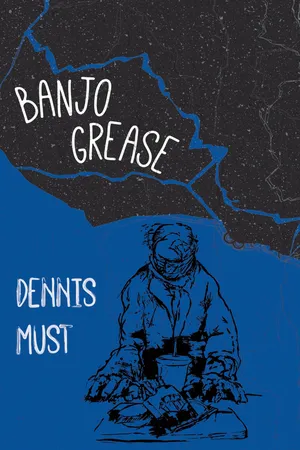
Banjo Grease is about life and death in a mill town where at each epiphany and rite of passage, the narrator yields a ration of innocence. Characters portray class as a marker as strong as race and gender, and distrust that they will ever escape in their lifetimes. Faulkner uses the term "eager fatalism." These stories' cumulative effect asks: When exchanging naiveté for worldliness, what is lost in denying one's past?
"These stories float through the reader like frozen images. Each one fits into the others unevenly as jagged glass. This is the essence of great fiction at the end of the century; Ray Carver and Thom Jones plowed into some stupendous force that whips along with a tilted wild energy." —Kate Gale, author of
The
Goldilocks Zone
"Dennis Must's first collection of short stories is no ordinary debut but the mature work of a fully accomplished literary artist. Moreover, his originality, his deep irreverence, and his compassion for working-class men and women . . . Strivers and seekers of dreams, signal him as an inspired author in a new American grain?a visionary, poet, and realist." —Tom Jenks, cofounder and editor,
Narrative Magazine
"Dennis Must's stunning collection
Banjo Grease is just what one hopes for: a series of intriguing, interlocking stories whose cumulative force goes beyond the sum of its parts."— Geoffrey Clark, author of
Two, Two, Lily-White Boys
- 168 pages
- English
- ePUB (mobile friendly)
- Available on iOS & Android
eBook - ePub
Banjo Grease
About this book
Trusted by 375,005 students
Access to over 1 million titles for a fair monthly price.
Study more efficiently using our study tools.
Information
Topic
LetteraturaSubtopic
Letteratura generalePASSING THROUGH AMBRIDGE
THEY GAVE ME a track lantern, but I had to buy the mattress-ticking cap. I asked Katy to pick me up a metal dinner bucket. “One of those that look like a silver-dome mobile home.” The railroaders all carried them.
I’d been anxious to get into the man’s game for some time. When I stepped off the bus in Mahoningtown at dusk, about a mile’s walk from the Baltimore & Ohio roundhouse, a kerchief knotted about my neck and sporting a new pair of steel-toed clodhoppers, it smelled and felt like the real thing. The couple nights a week at the archaic weight room in the local YMCA had begun to pay off, too.
Railroad tracks—one sure way out of town—held a special romance for me. The tracks were the primary source of the strange men who camped out at the brickyards near our house, nesting down alongside the ovens during the cold months. A week wouldn’t pass that one of these “vagrants” didn’t show up at our backdoor begging for food or coins in exchange for some odd job. Unkempt and smelling bad, they’d settle for a bologna sandwich and an orange in a paper sack that Katy would dangle outside the screen door like it was a dead mouse.
The tracks carried the circus and carnival into town, too. And once near Christmas, our old man took my brother, Westley, and me to Radio City Music Hall by rail. The first time the three of us had ever been out of Hebron. When we passed through the outskirts of Ambridge, Pap told us that all the bridges in America were built there. From the railcar we could see story-high AMBRIDGE letters on a factory building.
“Even the Golden Gate Bridge?” I asked.
“All of them, Son,” he said.
“The Brooklyn Bridge, too?” Westley asked.
“That, too,” Pap replied.
I had a difficult time imagining this small Pennsylvania town fabricating those mighty dream bridges over a piddley-ass river that ran in front of the plant. But when we got to New York City and I saw all those tall skyscrapers stacked up next to each other, their marble and gold lobbies tall as Hebron’s Masonic Temple, I was ready to believe anything.
Pap was the eye-opener of our family. Been up to our mother, Westley and me would’ve kept our eyes shut. Even later on in her life, Katy’d said, “I’ve seen enough.” But Pap, when he died, I specifically ordered Mr. Nolde, the mortician, to leave Pap’s eyes open. When we found him lying cold on the kitchen floor one morning, they were wide awake. Maybe he’d pass through Ambridge, I thought.
Dexter Connaughton, my track boss, handed me a janitor’s broom and pointed me to the supply depot just outside the roundhouse. My shift ran from 8 p.m. to 4 a.m. Weren’t quite an hour passed before Cannaughton showed up to check on me. Katy had taught me good work habits. She’d walked every lawn I’d ever mowed. If it wasn’t done to her satisfaction, she’d drag me back, apologize to the Mrs., and then the two of us would mow and trim until it suited her. But Connaughton wore a look of disapproval across his pudding face.
“What is it, sir?” I said.
“You aimin’ to keep this job for the whole summer, boy?”
“Yessir,” I said. “I like it here, sir.” They paid good union wages.
“Then you’d better brighten up—fast.”
He was eluding me.
“You watch anybody else work around here?”
“My second day, sir. Ain’t had much chance to observe.”
“How long you think this here job should take, Daugherty?”
“I guess I should have been done by now, huh?”
“Done?” he laughed, surveying the storage depot floor. “One week, Daugherty. This job should take you at least one damn week.”
“One week! I’ll be done in a half hour, sir.”
“Then pick up your paycheck. And don’t bother coming back tomorrow, ’cause there won’t be a goddamn thing for you to do.”
Katy would have shit. This was contrary to everything I knew about giving an honest day’s work in return for an honest dollar. Connaughton standing there ordering me to loaf, but pretend I was working. I wasn’t hired to work on the railroad; I was hired for summer stock, evening shift. And after I began observing my fellow workers, damn if they weren’t all actors, too. A crew would spend all night hauling supplies from the storage depot to the roundhouse. The next evening they’d trestle them back to the supply depot again. All these grown men working the night railyards, lanterns swinging from their sides, moving around like fireflies. Not one damn honest night’s labor occurring.
The fifth day of my employment, Connaughton directed me to an unhitched caboose out in the railyard, saying I’d find my crew inside. “Report to the caboose for the remainder of the summer, Daugherty,” he wheezed. Smoke rose out of its stovepipe chimney and as I got closer, I could hear chortling inside.
“C&O, go see who’s at our door,” a gruff voice ordered.
C&O, short for Chesapeake & Ohio, welcomed me in. Four bandanna-necked men sat around a potbelly stove drinking out of their tin lunch pail cups and playing poker on the caboose lunch table. Each was comfortably seated on upholstered railcar seat cushions with illuminated red caution bulbs on their rail lanterns alongside, creating a seasonal atmosphere. It was damn hot in the caboose. All of the men except C&O had stripped down to their undershirts. The temperature outside wasn’t below 700. One man—I presume the crew foreman—motioned me to sit down alongside C&O, who was sitting out the game. Along the inside walls of the caboose were seat rails appointed by these mohair seat cushions.
“Why’s it so damn hot?” I asked C&O, staring at the cheesecake calendars tacked above the players’ heads.
“Sal likes it that way.”
“Why? It’s summer outside.”
“Sal says he got to work up a sweat somehow.”
I started to laugh. C&O didn’t.
It must have been 900 in the caboose. I stripped down, but didn’t have any undershirt on. Finally the game was over. Sal rose.
“What’s your name?”
“Daugherty. Jimmy Daugherty.”
“Your old man a railroader?”
“No, sir.”
“How’d the fuck you get in here?”
“State Unemployment Office.”
“You’re a liar, Daugherty.”
“Honest to God,” I said. The three at the poker table looked like they were about to jump me. C&O held his head down. I knew about rites of initiation.
“You got to know somebody to work on the fucking Baltimore and Ohio railroad, Daugherty. Who in the hell is it? Don’t give us any shit, boy.” Sal wasn’t letting up.
“Maybe it’s his mother,” a heavyset, mustachioed worker drawled.
They all laughed. C&O tried to suppress his, clearly embarrassed by this confrontation.
“Your mother a gandy dancer?” another heckled. “You know Daugherty’s mother, C&O?”
C&O began to blush. Then giggle. Like somebody was fingering him under his armpits, jukin’ his ribs. He began to writhe in laughter, and his skeletal frame fell to the caboose floor, spittle seeping out the sides of his mouth. At first the men watched him bemusedly, then they, too, began to laugh. Soon, all of the men were laughing uproariously and emitting loud gas noises. I stood shirtless in the corner of the caboose, humorless. When the spell petered out, Sal addressed me.
“Well?”
“I’m here for the summer. Connaughton said you were short a man.”
“Short a man!” Sal croaked. He ran out of the caboose and pissed up against its side, caught in the paroxysm of laughter that once again had gripped the crew.
A factory whistle shattered the gaiety.
“Chow time!” C&O yelled.
We gathered around the caboose card table and opened our metal buckets.
“Welcome, Daugherty,” Sal said. “We don’t like pricks working with us. But a schoolboy needs help. When the summer job is over, put a fucking lid on it, boy. Don’t ever come back. Look at us.”
They did look like a sorry bunch. Sal was the only one who looked intelligent. He had the upper body of a boxer. And straight black hair Brilliantined to his head. Clean-shaven, with a Clorox-white undershirt. He wore a spotless pair of khaki pants that he or his wife had sewn a crease in. The other men, excluding C&O, were nondescript types. Reuben affected a mustache and a two-day-old beard, always. He also wore a navy pea coat even in the hottest weather. Except in the hot caboose, when it hung on a hook behind him. Reuben was grossly overweight—his undershirts all had a yellowish cast with a hole at the midriff, and an industrial-weight belt cinched so severely he looked like a knockwurst.
Otto and Sydney were older, bespectacled types. Like two vagrants who spent their time in libraries reading week-old newspapers. Each was always arguing with the other about politics. I sensed they were some kind of washed-up Party sympathizers. Sal would get impatient with their wrangling and tell them Stalin was a Sicilian who was jerkin’ them both off. But Otto and Sydney dismissed Sal, since they were intellectuals and he wasn’t. Each huddled about him like he were the caboose stove, however, even in the middle of July.
And C&O was a simpleton.
He couldn’t read, spell, or count and was dropped off to work each evening, then met at the guard’s gate at 4 a.m. by his emaciated mother, Rose Calucca. Carrying or sweeping he could do, tasks that had to be closely monitored by Sal—who was paternal toward him (sometimes sadistic). Both had Italian ancestry, and lived a few short streets from each other in Mahoningtown, close to the roundhouse. C&O’s brother, Junior Calucca, was a Baltimore & Ohio switch foreman on day shift—had been for nearly two decades—and when mother Rose Calucca grew too old and feeble to handle C&O, Junior finagled him a permanent job on the evening shift with Sal’s supply crew. (Sal was getting some vigorish on the side, we suspected.)
If you asked C&O to carry a carton of wiping rags, say, a hundred yards to the pumping station, after fifty he’d forget where he was going and return to the beginning, asking for fresh directions. He was perfect for the railroad play-acting job. My first night with the crew, watching the four play cards until 1 a.m., I was startled to hear Sal announce it was time to work. The fire had died out. We dressed to go outside the caboose, where Sal directed us to hand-truck thirty five-gallon cans of lubrication to the roundhouse for the steam engines. The following evening we carted them all back to the supply depot, short six—what the roundhouse requisitioned in the first place.
In the second week of my employment, I had the routine down. We’d meet in the caboose, I’d ignite a small fire in the potbelly stove, pour booze Sal had purloined from the B&O boardroom into each thermos, lay the cards out—and a game would ensue. I didn’t play, choosing instead to read books in the caboose’s corner.
“Do what you want, Daugherty,” the men obliged.
Occasionally one of them would ask what I was reading. Sydney would pull some political material he wanted me to read out of his lunch bucket. But it never went much further than that—my education on class warfar...
Table of contents
- Cover Page
- Title Page
- Copyright Page
- Contents
- Escape
- Chrysalis
- Big Whitey
- Say Hello To Stanley
- Horace
- Day Laborer
- The Scar
- Popeye’s Dead
- Passing Through Ambridge
- Banjo Grease
- The Aviary
- The Pruner
- White Shoulders
- Nolde’s Sun
- Cloth
- Oh, Josephine
- Acknowledgments
- Biographical Note
- Backcover
Frequently asked questions
Yes, you can cancel anytime from the Subscription tab in your account settings on the Perlego website. Your subscription will stay active until the end of your current billing period. Learn how to cancel your subscription
No, books cannot be downloaded as external files, such as PDFs, for use outside of Perlego. However, you can download books within the Perlego app for offline reading on mobile or tablet. Learn how to download books offline
Perlego offers two plans: Essential and Complete
- Essential is ideal for learners and professionals who enjoy exploring a wide range of subjects. Access the Essential Library with 800,000+ trusted titles and best-sellers across business, personal growth, and the humanities. Includes unlimited reading time and Standard Read Aloud voice.
- Complete: Perfect for advanced learners and researchers needing full, unrestricted access. Unlock 1.4M+ books across hundreds of subjects, including academic and specialized titles. The Complete Plan also includes advanced features like Premium Read Aloud and Research Assistant.
We are an online textbook subscription service, where you can get access to an entire online library for less than the price of a single book per month. With over 1 million books across 990+ topics, we’ve got you covered! Learn about our mission
Look out for the read-aloud symbol on your next book to see if you can listen to it. The read-aloud tool reads text aloud for you, highlighting the text as it is being read. You can pause it, speed it up and slow it down. Learn more about Read Aloud
Yes! You can use the Perlego app on both iOS and Android devices to read anytime, anywhere — even offline. Perfect for commutes or when you’re on the go.
Please note we cannot support devices running on iOS 13 and Android 7 or earlier. Learn more about using the app
Please note we cannot support devices running on iOS 13 and Android 7 or earlier. Learn more about using the app
Yes, you can access Banjo Grease by Dennis Must in PDF and/or ePUB format, as well as other popular books in Letteratura & Letteratura generale. We have over one million books available in our catalogue for you to explore.