The renowned Christian pastor and author of
The Message and
Run with Horses shares his spirituality in a very personal collection of poetry.
Eugene H. Peterson had long been known as a pastor, professor, and provocateur. With his first-ever collection of verse, Peterson became known as a poet, too.
Holy Luck emerged over many years, initially as individual poems sent to family, friends, and church congregations. Now, the translator of the bestselling Bible paraphrase
The Message has collected his poems into three thematic sections of verses—on the Beatitudes, the kingdom of God in the ordinary, and following Jesus everyday—here released as one transcendent volume.
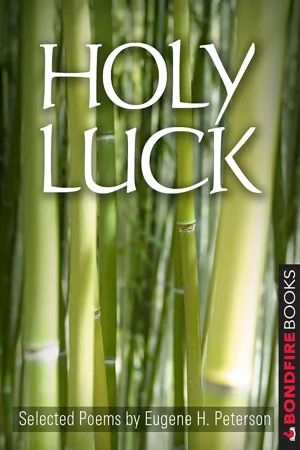
- 128 pages
- English
- ePUB (mobile friendly)
- Available on iOS & Android
eBook - ePub
About this book
Information
Subtopic
American PoetryIndex
Literature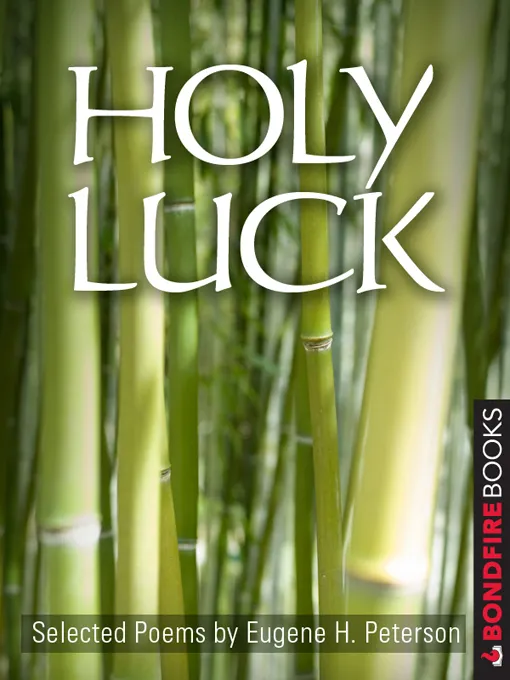
Holy Luck
Eugene H Peterson
“Good luck have thou with thine honour” Psalm 45:4 (BCP)
Copyright
Holy Luck
Copyright © 2012 by Eugene H Peterson
Cover art to the electronic edition copyright © 2012 by Bondfire, LLC
All rights reserved. No part of this book may be used or reproduced in any form or by any electronic or mechanical means, including information storage and retrieval systems, without permission in writing from the publisher, except by a reviewer who may quote brief passages in a review.
Electronic edition published 2012 by Bondfire LLC,
Author is represented by Alive Communications, Inc., 7680 Goddard St., Suite 200, Colorado Springs, CO 80920.
ISBN EPUB edition: 978-0-7953-2360-7
Dedication
For Jan in our 54th year of marriage
Contents
Title Page
Copyright Page
Introduction
I Holy Luck
1 The Lucky Poor
2 The Lucky Sad
3 The Lucky Meek
4 The Lucky Hungry
5 The Lucky Merciful
6 The Lucky Pure
7 The Lucky Peacemakers
8 The Lucky Persecuted
II The Rustling Grass
1 Cradle
2 Dream
3 Tree
4 Present
5 Kiss
6 Pain
7 Dance
8 Star
9 Time
10 Candle
11 Offertory
12 War
13 Choir
14 Greetings
15 Feast
16 Stamp
17 Womb
18 Question
19 Dawn
20 Egypt
21 Message
22 Lights
23 Pregnancy
24 Glory
25 Meditation
26 Homecoming
27 Story
28 Quiet
29 Terror
30 Snow
31 Ancestors
32 Silence
33 Beauty
34 Hospitality
35 Uncle Ernie
36 Altar
37 Yes and Amen and Jesus
38 Green
39 Friends
III Smooth Stones
1 Smooth Stones
2 A Prayer of Blessing for Trygve the New
3 Assateague Island
4 Lazarus in Spring
5 Beware the Dogs
6 Prayer Time
7 Intercessory Prayer
8 Aaron’s Beard
9 Lent
10 Hell
11 Ascension
12 Shalom
13 Maranatha
14 Birdwatching
15 Let No Man Put Asunder
16 Ballad to the Fisher King
17 Light on Light
18 Sermons from Figs
19 A Cave of Marriage
20 Resurrection Flower
21 The New Math
22 Stations of the Cross
23 Sabbath Prayers
Introduction
David’s Psalms were my introduction to poetry. I was thirteen years old and had just purchased with my own money a burgundy, leather-bound King James Bible. It was summer and we had just moved across town to a neighborhood where I had yet to make new friends. Friendless and bored I filled in the empty, unfriended days by reading my new Bible. It wasn’t long before I discovered the Psalms.
The biblical culture in which I grew up was fiercely insistent that every word in the Bible is true just as it appears on the page, literally true, straight from the mouth of God, no questions asked. But in the Psalms that way of reading wasn’t getting me anywhere I wanted to go. I read “…thou, O Lord, art a shield…The Lord is my rock….put thou my tears in thy bottle…God shall shoot at them with an arrow…”
God is a weapon? God is a rock? God carries a specimen bottle to collect tears? God prowls the earth with bow and arrow to destroy my enemies?
Literal wasn’t working for me. But I was shy about asking questions, fearful that I would be reprimanded for calling the Bible, God’s very words, into question. In the church world I inhabited asking questions was suspect and so I plodded on, quite enjoying the rhythms and images but puzzled how to make literal sense of them. And in the process of plodding, without really noticing what was happening, I quit trying to figure these psalms out and found myself drawn into a world of words in which I was no longer a questioner but a participant, and enjoying the participation.
About half way through the summer I realized that there was a way of using words that was not literal. I was learning more or less on the job the magic of metaphor, although it would be years before I acquired a vocabulary to name what I was experiencing in David’s poems....
Table of contents
- Cover Page
- Title Page
Trusted by 375,005 students
Access to over 1.5 million titles for a fair monthly price.
Study more efficiently using our study tools.
Frequently asked questions
Yes, you can cancel anytime from the Subscription tab in your account settings on the Perlego website. Your subscription will stay active until the end of your current billing period. Learn how to cancel your subscription
No, books cannot be downloaded as external files, such as PDFs, for use outside of Perlego. However, you can download books within the Perlego app for offline reading on mobile or tablet. Learn how to download books offline
Perlego offers two plans: Essential and Complete
- Essential is ideal for learners and professionals who enjoy exploring a wide range of subjects. Access the Essential Library with 800,000+ trusted titles and best-sellers across business, personal growth, and the humanities. Includes unlimited reading time and Standard Read Aloud voice.
- Complete: Perfect for advanced learners and researchers needing full, unrestricted access. Unlock 1.5M+ books across hundreds of subjects, including academic and specialized titles. The Complete Plan also includes advanced features like Premium Read Aloud and Research Assistant.
We are an online textbook subscription service, where you can get access to an entire online library for less than the price of a single book per month. With over 1.5 million books across 990+ topics, we’ve got you covered! Learn about our mission
Look out for the read-aloud symbol on your next book to see if you can listen to it. The read-aloud tool reads text aloud for you, highlighting the text as it is being read. You can pause it, speed it up and slow it down. Learn more about Read Aloud
Yes! You can use the Perlego app on both iOS and Android devices to read anytime, anywhere — even offline. Perfect for commutes or when you’re on the go.
Please note we cannot support devices running on iOS 13 and Android 7 or earlier. Learn more about using the app
Please note we cannot support devices running on iOS 13 and Android 7 or earlier. Learn more about using the app
Yes, you can access Holy Luck by Eugene H. Peterson in PDF and/or ePUB format, as well as other popular books in Literature & American Poetry. We have over 1.5 million books available in our catalogue for you to explore.