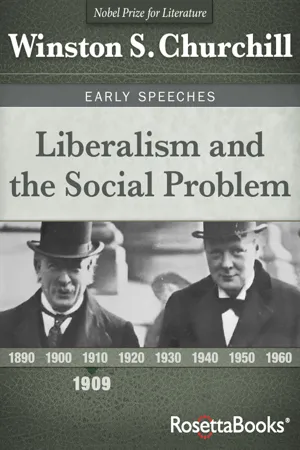
This collection of speeches from 1906 to 1909 documents Churchill's early years as a Member of the Liberal Party in the House of Commons.
Sir Winston Churchill is admired as a brilliant Conservative politician and statesman—but he wasn't always a Conservative. In 1904, he crossed over to join the Liberal party, becoming Under-Secretary of State for the Colonies and later joining the Liberal Cabinet. This collection of his speeches reveals Churchill's dramatic shift toward a more progressive governing philosophy.
Here, the young MP's fervently argues his positions on some of the most important issues of the time, including the "People's Budget," a highly controversial new wealth distribution initiative. The resulting conflict between the House of Lords and the House of Commons led to the passage of the Parliament Act of 1911, asserting the House of Commons' legislative powers. This compilation of speeches is both an enlightening historical document and a fascinating display of the future Prime Minister's political insights and oratory skill.
- 164 pages
- English
- ePUB (mobile friendly)
- Available on iOS & Android
eBook - ePub
Liberalism and the Social Problem
About this book
Information
Subtopic
Modern British HistoryIndex
LiteratureI
THE RECORD OF THE GOVERNMENT
THE CONCILIATION OF SOUTH AFRICA
HOUSE OF COMMONS, April 5, 1906
We have travelled a long way since this Parliament assembled, in the discussion of the Transvaal and Orange River Colony Constitutions. When the change of Government took place Mr. Lyttelton’s Constitution was before us. That instrument provided for representative and not responsible government. Under that Constitution the election would have been held in March of this year, and the Assembly would have met in June, if the home Government had not changed. But just at the time that the Government changed in December two questions arose—the question of whether or not soldiers of the British Army in garrison should be allowed to vote; and the question whether it would not be better to have sixty constituencies instead of thirty; and, as both questions involved necessary alterations in the Letters Patent, the time was ripe, quite apart from any difference which the change of the men at the helm might make, for a reconsideration and review of the whole form of the government which was to be given to the two Colonies.
The objection that must most readily occur in considering Mr. Lyttelton’s Constitution is that it was unworkable. It proposed that there should be from six to nine nominated Ministers in an Assembly of thirty-five, afterwards to be increased to sixty elective members. The position of a Minister is one of considerable difficulty. He often has to defend rather an awkward case. When favourable facts are wanting he has to depend upon the nimbleness of his wits, and, when these fail him, he has to fall back upon the loyalty of his supporters. But no Minister can move very far upon his road with satisfaction or success if he has not behind him either a nominated majority or an organised Party majority. Mr. Lyttelton’s Ministers had neither. They would have been alone, hopelessly outnumbered in an Assembly, the greater part of which was avowedly in favour of responsible and not of representative government. These Ministers, with one exception, had no previous Parliamentary experience and no ascertained Parliamentary ability. They would have been forced to carry their Bills and their Estimates through an Assembly in the main opposed to them. All this time, while we should have given to these Ministers this serious duty, we should ourselves have had to bear the whole responsibility in this country for everything that was done under their authority; and their authority could only be exerted through an Assembly which, as things stood, they could not control.
The Committee can easily imagine the telegrams and the questions which would have been addressed from Downing Street and the House of Commons to these Ministers on native matters, on the question of the administration of the Chinese Ordinance, on all the numerous intricate questions with which we are at the present moment involved in South Africa. And what would have been the position of these Ministers, faced with these embarrassments in a hostile Assembly in which they had few friends—what possibility would they have had of maintaining themselves in such an Assembly? Is it not certain that they would have broken down under the strain to which they would have been exposed, that the Assembly would have been infuriated, that Parties differing from each other on every conceivable question, divided from each other by race and religion and language, would have united in common hatred of the interference of the outside Power and the government of bureaucrats. Then we should very speedily have got to the bottom of the hill. There would have been a swift transition. The Legislative Assembly would have converted itself into a constituent Assembly, and it would have taken by force all that the Government now have it in their power to concede with grace, distinction, and authority. On these grounds his Majesty’s Government came to the conclusion that it would be right to omit the stage of representative government altogether and to go directly to the stage of responsible government.
It is the same in politics as it is in war. When one crest line has been left, it is necessary to go to the next. To halt half-way in the valley between is to court swift and certain destruction, and the moment you have abandoned the safe position of a Crown Colony government, or government with an adequate nominated majority, there is no stopping-place whatever on which you may rest the sole of your foot, until you come to a responsible Legislative Assembly with an executive obeying that Assembly. These arguments convinced his Majesty’s Government that it would be necessary to annul the Letters Patent issued on March 31, 1905, and make an end of the Lyttelton Constitution. That Constitution now passes away into the never-never land, into a sort of chilly limbo that is reserved for the disowned or abortive political progeny of many distinguished men.
The Government, and those who support them, may rejoice that we have been able to take this first most important step in our South African policy with such a very general measure of agreement, with, indeed, a consensus of opinion which almost amounts to unanimity. Both races, every Party, every class, every section in South Africa have agreed in the course which his Majesty’s Government have adopted in abandoning representative government and going at once to responsible government. That is already a very great thing, but it was not always so. Those who sat in the last Parliament will remember that it was not always so. We remember that Lord Milner was entirely opposed to granting responsible government. We know that Mr. Lyttelton wrote pages and pages in the Blue Book of last year proving how futile and dangerous responsible government would be; and the right hon. Member for West Birmingham, who took the Government decision as a matter of course on the first day of the present session, made a speech last session in which he indicated in terms of great gravity and force, that he thought it was wholly premature to grant responsible government to the Transvaal. But all that is abandoned now. I heard the right hon. Member for West Birmingham, in the name of the Party opposite, accept the policy of his Majesty’s Government. I heard the hon. Member for Blackpool this afternoon say that he hoped that responsible government would be given to the Transvaal at the earliest possible moment. In regard to the Orange River Colony, it is quite true that the official Opposition, so far as I gather their view, think that it should be delayed, and should not be given at the same time as to the Transvaal; but that is not the view of the right hon. Member for West Birmingham. Speaking in the House of Commons on July 27, 1905, the right hon. gentleman said:
“Objection has also been taken that the same government which is now being given to the Transvaal has not been given to the Orange River Colony. I think that the experiment might have been far better tried in the Orange River Colony. It is quite true that in that Colony there is an enormous majority of the Dutch or Boer population. But they have shown by long experience that they are most capable and moderate administrators—under the admirable rule of President Brand they set an example to the whole of South Africa; and although I think there is some danger in this experiment, it is in the Orange River Colony that I myself would have been inclined, in the first instance, to take the risk.”
It is true the right hon. gentleman was speaking of representative government; but it cannot be disputed that if an advance were to be made in associating the people of the conquered Colonies with the government of those Colonies, the right hon. gentleman thought that it had better be in the Orange River Colony first. But at any rate now it is incontestable that there is no Party in this country or in the Transvaal that opposes the grant of responsible government to the Transvaal. That is a great advance, and shows that we have been able to take our first step with the approbation of all concerned.
But the Opposition, having abandoned their resistance to the grant of responsible government, now contend that on no account must the basis of the Lyttelton Constitution be departed from. I am not convinced by that argument. The Government are to pursue a new purpose, but to adhere to the old framework. We are to cut off the head of the Lyttelton Constitution, but are to preserve the old trunk and graft a new head on it. I do not believe that any Government, approaching this question from a new point of view, uncompromised and unfettered, would be bound by the framework and details of the Lyttelton Constitution. It may be that that Constitution contains many excellent principles, but the Government have a right to consider things from the beginning, freshly and freely, to make their own plans in accordance with their own ideas, and to present those plans for the acceptance of the House.
The noble lord the Member for South Birmingham spoke of the principle of “one vote, one value,” which was embodied in the Lyttelton Constitution. The principle of “one vote, one value” is in itself an orthodox and unimpeachable principle of democracy. It is a logical, numerical principle. If the attempt be made to discriminate between man and man because one has more children and lives in the country, it would be arguable that we should discriminate because another man has more brains or more money, or lives in the town, or for any other of the many reasons that differentiate one human being from another. The only safe principle, I think, is that for electoral purposes all men are equal, and that voting power, as far as possible, should be evenly distributed among them.
In the Transvaal the principle of “one vote, one value” can be made operative only upon a basis of voters. In nearly every other country in the world, population is the usual basis of distribution, for population is the same as electorate and electorate the same as population. On both bases the distribution of the constituencies would be the same. There is, for instance, no part of this country which is more married, or more celibate, or more prolific than any other part. It is only in the Transvaal, this country of afflicting dualities and of curious contradictions, where everything is twisted, disturbed, and abnormal, that there is a great disparity between the distribution of seats on the basis of voters and on the basis of population. The high price of provisions in the towns restricts the growth of urban population, and the dullness of the country districts appears to be favourable to the growth of large families. It is a scientific and unimpeachable fact that, if you desire to apply the principle of “one vote, one value” to the Constitution of the Transvaal, that principle can best be attained—I am not sure that it cannot only be attained—on the basis of voters, and that is the basis Mr. Lyttelton took in the Constitution he formed.
But Mr. Lyttelton’s plan did not stop there. Side by side with this basis of voters, he had an artificial franchise of £100 annual value. That is a very much lower qualification in South Africa, than it would be in this country, and I do not think that the franchise which Mr. Lyttelton proposed could be called an undemocratic franchise, albeit that it was an artificial franchise, because it yielded 89,000 voters out of a population of 300,000, and that is a much more fertile franchise, even after making allowance for the abnormal conditions of a new country, than we have in this country or than is the case in some American and European States. So that I do not accuse Mr. Lyttelton of having formulated an undemocratic franchise, but taking these two points together—the unusual basis of distribution with the apparently artificial franchise—acting and reacting, as they must have done, one upon the other—there was sufficient ground to favour the suspicion, at any rate, that something was intended in the nature of a dodge, in the nature of a trick, artificially to depress the balance in one direction and to tilt it in the other.
In dealing with nationalities, nothing is more fatal than a dodge. Wrongs will be forgiven, sufferings and losses will be forgiven or forgotten, battles will be remembered only as they recall the martial virtues of the combatants; but anything like chicane, anything like a trick, will always rankle. The Government are concerned in South Africa not only to do what is fair, but to do what South Africa will accept as fair. They are concerned not merely to choose a balance which will deal evenly between the races, but one which will secure the acceptance of both races.
***
We meet unjust charges in good heart. The permanence and security of British sovereignty in South Africa is not a matter of indifference to his Majesty’s Ministers. Surely no honourable Member believes that we could wish to cheat the British race in the Transvaal of any numerical preponderance which may properly belong to them. Equally with our political opponents we desire to see the maintenance of British supremacy in South Africa. But we seek to secure it by a different method. There is a profound difference between the schools of thought which exist upon South African politics in this House. We think that British authority in South Africa has got to stand on two legs. You have laboured for ten years to make it stand on one. We on this side know that if British dominion is to endure in South Africa it must endure with the assent of the Dutch, as well as of the British. We think that the position of the Crown in South Africa, and let me add the position of Agents and Ministers of the Crown in South Africa, should be just as much above and remote from racial feuds, as the position of the Crown in this country is above our Party politics. We do not seek to pit one race against the other in the hope of profiting from the quarrel. We hope to build upon the reconciliation and not upon the rivalry of races. We hope that it may be our fortune so to dispose of affairs that these two valiant, strong races may dwell together side by side in peace and amity under the shelter of an equal flag.
THE TRANSVAAL CONSTITUTION
HOUSE OF COMMONS, July 31, 1906
It is my duty this afternoon, on behalf of the Government, to lay before the Committee the outline and character of the constitutional settlement which we have in contemplation in regard to the lately annexed Colonies in South Africa. This is, I suppose, upon the whole, the most considerable business with which this new Parliament has had to deal. But although no one will deny its importance, or undervalue the keen emotions and anxieties which it excites on both sides of the House, and the solemn memories which it revives, yet I am persuaded that there is no reason why we should be hotly, sharply, or bitterly divided on the subject; on the contrary, I think its very importance makes it incumbent on all who participate in the discussion—and I will certainly be bound by my own precept—to cultivate and observe a studious avoidance of anything likely to excite the ordinary recriminations and rejoinders of Party politics and partisanship.
After all, there is no real difference of principle between the two great historic Parties on this question. The late Government have repeatedly declared that it was their intention at the earliest possible moment—laying great stress upon that phrase—to extend representative and responsible institutions to the new Colonies; and before his Majesty’s present advisers took office the only question in dispute was, When? On the debate on the Address, the right hon. Member for West Birmingham—whose absence to-day and its cause I am quite sure are equally regretted in all parts of the House—spoke on this question with his customary breadth of view and courage of thought He said: “The responsibility for this decision lies with the Government now in power. They have more knowledge than we have; and if they consider it safe to give this large grant, and if they turn out to be right, no one will be better pleased than we. I do not think that, although important, this change should be described as a change in colonial policy, but as continuity of colonial policy.”
If, then, we are agreed upon the principle, I do not think that serious or vital differences can arise upon the method. Because, after all, no one can contend that it is right to extend responsible government, but not right to extend it fairly. No one can contend that it is right to grant the forms of free institutions, and yet to preserve by some device the means of control. And so I should hope that we may proceed in this debate without any acute divergences becoming revealed.
I am in a position to-day only to announce the decision to which the Government have come with respect to the Transvaal. The case of the Transvaal is urgent. It is the nerve-centre of South Africa. It is the arena in which all questions of South African politics—social, moral, racial, and economic—are fought out; and this new country, so lately reclaimed from the wilderness, with a white population of less than 300,000 souls, already reproduces in perfect miniature all those dark, tangled, and conflicting problems usually to be found in populous and old-established European States. The case of the Transvaal differs fundamentally from the case of the Orange River Colony. The latter has been in the past, and will be again in the future, a tranquil agricultural State, pursuing under a wise and tolerant Government a happy destiny of its own. All I have to say about the Orange River Colony this afternoon is this—that there will be no unnecessary delay in the granting of a Constitution; and that in the granting of that Constitution we shall be animated only by a desire to secure a fair representation of all classes of inhabitants in the country, and to give effective expression to the will of the majority.
When we came into office, we found a Constitution already prepared for the Transvaal by the right hon. Member for St. George’s, Hanover Square.1 That Constitution is no more. I hope the right hon. gentleman will not suspect me of any malevolence towards his offspring. I would have nourished and fostered it with a tender care; but life was already extinct. It had ceased to breathe even before it was born; but I trust the right hon. gentleman will console himself by remembering that there are many possibilities of constitutional settlements lying before him in the future. After all, the Abbé Sieyès, when the Constitution of 1791 was broken into pieces, was very little younger than the right hon. gentleman, and he had time to make and survive two new Constitutions.
Frankly, what I may, for brevity’s sake, call the Lyttelton Constitution was utterly unworkable. It surrendered the machinery of power; it preserved the whole burden of responsibility and administration. Nine official gentlemen, nearly all without Parliamentary experience, and I daresay without Parliamentary aptitudes, without the support of that nominated majority which I am quite convinced that the right hon. Member for West Birmingham had always contemplated in any scheme of representative government, and without the support of an organised party, were to be placed in a Chamber of thirty-five elected members who possessed the power of the purse. The Boers would either have abstained altogether from participating in that Constitution, or they would have gone in only for the purpose of wrecking it. The British party was split into two sections, and one section, the Responsibles, made public declarations of their intention to bring about a constitutional deadlock by obstruction and refusing supplies, and all the other apparatus of Parliamentary discontent. In fact, the Constitution of the right hon. gentleman seemed bound inevitably to conjure up that nightmare of all modern politicians, government resting on consent, and consent not forthcoming.
As I told the House in May, his Majesty’s Government thought it their duty to review the whole question. We thought it our duty and our right to start fair, free, and untrammelled, and we have treated the Lyttelton Constitution as if it had never been. One guiding principle has animated his Majesty’s Government in their policy—to make no difference in this grant of responsible government between Boer and Briton in South Africa. We propose to extend to both races the fullest privileges and rights of British citizenship; and we intend to make no discrimination in the grant of that great boon, between the men who have fought most loyally for us and those who have resisted the British arms with the most desperate courage. By the Treaty of Vereeniging, in which the peace between the Dutch and British races was declared for ever, by Article 1 of that treaty the flower of the Boer nation and its most renowned leaders recognised the lawful authority of his Majesty King Edward VII, and henceforth, from that moment, British supremacy in South Africa stood on the sure foundations of...
Table of contents
- Cover
- Title Page
- Copyright
- Contents
- Introduction
- I
- II
- III
- Endnotes
Trusted by 375,005 students
Access to over 1.5 million titles for a fair monthly price.
Study more efficiently using our study tools.
Frequently asked questions
Yes, you can cancel anytime from the Subscription tab in your account settings on the Perlego website. Your subscription will stay active until the end of your current billing period. Learn how to cancel your subscription
No, books cannot be downloaded as external files, such as PDFs, for use outside of Perlego. However, you can download books within the Perlego app for offline reading on mobile or tablet. Learn how to download books offline
Perlego offers two plans: Essential and Complete
- Essential is ideal for learners and professionals who enjoy exploring a wide range of subjects. Access the Essential Library with 800,000+ trusted titles and best-sellers across business, personal growth, and the humanities. Includes unlimited reading time and Standard Read Aloud voice.
- Complete: Perfect for advanced learners and researchers needing full, unrestricted access. Unlock 1.5M+ books across hundreds of subjects, including academic and specialized titles. The Complete Plan also includes advanced features like Premium Read Aloud and Research Assistant.
We are an online textbook subscription service, where you can get access to an entire online library for less than the price of a single book per month. With over 1.5 million books across 990+ topics, we’ve got you covered! Learn about our mission
Look out for the read-aloud symbol on your next book to see if you can listen to it. The read-aloud tool reads text aloud for you, highlighting the text as it is being read. You can pause it, speed it up and slow it down. Learn more about Read Aloud
Yes! You can use the Perlego app on both iOS and Android devices to read anytime, anywhere — even offline. Perfect for commutes or when you’re on the go.
Please note we cannot support devices running on iOS 13 and Android 7 or earlier. Learn more about using the app
Please note we cannot support devices running on iOS 13 and Android 7 or earlier. Learn more about using the app
Yes, you can access Liberalism and the Social Problem by Winston S. Churchill in PDF and/or ePUB format, as well as other popular books in Literature & Modern British History. We have over 1.5 million books available in our catalogue for you to explore.