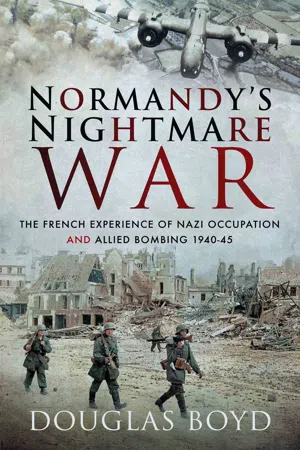
The toll that both Nazi occupation and Allied liberation took on this northern French region during World War II, told through eyewitness accounts.
Famous for Calvados apple brandy and Camembert cheese, Normandy is a green and pleasant land now dotted with thousands of British-owned second homes. Its coastline is also dotted with thousands of indestructible reinforced-concrete bunkers and gun emplacements that formed part of the Atlantic Wall of Hitler's Fortress Europe.
Tourists passing through the ferry ports like Boulogne, Cherbourg and Dunkirk may wonder why there are so few old buildings. Few know that the demolition which preceded the extensive urban renewal of the ancient town centers was affected by British bombs during four years of hell for the people living there. Before its belated liberation three ghastly months after D-Day, the sirens in Le Havre wailed 1,060 times to warn of approaching British and American bombers. After one single Allied raid, over 3,000 dead civilians were recovered from the city's ruins, without counting the thousands of injured, maimed and traumatized survivors.
So, whom did the Normans regard as the enemy: the German occupiers who shot a few hundred civilians or the Allied airmen who killed as many neutral citizens of northern France as died in Britain from German bombs during the whole war?
Told largely in the words of French, German and Allied eyewitnesses—including the moving last letters of executed hostages—this is the story of Normandy's nightmare war.
"Boyd . . . uncovers some remarkable facts . . . A fascinating look at a region that has played a huge part in our own history." —
Books Monthly
eBook - ePub
Normandy's Nightmare War
The French Experience of Nazi Occupation and Allied Bombing, 1940–45
- 224 pages
- English
- ePUB (mobile friendly)
- Available on iOS & Android
eBook - ePub
Normandy's Nightmare War
The French Experience of Nazi Occupation and Allied Bombing, 1940–45
About this book
Information
PART 1
DEMORALISATION AND DEFEAT
Chapter 1
Days of desperation
Woken at 01.00hrs on 10 May 1940 to hear the latest intelligence reports from France’s north-eastern frontier, where Hitler had been building up his ground and air forces for a massive invasion, the 70-year-old syphilitic French commander-in-chief General Maurice-Gustave Gamelin muttered, ‘Take no action,’ and went back to sleep. History does not record the wakefulness or otherwise of commanders closer to the impending action, like the C-in-C of the British Expeditionary Force (BEF) General Lord John Gort at his HQ in the Château de Habarcq near Arras, nor that of General Blanchard, commanding the French 1st Army Group, under whose orders Gort was placed.
None of the several million men massed on the German side of the Rhine had much sleep that night. With his eastern frontiers secured for the moment by the Ribbentrop–Molotov Non-Aggression Pact signed before his unprovoked attack on Poland in September 1939, Adolf Hitler had deployed on Germany’s western frontiers no less than 135 divisions, including twelve Panzer divisions with 2,439 tanks. Close support of these ground troops was to be provided by 3,369 warplanes of the Luftwaffe, back to strength after losing thirty per cent of its aircraft in the invasion of Poland.1
Facing them were 104 French divisions and the fifteen divisions of the BEF, plus significant reserves. This should have been sufficient to fight a defensive action in prepared positions, without counting the armies of neutral Belgium – through which the German advance was planned to drive – and Holland, the conquest of which was necessary to secure the right flank of Hitler’s attack.
The British government of Neville Chamberlain had promised to assist the defence of France by building up the BEF to thirty-two, and eventually, forty-five, divisions – but not before 1941 at the earliest!2 Did Chamberlain think that Hitler would delay the start of the war he planned to give the Allies a sporting chance? With the French government calling up 4,725,350 French reservists in September 1939 to swell the ranks of its 800,000-strong standing army – the largest in Europe – as against 394,165 men in the BEF, many French political and military leaders thought that Britain was under-committed to the alliance in terms of both manpower and equipment on the ground in France. When nothing happened in the months of the phoney war that the French called la drôle de guerre and the Germans der Sitzkrieg, hundreds of thousands of conscripts from rural areas of France were sent home to prepare the land for the coming year’s harvests.
It is not true that the French General Staff placed all its faith in the Maginot Line – the chain of technically impressive and allegedly impregnable concrete fortifications that ran from the Swiss frontier opposite Basel northward along the left bank of the Rhine and then north-westward to Montmédy on the frontier with Belgium. However, both British and French general staffs refused to accept that modern weaponry had changed the nature of military conflict from static slogging matches to Blitzkrieg – the new warfare made possible by fast-moving armoured columns with integrated air support. Politicians and generals on both sides of the Channel had been persistently deaf to the vociferous protests of a few rebel officers like Colonel Charles De Gaulle, who advocated grouping tanks in mobile columns with their own motorized artillery and close air support. Both the RAF and the French Air Force considered that integration of their fighter arms with ground forces would be an unacceptable subordination to the ‘brown jobs’, even after Hitler’s invasion of Poland proved its terrible efficiency.
Making matters worse in France, forty-one of the best French infantry divisions were immobilised in and behind the Maginot Line, with only thirty-nine divisions plus the BEF on the 300-mile stretch from the western end of the Line to the Channel coast. Of these, twelve infantry and four horsed cavalry divisions were tasked with holding the least fortified stretch east and west of Sedan, where the German armies had broken through in 1870 and 1914. General André Georges Corap, commanding 9th Army in that sector, repeatedly protested that he was critically short of men and material, which were pointlessly immobilised in the Maginot Line sector. However, Gamelin stuck obstinately to his conviction that there was no need to reinforce 9th Army because the hilly, forested area of the Ardennes to the north of Sedan was impassable for German mechanised troops.
Accordingly, the defenders on this crucial stretch of the frontier were largely second-rate divisions rotated so often that officers neither knew their men nor which units were on their flanks, while the conscripts they commanded were less acquainted with weaponry than with the picks and shovels they had been issued to construct blockhouses and trenches in a hopeless endeavour to extend the Line westwards in a race against the clock. Here, too, ninety per cent of French artillery pieces dated from the First World War and the troops in the sector of Sedan itself had not a single anti-tank gun capable of stopping a Panzer in 1940.3
After Gamelin awoke later on 10 May to learn that the German attack had begun at 04.30hrs, the French 7th Army under General Giraud advanced according to plan from its positions on the Channel coast, with the BEF and Blanchard’s 1st Army moving up alongside until they reached the Dyle River in Belgium. This move had not been permitted earlier by the Belgian government because they thought it would jeopardise Belgian neutrality – as though Hitler was likely to be deterred by that! Like many ideas that look good on paper or a sand table, yet fail miserably in practice, the new Dyle Line had no effect on the German advance because it was in the wrong place.
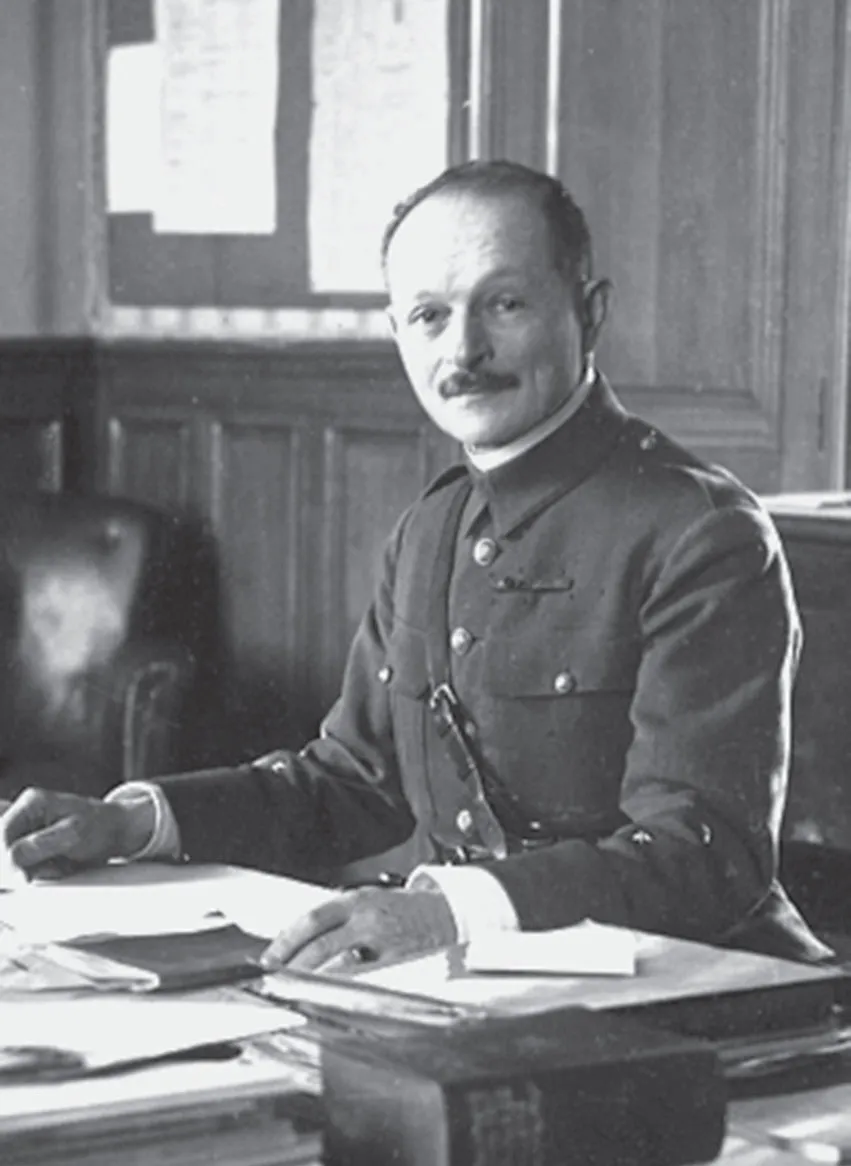
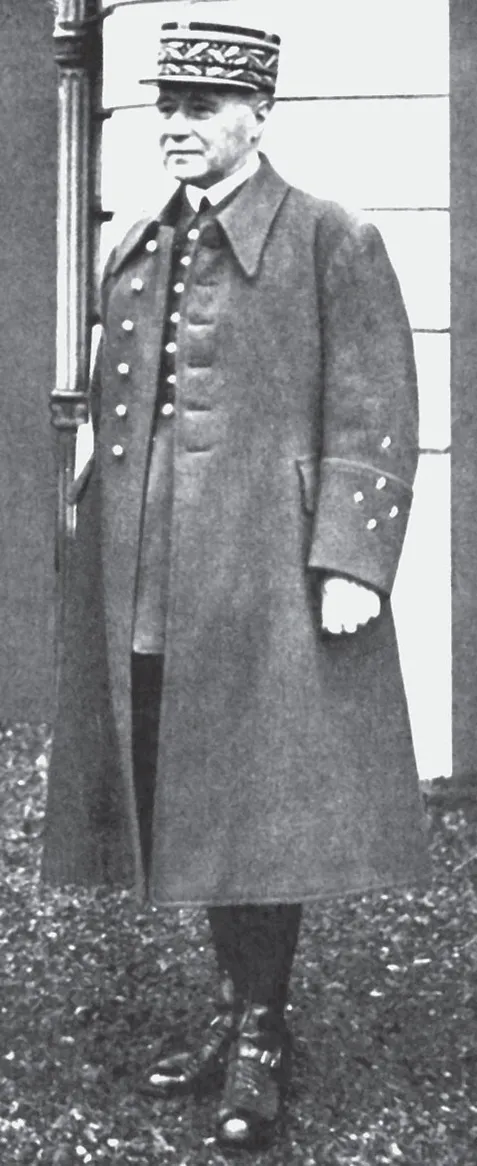
French commanding generals Weygand (left) and Gamelin (right).
In the north, General Fedor von Bock’s Army Group B drove on several axes into Holland, forcing the Dutch army back to the coast, after which the terror-bombing of Rotterdam caused the Dutch queen to surrender and flee with her family to Britain. In the south, General Wilhelm von Leeb’s German Army Group C stayed opposite the Maginot Line to inhibit any move by the French to re-deploy its enormous garrison. The key to the success of the German master plan was Field Marshal Gerd von Rundstedt’s Army Group A, placed in the centre of the three-pronged attack. This comprised more than 1.5 million men and 1,500 tanks in forty-four divisions, with twenty-seven more in reserve. In a classic, fast-moving Panzer operation with close air support, planned by General Erich von Manstein, seven armoured divisions drove into Luxemburg and Belgium, aiming at the weakest point in the Franco- British line: Sedan.
Panic in Downing Street saw Chamberlain resigning that evening and Winston Churchill installed as prime minister of a government of national unity. Forty-eight hours later, the German spearheads were across the Franco–Belgian frontier, causing a rout on either side of their advance which made imperative a rapid retreat from the Dyle Line by the French and British forces there, if they were not to be completely cut off.
Hermann Goering’s Luftwaffe had blown the Polish air force out of the sky the previous year. Neutralising the largely obsolete 1,562 aircraft of the French air force was no harder. From grass runways in outdated aircraft using 70 or 87 octane fuel, the French pilots took off with little but courage and a willingness to die for their country against the battle-tested Luftwaffe’s cutting-edge Junkers Ju 87 Stuka dive-bombers and Willy Messerschmitt’s Bf 109 – then the fastest aircraft in the world. Against these, only the few Dewoitine D-520s and some Hawker Hurricanes among the RAF aircraft of the Advanced Air Striking Force in France stood a chance, for they alone had the speed and manoeuvrability to engage the German aircraft with any hope of success.
After rapidly establishing air superiority, on 13 May more than 1,000 Luftwaffe dive-bombers flew a total of 3,940 missions against the French positions on the south bank of the River Meuse, driving back the defenders so that assault troops could cross the river on inflatable boats and rafts. The following day, Guderian’s tanks widened the Sedan bridgehead and beat off French counterattacks. On 15 May they were through into open country, swinging westward towards the Channel coast and making nearly fifty miles that day. The sheer speed of this advance caused the German High Command – Oberkommando der Wehrmacht (OKW) – to call a brief halt for infantry and supplies to catch up. With more German armour crossing the Meuse down-river from Sedan, the breach in the Allied front was nearly sixty miles wide.
A few individual French commanders like De Gaulle achieved local successes by individual initiative and courage. Elsewhere, panic paralysed the chain of command, with Gamelin informing Prime Minister Paul Reynaud that Paris could fall in less than three days. Generals being sacked all round, Reynaud recalled from French-occupied Syria General Maxime Weygand, who alone seemed a better bet than the demoralised Gamelin, but Weygand could not get back to France before 19 May, by which time the game was lost.
After the Panzers of the two northern thrusts re-grouped and swung southwards, they poured through the weakest point in the centre of the Allied line. The German bridgeheads across the Meuse leaving him with an unprotected right flank, Lord Gort judged the Battle of France lost, and considered that the only intelligent course of action was to save as much of the BEF as possible by withdrawing to the coast in the hope of evacuation before the line of retreat was cut. Orders from London obliged him to counter-attack at Arras, but this did no more than momentarily alarm OKW. Guderian’s Panzers reached the Channel coast near Abbeville on 20 May in a drive that squeezed the outflanked Belgian, British and French forces westwards against the sea, before swinging north to cut them off from the only accessible evacuation ports.
Gort’s men nearly missed the boat, literally. Nearing the port of Dunkirk on 24 May, with every prospect of shortly taking a half-million or more prisoners, Guderian received an order, endorsed by Hitler, to withdraw and take up positions outside the town. The order was sent by radio unencoded and was thus picked up by BEF monitors.4 Historians disagree on the reasons. Some believe that it was to avoid humiliating the British, with whom Hitler still wanted to make peace; others argue that the German tanks were badly in need of maintenance after covering the whole distance from the German frontier on their tracks; others still think that Goering wanted a free hand for the Luftwaffe to claim the glory of wiping out Gort’s now desperate force. If the last is true, this was the first of a number of critical times when Hitler’s trust in Goering proved grossly misplaced.

Lord Gort indicating to Lt Gen Pownall troop movements on a map at HQ British Expeditionary Force in France.
Despite the horror stories of German atrocities during the invasion of 1914, there were relatively few excesses this time. One took place at Aubigny-en-Artois, between Arras and Boulogne. On 21 and 22 May 1940 the SS Division Totenkopf wiped out a small British force defending Aubigny. Suspecting the locals of having helped the British, they selected ninety-eight men and women, the youngest being a boy of sixteen – and shot them at 20.00hrs in a quarry outside the village. On 23 May, they compelled the survivors to bury their victims. Another twenty civilians were shot nearby, for reasons unknown.
When Lucien Vadez, mayor of Calais, was called up in September 1939, he was replaced by 60-year-old regional councillor André Gerschel, who ran a clothes shop in the town. He was a decorated veteran, several times wounded in the First World War and, although strongly left-wing, steered the town quietly through the drôle de guerre by persuading the councillors to forget their previous political differences. After the Germans entered Calais on 26 May 1940 he continued to exercise his functions until arrested on 7 July 1940 and locked up in the soon-to-be-infamous prison at Loos-lès-Lille for three months. After release, he returned to his shop, which had been looked after meantime by his wife Odette.
Warned that he risked more serious problems under Vichy’s anti-Jewish laws of October 1940, Gerschel fled to Brittany, from where he managed to cross into the unoccupied part of France with false papers, en route to the home of relatives in Nice. All was in vain. Once the Germans invaded the Free Zone in November 1942, it was only a matter of days before Gerschel, his wife and her 8-year-old daughter were caught in a routine comb-out. On 11 November 1942 – the twenty-fourth anniversary of the end of the war in which he had suffered so much as an infantryman – they were deported to Auschwitz and death. As a gesture of the town’s respect, both his name and that of Odette were symbolically placed on the list of candidates in the postwar municipal elections.
Having been occupied by Guderian’s Panzers on 25 May 1940, Boulogne had the unwelcome distinction of being the first French town to be bombed by the RAF – on 12 June, while France and Britain were still allies combating the German advance. At 16.53hrs precisely that afternoon, people in the town centre, watching what they thought was a flight of friendly planes bearing the familiar RAF roundels, saw the bombbay doors open and bombs falling towards them. The casualty figures were not impressive compared with later raids, but the count of fourteen de...
Table of contents
- Cover
- Title
- Copyright
- Contents
- About the author
- List of acronyms
- Update
- Introduction
- PART 1: DEMORALISATION AND DEFEAT
- PART 2: OCCUPATION AND HUNGER
- PART 3: PREPARATION AND PAIN
- PART 4: LIBERATION AND DEATH
- Epilogue
- Acknowledgements
- Further Reading in English
- Notes and Sources
Trusted by 375,005 students
Access to over 1.5 million titles for a fair monthly price.
Study more efficiently using our study tools.
Frequently asked questions
Yes, you can cancel anytime from the Subscription tab in your account settings on the Perlego website. Your subscription will stay active until the end of your current billing period. Learn how to cancel your subscription
No, books cannot be downloaded as external files, such as PDFs, for use outside of Perlego. However, you can download books within the Perlego app for offline reading on mobile or tablet. Learn how to download books offline
Perlego offers two plans: Essential and Complete
- Essential is ideal for learners and professionals who enjoy exploring a wide range of subjects. Access the Essential Library with 800,000+ trusted titles and best-sellers across business, personal growth, and the humanities. Includes unlimited reading time and Standard Read Aloud voice.
- Complete: Perfect for advanced learners and researchers needing full, unrestricted access. Unlock 1.5M+ books across hundreds of subjects, including academic and specialized titles. The Complete Plan also includes advanced features like Premium Read Aloud and Research Assistant.
We are an online textbook subscription service, where you can get access to an entire online library for less than the price of a single book per month. With over 1.5 million books across 990+ topics, we’ve got you covered! Learn about our mission
Look out for the read-aloud symbol on your next book to see if you can listen to it. The read-aloud tool reads text aloud for you, highlighting the text as it is being read. You can pause it, speed it up and slow it down. Learn more about Read Aloud
Yes! You can use the Perlego app on both iOS and Android devices to read anytime, anywhere — even offline. Perfect for commutes or when you’re on the go.
Please note we cannot support devices running on iOS 13 and Android 7 or earlier. Learn more about using the app
Please note we cannot support devices running on iOS 13 and Android 7 or earlier. Learn more about using the app
Yes, you can access Normandy's Nightmare War by Douglas Boyd in PDF and/or ePUB format, as well as other popular books in History & European History. We have over 1.5 million books available in our catalogue for you to explore.