"A robustly researched and smoothly written overview of the many challenges confronting our devotion to fossil fuels" from the author of
Tar Sands (
Quill & Quire).
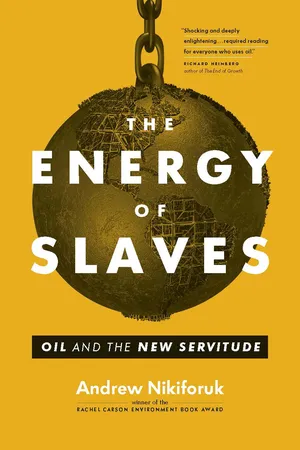
Ancient civilizations relied on shackled human muscle. It took the energy of slaves to plant crops, clothe emperors, and build cities. Nineteenth-century slaveholders viewed critics as hostilely as oil companies and governments now regard environmentalists. Yet the abolition movement had an invisible ally: coal and oil. As the world's most versatile workers, fossil fuels replenished slavery's ranks with combustion engines and other labor-saving tools. Since then, cheap oil has transformed politics, economics, science, agriculture, and even our concept of happiness. Many North Americans today live as extravagantly as Caribbean plantation owners. We feel entitled to surplus energy and rationalize inequality, even barbarity, to get it. But endless growth is an illusion.
In this provocative book, Andrew Nikiforuk, winner of the Rachel Carson Environment Book Award, argues that what we need is a radical emancipation movement that ends our master-and-slave approach to energy. We must learn to use energy on a moral, just, and truly human scale.
Published in Partnership with the David Suzuki Institute
"In his cautionary tale about the evils of oil . . . Nikiforuk makes his case for impending doom if we don't mend our energy-spending ways." —
The Star
"In this cogently argued book, Andrew Nikiforuk deploys a powerful metaphor. Oil dependency, he writes, is a modern form of slavery—and it's time for a global abolition movement." —Taras Grescoe, author of
Shanghai Grand
"A startling critique that should rouse us from our pipe dream of endless plenty." —Ronald Wright, author of
On Fiji Islands
- 298 pages
- English
- ePUB (mobile friendly)
- Available on iOS & Android
eBook - ePub
About this book
Information
Subtopic
Environmental EconomicsIndex
EconomicsTable of contents
- Cover
- Title
- Contents
- Dedication
- Prologue
- 1. The Energy of Slaves
- 2. Slaves to Energy
- 3. The Oil Pioneer
- 4. The New Servitude
- 5. The Unsettling of Agriculture
- 6. The Viagra of the Species
- 7. The Urban Fire
- 8. The Economist’s Delusion
- 9. Peak Science
- 10. The Petrostate
- 11. The Surplus Devolution
- 12. Oil and Happiness
- 13. Japan and the Fragility of the Petroleum Age
- Epilogue
- Sources
- Acknowledgments
- Index
- The David Suzuki Foundation
- Copyright
Trusted by 375,005 students
Access to over 1.5 million titles for a fair monthly price.
Study more efficiently using our study tools.
Frequently asked questions
Yes, you can cancel anytime from the Subscription tab in your account settings on the Perlego website. Your subscription will stay active until the end of your current billing period. Learn how to cancel your subscription
No, books cannot be downloaded as external files, such as PDFs, for use outside of Perlego. However, you can download books within the Perlego app for offline reading on mobile or tablet. Learn how to download books offline
Perlego offers two plans: Essential and Complete
- Essential is ideal for learners and professionals who enjoy exploring a wide range of subjects. Access the Essential Library with 800,000+ trusted titles and best-sellers across business, personal growth, and the humanities. Includes unlimited reading time and Standard Read Aloud voice.
- Complete: Perfect for advanced learners and researchers needing full, unrestricted access. Unlock 1.5M+ books across hundreds of subjects, including academic and specialized titles. The Complete Plan also includes advanced features like Premium Read Aloud and Research Assistant.
We are an online textbook subscription service, where you can get access to an entire online library for less than the price of a single book per month. With over 1.5 million books across 990+ topics, we’ve got you covered! Learn about our mission
Look out for the read-aloud symbol on your next book to see if you can listen to it. The read-aloud tool reads text aloud for you, highlighting the text as it is being read. You can pause it, speed it up and slow it down. Learn more about Read Aloud
Yes! You can use the Perlego app on both iOS and Android devices to read anytime, anywhere — even offline. Perfect for commutes or when you’re on the go.
Please note we cannot support devices running on iOS 13 and Android 7 or earlier. Learn more about using the app
Please note we cannot support devices running on iOS 13 and Android 7 or earlier. Learn more about using the app
Yes, you can access The Energy of Slaves by Andrew Nikiforuk in PDF and/or ePUB format, as well as other popular books in Economics & Environmental Economics. We have over 1.5 million books available in our catalogue for you to explore.