"An important contribution to the global debate about growth, equality, climate change, and the path to a viable human future." —David Korten, international bestselling author of When Corporations Rule the World
The biggest challenges facing human wellbeing today—widening income inequality, continuing global poverty, and environmental degradation—may be simple to solve in theory. But, because we are required to come up with solutions that are acceptable to a political majority in the rich world, they are much harder to solve in practice. Most of the commonly proposed "solutions" are simply not acceptable to most people. Many of these proposed solutions—like stopping the use of fossil fuels—require a sacrifice today in order to obtain an uncertain advantage in the far future. Therefore they are politically infeasible in the modern world, which is marked by relatively short term thinking.
In
Reinventing Prosperity, Graeme Maxton and Jorgen Randers provide a new approach altogether through thirteen recommendations which are both politically acceptable and which can be implemented in the current period of slow economic growth around the world.
Reinventing Prosperity solves the forty-year-old growth/no-growth standoff, by providing a solution to income inequality, continuing global poverty and climate change, a solution that will provide for economic growth but with a declining ecological footprint.
Reinventing Prosperity shows us how to live better on our finite planet—and in ways we can agree on.
"An essential guide to those who want to change the world for the better—and for certain." —Ha-Joon Chang, international bestselling author of
23 Things They Don't Tell You About Capitalism
"[A] well-argued book . . . explaining complex issues in a style that is clear, logical, and succinct." —
Publishers Weekly

eBook - ePub
Reinventing Prosperity
Managing Economic Growth to Reduce Unemployment, Inequality, and Climate Change
- 272 pages
- English
- ePUB (mobile friendly)
- Available on iOS & Android
eBook - ePub
Reinventing Prosperity
Managing Economic Growth to Reduce Unemployment, Inequality, and Climate Change
About this book
Information
Subtopic
Environmental EconomicsIndex
Economics– CHAPTER 1 –
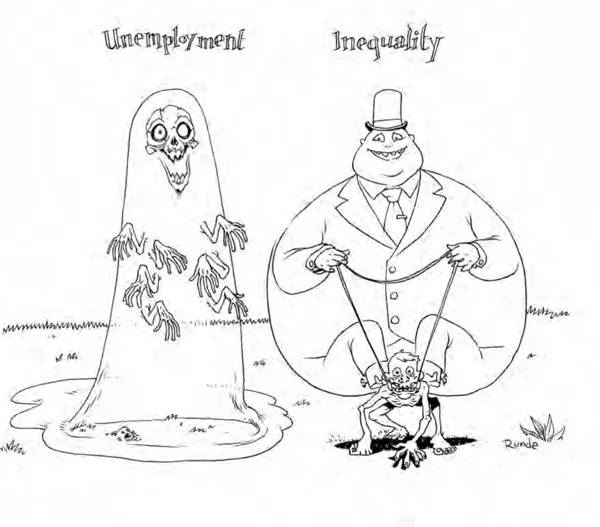
TWO URGENT PROBLEMS IN THE RICH WORLD

Two of the most urgent problems facing the modern rich world are persistent unemployment and rising inequality.
IN THE RICH world, the gap between rich and poor has been widening.1 As there has been strong economic growth for most of the last thirty years, this is something of a puzzle. Economic growth was meant to reduce inequality. The trickle-down effect, where the spending by the rich descends through some sort of economic filtration into the pockets of the poor, should have fortified the general population and raised living standards for everyone.
Yet millions of people in the rich world today live in conditions more like those of Victorian Britain. In the United States, 49 million people—out of a total population of 320 million—live in poverty.2 In Europe, it is one in every seven.3 In Eastern Europe, Spain, and Greece, poverty affects one in five, with women, single-parent families, and the young worst affected. Including those on very low incomes, a quarter of the population of the developed—rich—world is currently classified as being “at risk of poverty or exclusion.” That is almost 200 million people.
As the gap between rich and poor has widened, unemployment has also risen throughout the rich world, and it remains stubbornly high. Particularly badly afflicted are those under the age of twenty-five, though millions of baby-boomers in their fifties and sixties have found themselves without any income, pension, or work prospects too. And there has been a huge increase in the number of under-employed, those who want to work more but cannot find a paid full-time job.
At a time of record global wealth, and after so many decades of healthy economic growth, none of this should be. For decades, economists told people that economic growth would bring jobs, better incomes, and higher standards of living. But it has not.
What on earth is going on?
British charity Oxfam puts it simply. There has been a “power grab”4 by the rich, it says.5 It accuses the world’s fattest fat cats of manipulating the political system to rig the rules of the game in their favor, so that they are taxed less, regulated less, and scrutinized less. As a result, wealth and income have been moving in the opposite direction from what people believed.
Without change, this situation will not improve. The rich will continue to get richer because, as we will explain, that is what the current economic system does. Proponents of today’s free-market model like to claim that it promotes a more egalitarian society. In reality, though, as we will show, it has created a society that is more like a gigantic casino where the outcome is rigged in favor of the rich.
In his groundbreaking book Capital in the Twenty-First Century, French economist Thomas Piketty predicts that if nothing changes, much of the developed world will gradually return to something more like the nineteenth century, to a time when factory owners, entrepreneurs, and bankers controlled most of the wealth and everyone else struggled to survive. He sees a future in which the rich world’s middle classes effectively disappear.
This raises a fundamental and troubling question. Were the few decades after World War I, when the gap between rich and poor greatly declined, an anomaly caused by a particular set of circumstances? Is it possible that the natural order is more like the world of the past, more like that which reigned for most of human history, where a tiny minority controlled almost all the wealth and the vast majority were very poor?
It is an increasingly difficult question to answer. For most of the last seventy years, a rich world dominated by a middle class has seemed so natural and so right. Yet, historically, it is an oddity. At no other time in the last two thousand years has a middle class existed on such a scale.
Unless there is a radical shift in economic direction, Piketty says, “the past will devour the future,” and the few decades of comparative comfort enjoyed by the middle classes during the second half of the twentieth century will be consigned to the history books as little more than an interesting, but temporary, social phenomenon.
Piketty’s solution is a global wealth tax. He believes that there should be much greater cooperation between national tax authorities to exchange and share data on individual wealth, as well as a more “equitable tax system” for governments to invest in infrastructure and education. Taxation should be used to redistribute wealth and create a more balanced society, he says.
This will be difficult to implement, though, because it would require the rich world’s politicians to do the opposite of what they have done for the last thirty years: to tax their biggest financial supporters and most powerful citizens more.
Other economists have suggested that the inequality and unemployment problems should be tackled by boosting infrastructure spending, to create jobs; by changing intellectual property rights, to create more opportunities for people to access new technologies and ideas; and by changing the education system, to encourage more entrepreneurs.
None of these solutions addresses the underlying problem, however. Offering large numbers of people the chance to work—to build new roads or tunnels or to set themselves up in business, for example—gives them work and the opportunity to earn an income. But it does not change a system in which wealth gradually flows from the majority to the rich, as we will explain.
Such proposals offer only a temporary fix, helping the poor to earn more and the unemployed to find some work, without offering long-term change.
We believe the solution needs to be more radical. Rich-world nations will need to change their economic systems. They will need to step back from today’s economic mantra, which promotes individual freedom, applauds free markets and free trade, and minimizes state influence, and instead rearrange their economies to boost average well-being. Markets and trade should not be left largely unregulated any longer but actively managed. Governments should also be “right sized”—that is, small enough to ensure that they operate efficiently but big enough to be able to do their job well and tackle the challenges that lie ahead.
There is one other problem, however. The current economic system also requires continuous growth in the throughput of natural resources to function. This is built into the system’s DNA. People need to consume ever more, and manufacturers need to produce ever more to stop unemployment rising and keep the system functioning.
The trouble is, this process is generating ever-greater quantities of greenhouse gases, and these are causing the climate of the planet to change. This has already become so bad that global weather patterns will continue to worsen for decades and sea levels will rise, regardless of what is done now.
Yet any attempt to manage economic growth, and so slow down the environmental damage, shuts off the fuel that keeps the economic engine running. A slowing economy increases unemployment, as well as inequality and poverty, even more.
The current economic system has put the developed world on a treadmill that is driving society in a hopeless social and environmental direction, yet any conventional attempt to stop what is happening only makes the situation worse.
Conventional solutions cannot reduce inequality and joblessness (or climate change). Nor will a wealth tax, boosting infrastructure spending, or encouraging more entrepreneurs.
What are needed are unconventional solutions that will be attractive to the majority of people, so that they will welcome the transition.
The proposals in this book do this. They boost average well-being while at the same time cutting unemployment and reducing inequality, while offering an immediate benefit to the majority. That they also happen to reduce the rate of climate change (though not fix it) might be incidental to many readers. But it is not incidental to us.
It is the reason we wrote this book.
– CHAPTER 2 –
THE TRADITIONAL SOLUTION: ECONOMIC GROWTH
Traditionally, economic growth has been seen as the best way to reduce unemployment and inequality.
ALMOST NO MATTER where you live in the world, economic growth has become something of a constant. For more than thirty years, businesspeople, governments, and politicians have seen the pursuit of economic growth as their main goal. News reports and commentators focus on it endlessly. Taxi drivers, bankers, and economists often seem to talk of little else: How is it possible to boost economic growth? Why is the growth rate down this quarter? When will the economy recover?
Economic growth appears to be in our collective blood. It is hard to believe that it was not always so.
What is economic growth?
It is regrettable that the word “growth” is often used alone in the context of the economy, because this leads to much unnecessary confusion in the world. It is always necessary to be precise and to explain exactly what is growing, whether it is the economy (the total gross domestic product, otherwise known as GDP), demand, consumption, or GDP per person, for example. The descriptor matters because these variables do not move in parallel. If consumption grows, for example, that does not necessarily mean that the economy also grows. More importantly, it matters because these variables do not contribute equally to human well-being.
If you want to be a source of clear thinking never use the word “growth” alone. Explain what is growing!
Economic growth is the increase in the total output of an economy from one period to another, typically measured in percent per year. The total output is the market value of all goods and services produced in a nation in a set time period, less the costs of the inputs (such as raw materials) used (with an adjustment for trade). The resulting figure is called the gross domestic product. GDP measures the value added in the country in a time period of interest. Economic growth is the same as growth in GDP.
Since most (between two thirds and three quarters) of the output of rich nations is consumer goods and services, economic growth is normally associated with consumption growth—not least because the media often wrongly portrays economic growth and consumption growth as the same thing. But it is not always like this. In times of war, for example, GDP often grows spectacularly because of increased production of military equipment, while consumption declines.
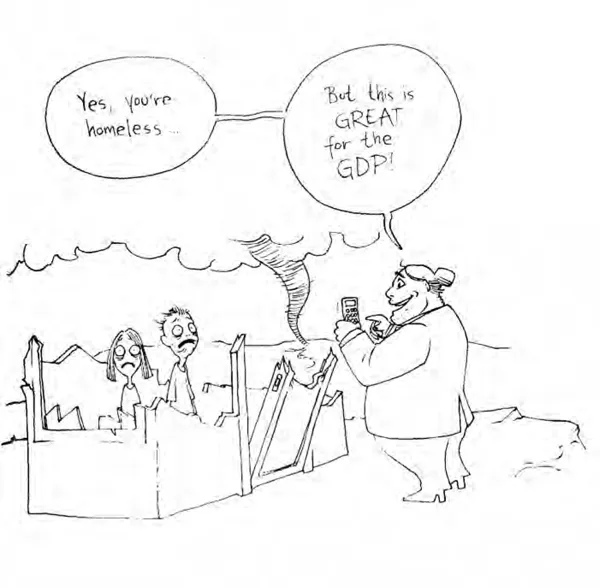
Many people forget that GDP is a measure of the level of activity in an economy, not the level of happiness or the standard of living. GDP certainly increases when more consumer goods and services are produced, but it also increases when prisons are built, when warships are launched and guns are fired, when road accident victims are treated, and when dikes are rebuilt after flood damage.
One particularly important example of an activity that boosts GDP but does not improve well-being is the repair and adaptation work needed in...
Table of contents
- Cover
- Title Page
- Contents
- List of Boxes
- Foreword by David Suzuki
- Preface
- Chapter 1. Two Urgent Problems in the Rich World
- Chapter 2. The Traditional Solution: Economic Growth
- Chapter 3. The Old Approach No Longer Works
- Chapter 4. Advancing Robotization
- Chapter 5. Other Threats to the Current Economic System
- Chapter 6. Dead End: The Failure of Extreme Free-Market Thinking
- Chapter 7. The Storms Ahead
- Chapter 8. A New Approach
- Chapter 9. Thirteen Politically Feasible Proposals to Reduce Unemployment, Inequality, and Climate Change
- Chapter 10. Let the Majority Decide
- Chapter 11. Let the Poor World Grow
- Chapter 12. Saving the World
- Chapter 13. The Epic Battle to Come
- Acknowledgments
- Notes
- Select Bibliography and Further Reading
- About the Authors
- About the Cartoonist
- Index
- Copyright Page
Trusted by 375,005 students
Access to over 1.5 million titles for a fair monthly price.
Study more efficiently using our study tools.
Frequently asked questions
Yes, you can cancel anytime from the Subscription tab in your account settings on the Perlego website. Your subscription will stay active until the end of your current billing period. Learn how to cancel your subscription
No, books cannot be downloaded as external files, such as PDFs, for use outside of Perlego. However, you can download books within the Perlego app for offline reading on mobile or tablet. Learn how to download books offline
Perlego offers two plans: Essential and Complete
- Essential is ideal for learners and professionals who enjoy exploring a wide range of subjects. Access the Essential Library with 800,000+ trusted titles and best-sellers across business, personal growth, and the humanities. Includes unlimited reading time and Standard Read Aloud voice.
- Complete: Perfect for advanced learners and researchers needing full, unrestricted access. Unlock 1.5M+ books across hundreds of subjects, including academic and specialized titles. The Complete Plan also includes advanced features like Premium Read Aloud and Research Assistant.
We are an online textbook subscription service, where you can get access to an entire online library for less than the price of a single book per month. With over 1.5 million books across 990+ topics, we’ve got you covered! Learn about our mission
Look out for the read-aloud symbol on your next book to see if you can listen to it. The read-aloud tool reads text aloud for you, highlighting the text as it is being read. You can pause it, speed it up and slow it down. Learn more about Read Aloud
Yes! You can use the Perlego app on both iOS and Android devices to read anytime, anywhere — even offline. Perfect for commutes or when you’re on the go.
Please note we cannot support devices running on iOS 13 and Android 7 or earlier. Learn more about using the app
Please note we cannot support devices running on iOS 13 and Android 7 or earlier. Learn more about using the app
Yes, you can access Reinventing Prosperity by Graeme Maxton,Jorgen Randers in PDF and/or ePUB format, as well as other popular books in Economics & Environmental Economics. We have over 1.5 million books available in our catalogue for you to explore.