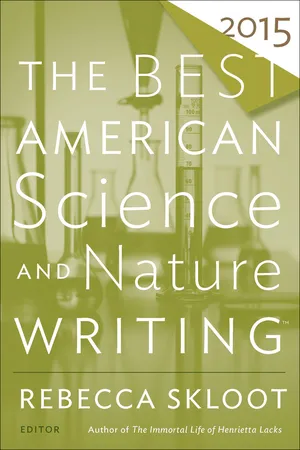
This anthology of essays and articles explores topics ranging from untouched wilderness to scientific ethics—and the nature of curiosity itself.
Scientists and writers are both driven by a dogged curiosity, immersing themselves in detailed observations that, over time, uncover larger stories. As Rebecca Skloot says in her introduction, all the stories in this collection are "written by and about people who take the time, and often a substantial amount of risk, to follow curiosity where it may lead, so we can all learn about it."
The Best American Science and Nature Writing 2015 includes work from both award-winning writers and up-and-coming voices in the field. From Brooke Jarvis on deep-ocean mining to Elizabeth Kolbert on New Zealand's unconventional conservation strategies, this is a group that celebrates the growing diversity in science and nature writing alike. Altogether, the writers honored in this volume challenge us to consider the strains facing our planet and its many species, while never losing sight of the wonders we're working to preserve for generations to come.
This anthology includes essays and articles by Sheri Fink, Atul Gawande, Leslie Jamison, Sam Kean, Seth Mnookin, Matthew Power, Michael Specter and others.
- 352 pages
- English
- ePUB (mobile friendly)
- Available on iOS & Android
eBook - ePub
The Best American Science and Nature Writing 2015
About this book
Information
Subtopic
Literary EssaysIndex
Literature LESLIE JAMISON
The Empathy Exams
A Medical Actor Writes Her Own Script
FROM The Believer
DISCUSSED: Inexplicable Seizures, An Ailing Plastic Baby, Teenagers in Ponchos, An Endless Supply of Mints, Another Word for Burning, Crippled Rabbits in Love, The Sad Half-Life of Arguments, A Kid’s Drawing of God, Praying in the Nook, Major Personality Clusters, fMRI Scans, Adam Smith, Pet Fears, Impulse’s Dowdier Cousin, A Broken Arrow, A Bottle of Rain
My job title is Medical Actor, which means I play sick. I get paid by the hour. Medical students guess my maladies. I’m called a Standardized Patient, which means I act toward the norms of my disorders. I’m standardized-lingo SP for short. I’m fluent in the symptoms of preeclampsia and asthma and appendicitis. I play a mom whose baby has blue lips.
Medical acting works like this: You get a script and a paper gown. You get $13.50 an hour. Our scripts are 10 to 12 pages long. They outline what’s wrong with us—not just what hurts but how to express it. They tell us how much to give away, and when. We are supposed to unfurl the answers according to specific protocols. The scripts dig deep into our fictive lives: the ages of our children and the diseases of our parents, the names of our husbands’ real estate and graphic design firms, the amount of weight we’ve lost in the past year, the amount of alcohol we drink each week.
My specialty case is Stephanie Phillips, a 23-year-old who suffers from something called conversion disorder. She is grieving the death of her brother, and her grief has sublimated into seizures. Her disorder is news to me. I didn’t know you could have a seizure from sadness. She’s not supposed to know either. She’s not supposed to think the seizures have anything to do with what she’s lost.
Stephanie Phillips
PSYCHIATRY
SP TRAINING MATERIALS
Case Summary: You are a 23-year-old female patient experiencing seizures with no identifiable neurological origin. You can’t remember your seizures but are told you froth at the mouth and yell obscenities. You can usually feel a seizure coming before it arrives. The seizures began two years ago, shortly after your older brother drowned in the river just south of the Bennington Avenue Bridge. He was swimming drunk after a football tailgate. You and he worked at the same mini-golf course. These days you don’t work at all. These days you don’t do much. You’re afraid of having a seizure in public. No doctor has been able to help you. Your brother’s name was Will.
Medication History: You are not taking any medications. You’ve never taken antidepressants. You’ve never thought you needed them.
Medical History: Your health has never caused you any trouble. You’ve never had anything worse than a broken arm. Will was there when it was broken. He was the one who called for the paramedics and kept you calm until they came.
Our simulated exams take place in three suites of purpose-built rooms. Each room is fitted with an examination table and a surveillance camera. We test second- and third-year medical students in topical rotations: pediatrics, surgery, psychiatry. On any given day of exams, each student must go through “encounters”—their technical title—with three or four actors playing different cases.
A student might have to palpate a woman’s 10-on-a-scale-of-10 pain in her lower abdomen, then sit across from a delusional young lawyer and tell him that when he feels a writhing mass of worms in his small intestine, the feeling is probably coming from somewhere else. Then this med student might arrive in my room, stay straight-faced, and tell me that I might go into premature labor to deliver the pillow strapped to my belly, or nod solemnly as I express concern about my ailing plastic baby: “He’s just so quiet.”
Once the 15-minute encounter has finished, the medical student leaves the room and I fill out an evaluation of his/her performance. The first part is a checklist: which crucial pieces of information did he/she manage to elicit? Which ones did he/she leave uncovered? The second part of the evaluation covers affect. Checklist item 31 is generally acknowledged as the most important category: “Voiced empathy for my situation/problem.” We are instructed about the importance of this first word, voiced. It’s not enough for someone to have a sympathetic manner or use a caring tone of voice. The students have to say the right words to get credit for compassion.
We SPs are given our own suite for preparation and decompression. We gather in clusters: old men in crinkling blue robes, MFA graduates in boots too cool for our paper gowns, local teenagers in ponchos and sweatpants. We help each other strap pillows around our waists. We hand off infant dolls. Little pneumonic Baby Doug, swaddled in a cheap cotton blanket, is passed from girl to girl like a relay baton. Our ranks are full of community-theater actors and undergrad drama majors seeking stages, high school kids earning booze money, retired folks with spare time. I am a writer, which is to say, I’m trying not to be broke.
We play a demographic menagerie: young jocks with ACL injuries and business executives nursing coke habits. STD Grandma has just cheated on her husband of 40 years and has a case of gonorrhea to show for it. She hides behind her shame like a veil, and her med student is supposed to part the curtain. If he’s asking the right questions, she’ll have a simulated crying breakdown halfway through the encounter.
Blackout Buddy gets makeup: a gash on his chin, a black eye, and bruises smudged in green eye shadow along his cheekbone. He’s been in a minor car crash he can’t remember. Before the encounter the actor splashes booze on his body like cologne. He’s supposed to let the particulars of his alcoholism glimmer through, very “unplanned,” bits of a secret he’s done his best to keep guarded.
Our scripts are studded with moments of flourish: Pregnant Lila’s husband is a yacht captain sailing overseas in Croatia. Appendicitis Angela has a dead guitarist uncle whose tour bus was hit by a tornado. Many of our extended family members have died violent, midwestern deaths: mauled in tractor- or grain-elevator accidents, hit by drunk drivers on the way home from Hy-Vee grocery stores, felled by a Big Ten tailgate—or, like my brother Will, by the aftermath of its debauchery.
Between encounters we are given water, fruit, granola bars, and an endless supply of mints. We aren’t supposed to exhaust the students with our bad breath and growling stomachs, the side effects of our actual bodies.
Some med students get nervous during our encounters. It’s like an awkward date, except half of them are wearing platinum wedding bands. I want to tell them I’m more than just an unmarried woman faking seizures for pocket money. I do things! I want to tell them. I’m probably going to write about this in a book someday! We make small talk about the rural Iowa farm town I’m supposed to be from. We each understand the other is inventing this small talk and we agree to respond to each other’s inventions as genuine exposures of personality. We’re holding the fiction between us like a jump rope.
One time a student forgets we are pretending and starts asking detailed questions about my fake hometown—which, as it happens, if he’s being honest, is his real hometown—and his questions lie beyond the purview of my script, beyond what I can answer, because in truth I don’t know much about the person I’m supposed to be or the place I’m supposed to be from. He’s forgotten our contract. I bullshit harder, more heartily. “That park in Muscatine!” I say, slapping my knee like a grandpa. “I used to sled there as a kid.”
Other students are all business. They rattle through the clinical checklist for depression like a list of things they need to get at the grocery store: “sleep disturbances, changes in appetite, decreased concentration.” Some of them get irritated when I obey my script and refuse to make eye contact. I’m supposed to stay swaddled and numb. These irritated students take my averted eyes as a challenge. They never stop seeking my gaze. Wrestling me into eye contact is the way they maintain power, forcing me to acknowledge their requisite display of care.
I grow accustomed to comments that feel aggressive in their formulaic insistence: That must really be hard [to have a dying baby], That must really be hard [to be afraid you’ll have another seizure in the middle of the grocery store], That must really be hard [to carry in your uterus the bacterial evidence of cheating on your husband]. Why not say, I couldn’t even imagine?
Other students seem to understand that empathy is always perched precariously between gift and invasion. They won’t even press the stethoscope to my skin without asking if it’s okay. They need permission. They don’t want to presume. Their stuttering unwittingly honors my privacy: “Can I . . . could I . . . would you mind if I—listened to your heart?” “No,” I tell them. “I don’t mind.” Not minding is my job. Their humility is a kind of compassion in its own right. Humility means they ask questions, and questions mean they get answers, and answers mean they get points on the checklist: a point for finding out my mother takes Wellbutrin, a point for getting me to admit I’ve spent the last two years cutting myself, a point for finding out my father died in a grain elevator when I was two—for realizing that a root system of loss stretches radial and rhizomatic under the entire territory of my life.
In this sense, empathy isn’t measured just by checklist item 31—“Voiced empathy for my situation/problem”—but by every item that gauges how thoroughly my experience has been imagined. Empathy isn’t just remembering to say That must really be hard, it’s figuring out how to bring difficulty into the light so it can be seen at all. Empathy isn’t just listening, it’s asking the questions whose answers need to be listened to. Empathy requires inquiry as much as imagination. Empathy requires knowing you know nothing. Empathy means acknowledging a horizon of context that extends perpetually beyond what you can see: an old woman’s gonorrhea is connected to her guilt is connected to her marriage is connected to her children is connected to the days when she was a child. All this is connected to her domestically stifled mother, in turn, and to her parents’ unbroken marriage; maybe everything traces its roots to her very first period, how it shamed and thrilled her.
Empathy means realizing no trauma has discrete edges. Trauma bleeds. Out of wounds and across boundaries. Sadness becomes a seizure. Empathy demands another kind of porousness in response. My Stephanie script is 12 pages long. I think mainly about what it doesn’t say.
Empathy comes from the Greek empatheia—em (“into”) and pathos (“feeling”)—a penetration, a kind of travel. It suggests you enter another person’s pain as you’d enter another country, through immigration and customs, border-crossing by way of query: What grows where you are? What are the laws? What animals graze there?
I’ve thought about Stephanie Phillips’s seizures in terms of possession and privacy—that converting her sadness away from direct articulation is a way to keep it hers. Her refusal to make eye contact, her unwillingness to explicate her inner life, the very fact that she becomes unconscious during her own expressions of grief and doesn’t remember them afterward—all of these might be ways of keeping her loss protected and pristine, unviolated by the sympathy of others.
“What do you call out during seizures?” one student asks.
“I don’t know,” I say, and want to add, but I mean all of it.
I know that saying this would be against the rules. I’m playing a girl who keeps her sadness so subterranean she can’t even see it herself. I can’t give it away so easily.
Leslie Jamison
OB-GYN
SP TRAINING MATERIALS
Case Summary: You are a 25-year-old female seeking termination of your pregnancy. You have never been pregnant before. You are five and a half weeks but have not experienced any bloating or cramping. You have experienced some fluctuations in mood but have been unable to determine whether these are due to being pregnant or knowing you are pregnant. You are not visibly upset about your pregnancy. Invisibly, you are not sure.
Medication History: You are not taking any medications. This is why you got pregnant.
Medical History: You’ve had several surgeries in the past but you don’t mention them to your doctor because they don’t seem relevant. You are about to have another surgery to correct your tachycardia, the excessive and irregular beating of your heart. Your mother has made you promise to mention this upcoming surgery in your termination consultation, even though you don’t feel like discussing it. She wants the doctor to know about your heart condition in case it affects the way he ends your pregnancy, or the way he keeps you sedated while he does it.
I could tell you I got an abortion one February or heart surgery that March—like they were separate cases, unrelated scripts—but neither one of these accounts would be complete without the other. A single month knitted them together; two mornings I woke up on an empty stomach and slid into a paper gown. One operation depended on a tiny vacuum, the other on a catheter that would ablate the tissue of my heart. Ablate? I asked the doctors. They explained that meant “burn.”
One procedure made me bleed and the other was nearly bloodless; one was my choice and the other wasn’t; both made me feel—at once—the incredible frailty and capacity of my own body; both came in a bleak winter; both left me prostrate under the hands of men, and dependent on the care of a man I was just beginning to love.
Dave and I first kissed in a Maryland basement at three in the morning on our way to Newport News to canvass for Obama in 2008. We canvassed for an organizing union called Unite Here. Unite Here! Years later that poster hung above our bed. That first fall we walked along Connecticut beaches strewn with broken clamshells. We held hands against salt winds. We went to a hotel for the weekend and put so much bubble bath in our tub that the bubbles ran all over the floor. We took pictures of that. We took pictures of everything. We walked across Williamsburg in the rain to see a concert. We were writers in love. My boss used to imagine us curling up at night and taking inventories of each other’s hearts. How did it make you feel to see that injured pigeon in the street today?, etc. And it’s true: we once talked about seeing two crippled bunnies trying to mate on a patchy lawn—how sad it was, and moving.
We’d been in love about two months when I got pregnant. I saw the cross on the stick and called Dave and we wandered college quads in the bitter cold and talked about what we were going to do. I thought of the little fetus bundled inside my jacket with me and wondered—honestly wondered—if I felt attached to it yet. I wasn’t sure. I remember not knowing what to say. I remember wanting a drink. I remember wanting Dave to be inside the choice with me but also feeling possessive of what was happening. I needed him to understand he would never live this choice like I was going to live it. This was the double blade of how I felt about anything that hurt: I wanted someone else to feel it with me, and also I wanted it entirely for myself.
We scheduled the abortion for a Friday and I found myself facing a week of ordinary days until it happened. I realized I was supposed to keep doing ordinary things. One afternoon I holed up in the library and read a pregnancy memoir. The author described a pulsing fist of fear and loneliness inside her—a fist she’d carried her whole life, had numbed with drinking and sex—and explained how her pregnancy had replaced this fist with the tiny bud of her fetus, a moving life.
I sent Dave a text. I wanted to tell him about the fist of fear, the baby heart, how sad it felt to read about a woman changed by pregnancy when I knew I wouldn’t be changed by mine—or at least not like she’d been. I didn’t hear anything back for hours. This bothered me. I felt guilt that I didn’t feel more about the abortion; I felt pissed off at Dave for bein...
Table of contents
- Title Page
- Contents
- Copyright
- Foreword
- Introduction
- JAKE ABRAHAMSON: Waiting for Light
- BURKHARD BILGER: In Deep
- SHEILA WEBSTER BONEHAM: A Question of Corvids
- REBECCA BOYLE: The Health Effects of a World Without Darkness
- ALISON HAWTHORNE DEMING: Spotted Hyena
- SHERI FINK: Life, Death, and Grim Routine Fill the Day at a Liberian Ebola Clinic
- ATUL GAWANDE: No Risky Chances
- LISA M. HAMILTON: Linux for Lettuce
- ROWAN JACOBSEN: Down by the River
- LESLIE JAMISON: The Empathy Exams
- BROOKE JARVIS: The Deepest Dig
- SAM KEAN: Phineas Gage, Neuroscience’s Most Famous Patient
- JOURDAN IMANI KEITH: At Risk
- JOURDAN IMANI KEITH: Desegregating Wilderness
- ELI KINTISCH: Into the Maelstrom
- ELIZABETH KOLBERT
- AMY MAXMEN: Digging Through the World’s Oldest Graveyard
- SETH MNOOKIN: One of a Kind
- DENNIS OVERBYE: A Pioneer as Elusive as His Particle
- MATTHEW POWER: Blood in the Sand
- SARAH SCHWEITZER: Chasing Bayla
- MICHAEL SPECTER: Partial Recall
- MEERA SUBRAMANIAN: The City and the Sea
- KIM TODD: Curious
- DAVID WOLMAN: The Aftershocks
- BARRY YEOMAN: From Billions to None
- Contributors’ Notes
- Other Notable Science and Nature Writing of 2014
- Read More from The Best American Series®
- About the Editors
- Footnotes
Trusted by 375,005 students
Access to over 1.5 million titles for a fair monthly price.
Study more efficiently using our study tools.
Frequently asked questions
Yes, you can cancel anytime from the Subscription tab in your account settings on the Perlego website. Your subscription will stay active until the end of your current billing period. Learn how to cancel your subscription
No, books cannot be downloaded as external files, such as PDFs, for use outside of Perlego. However, you can download books within the Perlego app for offline reading on mobile or tablet. Learn how to download books offline
Perlego offers two plans: Essential and Complete
- Essential is ideal for learners and professionals who enjoy exploring a wide range of subjects. Access the Essential Library with 800,000+ trusted titles and best-sellers across business, personal growth, and the humanities. Includes unlimited reading time and Standard Read Aloud voice.
- Complete: Perfect for advanced learners and researchers needing full, unrestricted access. Unlock 1.5M+ books across hundreds of subjects, including academic and specialized titles. The Complete Plan also includes advanced features like Premium Read Aloud and Research Assistant.
We are an online textbook subscription service, where you can get access to an entire online library for less than the price of a single book per month. With over 1.5 million books across 990+ topics, we’ve got you covered! Learn about our mission
Look out for the read-aloud symbol on your next book to see if you can listen to it. The read-aloud tool reads text aloud for you, highlighting the text as it is being read. You can pause it, speed it up and slow it down. Learn more about Read Aloud
Yes! You can use the Perlego app on both iOS and Android devices to read anytime, anywhere — even offline. Perfect for commutes or when you’re on the go.
Please note we cannot support devices running on iOS 13 and Android 7 or earlier. Learn more about using the app
Please note we cannot support devices running on iOS 13 and Android 7 or earlier. Learn more about using the app
Yes, you can access The Best American Science and Nature Writing 2015 by Rebecca Skloot in PDF and/or ePUB format, as well as other popular books in Literature & Literary Essays. We have over 1.5 million books available in our catalogue for you to explore.