Status quo investing is dead, and a growing number of investors want to take advantage of the risk-reduction features of active management. In this second, expanded edition of his prophetic 2009 classic, Ken Solow reveals the secrets of the successful active manager as he walks you through the proprietary methods of his own firm. A provocative and thoughtful critique of the current state of the money management industry, "Buy and Hold is Dead (AGAIN)" remains an invaluable investment guide for our financially challenging times.
eBook - ePub
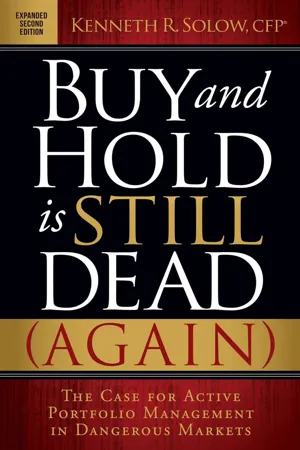
Buy and Hold is Still Dead (Again)
The Case for Active Portfolio Management in Dangerous Markets
- 303 pages
- English
- ePUB (mobile friendly)
- Available on iOS & Android
eBook - ePub
Buy and Hold is Still Dead (Again)
The Case for Active Portfolio Management in Dangerous Markets
About this book
Information
Topic
Negocios y empresaSubtopic
Inversiones y valoresPART ONE
BUY AND HOLD IS DEAD
| 1 | WE’RE ALL INVESTMENT GENIUSES IN BULL MARKETS |
Any investor can feel like a genius in a bull market. During those highly profitable times when asset values are rising, virtually anyone can prove their investment acumen by the appreciation of their portfolio values. During bull markets, the notion of investment risk is flipped on its head, redefined as being “out of the market” and missing out on the capital appreciation that is available to all while stock prices move higher. The notion that risk management is about protecting one’s capital becomes lost as people who don’t yet own the market wallow in self-pity and wonder if it is too late to jump in and buy. We are taught that bull markets are the natural order of things in a capitalistic system where economic growth is predicated on the “animal spirits” of market participants trying to further their own self-interests, and where ever-expanding corporate profits are the reliable result of human enterprise, ingenuity, creativity, and the drive to succeed. It is no wonder then, that investors believe that given enough time and enough patience, buying and holding stocks for the long run is a low-risk strategy. In today’s Internet-connected, high-technology, and increasingly democratic and capitalistic world, where equity ownership allows investors to participate in the profits of corporations around the globe, choosing to be anything other than an equity owner as stock prices increase over time is just plain foolish.
Of course, there are those times when stock prices move significantly lower for short periods. This condition, called a bear market, is acknowledged to occur on occasion and investors are taught that the associated fear and anxiety that accompanies bear markets are simply the “cost of doing business” in the world of buy and hold investing. For the past forty years the investment industry’s message has been that stock returns will always “eventually” outperform bond and cash returns over the long-term because equity ownership always offers investors a premium return for the risk (volatility) that they are willing to accept. Therefore, the industry’s accepted strategy for dealing with bear markets has been simple: Just ignore them.
For years, professional and non-professional investors alike who thought there must be a better investment strategy for dealing with portfolio risk and volatility than simply waiting until things get better have been routinely ostracized and ignored. The status quo thinking about risk reduction techniques in portfolio construction and management has not changed for a generation of investors, schooled in the buy and hold strategy of investing during the great secular bull market that began in 1982 and ended in early 2000. There can be no doubt that buy and hold investing does work quite well in bull markets—as does just about every other investment technique when stocks are charging ahead.
Historic long-term bull markets with record breaking returns create lasting impressions for those who participate in and profit from them, but the secular bull market of 1982-2000 was only one of the reasons that buy and hold investing became the only acceptable methodology for building portfolios and creating wealth. The buy and hold strategy—known in the professional investment world as “strategic asset allocation”—was born out of a series of academic papers that eventually earned Nobel Prizes for their authors, who are now considered the fathers of modern finance. Their theories of Modern Portfolio Theory (MPT), The Capital Asset Pricing Model (CAPM), and the Efficient Markets Hypothesis all rely on a series of assumptions about risk and the nature of how prices change in financial markets which assert that current market prices are always rational, that investors are nearly perfect in their ability to forecast future changes in prices, and that risk premiums afforded to stocks (the added returns that investors earn by owning stocks versus owning cash) are relatively stable over long periods of time. These assumptions led to mathematical models for portfolio construction that promised investors the highest possible returns for a given level of risk. The army of finance professors teaching this one approach to portfolio construction was overwhelming, and all other approaches to portfolio construction were simply ignored. Virtually every MBA, Chartered Financial Analyst®(CFA®), and Certified Financial Planner® (CFP®) was taught this one methodology of money management to the virtual exclusion of all others.
And if this powerful combination of academic endorsement along with a reinforcing secular bull market wasn’t enough to calcify the investment world’s reliance on buy and hold investing, the ascendance of this status quo approach was also driven by one other important motivation in the investment world: the desire by the professional financial planning industry for a consistent, mathematically-based approach to investing that they could sell to their clients. The professional financial planning industry, as we know it today, was in its infancy in the mid- 1970’s. Exhausted from the secular bear market that lasted from 1965 to 1982, the investment industry needed a strategy of managing money that offered clients a more “scientific” methodology for reaching their financial goals. Strategic asset allocation (aka, buy and hold) met the industry’s requirement for a systematic and scientific approach to portfolio construction, and provided the entire money management industry with a consistent strategy that could be “mass produced,” duplicated by thousands of financial advisors and institutional investors at every level of experience. The popularity of buy and hold investing grew along with the growth of the financial planning industry, with financial professionals and industry pundits singing its praises for decades.
As a result of these three powerful forces—a long-term secular bull market that confirmed the value of buying stocks for the long run, a Nobel Prize–winning theory that provided academic support, and the financial industry’s business model that was greatly enhanced by an easy, duplicable, buy and hold message—the strategy of buy and hold investing became the single most powerful and popular investment philosophy of the last 50 years.
That is, until now.
Buy And Hold Is Dead
At the time of this writing, investors are facing a financial crisis that threatens to overwhelm the entire global banking system and drive governments to the brink of bankruptcy. Investor panic, as measured by the amount of volatility in the options markets, as well as by the extent of recent price declines, is at record highs. Virtually all risk-oriented asset classes, including stocks, commodities, and real estate, have plunged in value, and serious pundits are talking about the possibility of another Great Depression.
As frightening as the current bear market feels to investors, the current market trauma is not an isolated event, but comes after a prolonged period of genuine market upheaval. The bursting of the Internet bubble at the beginning of this decade completely destroyed leveraged investors in the technology sector and saddled non-leveraged NASDAQ investors with 75% declines. The bursting of the dot. com bubble helped to create the conditions for a mammoth bubble in real estate prices that was aided and abetted by stimulative fiscal and monetary government policy. And now the real estate bubble has burst, which has resulted in the end (for now, anyway) of a 30-year cycle of credit creation that was built on the back of lax regulation of the banking sector, impossibly complicated financial products, changing social values about thrift, and policy makers of all political persuasions agreeing that asset inflation had to be maintained at all costs in order for the system to perpetuate itself and prosperity to continue.
The results for long-term, buy and hold investors have been catastrophic, or not, depending on your point of view and your approach to risk. For 10 years, from 10/30/1998 to 10/30/2008 the S&P 500 Index has essentially broken even. The index traded at 1098 in 1998, and it traded at 954 on October of 2008, a loss of 13.1%. If an investor owned the S&P 500 market index and reinvested the dividends, then their return would have “skyrocketed” to an annual return of only 0.38% per year. Those who view risk in terms of a decline in the value of their assets should feel comforted in knowing that they haven’t “lost” a lot of money in that period. However, for those who take a slightly more sophisticated view of market returns, they would observe that cash (in this case measured by the return of 90-day T-Bills) returned a total of 43%, or an annualized return of 3.60% per year for the same period that stocks essentially earned zero. For an investor with a $1 million portfolio, the “cost” of owning the stock market over that period was approximately $400,000. From a financial planning point of view, if an investor relied on the appreciation of the stock market to offset the impact of inflation on his portfolio, then unfortunately the buying power of their portfolio has been dramatically reduced, even though we have experienced a relatively low rate of inflation at the same time. Inflation was 2.8% per year for the decade and cash returned 3.6% for the same period. (That is, if you believe the government statistics on inflation. For skeptics, the loss of buying power for investors over the past decade has been even higher.) Obviously, earning 0.38% per year in the stock market while inflation grew at 2.8% constituted a real or inflation-adjusted annual loss of 2.42%.
Perhaps the most unfortunate group of investors are those who retired in the late 1990’s expecting that the stock market would deliver its historical average return of about 11% per year in a 3% inflation environment. For those who either invested in a balanced portfolio of stocks and bonds on their own, or who relied on the advice of professional financial advisors, and who have subsequently systematically withdrawn their capital in order to maintain their standard of living in retirement, the resulting decade of less than expected portfolio performance has been potentially catastrophic. Depending on the amount that these investors have withdrawn from their portfolios, and depending on the details of the asset classes used to build their portfolios, those ten years of flat returns from the stock market have forced retirees either to significantly reduce their standards of living, or to go back to work. In many cases, neither of these negative possibilities was considered to be a risk when they retired.
Unbelievably, according to the buy and hold approach, the most widely followed theory of investing, absolutely none of the above should have happened at all. Buy and hold, or strategic asset allocation as the professionals call it, was supposed to best manage the risk of the current market problems because, according to the theory that justifies it, investors and other “economic agents” are supposed to have a perfect (or a close to perfect) ability to know what the correct or “equilibrium” price of stocks should be in the future, given any change in today’s news. Therefore, bubbles in the stock market, the real estate market, the commodities market, and the credit market, simply should not happen, and therefore investors don’t need a portfolio strategy that allows them to manage the risk that these events could actually occur. According to the theory that supports strategic asset allocation, all asset classes should eventually generate average returns for investors in the future equal to their average past returns (mathematicians would call this approach to past data static, non-linear programming), and therefore, all we need to do is wait patiently for the returns to materialize over a long enough period of time. As we will learn, unfortunately the period of time may be too long for most investors to be able to afford to wait.
Strategic (buy and hold) investing, the investment strategy adhered to by most professional financial advisors, and the strategy that is taught to all CFP® practitioners and CFA®s presumes that the market mechanism governing day-to-day price movements is perfectly random, and that there is no such thing as momentum or any other movement in price caused by investors themselves. In the theory, all risk is “exogenous,” meaning that forces outside of the market cause price changes to occur. We can call this type of exogenous risk “the news.” But investor panics, or the risk of market participants actually causing changes in market prices due to emotion, or plain old investor mistakes, simply cannot happen.
Nonetheless, for the second time in a decade, investors who follow the rules of buy and hold investing are watching their portfolios plummet in value. It is very difficult to make the case that the best way to manage portfolio risk is to own the stock market and ignore short-term volatility when the stock market delivered 10 years of returns that are less than cash returns. All of the sudden, informed investors are taking a hard look at strategic asset allocation and questioning why it is that no other methods of portfolio construction are considered to be acceptable at a time when the financial markets are experiencing the greatest volatility since the Great Depression.
A Fantastic Business Model
I began my career as a financial professional in 1984, and for the first sixteen years of my career as a professional investor I invested according to the principles that I was taught as a CFP® practitioner and as a Chartered Financial Consultant® (ChFC®), meaning that I religiously followed the teachings of Modern Portfolio Theory. For those who don’t know, Modern Portfolio Theory (MPT) is the Nobel Prize–winning theory of portfolio construction given to us by Harry Markowitz in 19524, which proposes that investors can use the laws of chance and probability to construct a portfolio that is the most “efficient” mix of the various asset classes that are used to build it. In this case, efficient means crafting a portfolio that will give us the most return for any given level of risk.
In addition to Modern Portfolio Theory, I, along with all other informed investors, was also taught the basics of William Sharpe’s Nobel Prize–winning Capital Asset Pricing Model (CAPM), which teaches us that there are two kinds of risk: unsystematic or business risk that we can diversify away in our portfolio, and systematic or market risk that we cannot. The measure of systematic risk is something called beta, and once we know what it is we can measure the risk of our portfolio by comparing the volatility of our portfolio to the volatility of the market. I learned to evaluate my success or failure as an investor by trying to achieve portfolio “alpha,” which is the amount of return actually earned over and above the expected return of the portfolio, as measured by the risk relationship between cash and the stock market in the CAPM model.
As discussed earlier in this chapter, the strategic model of portfolio construction also relies on something called the Efficient Market Hypothesis, which was popularized by Eugene Fama in the 1970’s, but can be traced back to a French economist named Louis Bachelier5 who originally developed the mathematics of efficient pricing models in the early 1900’s. As it is commonly used today, the theory proposes that a large group of investors can either perfectly (or at least imperfectly) know what market prices will be in the future given the news of today. The theory teaches us that the market so efficiently prices changes in the news that it is not possible to “beat” the market’s performance, and so the conclusion that rational investors much reach is that they should simply own the market i...
Table of contents
- Cover
- Title
- Copyright
- Table Of Contents
- List of Tables and Charts
- Acknowledgements
- Preface to the Second Edition
- Introduction
- Part One: Buy And Hold Is Dead
- Part Two: Active Portfolio Management
- About The Author
- Index
Trusted by 375,005 students
Access to over 1.5 million titles for a fair monthly price.
Study more efficiently using our study tools.
Frequently asked questions
Yes, you can cancel anytime from the Subscription tab in your account settings on the Perlego website. Your subscription will stay active until the end of your current billing period. Learn how to cancel your subscription
No, books cannot be downloaded as external files, such as PDFs, for use outside of Perlego. However, you can download books within the Perlego app for offline reading on mobile or tablet. Learn how to download books offline
Perlego offers two plans: Essential and Complete
- Essential is ideal for learners and professionals who enjoy exploring a wide range of subjects. Access the Essential Library with 800,000+ trusted titles and best-sellers across business, personal growth, and the humanities. Includes unlimited reading time and Standard Read Aloud voice.
- Complete: Perfect for advanced learners and researchers needing full, unrestricted access. Unlock 1.5M+ books across hundreds of subjects, including academic and specialized titles. The Complete Plan also includes advanced features like Premium Read Aloud and Research Assistant.
We are an online textbook subscription service, where you can get access to an entire online library for less than the price of a single book per month. With over 1.5 million books across 990+ topics, we’ve got you covered! Learn about our mission
Look out for the read-aloud symbol on your next book to see if you can listen to it. The read-aloud tool reads text aloud for you, highlighting the text as it is being read. You can pause it, speed it up and slow it down. Learn more about Read Aloud
Yes! You can use the Perlego app on both iOS and Android devices to read anytime, anywhere — even offline. Perfect for commutes or when you’re on the go.
Please note we cannot support devices running on iOS 13 and Android 7 or earlier. Learn more about using the app
Please note we cannot support devices running on iOS 13 and Android 7 or earlier. Learn more about using the app
Yes, you can access Buy and Hold is Still Dead (Again) by Kenneth R. Solow in PDF and/or ePUB format, as well as other popular books in Negocios y empresa & Inversiones y valores. We have over 1.5 million books available in our catalogue for you to explore.