A practical, life-changing real estate investment guide by a #1 international bestselling, award-winning author and property tycoon.
Are you tired of working for a living? Are you fed up with only JUST being able to pay your bills? Are you sick of thinking about work every single day? Are you going crazy thinking someone will take your job? Millions are in the same boat as you!
There is no such thing as a job for life anymore. People are getting outsourced, paid less, told to work longer hours, and are being replaced with robots and imminently Artificial Intelligence.
The Financial Freedom Guarantee is for people that really want to start doing what they LOVE to do instead of doing what they have to do to pay the bills. Inside you'll discover how to create enough passive income from four award-winning property investment tools that create enough positive cash-flow to replace your living expenses. Meaning you could quit your job and never have to rely on a salary ever again—and thousands of readers are doing it within ninety days!
Never before has a body of work been so relevant and timely in a world full of debt and servitude. In nine months, Marco purchased ninety-six properties using other people's money and created millions of dollars in profit. More importantly, he has helped thousands of his students do the same. Now you can, too.
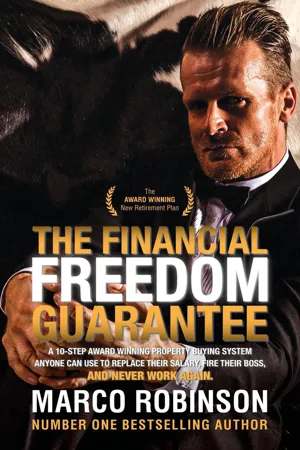
eBook - ePub
The Financial Freedom Guarantee
The 10-Step Award Winning Property Buying System Anyone Can Use to Replace Their Salary, Fire Their Boss, and Never Work Again
- 185 pages
- English
- ePUB (mobile friendly)
- Available on iOS & Android
eBook - ePub
The Financial Freedom Guarantee
The 10-Step Award Winning Property Buying System Anyone Can Use to Replace Their Salary, Fire Their Boss, and Never Work Again
About this book
Information
CHAPTER 1
DO NOT LISTEN TO UNQUALIFIED FINANCIAL ADVICE
Let me ask you a few simple questions.
Did the government or the bank or any financial advisers, or your family or friends, advise you to buy property in the United States or United Kingdom in the very early 2000s, and to sell it in 2007? Did any of them advise you to buy gold ten years ago and sell it in 2012? Did any of these people tell you to reinvest your property profits from 2007 by buying foreclosed properties in the United States from 2008 onwards? Or to invest in new property in Singapore and London in 2009?
No?
Why do you think that is the case? Two very simple reasons: 1) Those people are not qualified because they didn’t do any of that; 2) Your radar was not tuned to pick up successful financial people’s strategies because you’re conditioned to be an employee who must trade time for money and save hard.
Now, let me ask you another simple question. Do you think by following the simple strategies above you would have made lots of money? You are probably guessing that you would have. The truth is you could have made millions without using your own money! And you would not be reading this book right now because you would already be financially free.
The truth is some people, including myself, did follow those strategies, made millions in the process, and are still making money because we do not take advice from people who are not qualified to give it.
Do you really believe your government is great at managing money? Do you think they empower their citizens in free enterprise and money making opportunities? No? You’re right. Let’s take a look at some evidence.
DEBT TO GDP
GDP stands for Gross Domestic Product, which is the economic output of a country. Debt to GDP is the ratio of what a country owes—the debt the country is carrying or how much they are borrowing to produce all the products they export or sell within the country—to the value of everything it produces. In some countries, this ratio is greater than 100 percent! When that ratio is very high, a country has to keep borrowing to keep its infrastructure going and pay all its workers, because the tax revenue is just not enough on its own. And when this continually happens the government will do two things:
1. They will institute austerity measures: The Government will increase taxes and increase the cost of every service they provide so that they can collect more revenue to keep the country going.
2. They will print more money. Austerity measures do not collect enough cash. You can only collect so much money from the same amount of people paying tax; therefore, they print money.
Does that seem a bit odd to you?
They are taxing you more, and paying themselves more, so you end up with a lot less, and they end up with a lot more. It’s not even your debt, yet you’re paying for it and you still have to pay the people managing your tax dollars so terribly.
Let me put it this way: When you go to a supermarket and pay for your purchases you get an itemized receipt outlining exactly what you spent your money on. When you pay your tax bill the government doesn’t issue an itemized receipt outlining exactly where your money went. Governments don’t share that information with you because governments are not transparent. But what they do tell you is that if you don’t pay your tax bill, you are breaking the law and will be jailed!
Now if you had been educated on how to understand basic economic data, you could be rich right now. If you had understood why there was an economic crisis in 2008, and you had been told to buy assets at rock bottom prices, you would be financially free right now.
GLOBAL FINANCIAL CRISIS
The world is still affected by the global financial crisis. Millions of people lost their homes and savings were wiped out in a year. The bankers gained control of the economy and the government let them do it. Home prices in some places dropped to less than half their value in as little as six months.
And I am going to take the time to explain how this happened to you. Once you understand it, first of all you’re going to be so shocked at how uncomplicated it really is, and then you are going to learn for the first time in your life to be in control of your own money and stop trusting unqualified people with it.
Why did the GFC happen? How can you profit and help other people profit from every recession from now on?
Before I elaborate it is important for you to understand the definitions that follow. If you read them you will grasp what I am about to say with ease. Part of the reason I include these definitions is because you need to know the truth and you need to see that this information is the same from all sources.
INVESTMENT BANK
“An investment bank is a financial institution that assists individuals, corporations, and governments in raising financial capital by underwriting or acting as the client’s agent in the issuance of securities (or both). An investment bank may also assist companies involved in mergers and acquisitions (M&A) and provide ancillary services such as market making, trading of derivatives and equity securities, and FICC services (fixed income instruments, currencies, and commodities).”
—Wikipedia, s.v. “Investment Banking,” accessed October 9, 2015, https://en.wikipedia.org/wiki/Investment_banking.
DERIVATIVE
“In finance, a derivative is a contract that derives its value from the performance of another entity. This entity can be an asset, index, or interest rate, and is often called the ‘underlying.’ Derivatives can be used for a number of purposes, including insuring against price movements (hedging), increasing exposure to price movements for speculation or getting access to otherwise hard-to-trade assets or markets. Some of the more common derivatives include forwards, futures, options, swaps, and variations of these such as synthetic collateralized debt obligations and credit default swaps. Most derivatives are traded over-the-counter (off-exchange) or on an exchange such as the Chicago Mercantile Exchange, while most insurance contracts have developed into a separate industry. Derivatives are one of the three main categories of financial instruments, the other two being stocks (i.e., equity or shares) and debt (i.e., bonds and mortgages).”
—Wikipedia, s.v. “Derivative (Finance),” accessed October 9, 2015, https://en.wikipedia.org/wiki/Derivative_(finance).
COLLATERALIZED DEBT OBLIGATION (CDO)
“A collateralized debt obligation (CDO) is a type of structured asset-backed security (ABS). Originally developed for the corporate debt markets, over time CDOs evolved to encompass the mortgage and mortgage-backed security (‘MBS’) markets. Like other private label securities backed by assets, a CDO can be thought of as a promise to pay investors in a prescribed sequence, based on the cash flow the CDO collects from the pool of bonds or other assets it owns. The CDO is ‘sliced’ into ‘tranches,’ which ‘catch’ the cash flow of interest and principal payments in sequence based on seniority. If some loans default and the cash collected by the CDO is insufficient to pay all of its investors, those in the lowest, most ‘junior’ tranches suffer losses first. The last to lose payment from default are the safest, most senior tranches. Consequently, coupon payments (and interest rates) vary by tranche with the safest/most senior tranches paying the lowest rates and the lowest tranches paying the highest rates to compensate for higher default risk. As an example, a CDO might issue the following tranches in order of safeness: Senior AAA (sometimes known as ‘super senior’); Junior AAA; AA; A; BBB; Residual.”
—Wikipedia, s.v. “Collateralized Debt Obligation,” accessed October 9, 2015, https://en.wikipedia.org/wiki/Collateralized_debt_obligation.
SUBPRIME LENDING
“In finance, subprime lending (also referred to as near-prime, nonprime, and second-chance lending) means making loans to people who may have difficulty maintaining the repayment schedule, sometimes reflecting setbacks such as unemployment, divorce, medical emergencies, etc. Historically, subprime borrowers were defined as having a FICO scores below 640, although ‘this has varied over time and circumstances.’
“These loans are characterized by higher interest rates, poor quality collateral, and less favorable terms in order to compensate for higher credit risk. Many subprime loans were packaged into mortgage-backed securities (MBS) and ultimately defaulted, contributing to the financial crisis of 2007–2008.
“Proponents of subprime lending maintain that the practice extends credit to people who would otherwise not have access to the credit market. Professor Harvey S. Rosen of Princeton University explained, ‘The main thing that innovations in the mortgage market have done over the past 30 years is to let in the excluded: the young, the discriminated-against, and the people without a lot of money in the bank to use for a down payment.’”
—Wikipedia, s.v. “Subprime Lending,” accessed October 9, 2015, https://en.wikipedia.org/wiki/Subprime_lending.
SUBPRIME CRISIS
“The U.S. subprime mortgage crisis was a nationwide banking emergency that coincided with the U.S. recession of December 2007–June 2009. It was triggered by a large decline in home prices, leading to mortgage delinquencies and foreclosures and the devaluation of housing-related securities. Declines in residential investment preceded the recession and were followed by reductions in household spending and then business investment. Spending reductions were more significant in areas with a combination of high household debt and larger housing price declines.
“The expansion of household debt was financed with mortgage-backed securities (MBS) and collateralized debt obligations (CDO), which initially offered attractive rates of return due to the higher interest rates on the mortgages; however, the lower credit quality ultimately caused massive defaults. While elements of the crisis first became more visible during 2007, several major financial institutions collapsed in September 2008, with significant disruption in the flow of credit to businesses and consumers and the onset of a severe global recession.
“There were many causes of the crisis, with commentators assigning different levels of blame to financial institutions, regulators, credit agencies, government housing policies, and consumers, among others. A proximate cause was the rise in subprime lending. The percentage of lower-quality subprime mortgages originated during a given year rose from the historical 8% or lower range to approximately 20% from 2004 to 2006, with much higher ratios in some parts of the U.S. A high percentage of these subprime mortgages, over 90% in 2006 for example, were adjustable-rate mortgages. These two changes were part of a broader trend of lowered lending standards and higher-risk mortgage products. Further, U.S. households had become increasingly indebted, with the ratio of debt to disposable personal income rising from 77% in 1990 to 127% at the end of 2007, much of this increase mortgage-related.”
—Wikipedia, s.v. “Subprime Mortgage Crisis,” accessed October 9, 2015, https://en.wikipedia.org/wiki/Subprime_mortgage_crisis.
SECURITIZATION
“Securitization is the financial practice of pooling various types of contractual debt such as residential mortgages, commercial mortgages, auto loans or credit card debt obligations (or other non-debt assets which generate receivables) and selling their related cash flows to third party investors as securities, which may be described as bonds, pass-through securities, or collateralized debt obligations (CDOs). Investors are repaid from the principal and interest cash flows collected from the underlying debt and redistributed through the capital structure of the new financing. Securities backed by mortgage receivables are called mortgage-backed securities (MBS), while those backed by other types of receivables are called asset-backed securities.”
—Wikipedia, s.v. “Securitization,” accessed October 9, 2015, https://en.wikipedia.org/wiki/Securitization.
RATINGS AGENCY
“A credit rating agency (CRA, also called a ratings service) is a company that assigns credit ratings, which rate a debtor’s ability to pay back debt by making timely interest payments and the likelihood of default. An agency may rate the creditworthiness of issuers of debt obligations, of debt instruments, and in some cases, of the servicers of the underlying debt, but not of individual consumers.
“The debt instruments rated by CRAs include government bonds, corporate bonds, CDs, municipal bonds, preferred stock, and collateralized securities, such as mortgage-backed securities and collateralized debt obligations.
“The issuers of the obligations or securities may be companies, special purpose entities, state or local governments, non-profit organizations, or sovereign nations. A credit rating facilitates the trading of securities on a secondary market. It affects the interest rate that a security pays out, with higher ratings leading to lower interest rates. I...
Table of contents
- Cover
- Title Page
- Copyright
- Contents
- Introduction
- FFG: Sneak Preview
- FFG Ten-Step Blueprint
- Chapter 1 Do Not Listen to Unqualified Financial Advice
- Chapter 2 Reprogram Your Default Operating System
- Chapter 3 Get a Revolutionary, Effective Financial Education
- Chapter 4 Have Compelling Life Goals
- Chapter 5 Master Precise Money Allocation
- Chapter 6 Borrow!
- Chapter 7 Master Precise Research Analysis (PRA)
- Chapter 8 Do the Numbers
- Chapter 9 Manage Your Investments Wisely
- Chapter 10 Calculate and Minimize Your Risk
- About the Author
- The Bonus Chapter
Trusted by 375,005 students
Access to over 1.5 million titles for a fair monthly price.
Study more efficiently using our study tools.
Frequently asked questions
Yes, you can cancel anytime from the Subscription tab in your account settings on the Perlego website. Your subscription will stay active until the end of your current billing period. Learn how to cancel your subscription
No, books cannot be downloaded as external files, such as PDFs, for use outside of Perlego. However, you can download books within the Perlego app for offline reading on mobile or tablet. Learn how to download books offline
Perlego offers two plans: Essential and Complete
- Essential is ideal for learners and professionals who enjoy exploring a wide range of subjects. Access the Essential Library with 800,000+ trusted titles and best-sellers across business, personal growth, and the humanities. Includes unlimited reading time and Standard Read Aloud voice.
- Complete: Perfect for advanced learners and researchers needing full, unrestricted access. Unlock 1.5M+ books across hundreds of subjects, including academic and specialized titles. The Complete Plan also includes advanced features like Premium Read Aloud and Research Assistant.
We are an online textbook subscription service, where you can get access to an entire online library for less than the price of a single book per month. With over 1.5 million books across 990+ topics, we’ve got you covered! Learn about our mission
Look out for the read-aloud symbol on your next book to see if you can listen to it. The read-aloud tool reads text aloud for you, highlighting the text as it is being read. You can pause it, speed it up and slow it down. Learn more about Read Aloud
Yes! You can use the Perlego app on both iOS and Android devices to read anytime, anywhere — even offline. Perfect for commutes or when you’re on the go.
Please note we cannot support devices running on iOS 13 and Android 7 or earlier. Learn more about using the app
Please note we cannot support devices running on iOS 13 and Android 7 or earlier. Learn more about using the app
Yes, you can access The Financial Freedom Guarantee by Marco Robinson in PDF and/or ePUB format, as well as other popular books in Business & Real Estate. We have over 1.5 million books available in our catalogue for you to explore.