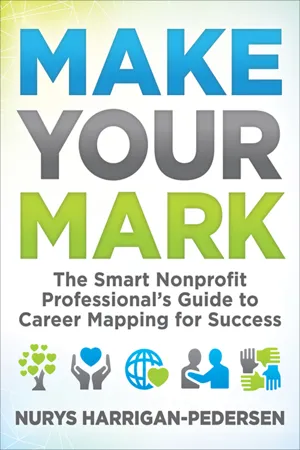
eBook - ePub
Make Your Mark
The Smart Nonprofit Professional's Guide to Career Mapping for Success
- 119 pages
- English
- ePUB (mobile friendly)
- Available on iOS & Android
eBook - ePub
Make Your Mark
The Smart Nonprofit Professional's Guide to Career Mapping for Success
About this book
Make Your Mark guides those who want to change their career route to create an empowering, re-warding, and fulfilling journey towards having a job they love. What would it be like to have a job that makes you so happy you could sing, where your professional goals are aligned and make a significant impact in your personal life and on your family, those around you, and the world? For over fifteen years talent management and staffing expert Nurys Harrigan-Pedersen has helped professionals create career maps that have dramatically changed the course of their lives with the belief that everyone deserves to have a job they love. Follow the insightful and practical steps outlined in this guide and create a unique map that will make your life soar to unprecedented heights. Make Your Mark is the GPS of your professional life and will help you move forward with renewed enthusiasm and purpose. The best part: This GPS is programmed by you!
Information
CHAPTER ONE
My Story – Looking for the HOV Lane
For the past two decades, I have been interviewing, recommending, reference-checking, and placing professionals in all types of nonprofit organizations and positions, from data entry clerks to senior managers and leaders. I have wonderful stories to share about making the right recommendation and connecting the best professionals with the best employers and causes. I also have many not-so-great stories about professionals committing career suicide because they wanted more but didn’t know exactly what that more was. So, they made poor decisions, they reacted on impulse, they left a job too early, they accepted an offer too soon, they stayed in a job for too long. They negotiated on the wrong things. They lost track of what was important.
They confused their more with less. They went for a better title, but the job didn’t reflect their true potential. They went for more money, but they had less interest, excitement, and commitment than ever before. They had more responsibilities, but showed up as a far less true professional than was expected of them. They gave up so much more for so much less.
In my early recruiting days and in a very organic way, many of the nonprofit professionals I worked with joined me in brainstorming conversations around their career goals and aspirations. In these very casual conversations, we planned, deliberated, and found ways to materialize them.
After many years of going at it so informally but seeing all the benefits this practice provided, I decided to dedicate time and effort into turning something unstructured and unplanned into a deliberate, structured, planned, and easy-to-follow method that has changed the lives of many. I perfected a process called Career Mapping. Using this process, nonprofit professionals at different stages in their career create their unique Career Map. A Career Map is a tool that empowers nonprofit professionals to follow their dreams and pursue a nonprofit career where they can best serve and utilize their skills, experience, and unique strengths to make their mark in the world. This tool will simplify your professional path with clarity, purpose, direction, and intention.
What began as a goal-oriented process became a discovery process that I was able to share with many. I saw how successful this new and improved method was and how distinct the career outcomes were between those who followed the process and those that didn’t. Professionals who created their Career Map and followed it met their career goals much, much faster and had phenomenal work experiences. Career Mapping not only provided benefits to the professional creating it, but also to the nonprofit organizations those professionals were part of or joined. It made a world of a difference. It was crystal clear to me that professionals who didn’t have a plan encountered more roadblocks, obstacles, confusion, and fears that made it difficult to accomplish their career goals.
I was on a mission. Career Mapping came to life, and with it, the Professional Identity.
A Professional Identity is your true and unique professional self. It is what you are made of, your beliefs, your character, the way you decide to show up in the world and make a difference. It is made up of more than your skills and work experience. It is the true expression of your gifts and innate talents and your professional desires and aspirations. Your Professional Identity is not what you are, but who you are. Who shows up at work (excited, willing, team player, problem solver), not what type of professional role you take (Accountant, Fundraiser, Marketing Manager).
My deadly sin: I’m greedy
I always wanted more. More in the sense of experiences, compensation, validation, responsibilities, you name it – I wanted it. Those types of more changed over time. They each filled a primary need at its given stage in my life (more on those needs in Chapter 4).
Figuring out the more is an innate ability that I’ve been gifted with. I have always been fortunate in that I’ve enjoyed wholeheartedly all the companies I worked for, and the roles I held in those companies. And for the most part, they gave me the more that I craved, sometimes without many of the things that I really wanted.
Because of my own experience and exposure to thousands of professionals in the nonprofit sector and their challenges, it’s easy and rewarding for me to help others find their more and help them create a Career Map that would get them there, without confusing the more with less. When I made my last professional transition from being an employee to business owner, I met with a career coach recommended by a friend to help me with some career insecurities and identify a clear path. I didn’t know if I would do well as an entrepreneur or if I had what it took to start and grow a business. I wasn’t sure if I was willing to leave my comfort zone and the life I’d created in NYC to chart a new personal and professional path for myself. In that moment, I became the client, not the coach. With her help, I started a career route that has taken me on journeys that are indescribable, and I have manifested all the professional dreams I’d set out for myself, with more to come. Once you create the route, the road is endless.
“Luck is what happens when preparation meets opportunity.”
I plan, I prepare, and I accomplish. And so can you.
One of the main benefits for those who nurture and grow their Professional Identity within the structure of a Career Map is that they gain or regain control of the driver’s seat. In my live workshops, I break the ice by asking the attendees if they use a GPS whenever they are going to a new location. The response is unanimous; they all say yes! Some say they use it all the time, even when they know where they are going, just to be sure!
It is the same principle with a Career Map. Professionals who have taken their time to plan and prepare accomplish more, and faster. More gas in their tank, more time to spare, more views to enjoy. And they experience less. Less competition, less stress, and fewer U-turns. Taking the driver’s seat in your Professional Identity, and with a Career Map charting the way, changes everything. No longer are other people deciding for you. Now, you plan and act. Now, you prepare and accomplish.
Many individuals create a different identity for every job they interview for or every position they hold. What if you nurtured your Professional Identity instead and sought out a position that aligns with it? Or better yet, created a role that sustains this Identity? One of the main changes I made to get to where I wanted to be, was to connect with my Professional Identity, my true north star, and to only engage in work activities that kept it alive. Of course there will be times when you are doing work that’s not in alignment, but that too should be the exception, not the norm. And if you spend most of your time in alignment with your Career Map, those times that you are not aligned will be farther and fewer in between. Why? Because you will be such an amazing contributor while in your zone of genius that neither you nor your boss will ever want to get you out of there. Yes! This is when it gets really fun. This is when you make your mark and make a real difference with the work that you do!
It is my strong belief, and I have stories to prove it, that if you feel that you are:
- •in a career rut, or
- •in a job from hell, or
- •in career limbo,
then most likely you have not been the one making the decisions in your career. Someone else has. Even if you think that you have been, as most professionals like to believe. Most people believe they are in control, but without fail, after I do a little digging into their professional history, I help them see that they left major decisions in the hands of others. This book will help you regain control and get out of your rut, your hell, or your limbo with the help of a Career Map and the creation and release of your Professional Identity.
To give you an example of how real this concept is, from January to February 2017, Careers In Nonprofits, the staffing firm I founded in 2006 to serve the nonprofit sector, surveyed candidates in Atlanta, Chicago, and Washington, D.C., collecting 440 responses. These were the findings:
Question: Who do you think is in control of your career progression?
- •67. 08%: I am in control of my career progression.
- •11. 06%: I don’t know.
- •7. 62%: The executive leadership at my organization is in control of my career progression.
- •7. 62%: The Universe is in control of my career progression.
- •6. 39%: My direct supervisor is in control of my career progression.
- •0. 25%: My friends are in control of my career progression.
Most people say that they are in control of their career progression, but their decisions prove otherwise. After speaking with hundreds of candidates about the career choices they’ve made, it is clear that a lot of weight has been given to factors outside of their true desires, intentions, and Professional Identity. There are some workplace myths that have been around for centuries that have clouded people’s minds and contributed to career confusion. Myths that accuse work of being a “thief” of people’s lives and dignity. Myths that distort how one should view one’s career of choice and the joy of having a place to call work. How many people do you know that “work for the weekend”? Maybe you are one of them. We hear people talk about the grind and the Monday blues. Why is that? Why is it that one of the most significant sources of fulfillment in life such as having a career and making a living make so many unhappy? Shouldn’t work be a source of joy and satisfaction? Why stay in a job where you are not happy or where you are not contributing at your fullest?
I believe that most people live in fear and are afraid of taking chances and taking a leap. Most people are not able to create an action plan that will catapult them to a much better position in life. They suffer at work by choice, if only by making the choice of not making changes. We give our work its meaning. And what we put in, we take out. Therefore, if we take the time to put in the right energy, set of goals, purpose, and intention into our Career Map, the results might work for us very well.
Taking responsibility and deciding to make your mark often times requires leaving the known for the unknown. I know that it was very difficult for me to leave my close group of friends and chart a new path. I had college friends and roommates with whom I’d grown into adulthood and shared a life. It was difficult to plan a future without them. But I wanted more. I dreamt of starting and growing my own business. I also dreamt of living in different cities around the US. When I decided to pursue a promotion with my former employer, relocate to Washington, DC, and then, shortly after that, start my journey of business ownership, I was really on my own. None of my best friends were business owners, and we couldn’t relate at that level. They were all very supportive and encouraging, but we started to live different lives. I had to decide: Did I want to continue going for my dreams, or did I want to stay in my comfort zone? Making conscious, clear choices is a habit that can be learned. And it’s never too late to start.
Where do you start?
You start from the beginning. If you go back to the times when you have accepted a position, most likely you sought out the opportunity, applied, interviewed, and voilá, you had a job offer in front of you. They wanted y...
Table of contents
- Cover
- Title
- Copyright
- Table of Contents
- Introduction : Lost and Looking for a Map!
- Chapter One : My Story – Looking for the HOV Lane
- Chapter Two : Why a Career Map?
- Chapter Three : Gaining Clarity
- Chapter Four : Find Your Purpose
- Chapter Five : Set Your Direction
- Chapter Six : Gain Intention
- Chapter Seven : Yellow, Green, and Red Lights
- Conclusion
- Acknowledgements
- About the Author
- Thank You
Trusted by 375,005 students
Access to over 1.5 million titles for a fair monthly price.
Study more efficiently using our study tools.
Frequently asked questions
Yes, you can cancel anytime from the Subscription tab in your account settings on the Perlego website. Your subscription will stay active until the end of your current billing period. Learn how to cancel your subscription
No, books cannot be downloaded as external files, such as PDFs, for use outside of Perlego. However, you can download books within the Perlego app for offline reading on mobile or tablet. Learn how to download books offline
Perlego offers two plans: Essential and Complete
- Essential is ideal for learners and professionals who enjoy exploring a wide range of subjects. Access the Essential Library with 800,000+ trusted titles and best-sellers across business, personal growth, and the humanities. Includes unlimited reading time and Standard Read Aloud voice.
- Complete: Perfect for advanced learners and researchers needing full, unrestricted access. Unlock 1.5M+ books across hundreds of subjects, including academic and specialized titles. The Complete Plan also includes advanced features like Premium Read Aloud and Research Assistant.
We are an online textbook subscription service, where you can get access to an entire online library for less than the price of a single book per month. With over 1.5 million books across 990+ topics, we’ve got you covered! Learn about our mission
Look out for the read-aloud symbol on your next book to see if you can listen to it. The read-aloud tool reads text aloud for you, highlighting the text as it is being read. You can pause it, speed it up and slow it down. Learn more about Read Aloud
Yes! You can use the Perlego app on both iOS and Android devices to read anytime, anywhere — even offline. Perfect for commutes or when you’re on the go.
Please note we cannot support devices running on iOS 13 and Android 7 or earlier. Learn more about using the app
Please note we cannot support devices running on iOS 13 and Android 7 or earlier. Learn more about using the app
Yes, you can access Make Your Mark by Nurys Harrigan-Pedersen in PDF and/or ePUB format, as well as other popular books in Commerce & Organismes sans but lucratif et organismes de bienfaisance. We have over 1.5 million books available in our catalogue for you to explore.