
- 190 pages
- English
- ePUB (mobile friendly)
- Available on iOS & Android
eBook - ePub
About this book
Heartselling is about selling from your heart and with your heart. It describes the paradigm shift from push marketing to pull marketing. Customers actively avoid pushy marketing and sales approaches and demand more from the companies they do business with. Heartselling is about the science and art of fostering your customer's love to buy from you. Alexander Christiani shows dozens of time tested strategies and tactics to activate the seven magnets of attracting customers. He shows how to orchestrate all these heartselling tools into one comprehensive marketing sinfonia.
Information
Chapter 1: Heartselling—Discovering the Pulse to Your Customer’s Heart
If the rumors are true, I may be able to save my business. If not, I am committing career suicide, using the last of my resources and time. Sipping a macchiato in the charming little town of Starnberg, Germany, on a crisp Monday morning would have been a treat at any other time, but today John was praying for a miracle. I flew 10,000 miles to meet an internationally known marketing “guru.” If he can’t help to rescue my company from decline, I may be even faster out of business than I can think . . .
The repetitive, bizarre dreams had started months ago. John had ignored them, considering them irrelevant, until they came into vivid focus. Finally, one day it hit him when he was reading the newspaper; his eyes caught the sub line of on article written by the neurologist Donald Calne: “The essential difference between emotion and reason is that emotion leads to action while reason leads to conclusions.” John’s inner voice turned up the volume. “This is why the solution to all your business headaches lies in Heartselling!”
John had never even heard the term, but his intuition piqued his curiosity enough to research “Heartselling” on Google. He discovered a German marketing master who had coined that term and was well known for his seven paths to the customer’s heart—a system he called the “Seven Magnets.”
When John started reading about “Heartselling” through the “Seven Magnets,” it all made a lot of sense. The only disturbing factor—John chuckled when he thought of his prejudice—was that this guy was from Germany instead of the United States! The United States continued to hold the spotlight as the fiercest market in the world for sales and marketing. How could anybody anywhere else in the world have figured out something that eluded the brightest American marketing experts?
The more John researched the Heartselling system, the more he was convinced that it must have to do with the power of German engineering. Loving Porsches and BMWs, John had told his wife when he left, “If there is anything in the world that Germans are really good at, it is figuring out powerful systems. Maybe they took our best marketing ideas and put them into one system focusing everything on marketing and sales to address the customer’s heart. If Heartselling is about what I think it is, then it may be exactly what the doctor ordered.”
Stopping his train of thought, he reminded himself of the reason he was here and waved for the waiter. After paying his bill, he crossed the busy street—tense and excited to see if the Master held the answers he required. It was 10:00 AM exactly when he approached the imposing mansion surrounded by a generous lawn. He rang the bell in anticipation.
The Master himself greeted John at the door. “Welcome. I hope your trip was comfortable. If my experience holds true, the clients that travel the furthest are typically the most committed. Flying 10,000 miles seems to be a great indicator that you are really interested in finding your customer’s pulse and learning the secrets of Heartselling.”
John looked doubtful as he replied with a frown, “I’m happy to meet you. I am committed. But I’m not so sure about being successful. Keeping my best customers is a constant struggle. The competition is fierce. I know my business. I stay current on what’s new and fresh in marketing. But it’s confusing. Every expert has a different opinion, and they seem contradictory. One says it’s positioning and branding. The next says the key is word of mouth. Yet another says the only important thing is one-to-one marketing and strong customer relationships, and nothing else really matters. Then someone else comes along and says all of that is outdated because buyers are too sophisticated, so all you need is a good sales channel on the Internet.” Taking a deep breath, John shrugged. “It gets confusing, not to say discouraging.”
With a knowing smile, the Master spoke. His smooth voice gave John the first glimmer of hope. “Come in. We’ll get started right away. I am well aware of how confusing it is. I have studied most of the ‘gurus’ for over twenty years. I’m appreciative of the education I have gleaned from their brilliant ideas . . . and I am equally appreciative of the blind spots I see in their philosophies. It does not take a rocket scientist to figure out what most marketing and sales approaches are missing. Think about Guerilla Marketing—it’s one of the most popular marketing approaches for small and medium-sized companies.
“The interesting question is: do you and I expect to fall in love with a company and build a long-lasting, trustworthy relationship with this company, knowing that it is targeting clients with guerrilla tactics?”
The Master’s smile broadened mysteriously. For a moment, John felt as though he was on some adventure to recover an ancient lost secret. The strong German accent quickly brought him back to the present.
“The experts have failed to address why marketing requires more energy and investment,” the Master confirmed. “Over the past two decades, however, this has been less effective year after year in developed markets. And the experts won’t solve anything until they address the two root causes.”
“Okay, you have my attention. What are the root causes?” John’s foot was bouncing. He could hardly contain his excitement, a detail that didn’t go unnoticed by the Master. John felt the first glimmer of hope forming. Maybe these rigid German engineers had fine-tuned their systems and were actually putting this system into action. BMW and Porsche were beating the hell out of the competition worldwide. Sure, everyone knows of and respects the efficiency of German production processes, but how could they have taken that know-how to develop a system to address the customer’s heart and make him or her fall in love with the company?
Without ceremony, the Master began his lesson. “Root Cause number one: for 3,000 years, marketing was successful. About 150 years ago, marketing ‘experts’ effectuated a paradigm shift that was dead wrong, yet they have refused to change it, even though it is obviously failing.”
“Wait a minute,” John interrupted. “Are you trying to tell me that the antiquated marketing of our ancestors from 3,000 years ago was successful and that the modern marketing of the past 150 years has been wrong? Furthermore, that the shift made 150 years ago is responsible for the mess we have today?”
“Exactly,” the Master replied, “and it’s easy to prove; just look it up in the dictionary. The word marketing is derived from the Latin root ‘mercatus,’ which means ‘doing business in marketplaces.’ When I first heard that definition, I thought it was redundant. However, as I explored it, the rationale behind the definition began to crystallize.
“Imagine living in Rome 2,800 years ago. As an everyday event, we go to the marketplace. There we find three young ‘entrepreneurs’ yelling to draw our attention toward their produce. One calls ‘young carrots,’ the next ‘big carrots,’ and the third ‘cheapest carrots; you can’t beat my price.’ The beauty of this approach is that we actually appreciate and enjoy the process. It helps us make our decision. We show this first of all by actually going to the market. This system worked because we wanted to be talked to.
“The marketing principle of informing and selling to people whose heart was open to be served because they invited us to do so worked for 3,000 years. Then, on 1 June 1855,” the Master paused and smiled. “Ernst Litfaß, a book printer in Berlin, got permission to set up 150 billboards in the shape of pillars. That was the birthday of interruption marketing. On that day, the paradigm shifted away from 3,000 years of focusing on the question: How do we listen and respond to customers and their hearts’ desires when they come to us? Instead, entrepreneurs began thinking: How can we get to the customer? And how can we carry the market to customers who aren’t even present?
“The answers to this question are the reasons for the push marketing, overkill advertising, and the general mess that you are in today. Customers are sick and tired of 3,000 or more “buy me” commands every day. They hate that they cannot get to their airplane without being asked twice whether they want another credit card. They are turned off by advertisers buying the first eight pages of a magazine, because they cannot find the table of contents with the articles they bought the magazine for in the first place.
“With this kind of marketing, it should not be a surprise to anyone that he is losing clients, or that you have to work harder to get them. You should be surprised that you have any at all.”
John nodded, a little confused but willing to go along. “All right, if ‘How do we get to the customer?’ is the wrong question, then what is the right question?”
Pleased with John’s enthusiasm, the Master leaned forward, gazing directly into John’s eyes. “The paradigm needs to shift from selling psychology to buying psychology. The strategic question is no longer, ‘How do we get to the customer?’ It has to be, ‘How can we invite the customer to buy from us?’
“The most overlooked point by most marketing experts is that people love to buy. They are driven by the need to buy. Psychologists tell us that people have a lust for buying. Consumers love to feel that they have discovered a great deal. Both men and women love to shop. Only the products they are drawn to differ . . . possibly high-tech toys vs. clothes, but the process is the same. All consumers love to be informed, even seduced when they are interested, and have decided show up at a marketplace. However, they hate having products and services shoved down their throats.
“So the marketing paradigm for the twenty-first century is:
How can we draw a prospective customer to us intelligently and invite him respectfully to buy from us? Knowing that reason leads to conclusion and emotion leads to action, we could rephrase that question to: How can we attract the buyer’s heart by opening our own heart and touching them? The answer to this question is what the Seven Magnets of attracting customers is about!”
The Marketing Master smiled at John, adding, “In case you think—like many of my clients—that this approach is common sense and is already used by every marketing expert, do a search on Google for ‘sales psychology’ and ‘buying psychology.’ When I did so recently, I found a ratio of twenty sites for sales psychology to one site for buying psychology. Buying psychology is still a very new field.”
John was convinced. He wanted to know everything about the “Seven Magnets.” But he didn’t want to get ahead of himself. “So one of the root causes is that sellers began attempting to push their own preferences instead of responding respectfully to the customer’s desire to buy. But didn’t you say there were two root causes? What is the second root cause of the mess that marketing is experiencing now?”
Impressed with the clarity of John’s mind, the Master continued. “The second root cause is simple.” He smiled. “Are you familiar with Edwards W. Deming, the world-famous American quality expert?”
“Yes, I know of him,” John replied. “I believe he is the father of the Japanese quality movement that propelled Japan into a dominating position with unmatched standards in multiple industries worldwide.”
“Exactly.” The Master nodded. “Dr. Deming discovered that 94 percent of the reason that things go wrong, i.e. that projects are not finished and targets are not achieved, is a result of the underlying systems in place, and only 6 percent is a result of the people making mistakes in executing the system.
“This philosophy makes it easy to understand why some of the greatest marketing ideas executed by the experts don’t work in your company. The reality is that you don’t have ‘experts’ implementing and integrating these systems into your operations. While these ideas may be great, they are not usually incorporated into an effective system. In addition, most of the gurus who have developed great systems have not had the foresight to relate them to other great marketing ideas.
“According to Dr. Deming, you only influence the marketing results with your actions by about 6 percent. The other 94 percent can and will be delivered only when you incorporate a system that integrates all of the great ideas about marketing and sales into one powerful ‘marketing machine.’ Therefore, the real question is: How can all great marketing ideas be integrated into one powerful marketing machine producing the desired results?”
Smiling confidently, the Master proceeded. “Are you ready?”
John was overwhelmed with excitement. If the system could deliver what the Master promised, he may have found the answer to his marketing challenges. John exclaimed, “It’s hard to believe that one system could integrate all of the greatest marketing ideas I’ve ever heard of, but you hooked me! I can’t wait to get started.”
The Marketing System of the Seven Magnets
“The beauty of the system of ‘Seven Magnets to touch your buyer’s heart’ lies in its simplicity. It reduces complexity so that a twelve-year-old can manipulate it. Let me give you a brief overview; after that, we’ll look closer at each magnet until you have mastered it.”
Going to the drawing board in the spacious office, the Master drew a picture, explaining, “The three hearts represent three layers of systems that work for or against each company as it builds a relationship converting prospects into customers, and customers into raving fans.”
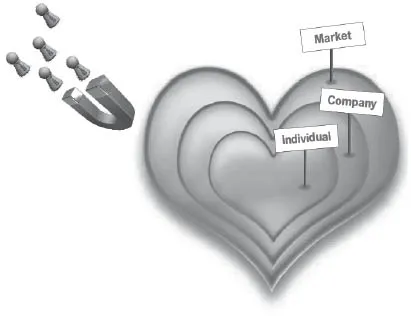
The three-level system of a company attracting customers
“The outside heart represents the market. On this level, the company and its competitors interact with their clients, suppliers, shareholders, and the public. This is the level of the heart that radiates into the marketplace.
“The middle heart represents the company itself, inclusive of the employees and support systems working more or less effectively together to produce the products and services offered.
“The small heart in the center represents the individual that bridges the company and the customer. It could be the sales representative, a service agent, or anyone who interacts with the client in the name of the company—the person who touches the client’s heart directly.”
The First Heart Magnet: Being unique...
Table of contents
- Cover
- Half title
- Title
- Copyright
- Table of Contents
- Preface
- Chapter 1: Heartselling—Discovering the Pulse to Your Customer’s Heart
- Chapter 2: The First Heart Magnet—Being Unique: The Secrets behind Expert Status and Positioning
- Chapter 3: The Second Heart Magnet—Trust-building through Word of Mouth
- Chapter 4: The Third Heart Magnet: Getting and Staying in Touch
- Chapter 5: The Fourth Heart Magnet: Humanics or how to win over your team with a five-star service philosophy and have them look forward to changing company processes
- Chapter 6: The Fifth Heart Magnet: Magnetic Selling: Tripling the Power of Persuasion
- Chapter 7: The Sixth Heart Magnet: Motivation—Radiating eyes as a key attractor for clients (as well as team members and yourself)
- Chapter 8: The Seventh Heart Magnet: Attracting clients with the right talents to the right positions
Trusted by 375,005 students
Access to over 1.5 million titles for a fair monthly price.
Study more efficiently using our study tools.
Frequently asked questions
Yes, you can cancel anytime from the Subscription tab in your account settings on the Perlego website. Your subscription will stay active until the end of your current billing period. Learn how to cancel your subscription
No, books cannot be downloaded as external files, such as PDFs, for use outside of Perlego. However, you can download books within the Perlego app for offline reading on mobile or tablet. Learn how to download books offline
Perlego offers two plans: Essential and Complete
- Essential is ideal for learners and professionals who enjoy exploring a wide range of subjects. Access the Essential Library with 800,000+ trusted titles and best-sellers across business, personal growth, and the humanities. Includes unlimited reading time and Standard Read Aloud voice.
- Complete: Perfect for advanced learners and researchers needing full, unrestricted access. Unlock 1.5M+ books across hundreds of subjects, including academic and specialized titles. The Complete Plan also includes advanced features like Premium Read Aloud and Research Assistant.
We are an online textbook subscription service, where you can get access to an entire online library for less than the price of a single book per month. With over 1.5 million books across 990+ topics, we’ve got you covered! Learn about our mission
Look out for the read-aloud symbol on your next book to see if you can listen to it. The read-aloud tool reads text aloud for you, highlighting the text as it is being read. You can pause it, speed it up and slow it down. Learn more about Read Aloud
Yes! You can use the Perlego app on both iOS and Android devices to read anytime, anywhere — even offline. Perfect for commutes or when you’re on the go.
Please note we cannot support devices running on iOS 13 and Android 7 or earlier. Learn more about using the app
Please note we cannot support devices running on iOS 13 and Android 7 or earlier. Learn more about using the app
Yes, you can access Heartselling by Alexander Christiani in PDF and/or ePUB format, as well as other popular books in Business & Management. We have over 1.5 million books available in our catalogue for you to explore.