New York Times–Bestseller: "This encouraging and practical book will give you hope and a plan" for overcoming obstacles and growing your business (David J. Rendall, author of
The Freak Factor).
Joe Mechlinski is a man with a mission: to help businesses grow regardless of their size, their industry, or the economy, and despite the government. Growing up in inner-city Baltimore, Joe learned firsthand what it's like to be undervalued and underserved. After graduating from one of the worst high schools in the city, Joe attended one of the best colleges in the country, became an entrepreneur, and learned one of the most critical steps to growth: People are your most important asset.
He now runs an award-wining management consulting firm. For more than ten years he has been sharing this and other critical strategies for "growing regardless" with hundreds of companies nationwide.
Grow Regardless presents the philosophy behind each step, explains how to implement, and provides exercises to help leaders get started. It also features in-depth interviews with successful CEOs talking candidly about their experiences and successes with this method.
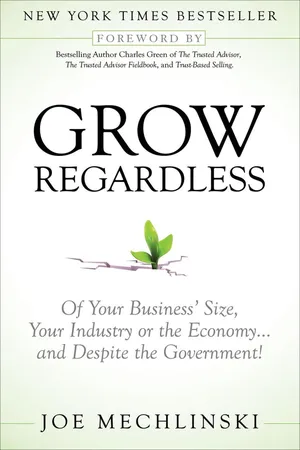
eBook - ePub
Grow Regardless
Of Your Business' Size, Your Industry or the Economy and Despite the Government!
- 194 pages
- English
- ePUB (mobile friendly)
- Available on iOS & Android
eBook - ePub
Grow Regardless
Of Your Business' Size, Your Industry or the Economy and Despite the Government!
About this book
Trusted by 375,005 students
Access to over 1.5 million titles for a fair monthly price.
Study more efficiently using our study tools.
Information
Part One:
CLEARING THE WAY FOR GROWTH REGARDLESS
Chapter 1
THE METHOD AND ME—HUMBLE ORIGINS

The majority of men are bundles of beginnings.
—Ralph Waldo Emerson
It was the summer of 1990 and I was thirteen years old, pounding the Baltimore pavement in search of a job. I was desperate for money. I had just had a big blowout with my mother and moved in with my dad.
My parents married young because I was on the way, and they were long divorced by this time. Dad, the hardest working man I have ever known, worked in a warehouse as a forklift driver. Mom was an aspiring actress who, as bright and lovely as she was, found it impossible to keep a conventional day job. Mom spent much of her time auditioning for television commercials and movie extra roles—for which she was rarely chosen. Consequently, she and I bounced around from place to place, house to house, and sofa to sofa for more than a decade, never actually homeless and starving but never stable, either. I attended five different schools in as many years, and I became a pro at recycling the few outfits we bought at Goodwill so I never had to wear the same combination of pants and shirt two days in a row. By the time I was a teenager, I was sick and tired of being broke and fed up with having no control over my life. Like most teenagers, I didn’t want to rely on my dad or my mom anymore. I wanted to be independent and self-sufficient.
So that summer, while other kids my age were hanging out at the community swimming pool and playing ball in the sandlot, I was tramping up and down Eastern Avenue, cold-calling every gas station, convenience store, market, shop, and warehouse begging for work. It was hard for me to walk up to total strangers and ask for a job. I was painfully shy, and so much was riding on their answer. I must have gone to twenty-five places and talked to dozens of people, and everyone said no—except for the manager of a bakery. When I asked if he had a job for me, he said with a snort, “You want a job? Come back tomorrow at 4:30 a.m. and I’ll put you to work.”
I was so excited I practically flew the two blocks to our house. My dad, ever the pragmatist, was skeptical. But because he always supported me, he got up with me the next morning, drove me to the bakery at 4:30 a.m., and waited in the car to make sure everything was legit. The place was all lit up and workers, including the manager from the day before, bustling inside. I tried the door, but it was locked. I tapped on the glass and the workers and the manager looked up. I smiled and waved. When the manager saw me, he smirked, said something to the other people, and turned his back to me. I knocked again, but they all ignored me.
That bakery manager saw me, a timid kid, standing there tapping at his door at 4:30 a.m., but he decided not to let me in. That incident started me thinking that when you’re in business and you promise something to someone, you’ve got to keep your word, no matter what. Whether you keep your word tells the story of who you are and where you’re going in business and in life. It turns out this was only the first of many times I watched a company make a promise and then break it.
That bakery, by the way, has since gone out of business. I like to think it was because karma kicked them to the curb, but who am I to say?
Not long afterward, my dad ran into the man he used to work for when he was a teenager. Dad asked his former boss if he knew anyone who might give me a job. The man replied, “If your son is half the worker you are, I’ll hire him myself.”
So it was, that I went to work for Leo’s Seafood, a Baltimore institution since the 1950s. Leo’s had everything: seafood and grocery markets, a restaurant, a liquor store, and poker machines in the back—a true one-stop shop for the people of our blue-collar neighborhood. Working at Leo’s was a big adjustment. I was a city boy who had never even touched a fish, let alone cleaned one. Suddenly, I had to clean them for paying customers. I was also extremely shy, and at Leo’s I had to wait on customers face-to-face. There was no official hierarchy among the workers, but we all knew who our leader was: an elderly gentleman named Robert Butler. Robert was a quiet, unassuming man from the Deep South. He mumbled when he talked and shuffled when he walked. He moved as slow as molasses, but I’ll be damned if every single customer who came to the seafood counter wanted Robert—and only Robert—to wait on them.
Even though I’m shy, I’ve always been fairly competitive, and I wanted more customers to choose me. I started watching the way Robert interacted with people, and what I saw was contrary to everything I thought I knew about customer service. I thought people would want to be waited on quickly, but I learned that what people really wanted was to be waited on right. Robert took the time to pick out the fattest, freshest crabs, and he’d throw in a couple of extra ones for his best customers. He’d fill a bag with ice to keep the seafood chilled all the way home, and he’d personally walk his customers to the checkout line, asking how they were and inquiring about their children or a sick mother. Meanwhile, people lined up ten deep at the seafood counter, and none of them wanted anything to do with me. They preferred to wait for Robert, who was moseying along with his current customer, rehashing last night’s Orioles game.
People came to Leo’s for a product, and they left with that product, but they also left with something extra: Robert’s unconditional guarantee that if something wasn’t right, he would fix it. They knew he would be there for them no matter what—he would keep his word.
Eventually, after watching and learning from Robert, I started to earn a few loyal customers of my own. I worked my way into their hearts by imitating the little things Robert did to exceed their expectations. Once I had learned how to communicate that same sense of caring and accountability to our customers, more of them started to choose me.
I worked at the seafood market for seven years, every weekend of my teens. I learned about hard work and being part of a team. But more important, I learned about the client experience. This is where I started to understand that by giving everything and more to your customers, you get really good things in return . . . such as referrals and repeat business. You get growth.
Unfortunately, this story doesn’t have a great ending for Leo’s. As the economy soured, the company hit hard times and began grasping at straws to survive. The store tried to diversify too much too quickly. We started catering big jobs and parties, which diverted our focus from the neighborhood folks who were our bread and butter. Leo’s eventually closed after more than fifty years in business. Those of us who worked there learned the hard lesson that nothing is permanent. You have to take care of your customers if you want to last.
 | You have to take care of your customers if you want to last. |
Because I wanted to make more money than I was earning at Leo’s, I once took a second job at a gourmet grocery store famous for its outstanding customer service. It was true that the market was an amazing place to shop. But it was a terrible place to work. If you were a few seconds late returning from your break, or you didn’t tie your tie correctly, or you didn’t greet every customer with the same canned line, the manager nailed you to the wall. The workers had no authenticity or passion. They were well-programmed robots with a check-the-box mentality. I quit after three weeks, but it was one of the most valuable jobs I have ever had, because I learned that it wasn’t enough to provide a remarkable customer experience. You have to provide a quality employee experience, too. If that market had treated its employees as well as it did its customers, it would have been exponentially more successful.
I attended Baltimore’s Patterson High School, which was a pretty dismal place. More than 900 kids were in my freshman class, but only 235 of us graduated. Because I was a decent football player, I was recruited by Johns Hopkins University. Going from one of the worst high schools in the state to one of the best colleges in the world was a culture shock. I floundered a bit, changing my major from engineering to pre-med and back to engineering, finally settling on economics because I could talk my way through that. Somehow I did okay.
At the beginning of my sophomore year, I received a flyer in the mail that read: Do you want to run your own business? Check. Do you want to earn college credit? Check. Do you want to make $10,000 this summer? That was five times more than I had earned the previous summer, so . . . check!
The flyer came from a company that recruited college kids and taught them how to run their own painting franchises. Once trained, it was up to you to staff your team and find your own jobs. I signed on and went through the training. My first year was tough, like the first year of any new business. I hired a bunch of friends and then had to fire some of them because they rarely listened to anything I said. But because of what I’d learned by watching Robert at the seafood market all those years, we gave great customer service. And just like at the seafood market, I saw that the better the customer service, the more money we made.
By my second summer running the business, I had read Michael E. Gerber’s The E Myth, which explored the importance of making a promise to your customers and telling them a compelling story about yourself. So instead of just saying that we had a painting business, we told people we were working for our college tuition—we wanted to work hard and earn a fair wage by providing a service people needed. All of a sudden, our sales more than doubled. I went from having half a dozen employees to more than fifty, all by changing the way I positioned our story and by doubling down on client service. My teams showed up clean and on time. On the first day of a new job, we brought coffee and donuts for the client. If we didn’t finish on time, we refunded some of the money. When there was a problem, we fixed it. We cleaned up the job site when we left each day. We weren’t the best painters by a long stretch, but because we were sincere and we tried so hard, people were nice to us and told their friends about us.
By the third year, I had more than a hundred people working for me. I made more money that summer than many people make today in a year. But there were problems at the corporate level that I wasn’t aware of, and one day the company was unable to meet its obligations. I had a group of guys painting at a mansion near the Johns Hopkins campus, and when they found out what was happening with the company, they decided to get back at corporate. They trashed the mansion. They broke windows and threw black oil-based paint all over the place. The owner, St...
Table of contents
- Cover
- Title Page
- Copyright Page
- Dedication
- Contents
- Foreword
- Introduction
- Part One: Clearing the Way for Growth Regardless
- Part Two: Nurturing Growth Regardless
- Acknowledgements—Attitude of Gratitude
- About the Author
- Featured Companies
- Additional Resources
Frequently asked questions
Yes, you can cancel anytime from the Subscription tab in your account settings on the Perlego website. Your subscription will stay active until the end of your current billing period. Learn how to cancel your subscription
No, books cannot be downloaded as external files, such as PDFs, for use outside of Perlego. However, you can download books within the Perlego app for offline reading on mobile or tablet. Learn how to download books offline
Perlego offers two plans: Essential and Complete
- Essential is ideal for learners and professionals who enjoy exploring a wide range of subjects. Access the Essential Library with 800,000+ trusted titles and best-sellers across business, personal growth, and the humanities. Includes unlimited reading time and Standard Read Aloud voice.
- Complete: Perfect for advanced learners and researchers needing full, unrestricted access. Unlock 1.5M+ books across hundreds of subjects, including academic and specialized titles. The Complete Plan also includes advanced features like Premium Read Aloud and Research Assistant.
We are an online textbook subscription service, where you can get access to an entire online library for less than the price of a single book per month. With over 1.5 million books across 990+ topics, we’ve got you covered! Learn about our mission
Look out for the read-aloud symbol on your next book to see if you can listen to it. The read-aloud tool reads text aloud for you, highlighting the text as it is being read. You can pause it, speed it up and slow it down. Learn more about Read Aloud
Yes! You can use the Perlego app on both iOS and Android devices to read anytime, anywhere — even offline. Perfect for commutes or when you’re on the go.
Please note we cannot support devices running on iOS 13 and Android 7 or earlier. Learn more about using the app
Please note we cannot support devices running on iOS 13 and Android 7 or earlier. Learn more about using the app
Yes, you can access Grow Regardless by Joe Mechlinski in PDF and/or ePUB format, as well as other popular books in Business & Management. We have over 1.5 million books available in our catalogue for you to explore.