eBook - ePub
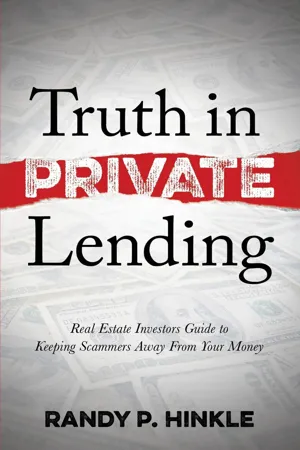
Truth in Private Lending
Real Estate Investors Guide to Keeping Scammers Away From Your Money
- 104 pages
- English
- ePUB (mobile friendly)
- Available on iOS & Android
eBook - ePub
Truth in Private Lending
Real Estate Investors Guide to Keeping Scammers Away From Your Money
About this book
Real estate agents and other investors who need money to close their purchases often use private lending as their main source for funding. Unfortunately, many private lenders take advantage of this. They use unethical and illegal tactics to persuade investors to pay fees to obtain loans. For this reason, investors need guidance from an expert who knows the language and the processes these imposters use. Truth in Private Lending gives detailed accounts of how private lending scammers typically operate, and advice on how to keep them from getting your money.
Information

Chapter One
WHY WE NEED FUNDING
All investors need funding to make purchases. Here is our biggest problem. We know there is a ton of money potentially available for us to borrow to make us and the private lender happy. This gives us a false sense of hope though, because even though the money is real, we do not have the patience and know-how to get to those private lenders in the correct fashion. These lenders will typically not loan to us unless we have a direct connection to them, to make them feel confident in us as a borrower. We know that we are honest, and believe this should be a simple deal. Sometimes we even think we are doing them a favor. When we can’t find what we need, we go blindly hunting online for a lender, instead of looking for what we really need to get this done—the direct contact.
This is where the problem starts. Impatience that leads to looking in the wrong place for the wrong thing, never finding the contacts that will connect you with a real lender. I can give you huge list of great buys I had on contract or a Letter of Intent(LOI) that would have made me a millionaire several times over—if the lenders that had promised the funding had closed the deal. We all know this process can be an emotional roller coaster. I am just like you and I want my deals to work! I have the emotional highs and then the depressing lows when things fall apart. I get sick when an investor contacts me about being scammed, knowing that each time it happens, it puts distance between them and real success. Consider the following investor’s scenario:
You think you have a legitimate private lender and they guarantee you they will deliver your loan after you pay an origination fee of $5,000. You pay that, but then they come back and approve your loan, but tell you that you will have to pay a transfer fee of $2,000. In the end they back out and do not close. At this point you have lost $7,000 of your down payment money, and this makes you even more desperate for a deal to close. A few months later you still have not had any success. One day while you’re in this desperate state, a nice professional-speaking lender calls and asks you if you have a deal they can fund. Of course, being a real estate investor, you always keep one in your back pocket.
We go down the same path of filling out the lender’s application, sending all of our personal data, and then suddenly they turn your loan down. Three months later you find out they have used your identity to obtain a credit card and used $5,000 in credit, which you have to pay. Now you are $12,000 in the hole, and very desperate, because you have almost exhausted half the funds you had originally. A few months later you find a great deal, you think you have a real lender that has everything in order and nothing unusual. You pay $2,500 for the appraisal and their origination fee of $3,000. You wait and let other deals pass by since you are sure this deal is going to work. Then the lender calls you back and tells you the appraisal has come back short by $100,000! The deal is over because you do not have the $100,000. This deal is another $5,500 loss.
All these losses from bad decisions add up to $17,500. Now I want you to think about how much time has elapsed, six to twelve months! If you had used the $17,500 as a down payment on a property that was affordable based on that down payment, you could have purchased an $87,500 property with a 20% down payment. If you made a really good buy you would sell the property at around $110,000 net. This investment would have cleared you $22,500, plus you have your $17,500 you put down. Now you have $40,000 to buy a $200,000 property. You sell it for $260,000 or 30% gain, which is $60,000 plus you have the $40,000 you started with, and now you have $100,000, and still have not used up half the time you wasted in the original scam lender scenario above.
When looking for funding, we should always consider our personal and local bankers first. They will always have the best deal for us if we can get qualified for the needed amount. This is an issue that has changed dramatically, as some public lending institutions are scared to death of investors like us because of bad past experiences. Not all of those experiences were from bad investor decisions, some were from their own overly aggressive bankers—which is what we like! Aggressive lending may be a thing of the past for some time, but they will need business eventually, and they will begin to forget those bad loans. At that point they will start easing the criteria and qualification process, and the loan amount, or Loan to Value (LTV), will start to gradually increase again.
Lets assume you cannot get qualified for a loan at your local bank. You still have numerous options depending on your financial situation, and the property.
There are private lenders, capital raises, crowd funding, institutional money, international investors, family, friends, and the Small Business Administration. These are some of the major avenues we can go down to find funding for our deal.
Private lenders are typically people with their own cash they are lending. This can be a group, and you typically are not speaking with the person that has the money, but with a broker. Another way to describe them is to say they are lenders without a store front, office, company name, etc. Capital raises are when you actually find investors yourself or have someone find them and you have a goal of some specified amount. You keep contacting cash investors until you reach your goal. Typically these investors want a return on their money invested and an equity portion of your investment or acquisition. Crowd funding is very similar to capital raises but there are much smaller amounts received from many more smaller investors to get to the funding needed. Institutional investors are basically hedge funds. International investors could be any of these categories, but located outside the United States. Of course, family and friends are self-explanatory.
First let’s consider the deal. What is it? Do we have a contract? Is it one property or a group? Do we have the property identified? What is the loan amount needed? What is the as-is and as repaired value (ARV)? What is our credit score? Does the property produce income? Is it in need of major repairs? If so do we have that experience? Two major factors to consider: How much experience in the industry related to our loan do we have? How much money do we have of our own, our skin in the game, to use as a down payment?
Before I go down the road of making private lenders look bad, let me first apologize to the good ones. This is not intended to bash the entire industry. True legitimate lenders lose their money and time just as often as the borrowers. There are many unscrupulous borrowers who lie on their applications, fraudulently furnish documentation, and back out of closing when the loan is ready. One indicator that you are dealing with a legitimate lender is that if you mention escrow for fees, they do not run. They understand it is a normal business practice. It’s important as a private investor to realize how the bad and good see this so differently.
I will discuss each of our deal questions above one by one.
First, what kind of deal are you trying to fund? I read a document from a reputable private lender that had an example of two borrowers with different types of properties. One was an income generating property and the other was a faith-based property. The lender used the property type as the deciding factor. They approved the loan on the income producing property, and declined the faith-based building, because it is hard to market. This decision is a no-brainer for me, as I work as an appraiser. But, for some investors they do not see it from the lender’s perspective. This can result in time and money wasted. Once I did have a faith-based distressed property that I got approved with a good private lender, but the deal had a good bit of expensive vacant commercial property on the road frontage. It did require some skin in the game on my part as well. We need to be aware of how the lender we are dealing with feels about our property type. We need to search for lenders who are interested in our property type before we engage them. Another important thought, private lenders always make decisions based on the possibility of getting the property back. So good locations are always preferred. We all know how important location is in real estate. If you have not heard this statement, get a real estate book and study location, it is truly the number one factor to consider in buying.
Lenders will typically not give you the time of day if you do not have the property under contract or you have a secure Letter of Intent (LOI). They are not interested in wasting their valuable time. If you do not have a contract or LOI, they have no guarantee that you can buy the property and that the price is set, which has a direct effect on loan amount. Contracts tell the lender many important things. It gives them the price, the legal description, and the type of transfer (fee simple, leasehold, or fee estate). Most lenders only deal in fee simple, meaning you buy the land, the buildings, and all rights except subsurface rights. It tells them the time window they have to close their loan with you. Most of the time it tells how much money you have to put down, what is required of you to pay at closing, and what the seller is required to pay. A contract also let’s the lender know if you have left out any important elements like inspections, repairs, or taxes and other prepaids.
If the deal is a single property it is the simplest form of transaction for financing in most instances. That being said, I will tell you that it is sometimes easier to get bigger deals done than smaller ones. The lender may prefer having less deals that are larger, rather than the same dollar amount in multiple, smaller loans. It is less work, and the tenants are typical closer to credit tenants. A credit tenant is a company that has received a good rating based on their financial strength from one of the major rating companies.
I prefer to buy in larger numbers which gives me a less risky portfolio. It lets you cost-average your occupancies and tenants over the entire portfolio instead of having so much risk in only a few tenants. If a tenant bankrupts, the smaller portfolio is hurt badly, but for the larger it is just a small bump in the road.
Have you actually picked out the property you want to buy? There are some very important factors in having your property picked out before going after funding. Without the specific property and the price, you have no idea what to put on an application as a requested loan amount. You need to know this as much as the lender. You can only make an educated decision on what to pay if you have two things, a contract price and terms of your loan. This is why cash flow analysis based on a specific price is so important. Second, If you do not have a specific property tied up in the form of a letter of intent or contract then the lender typically will not proceed with underwriting your request. They know some other party could buy that property if you do not have it secured properly, and all the work they had done would be wasted with no possibility of making a fee off your loan.
Most find the property first, but I like to have cash to buy before I go looking. Cash in hand gives you much greater negotiating power. I estimate that on average I can get about 20% off the price with cash compared to financing. If it is a distressed property, lenders really want to, and at times have to, get these properties off their books. When you have the cash they know you can close, and it takes out many of the contingencies in contract.
Without properties identified, you had better have a great business plan, a proven track record, and loads of experience.
Once you have the contract or LOI, you have established a purchase price. So, now we as investors want the highest loan-to-value or loan to purchase price (two different things) we can possibly obtain. The higher we get the less cash we have to use for each deal, and the more deals we can do. If you are like me it is all about numbers. You want to make as much as you can get. I am assuming you have enough experience to buy the right deals, at the right price, and in the right location. In bigger deals it is much easier to get a higher LTV than with smaller ones. Lenders get more aggressive because they will fight for the larger deals that are above $1 million. In most cases the lenders require a 6...
Table of contents
- Cover
- Title
- Copyright
- Contents
- Preface
- Chapter One Why We Need Funding
- Chapter Two The Categories of Risk
- Chapter Three How to See Through the Deception
- Chapter Four Fraud
- Chapter Five Money Laundering and Employment Scams
- Chapter Six Fee Scams
- Chapter Seven Johannesburg
- Chapter Eight Other Scams
- Chapter Nine The Truth about Private Lenders and What They Want to Fund
- Chapter Ten The Importance of Establishing Good Relationships!
- Chapter Eleven Acquisitions
- Chapter Twelve Off-Market Real Estate
- Chapter Thirteen Fighting Back!
- For More Information:
- About the Author
Trusted by 375,005 students
Access to over 1.5 million titles for a fair monthly price.
Study more efficiently using our study tools.
Frequently asked questions
Yes, you can cancel anytime from the Subscription tab in your account settings on the Perlego website. Your subscription will stay active until the end of your current billing period. Learn how to cancel your subscription
No, books cannot be downloaded as external files, such as PDFs, for use outside of Perlego. However, you can download books within the Perlego app for offline reading on mobile or tablet. Learn how to download books offline
Perlego offers two plans: Essential and Complete
- Essential is ideal for learners and professionals who enjoy exploring a wide range of subjects. Access the Essential Library with 800,000+ trusted titles and best-sellers across business, personal growth, and the humanities. Includes unlimited reading time and Standard Read Aloud voice.
- Complete: Perfect for advanced learners and researchers needing full, unrestricted access. Unlock 1.5M+ books across hundreds of subjects, including academic and specialized titles. The Complete Plan also includes advanced features like Premium Read Aloud and Research Assistant.
We are an online textbook subscription service, where you can get access to an entire online library for less than the price of a single book per month. With over 1.5 million books across 990+ topics, we’ve got you covered! Learn about our mission
Look out for the read-aloud symbol on your next book to see if you can listen to it. The read-aloud tool reads text aloud for you, highlighting the text as it is being read. You can pause it, speed it up and slow it down. Learn more about Read Aloud
Yes! You can use the Perlego app on both iOS and Android devices to read anytime, anywhere — even offline. Perfect for commutes or when you’re on the go.
Please note we cannot support devices running on iOS 13 and Android 7 or earlier. Learn more about using the app
Please note we cannot support devices running on iOS 13 and Android 7 or earlier. Learn more about using the app
Yes, you can access Truth in Private Lending by Randy P. Hinkle in PDF and/or ePUB format, as well as other popular books in Business & Real Estate. We have over 1.5 million books available in our catalogue for you to explore.