Small Business Big Pressure is the only book written by a small business owner for the small business owner that truly addresses the unique pressures faced daily by small business owners. Darryl is an entrepreneur, from a family of entrepreneurs, who has spent years advising entrepreneurs and small business owners. In Small Business Big Pressure, his unique perspective is evident.
Despite his unique intelligence, Albert Einstein had a reputation of being absent minded. There is a story that on one particularly cold winter day, Einstein elected to travel by train from one industrial town to the next. Prior to stepping on the locomotive, a young conductor requested Einstein’s ticket. He frantically scrambled in search of the boarding pass. Reaching into his jacket and pant pockets, and even in the cuff of his pant legs. His ticket was lost. Einstein’s haircut kept him from remaining anonymous. “Mr. Einstein, there is no need to fret about your ticket,” the conductor said. “I know who you are. Feel free to come on board.” The conductor courteously opened his hand to show him the way to the entrance.
Einstein settled in a dimly lit seat by himself in the back as he continued to search for the lost ticket. The conductor, recognizing the discomfort Einstein was experiencing, briskly walked over and kindly, yet directly, explained to Einstein, “Don’t be concerned about the ticket Mr. Einstein. My train is your train. No ticket necessary.” Einstein paused, breathed, and looked up from his seat. In his thick German accent, he replied, “Young man, I don’t need the ticket to board the train, I need the ticket to know where I am going.”
The story reflects the reality of an entrepreneur. Somewhere along the way, Mr. Einstein’s mind became messy with ideas and strategy, and thus lost sight of his destination. Likewise, the entrepreneur’s mind gets hazy. He stands in the middle of a cornfield blanketed by fog and mist. He moves because being paralyzed means death, but he still doesn’t know where he’s going. Stress, pressure, and worry keep his mind cloudy. His work ethic has his blood circulating and his heart beating but there is no destination in sight. He’s only manufacturing crop circles.
For the entrepreneur standing in the foggy cornfield and knowing the destination, is like having a ladder and a flashlight. Defining the destination, by creating a company mission, vision, and goals, gets him out of the fog. These three components provide clarity to the entrepreneur and to the team. Often, the entrepreneur has an idea of his destination lodged deep in his gut. However, he needs to step aside from the push of daily demands and exercise the powerful process of writing down the future. This process inscribes the vision on his consciousness. The two major benefits of defining the destination are (1) Focus and (2) Motivation.
Focus
Mr. Einstein was a genius of the past, so let’s consider icons and geniuses of the present. What do Warren Buffett and Bill Gates, Sr. have to say about defining a destination? One evening as the sun rested on the waters, the two enjoyed dinner with friends. I would imagine lobster, the most experienced wait-staff, and wine that is designed to be smelled before being tasted. Buffett would request a Cherry Coke. A few of the politicians, judges, and businessmen attending the dinner would do the same only to patronize Mr. Buffett.
After a few drinks, one member of the group had the confidence to pose a question to the table: What factor did they feel was the most important element that got them to where they were in life? Pause. No one wanted to misstep.
After deliberation, Buffett and Gates concurred, it was focus. The specific type of focus they were referring to was the type that sparks “intensity.” Entrepreneurs desire intensity but get sidetracked because of a lack or complete loss of focus. It only requires a little entrepreneurial effort to climb the ladder with a flashlight in hand, get the team focused, and enjoy the return of intensity.
Motivation
When the entrepreneur climbs the ladder and sees above the cornfield, he then becomes motivated. He’s motivated to continue to place bets and work late because he is convinced the destination is bliss. An entrepreneur who has a well-defined destination is inspired knowing one day he will be able to take time off and enjoy a steak dinner. But more importantly, he’s motivated to change the lives in his community through his company.
The team also experiences a new kind of motivation. Employees can only be motivated by a paycheck for so long. They often dread Mondays and celebrate TGIF a little too much. The benefits package isn’t a motivator; it’s only a buffer between them and Monster.com. If the entrepreneur puts a little more in the 401k, gratefulness doesn’t transcend having to deal with an angry customer. However, when the entrepreneur stands on the ladder and lights the way to the destination, the team will experience a new kind of motivation. The team is transformed from a collective group of people doing a job to a crusade for positive change. Entrepreneurs would rather lead a crusade than individual employees. Likewise, employees would rather follow a crusade than a boss.
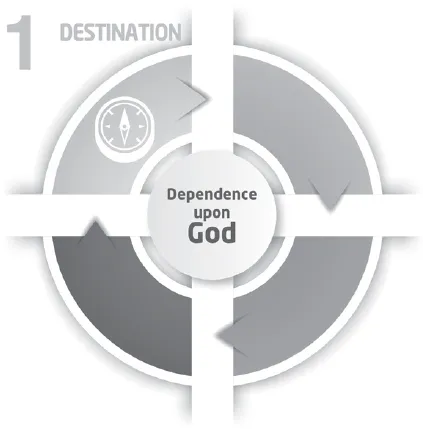
In this section, we will talk about how to define the destination and how to cast vision for your team. We will climb the ladder of a mission statement and a vision statement. Then, we will develop well-thought-out goals. Next, I’ll hand you a few flashlights that will keep you and your team focused. Lastly, we’ll qualify how critical it is for the entrepreneur to be 100 percent dependent on God while defining the destination.
ACTION ITEM
Answer the following question: Can I confidently articulate my company vision?
PRAYER
LORD, MY MIND IS STUCK IN THE FOG AND I’M CONFUSED. FRANKLY, I DON’T KNOW WHERE I AM GOING. BE MY LIGHT.
2
MISSION STATEMENT
The mission statement answers the question: Why does the company exist?
Specifically, a mission statement formula is:
What the company does + Who the company does it for = Mission statement (sometimes it includes: + How the company does it).
A simple way to start a mission statement process is to use the phrase, “We exist to …” This phrase helps shape the entrepreneur’s mind-set for creating a powerful mission statement. The mission statement defines the organization’s purpose, so every word must be deliberate. The entrepreneur can keep the phrase “We exist to” in the mission statement or he can remove it while he wordsmiths. The revision might make the statement feel more authentic but it takes time and a few rounds of, “No, that doesn’t sound right.” When it is completed, the mission statement should only be one strong, concise sentence. Take out the fluff and shoot it straight. Below are three examples of powerful mission statements:
“Use our pioneering spirit to responsibly deliver energy to the world.”
—Conoco Phillips1
“To bring inspiration and innovation to every athlete in the world.”
—Nike2
“To bring generational change to Middle America through a process of independent advice and principled leadership.”
—PAX Financial Group, LLC
The most valuable benefit of a mission statement is that it becomes a filter. The mission statement gives a company a sense of order and guides the decision-making process. Every purchase decision and project initiative must be filtered through the mission statement. For example, our company focuses on middle-class America, not the affluent. We drew a line in the sand when we created this mission. This means if “top-of-the-line,” “cutting edge,” “innovative” software packages that cater to the elite are dangling in front of us, we don’t take the bait. They’re not for us. This filtering process keeps us focused, not distracted by dead-end routes found in the corn maze.
A young lady I know had a mission statement—my mom. Growing up, my mom was routinely exposed to family instability. Unfortunately, the family challenges were at the hands of a Great War veteran who fought for our country at Iwo Jima as a teenager. At the time, people didn’t have a clue about Post-traumatic stress disorder and his pain was witnessed by my mom. As a result, my mom developed a mission statement of what a family tree with her future husband might look like. My mom, a sixteen-year-old young lady, gave birth to the most beautiful little boy (me). She, along with her twenty-year-old husband, had a mission statement for their family—peace and prosperity for her children and her children’s children. She prayed every day of her life for peace and prosperity for the next generation. This mission statement was her entire life’s focus.
My mother’s mission statement was woven on her heart and recorded on audio cassettes. Many of these cassettes can be found in the back of her closet with little white labels on the side stating, “Robin’s prayer.” She wouldn’t ever tell you she had developed a mission statement, but if you listened to the tapes you would realize that she was on a mission. The mission defined (1) what she was doing and (2) who she was doing it for.
I’ve seen business-people roll their eyes when I talk about the mission statement. They believe it is something you put on a website or something to satisfy a marketing initiative. If the sole purpose is to fulfill an obligation, the leader shouldn’t waste his minutes developing one. The miss...
Table of contents
Cover
Title
Copyright
Contents
Foreword
Preface
Acknowledgements
Introduction
Part 1: Destination
Part 2: Dollars
Part 3: Dialogue
Part 4: Identity
Notes
Trusted by 375,005 students
Access to over 1.5 million titles for a fair monthly price.
Study more efficiently using our study tools.
Frequently asked questions
Yes, you can cancel anytime from the Subscription tab in your account settings on the Perlego website. Your subscription will stay active until the end of your current billing period. Learn how to cancel your subscription
No, books cannot be downloaded as external files, such as PDFs, for use outside of Perlego. However, you can download books within the Perlego app for offline reading on mobile or tablet. Learn how to download books offline
Perlego offers two plans: Essential and Complete
Essential is ideal for learners and professionals who enjoy exploring a wide range of subjects. Access the Essential Library with 800,000+ trusted titles and best-sellers across business, personal growth, and the humanities. Includes unlimited reading time and Standard Read Aloud voice.
Complete: Perfect for advanced learners and researchers needing full, unrestricted access. Unlock 1.5M+ books across hundreds of subjects, including academic and specialized titles. The Complete Plan also includes advanced features like Premium Read Aloud and Research Assistant.
Both plans are available with monthly, semester, or annual billing cycles.
We are an online textbook subscription service, where you can get access to an entire online library for less than the price of a single book per month. With over 1.5 million books across 990+ topics, we’ve got you covered! Learn about our mission
Look out for the read-aloud symbol on your next book to see if you can listen to it. The read-aloud tool reads text aloud for you, highlighting the text as it is being read. You can pause it, speed it up and slow it down. Learn more about Read Aloud
Yes! You can use the Perlego app on both iOS and Android devices to read anytime, anywhere — even offline. Perfect for commutes or when you’re on the go. Please note we cannot support devices running on iOS 13 and Android 7 or earlier. Learn more about using the app
Yes, you can access Small Business Big Pressure by Darryl W. Lyons in PDF and/or ePUB format, as well as other popular books in Business & Entrepreneurship. We have over 1.5 million books available in our catalogue for you to explore.