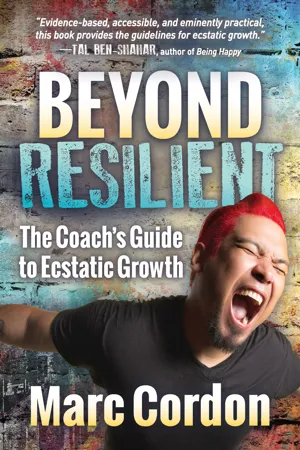
Life coaches serve their clients from languishing to flourishing, but they are not impervious to life's stress, vulnerabilities, and dissonance. In Beyond Resilient, life coach Marc Cordon weaves philosophy, positive psychology theory, and pop cultural references together to show how coaches and clients alike can use their daily experiences to unlock extraordinary outcomes in mental wellbeing, life transition, business performance, and leadership. Coaches and clients learn how to alleviate the internal mental chatter that causes self-doubt, while using resistance, criticism, and even failure to fuel their growth.
- 95 pages
- English
- ePUB (mobile friendly)
- Available on iOS & Android
eBook - ePub
About this book
The key to optimal living is not only bouncing back from failures but looking forward to the opportunities for extraordinary growth that they provide.
Information
Chapter One
WHEN QUIET DESPERATION IGNITES A FIRE
“The mass of men lead lives of quiet desperation. What is called resignation is confirmed desperation. From the desperate city, you go into the desperate country and have to console yourself with the bravery of minks and muskrats. A stereotyped but unconscious despair is concealed even under what are called the games and amusements of mankind. There is no play in them, for this comes after work. But it is a characteristic of wisdom not to do desperate things.”
If you are reading this book, you’ve already realized that you do not want to lead a life of quiet desperation. Somewhere along your coach training you’ve had an “AHA!” moment that is making it very difficult to go back to a job you once loved but now almost loathe. Yet to live that actualized life where you create space for transformation upon transformation feels like you’re standing on the edge of two tall towers. The tower ahead of you holds all your dreams as a coach. The tower upon which you stand represents your current life. This tower is so old that it is virtually condemned.
You’ve been able to deal with the creature comforts of your old tower until now because here comes Maslow’s tension again. You see the face of your vision of coaching right in front of you and know that you can no longer stay in your current situation. So with that insight, don’t look down, your building has been set on fire.
When you realized that you were putting in too much work and burning out over outcomes that you were no longer passionate about, your fire was lit.
When you said to yourself, “I want to be happier,” your fire was lit.
When you declared that you want the courage to live a more authentic life, not the life others expect of you, your fire was lit.
When you wanted to spend more time with friends and family, your fire was lit.
And when you committed to using your courage to express yourself, your fire was lit (Ware, 2011).
You set the right thing ablaze: your current life. A life where you have outgrown the challenges of your current work, to the point where you may feel as if you are just going through the motions. A life where you don’t like admitting that you’re looking at other people’s entrepreneurial accomplishments and feeling jealousy or envy. A life where you’ve made a good name for yourself, where your family depends on you, and where you have a good reputation with your community.
It may be scary now, but trust me, it gets better. When the time comes, you’ll unfurl your wings and land safely atop your dream coaching business. Even if your family, friends, and colleagues don’t understand it now, when the time is right, they will see you perched on your new tower and say that you deserve to be there. They’ll come around. Just continue to live gamefully.
If you’re finishing a coach training program, you are in a perfect place to become one. But you have a decision to make, “Is coaching the solution to your quiet desperation?” If it’s not, you may find yourself perched upon a burning coaching tower in a few years.
If it is, I’m here to be a part of what could arguably be the toughest part of the coaching journey: your emergence as an unapologetic coach— one who serves boldly and will never be ashamed again of who they are. This journey goes beyond resilience. It serves as the activation energy to ecstatic growth despite personal anarchy.
I Just Want Relief!
I screamed that at the top of my lungs in front of my iPEC (Institute for Professional Excellence in Coaching) cohort of coach trainees in October 2016. I played the role of a client in a fishbowl activity with our coach facilitator, Kyle, modeling the coaching process. And when Kyle probed deeper as to my goals in the next year, I couldn’t take it anymore. I didn’t know how much money I wanted to make. I didn’t know what my coaching niche would be. I just knew I wanted relief!
I knew there was something more for me than what I was currently doing. I thought I was losing my mind to question the stability and the name prestige that I had built up. I was a college administrator and in a Ph.D. program for College Student Affairs Administration. Though I always had a passion for the human development aspect of things, I could care less about naming programs or conduct codes or meetings that felt more like ego-driven urinating contests. I fell in love with positive psychology and saw its application to human development in my life and the people’s lives around me.
It’s an understatement to say how good the University was to me as a student and as a professional. For over 13 years, I was given space to create identity development retreats, sit on the University senate and score some sweet grants. I was handed opportunity upon opportunity to guest lecture in classes, spearhead summer internships, and even create a mini-course on happiness that was in line with the vision of many to turn it into a credit-bearing, revenue-generating academic minor or track. I was receiving offers to work with even more prestigious schools with bigger budgets, was mentioned in a national college health conference for having an innovative practice to tell student stories through assessment, and even hustled to get flourishing on our department-wide strategic plan.
Even with all the apparent accolades, it wasn’t enough. My appetite could not be satiated. And I distinctly remember three “AHA!” moments that shifted my whole being.
First, I remember a lecture in which Dr. Paul Bloom from Yale discussed the notion of the hedonic treadmill. He described it as the idea that we continuously habituate to short-term happiness. So, for example, if I won an award, I’d feel good at the moment, but a year later, I’d want another one to boost me back up. And the more and more you stay on this treadmill, the faster the speed and the higher the incline. You work hard. Your happiness is ephemeral. In the long-term, the most you may have acquired is regrets. What a nihilistic view of happiness!
I was disturbed by the number of years I was on that treadmill, almost as far back as I could remember, and tantamount, I was concerned by the nagging feeling that I was indoctrinating college students to stay on their treadmills. What’s worse? I didn’t know how to step off the treadmill even though I knew that I was on a path of temporary short-term highs that were getting me nowhere. The higher in the organization I went, the more administrative malarkey that didn’t resonate with me. If I chose to go the academic route, I saw the same treadmill— from researcher to assistant to associate to tenure to what? Department head or administrator that goes to more meaningless meetings? But how could I turn back after over 13 years?
My second “AHA!” moment happened while listening to my colleague, Dr. Corey Keyes, describe the notion of human flourishing as feeling good and functioning well. If you just feel good, with no purpose, then you are settling. Like the hedonic treadmill, I felt like I had so much more to give the world, but was so wrought with the fear of making the leap of faith that I settled for the quick-acting, but not lasting, happiness. On the other end, to function well with purpose and meaning, without experiencing that daily, quick-acting happiness, is called striving. To act on your purpose and not be on the treadmill is amazing, but to not get regular happiness from it, to strive, puts you on the road to distress and burnout. When I heard Corey describe flourishing in that way, I realized that I was striving in my Ph.D. program, settling at work, and flourishing absolutely nowhere.
The final “AHA!” moment occurred while giving a lecture to alumni and students about happiness and how all of the aforementioned concepts were coming together. I discussed the hedonic treadmill and Keyes’ ideas of striving, settling, and flourishing and told remarkable stories of overcoming them, but what I realized in the middle of the lecture, was that this once very fresh lecture had become stale and was now over two years old. Two years, and I didn’t have a single new slide about my life to tell. It became painfully obvious that I was going to need to face the fact the happiness guy needed to now deal with his own happiness or lack thereof. It was time to boogie or get off the pot when it came to my growth.
When you’re grass-fed daily, low-potency doses of messages that make you feel helpless, invisible, or “less-than” what you know you must be, you might react in several ways— feeling like the universe is conspiring against you or what appears to be a random volcanic explosion. I had the latter when Coach Kyle dug deep in our iPEC fishbowl session. I knew that I was settling and striving for mediocrity. I wanted to spend more time with my family. I served my job well and outgrew it.
We’re All Hermit Crabs
At some point, you outgrew your shell. What was once a perfect fit had become constricting. I needed to get out. I needed to find a bigger space but knew that moving from one shell to the other was what I feared the most. I needed relief. And after that, although it was scary, I’d find myself a new home with room to grow.
And with that, I declared that I didn’t want to attend meetings for meetings’ sake. I didn’t want to hand out water or condoms when Smashmouth was playing at our school’s homecoming. I wanted to work with more people as they found their purpose. I wanted to do what I was already doing, but more streamlined and on a bigger scale.
Be careful about what you wish. Because when you throw out a life change and let it soak down to your DNA, your mind, body, and soul go on a seek-and-destroy mission. Consciously or not, after I made my declaration at iPEC, I started taking action toward the “relief” I so desperately screamed for. I always ignored my health with work because I was so stuck on the treadmill. But after I announced to my iPEC group that I wanted off, my body got violently sick at the thought of going back to work.
And by the end of that October, the University terminated their contract with me. While the first 12 hours elicited a range of emotions, my iPEC declaration became true. Whether I liked it or not, relief was here.
My time at the University could have come to a more fitting ending to what I wished. I was pushed out of the nest and needed to figure out if the wings that I thought I had were real.
I don’t believe in coincidences. Yet the manuscript for this book is due precisely one year to the day that I asked for relief to live a dream life. It makes me grin that again I want relief in the form of finishing this manuscript. This time, I don’t feel victimized or angry. I’m choosing to push myself— and loving every millisecond of it.
With no backup job, a few clients, and a web domain, I took every positive psychology concept and put it to practice. In turn, I had the privilege of experiencing the ups, downs, and all-arounds of establishing a business very quickly and doing what I absolutely love doing the most— empowering as many people as possible while having as much fun as possible. In October 2016, my tribes fed me in many forms— from new clients, to my certifications in positive psychology from the Wholebeing Institute, and coaching through iPEC. Now it’s time for me to feed you. This book is a distillation of everything I learned in one year of disciplined practice.
Are you settling, striving, and ready to answer your call to serve the greater good? Good. It’s playtime.
Chapter Two
A FRAMEWORK TO LIVE GAMEFULLY
“Empty your mind. Be formless, shapeless like water.”
The world sends us messages of what’s in, what’s out, best practices, guidelines, timelines, deadlines. Here’s a lifeline. Becoming a skeptic of these messages and constructs is inherently a good thing. Yet it feels like a personal anarchy is taking place within you. It’s disrupting enough to unground you and send you into a dizzying existential spin. You’re freeing your mind of human constructs and getting a small glimpse of both the simplicity and expansiveness of natural law. Your inner revolution is just the uprising you need to create space and clarity to see your next step, and an immense move at that.
I offer you a framework that is light and almost invisible, but present in everything that grows. It is meant to have massive space for your creativity, tenacity, and improvisation to flourish. It is a framework for a gameful life. It contains four principles— objectives, obstacles, feedback loops, and choice (McGonigal, 2011). Together they comprise four pinholes connected by the thinnest thread made of the most robust graphene.
Gameful Principle #1: Objective
This may be the most crucial question in the book. Don’t skip it.
On your worst day, what gets you out of bed?
It is easy to answer when you have momentum, just as it is easy to sail when the wind is brisk. But try answering this question when you are in the middle of a doldrum … in a sea where there is no discernible movement … with no land in the visible horizon to give you directionality.
This question alludes to the first foundational principle of living gamefully. To have a singular objective in which to turn at your worst moment gives you a purpose. It doesn’t have to be your quintessential life purpose, just a purpose. Even if you respond in the most snarky ways like, “I answered this question to get to the next chapter” or “Because I have to,” you’re playing the game well. Snark is cool with me since I know that I’m asking a frustrated coach to write down their goal. Just don’t forget when someone offers you a warm meal, you best clean your plate, hungry Jack. So if you said something like, “It’s my objective to have an objective,” that works too.
Write it on a post-it note and keep it with you. Save it on your phone. Answer the question as best as you can and know that you have a reason to engage with the world.
Gameful Principle #2: Rules
In games, rules are external confines that restrict play. They create unnecessary obstacles.
We live in a society of constructed unnecessary obstacles. If you are working for a c...
Table of contents
- Cover
- Title
- Copyright
- Table of Contents
- Introduction
- Chapter One: When Quiet Desperation Ignites a Fire
- Chapter Two: A Framework to Live Gamefully
- Chapter Three: Magnify Your Signature Strengths
- Chapter Four: Overcome Your Inner Gremlin
- Chapter Five: Excite Your Tribe
- Chapter Six: Initiate Lasting Change
- Chapter Seven: Evolve an Antifragile Mindset
- Chapter Eight: A Framework to Die Gamefully
- Chapter Nine: Growing Pains
- Chapter Ten: Conclusion
- References
- Acknowledgments
- About the Author
- Thank You
Trusted by 375,005 students
Access to over 1.5 million titles for a fair monthly price.
Study more efficiently using our study tools.
Frequently asked questions
Yes, you can cancel anytime from the Subscription tab in your account settings on the Perlego website. Your subscription will stay active until the end of your current billing period. Learn how to cancel your subscription
No, books cannot be downloaded as external files, such as PDFs, for use outside of Perlego. However, you can download books within the Perlego app for offline reading on mobile or tablet. Learn how to download books offline
Perlego offers two plans: Essential and Complete
- Essential is ideal for learners and professionals who enjoy exploring a wide range of subjects. Access the Essential Library with 800,000+ trusted titles and best-sellers across business, personal growth, and the humanities. Includes unlimited reading time and Standard Read Aloud voice.
- Complete: Perfect for advanced learners and researchers needing full, unrestricted access. Unlock 1.5M+ books across hundreds of subjects, including academic and specialized titles. The Complete Plan also includes advanced features like Premium Read Aloud and Research Assistant.
We are an online textbook subscription service, where you can get access to an entire online library for less than the price of a single book per month. With over 1.5 million books across 990+ topics, we’ve got you covered! Learn about our mission
Look out for the read-aloud symbol on your next book to see if you can listen to it. The read-aloud tool reads text aloud for you, highlighting the text as it is being read. You can pause it, speed it up and slow it down. Learn more about Read Aloud
Yes! You can use the Perlego app on both iOS and Android devices to read anytime, anywhere — even offline. Perfect for commutes or when you’re on the go.
Please note we cannot support devices running on iOS 13 and Android 7 or earlier. Learn more about using the app
Please note we cannot support devices running on iOS 13 and Android 7 or earlier. Learn more about using the app
Yes, you can access Beyond Resilient by Marc Cordon in PDF and/or ePUB format, as well as other popular books in Business & Entrepreneurship. We have over 1.5 million books available in our catalogue for you to explore.