A photographic history of Nazi Germany's last days: "The images are well chosen—this reviewer cannot recall having seen any before." —
The NYMAS Review
By March 1945, the Red Army had closed in on Berlin. Marshal Zhukov, with almost a million soldiers and 20,000 tanks and guns at his disposal, launched his assault of the Seelow Heights. While costly, with 30,000 Russians killed, it brought the Russian Army to the gates of the capital.
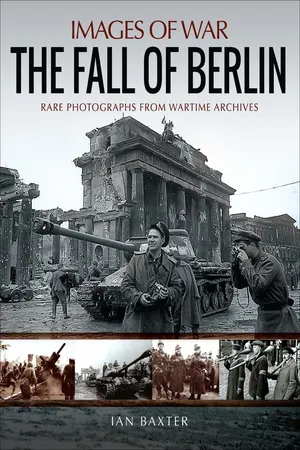
On April 20, Hitler's fifty-sixth birthday, Soviet artillery began a massive bombardment of the doomed city. The Fuhrer ordered every soldier, Hitlerjugend, and Volksstrum to fight to the death. The house-to-house fighting that followed was brutal and savage, with heavy casualties for both military and civilians. Using superb Russian and German imagery, this pictorial history describes the Russian assault and Nazi last-ditch defense of Hitler's capital during the final days of the Third Reich.
- 144 pages
- English
- ePUB (mobile friendly)
- Available on iOS & Android
eBook - ePub
The Fall of Berlin
About this book
Information
Chapter One
Vistula-Oder Offensive
On 12 January 1945, the Soviet winter offensive was finally mobilised against the weakening German front in Poland. Konev’s offensive began with the 1st Ukrainian Front making deep wide-sweeping penetrations against hardpressed German formations. On the first day the 4th Panzer Army took the full brunt of an artillery barrage followed by an armoured attack by the 1st Byelorussian Front. The following day the second East Prussian Offensive was launched.
The main drive of the offensive pierced through the heart of Poland westwards towards the Warsaw–Berlin axis, striking out from the Vistula River south of Warsaw. Within days Krakov was encircled and fell three days later on 17 January. The frozen ground ensured rapid movement for the Russian tank crews, but in some areas these advances were halted for a time by the skilful dispositions of Panzers, supporting troops, and defensive lines comprising mazes of intricate blockhouses and trenches. Towns that fell in the path of these defensive belts were evacuated. Thousands of women, children and old men were pressed into service to help construct anti-tank trenches and other obstacles.
While it appeared that the Germans were well defended, much of the equipment employed along the defensive belts was too thinly spread. To make matters worse, the Russians began bombing German positions along the frontier.
In spite of this, the Russians were met by very strong resistance in several areas. However, German forces continued to fall back, and were well aware that they needed to prevent the Red Army from crossing the borders of the Reich and onto the River Oder, which was no more than 50 miles from the Reich capital, Berlin.
By the end of January 1945 the Soviets had captured Warsaw, Lodz, Krakow and Poznan, and were driving the German forces west. Only three weeks earlier, the Eastern Front was still deep in Poland. Now Upper Silesia was lost and in East Prussia German forces were fighting for survival. Königsberg and Kolberg were involved in bitter defences, while Danzig braced itself for the last battle. Elsewhere on the Baltic coast, isolated areas of German resistance fought on, but they had no real prospect of holding back the Red Army. Hitler had made it clear that Army Group Kurland was not to be evacuated. Every soldier, he said, was to stand and fight. What Hitler had done in one sentence was to condemn to death some 8,000 officers and 180,000 soldiers and Luftwaffe personnel. Some did escape the destruction of Army Group Kurland and retreated back towards the Oder or returned by ship to Germany.
While German units in the north fought to hold onto their positions and prevent the Baltic States from collapsing, further south the situation for Army Group A was just as dire. Army Group A comprised three armies: 9th, 4th Panzer, and the 17th. The group comprised some 450,000 soldiers, 4,000 artillery pieces, and 1,150 tanks. It was initially led by Colonel General Josef Harpe who was later disgraced following his withdrawal through Poland. He was replaced on 20 January by Colonel General Ferdinand Schörner. Schörner was under no illusion about the seriousness of the situation. German intelligence had estimated that the Russians had a 3:1 numerical superiority; there was in fact a 5:1 superiority.
To avoid what Hitler referred to as the complete extinction of Army Group A, Army Group Vistula was created on 24 January 1945. The new group was intended to protect Berlin from Soviet armies advancing from the Vistula River. It was formed from an assortment of rebuilt, new and existing units and Hitler decided that Heinrich Himmler would take control of it. Although Army Group Vistula were poorly matched in terms of equipment and supply against the Red Army, many of the troops were hardened veterans who had survived some of the hardest battles in the East.
But still the Russians advanced. The Soviet 4th Tank Army was reported to have reached the Oder and secured a bridgehead at Steinau. A week later, on 31 January, it voluntarily halted. Although the Russians were aware that Berlin was virtually undefended and less than 50 miles away, orders had been sent to the various commands to consolidate positions before resuming their march on the Reich capital.
While the Soviets carried out mopping up operations against German defensive positions, it soon became apparent that Himmler lacked proper experience as a military commander, as much of the front he was commanding was collapsing at a far greater rate than at first anticipated. In an effort to stabilise the situation, Himmler was replaced by General Gotthard Heinrici as commander on 20 March. Troops and armoured vehicles were positioned along the main roads and highways, others were scattered in towns and villages, while heavy machine gun platoons dug in and held each end of the line. Crude obstacles were erected and troops were emplaced in defensive positions armed with a motley assortment of anti-tank and flak guns, machine guns, Panzerfaust and Panzerschreck.
For the Russians the Vistula-Oder Offensive was a major success. In a matter of days the Soviets had advanced hundreds of miles, sweeping away German positions, taking the bulk of Poland and striking deep across the previous borders of the Reich. The offensive had effectively smashed and dismembered Army Group A, and much of Germany’s capacity to resist. While stubborn resistance continued to rage ...
Table of contents
- Cover
- Title
- Copyright
- Contents
- About The Author
- Introduction
- Chapter One: Vistula-Oder Offensive
- Chapter Two: Defence of the Oder
- Chapter Three: Battle of Halbe
- Chapter Four: Battle for Berlin
- Appendix: Order of Battle
Trusted by 375,005 students
Access to over 1.5 million titles for a fair monthly price.
Study more efficiently using our study tools.
Frequently asked questions
Yes, you can cancel anytime from the Subscription tab in your account settings on the Perlego website. Your subscription will stay active until the end of your current billing period. Learn how to cancel your subscription
No, books cannot be downloaded as external files, such as PDFs, for use outside of Perlego. However, you can download books within the Perlego app for offline reading on mobile or tablet. Learn how to download books offline
Perlego offers two plans: Essential and Complete
- Essential is ideal for learners and professionals who enjoy exploring a wide range of subjects. Access the Essential Library with 800,000+ trusted titles and best-sellers across business, personal growth, and the humanities. Includes unlimited reading time and Standard Read Aloud voice.
- Complete: Perfect for advanced learners and researchers needing full, unrestricted access. Unlock 1.5M+ books across hundreds of subjects, including academic and specialized titles. The Complete Plan also includes advanced features like Premium Read Aloud and Research Assistant.
We are an online textbook subscription service, where you can get access to an entire online library for less than the price of a single book per month. With over 1.5 million books across 990+ topics, we’ve got you covered! Learn about our mission
Look out for the read-aloud symbol on your next book to see if you can listen to it. The read-aloud tool reads text aloud for you, highlighting the text as it is being read. You can pause it, speed it up and slow it down. Learn more about Read Aloud
Yes! You can use the Perlego app on both iOS and Android devices to read anytime, anywhere — even offline. Perfect for commutes or when you’re on the go.
Please note we cannot support devices running on iOS 13 and Android 7 or earlier. Learn more about using the app
Please note we cannot support devices running on iOS 13 and Android 7 or earlier. Learn more about using the app
Yes, you can access The Fall of Berlin by Ian Baxter in PDF and/or ePUB format, as well as other popular books in History & German History. We have over 1.5 million books available in our catalogue for you to explore.