"The stirring story of the achievements of the Victor, told by those who flew it and fixed it . . . well illustrated with spectacular photographs." —
Oxford Mail
The Handley Page Victor was the third of the three V Bombers and the most long lasting, serving in the RAF until 1993, and still doing invaluable service in the first Iraq War. Moreover, in 1982 it was only the Victor tanker fleet based on Ascension Island that made possible the Vulcan Black Buck bombing of Port Stanley airfield and the long-range reconnaissance of Argentina by Nimrods.
Victor Boys tells the story of all the great things that were achieved, recounted first hand by the operators themselves, aircrew and ground crew. Starting with accounts by test pilot Johnny Allam, who undertook the major development of the aircraft, through its work as a nuclear bomber during the Cold War, testing Blue Steel in Australia, to its superb work during the Falklands War and later as a first class air-to-air refueling tanker and vital support tool for fighters and other aircraft.
Published to coincide with the Victor's 60th anniversary, the gripping text is superbly illustrated with photographs from the operators themselves, never released before. The stories are collated and set in context by Tony Blackman, ex chief test pilot of Avros who helped develop the Vulcan and initiated the development of the Victor K2 tanker. For him, initially, the Victor seemed a competitor but he now readily admits what a wonderful aircraft the Victor became.
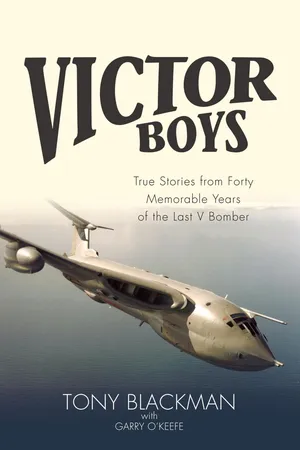
eBook - ePub
Victor Boys
True Stories from Forty Memorable Years of the Last V Bomber
- 192 pages
- English
- ePUB (mobile friendly)
- Available on iOS & Android
eBook - ePub
About this book
Trusted by 375,005 students
Access to over 1.5 million titles for a fair monthly price.
Study more efficiently using our study tools.
Information
Topic
HistoriaSubtopic
Historia militar y marítimaChapter One
A New Shape in the Sky
The first flight of the Victor was a landmark in the development of British-designed aircraft after the war. Its wing was unique and it made the aircraft possibly the best of the three V bombers. It is difficult not to make comparisons but the facts speak for themselves; compared with the Vulcan the aircraft could carry more bombs, more fuel, fly further, fly faster and could fly higher; furthermore it was in service much longer.

First prototype Victor WB771.
There have been many descriptions of the Victor and what seemed, at the time, to be its futuristic wing design; Charles Masefield, who took over from me as chief test pilot at Avros and had a large part in developing the Victor K2, has written not only an account of his Victor development test flying but also gives here an excellent description of this key feature that made the Victor so successful.
After the war, Handley Page turned its hand to the production of the Hastings military transport, already somewhat obsolete with its tail-wheel undercarriage at a time when the much more capable nose-wheel-configured Douglas DC4 had been giving wartime service with the USAF for some years. By the time the Hastings had evolved into the Hermes civil airliner for BOAC it was, yet again, behind the times as Douglas was by then producing the larger and more capable DC6. HP’s last civil airliner was the 40-passenger Herald which could not match the Avro 748 or the Fokker F27 which, between them, went on to capture the whole of the 1,000 aircraft DC3 replacement market throughout the world.
It was against this somewhat modest background that Handley Page produced, out of the blue, what was undoubtedly one of the most aerodynamically advanced and highest performing four-engine jet aircraft in the world at that time – the Victor bomber. The inspiration behind the Victor design came from the brilliant mind of chief aerodynamicist, Godfrey Lee. He had been a member of the Air Ministry-inspired scientific and technical fact-finding team which had visited the German aeronautical research establishments at Gottingen and Volkenrode immediately after the end of the war. It became clear from this visit that these German research establishments were considerably more advanced than those in any of the allied countries in the study of the use of swept wings to delay the onset of compressibility-induced drag at high subsonic speed.
Fired by what he had seen and learnt in Germany, Godfrey Lee returned to the UK and immediately began to formulate ideas for a very high performance four-engine jet aircraft. Although there was no Air Staff requirement for such an aircraft at that time, he nevertheless put forward his ideas in the form of a comprehensive brochure sent to the director of operational requirements at the Air Ministry. That this initiative made a major impact within the Operational Requirements Branch is in no doubt. Indeed it was as a result of this proposal that OR 230 was issued to the aircraft industry to which at this time six companies were able to respond. The resultant specification B35/46 ambitiously called for an aircraft able to cruise at 50,000ft close to the speed of sound and, amidst much lobbying at the highest levels of government and solely to protect the manufacturing industry and its jobs, the Air Ministry came to the bizarre – indeed to us in this day and age incredible – decision to order all three. Thus were born the three V bombers, the Valiant, the Vulcan and the Victor.
Recognising that the high mach number drag rise of any aircraft coincided with its velocity at which the first shock wave would begin to form at some point on the airframe, Godfrey Lee took the decision to attempt to design an aircraft in which the local airflow over every portion of its airframe reached its shock wave forming supersonic velocity simultaneously. With a chain only as strong as its weakest link he sought to eliminate every location of potential premature shock wave formation. With this aim he decided to bury the engines in the wing roots to avoid shock wave formation around external engine nacelles. Furthermore, if a constant critical mach number was to be achieved across the entire wing span it would have to feature an extremely steep sweep of 47.5 degrees at the six-foot-deep wing root. As the wing thickness reduced further outboard, so did its sweep to 40.5 degrees at mid span and to 32 degrees sweep for the very thin outboard section of the wing. So was born the unique crescent wing.
A similar ‘constant critical mach number’ approach was applied to the design of the fuselage, resulting in the characteristic very smooth, pointed Victor nose with the windscreen glass and Perspex panels merely forming part of an unbroken aerodynamic skin shape. In this aircraft there was to be no compromise of a raised cockpit windscreen to improve pilot view as any such discontinuity or blemish of the sleek lines would inevitably trigger the formation of local and draggy shock waves. The success of Godfrey Lee’s ‘no compromise’ design was vividly demonstrated when, on June 1st 1957, Johnny Allam exceeded the speed of sound in a Victor for the first time. In doing so the Victor became the largest aircraft in the world at that time to have flown at supersonic speed and, indeed, the first four-engine aircraft to do so. To add to this record Johnny’s navigator, Paul Langston, became the first man to fly supersonically backwards! It subsequently became a common occurrence for residents throughout eastern England to experience the characteristic double bang as Victors regularly exceeded the speed of sound on routine production test flights. What a remarkable aircraft it was.
The HP80’s first flight on Christmas Eve 1952 and the announcement to the world’s press was a great event but few people realised how much planning and design of the highest order was required to achieve this historic event. Though the aircraft had been tendered for by an experienced and talented company, Handley Page was of a very modest size to be taking on such an advanced and large-scale project, certainly in comparison with its American counterparts. That the resulting HP proposal would eventually come to fruition was both a remarkable and a colossal achievement, despite causing later bewilderment to one visiting American general who, while praising the later Victor production line at “Fred’s Shed” asked why they had to be “built in a barn”.

Godfrey Lee standing in front of one of the last Victors. (Darren Simons)
The pilot who was to advise, contribute towards and finally test-fly the first prototype was Hedley ‘Hazel’ Hazelden. He began working for HP in the spring of 1947 at the very time the revised tender B.35/46 had been agreed and was issued as OR 230. In fact, this was only a few months after the company’s visit to Germany and aerodynamicist Godfrey Lee’s initial doodles on the back of an envelope had begun, with further development being transferred onto the drawing boards at Cricklewood.
It is clear that Handley Page had been fortunate in having Hazleden whose technical ability was of the highest order while his general experience was second to none, most of which had been honed by the exigencies of war. At Handley Page he soon got involved with the new aircraft and their adaptations that the company busily strove to introduce in the aftermath of war; Sir Frederick and the Board were ever-mindful of the loss of orders that had befallen the company together with the rest of the then infant British aircraft industry after the previous carnage of WW1.
Developing the HP80 prototype in preparation for flight required not only a lot of wind tunnel testing but also airborne engine testing of the proposed Sapphire engine and, as far as was possible, flying the proposed crescent wing. Production of the original Metrovick F.9 turbojet engine planned for the HP80 had been taken over by Armstrong Siddeley Motors at Coventry who re-named the engine the Sapphire after scaling it up by 25% to give more thrust. When ready, two of these excellent jet turbines were attached to the second Hastings prototype TE583 in the outboard position and first flown in this configuration in November 1950 after which Hazelden later recalled that the aircraft could happily cruise at 175 knots on one engine only, thanks to the tremendous increase in power afforded by this revolutionary watershed in powered flight. Such test flying, coupled with high-speed development work with a Sapphire-engined Canberra, prepared the engine and made it ideal for the projected bomber.
When faced with the programme’s exacting specification the company had set up a special team to make an exhaustive aerodynamic study of the problems involved. In tandem with this team, other members of a project group were charged with more general design features, with special reference to complementary structural and installation problems. The official preliminary design won approval in principle at a conference in December 1947 with no major issues raised apart from questioning what escape provisions should be provided for the rear crew. HP considered this idea of a jettisonable crew cabin, years ahead of its time, but in the end the concept together with its ‘bug-eye’ canopy blisters had to be abandoned and the uniquely shaped nose section was fitted with further refined large, flush-fitting Triplex windscreens developed to taper and sweep down towards a sharp proboscis. Sixty years later it seems amazing that adequate escape provision was not given to the rear crew but at that moment the country was only just recovering from a terrible war and was faced with the urgent need to prepare for the Cold War, so time could not be spared to develop ejection seats or the equivalent for the rear crew members.

Sapphire-engined Hastings. (A. Dowsett)
The project moved forward with senior staff at HP wading in to make notable contributions, innovations and improvements with the help of the German research scientist Gustav Lachmann, chief designer Reginald Stafford and assistant chief designer Charles Joy, all working closely with aerodynamicists C.Vernon and Godfrey Lee. The latter had worked as a research engineer during the war before being promoted to chief aerodynamicist in 1949. Ray Sandifer and Frank Tyson as chief and assistant stressmen respectively began to carry out pioneering work on wing structures while Sir Frederick Handley Page added many of his own forthright opinions and suggestions.
It was realised that it was vital to get some aerodynamic testing on the proposed wing design. One plan was to develop the wing on a glider but this concept was abandoned and later replaced with the HP88, a Supermarine Attacker fuselage with a scaled-down crescent wing and tail, the testing of which would hopefully be able to give some positive comparisons between theoretical calculations and the ‘crescent wing’. After its eventual construction and initial testing by sub-contractor Blackburn in the summer of 1951, the job of test flying the HP88, XV330, was given to Dougie Broomfield DFM because, unfortunately, Hazelden’s 225lb weight and height of six feet one inches meant that he was too large to be comfortably accommodated in the airframe and was forced to watch and advise from afar.
HP88 research aircraft XV330.
In the meantime a decision had been taken in early 1948 to delete the original wing-tip fins and replace them with a central fin and rudder while, later in June, Victor engineer Lachmann also decided to raise the tailplane to the top of the fin. As the months passed into years, the concept drawings and wind-tunnel models continued to resemble those of a very futuristic aircraft to Hazelden’s eyes, while the planners of this sophisticated design fully expected their theories to result in Britain gaining an aircraft which would offer at least two-and-a-half times the performance of the most successful wartime Bomber Command ‘heavies’.
Hazelden, while not being able to fly the HP88, made his own contribution to the HP80 design thanks to a cockpit mock up which had been constructed at Cricklewood. He spent much time acquainting himself with it and making various recommendations that would be incorporated into the prototype. Crucially, he ensured that the real cockpit had a simple layout with an absence of complication or elaborate ‘gadgets’ that might cause future pilots problems, particularly on long and tiring missions. He also paid close attention to the control forces in flight which, when close to the speed of sound, would be impossible for humans to control without mechanical aids. All aileron, rudder and elevator control surfaces would have to be fully power-assisted, with the motors obeying the control decisions demanded by the pilot; the consequence of this was that artificial feel had to be provided to protect the aircraft structure and to make it possible for the pilots to fly precisely and safely without overcontrolling and damaging the airframe. He therefore advised the design office on what he considered would be the optimum forces for the control wheel and rudder, commensurate with the size and type of aircraft that was being flown. As a result, he frowned on controls being too light for a large aircraft, though ironically the RAF would later ask that the HP80s were ‘heavied up’ further. The artificial forces built into the Victor’s flying controls would make it feel like a slower aeroplane in terms of response and this was also complemented by his insistence on traditional ‘spectacle’ control columns, which clearly reminded pilots of the type of aircraft they were flying. This was in marked contrast to the Vulcan with its fighter-type control stick which, despite its huge wing area, could be manoeuvred around to out-turn many fighters of the day at altitude.
Unfortunately, the project suffered a setback when the HP88 crashed in August 1951 killing Dougie Broomfield. Though naturally saddened by this tragic loss, the HP team were relieved to hear from the Accident Investigation Branch findings that the HP88’s loss was not in any way due to any fault in the design or construction plan of the wing, rather it was a structural failure due to a tailplane servo control system failure.
The Victor and Vulcan contracts were approved at the same time and in June 1952 production orders were received by Avro and HP for twenty-five examples of their V solutions – the former before the prototype had flown, while the latter was now an HP80 no more – the ‘Victor’ being soon announced as the official name for the last of Britain’s V bomber designs, now completing a triumvirate of world class medium bombers for the RAF – the ‘V Force’. For HP the many years of thought, theorizing and experiment were concluded and were now narrowing down to their ultimate test of its ‘new shape’ which was about to make its mark in the flowering of British aviation’s post war ‘Jet-Age’. While Hazelden was undoubtedly saddened by Broomfield’s death, he was also concerned at the loss of any potential information which might have assisted him as to how the aircraft would behave when first taken aloft in its natural element, and he pondered over this while preparations were made for the first flight.
Handley Page intended to fly the first aircraft from Radlett but suddenly it was decided that the runway there was too short to fly it safely for the first time and the change of venue would be worth the extra delay to remove unnecessary risk. People blamed the ministry for the decision but it could be that Hazel was behind the change since the runway was being extended but the work wasn’t finished. The aircraft had to be taken apart again and transported in trucks down to the Armament Experimental Establishment, A&AEE, at Boscombe Down, Wiltshire; the situation was compounded by the desire of the Ministry of Defence to keep the aircraft secret. All the parts, wings, fuselage and the rest were covered up and labelled as fuel tanks and a lot of it went via Southampton Docks. Wrapped in canvas to disguise its still-secret shape from the world and labelled ‘Gelepandy Southampton’, the Victor fuselage of WB771 finally left the factory at Cricklewood on June 7th 1952, on its way to Boscombe with its very long runway. Other component sections arrived in the following weeks and Hazelden regularly flew across from Radlett in a light aircraft to watch the re-assembly. Sir Frederick was understandably anxious to have the aircraft cleared for a first appearance at the September Farnborough air show to match the Vulcan’s first outing; this proved impossible however due to the great time expended in testing and retesting each component before the aircraft could be given the final go ahead to fly.
It was at this time in 1952 that Johnny Allam, who was eventually to take over from Hazelden and was an RAF test pilot at Boscombe, had his first encounter with the Victor, since the aircraft was being re-assembled in B Squadron hangar and all their aircraft had to be moved onto the ramp outside. There was an enormous cloak of secrecy which made normal B Squadron operations very difficult.
Then tragedy struck once more some days after the missed Farnborough event, when leaking hydraulic fluid led to a fire in a small compartment at the rear of the aircraft. Within seconds a fierce fire had developed and three workers caught in the flames suffered severe burns before the blaze was quelled. One of them, Eddie Eyles, died in hospital of his injuries. Though the damage to the aircraft was not serious, further delays ensued and it was not until December 1952 that Hazelden found himself strapping in to the aircraft to commence taxiing trials. At last the aircraft was ready but alas, not the weather; finally on Christmas Eve Hazel took th...
Table of contents
- Coverpage
- Titlepage
- Copyright
- Contents
- Foreword
- Acknowledgements
- Dedication
- Preface
- Prologue
- Chapter 1 A New Shape In The Sky
- Chapter 2 Victor B1/B1A
- Chapter 3 Victor K1
- Chapter 4 4 Joint Services Trials Unit
- Chapter 5 Victor B2
- Chapter 6 Victor K2 Development And Operation
- Chapter 7 The Falklands Campaign
- Chapter 8 Black Buck 1
- Chapter 9 Tansor And Desert Storm
- Epilogue
- Appendix I Accidents
- Appendix II Victor Bases in the UK
- Appendix III Acronyms
- Index
Frequently asked questions
Yes, you can cancel anytime from the Subscription tab in your account settings on the Perlego website. Your subscription will stay active until the end of your current billing period. Learn how to cancel your subscription
No, books cannot be downloaded as external files, such as PDFs, for use outside of Perlego. However, you can download books within the Perlego app for offline reading on mobile or tablet. Learn how to download books offline
Perlego offers two plans: Essential and Complete
- Essential is ideal for learners and professionals who enjoy exploring a wide range of subjects. Access the Essential Library with 800,000+ trusted titles and best-sellers across business, personal growth, and the humanities. Includes unlimited reading time and Standard Read Aloud voice.
- Complete: Perfect for advanced learners and researchers needing full, unrestricted access. Unlock 1.5M+ books across hundreds of subjects, including academic and specialized titles. The Complete Plan also includes advanced features like Premium Read Aloud and Research Assistant.
We are an online textbook subscription service, where you can get access to an entire online library for less than the price of a single book per month. With over 1.5 million books across 990+ topics, we’ve got you covered! Learn about our mission
Look out for the read-aloud symbol on your next book to see if you can listen to it. The read-aloud tool reads text aloud for you, highlighting the text as it is being read. You can pause it, speed it up and slow it down. Learn more about Read Aloud
Yes! You can use the Perlego app on both iOS and Android devices to read anytime, anywhere — even offline. Perfect for commutes or when you’re on the go.
Please note we cannot support devices running on iOS 13 and Android 7 or earlier. Learn more about using the app
Please note we cannot support devices running on iOS 13 and Android 7 or earlier. Learn more about using the app
Yes, you can access Victor Boys by Tony Blackman,Garry O'Keefe in PDF and/or ePUB format, as well as other popular books in Historia & Historia militar y marítima. We have over 1.5 million books available in our catalogue for you to explore.