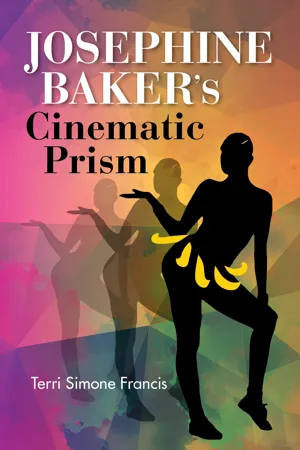
A history and in-depth analysis of the film career of the iconic Black star, activist, and French military intelligence agent.
Josephine Baker, the first Black woman to star in a major motion picture, was both liberated and delightfully undignified, playfully vacillating between allure and colonialist stereotyping.
Nicknamed the "Black Venus," "Black Pearl," and "Creole Goddess," Baker blended the sensual and the comedic when taking 1920s Europe by storm. Back home in the United States, Baker's film career brought hope to the Black press that a new cinema centered on Black glamour would come to fruition. In
Josephine Baker's Cinematic Prism, Terri Simone Francis examines how Baker fashioned her celebrity through cinematic reflexivity, an authorial strategy in which she placed herself, her persona, and her character into visual dialogue. Francis contends that though Baker was an African American actress who lived and worked in France exclusively with a white film company, white costars, white writers, and white directors, she holds monumental significance for African American cinema as the first truly global Black woman film star. Francis also examines the double-talk between Baker and her characters in
Le Pompier de Folies Bergère,
La Sirène des Tropiques,
Zou Zou,
Princesse Tam Tam, and
The French Way, whose narratives seem to undermine the very stardom they offered. In doing so, Francis illuminates the most resonant links between emergent African American cinephilia, the diverse opinions of Baker in the popular press, and African Americans' broader aspirations for progress toward racial equality.
Examining an unexplored aspect of Baker's career,
Josephine Baker's Cinematic Prism deepens the ongoing conversation about race, gender, and performance in the African diaspora.
- 202 pages
- English
- ePUB (mobile friendly)
- Available on iOS & Android
eBook - ePub
Josephine Baker's Cinematic Prism
About this book
Information
ONE

TRAVELING SHOES
Baker’s Migrations and the Conundrums of Sweet Paris
JOSEPHINE BAKER’S LIFE HAS BEEN the subject of several documentaries and biographies; thus, the broad outlines of her story are fairly well known. She is often cited in popular culture as a notable African American figure whose fame abroad cast into stark relief the limitations that were placed on Black success in the United States. On June 3, 2017, Baker’s 111th birthday, Lydia Nichols’s Google Doodle honored Baker, who Ernest Hemingway called “the most sensational woman any one ever saw or will,”1 with a series of interactive slides that highlighted Baker’s life and career milestones: Baker’s childhood in St. Louis, her upbringing during the early twentieth century, and her journey to Paris.2 Several scenes that show the music hall star dressed in fabulous and leg-revealing costumes, including the famous banana skirt, capture the fantastical aesthetic of Baker’s 1920s music hall performances at the Théâtre des Champs-Élysées and the Folies Bergère. In contrasting the bright colors of the music hall with the dull tones of St. Louis, the Google Doodle effectively communicates the political stakes and hopes of Baker’s relocation to Paris, where she seemed to be free of the racial barriers found in US society. This book focuses less on Baker’s life and more on her cinematic prismatic life: her artistic development and her contributions to film.
One illustrative slide in the Google Doodle shows Baker in character with a clapperboard, hinting at the French feature films in which she starred: La sirène des tropiques, directed by Henri Étiévant (released in 1927 in France and 1929 in the United States), Zouzou (directed by Marc Allégret, 1934), and Princesse Tam-Tam (directed by Edmond T. Gréville, 1935) as well as her short film Le pompier de Folies Bergère and the performance footage compiled in La revue des revues and Josephine Baker, Star of the Folies-Bergère and the Casino de Paris, particularly the famous banana dance. Also included is The French Way, by Jacques Baroncelli (1945).
Nichols’s Google Doodle traces Baker’s transitions from St. Louis to Paris and from dancing onstage to film acting to humanitarianism. As Guterl writes, “[Baker] defined herself by relentless movement, dislocation, and self-transformation” in an itinerancy whose power she learned early in her career traveling with Clara Smith and Shuffle Along.3 Professional evolutions were certainly part of her strength. Following her service as a French Resistance spy during World War II, Baker launched a visionary initiative in which her home would serve as a multicultural haven for discussions of racial harmony. To that end, she adopted many children of different races, and she was an activist who pushed to desegregate many of the American venues where she appeared, such as the Copacabana in Miami Beach, Florida, in 1952. Baker’s bananas at times eclipsed her political work as well as her contributions to the cinema, but that performance was a gateway. The figure of Baker is a cultural phenomenon generated by her environment, to be sure, but she was an agentive craftsperson as well. Because her films constitute the most visible but, in many ways, ironically, least truly seen aspect of her legacy, they require further examination—particularly now that the film landscape has changed so radically to include a wide variety of Black women filmmakers and screenwriters in the early twenty-first century.
Josephine Baker was born Freda Josephine MacDonald in St. Louis, Missouri, in 1906. In her 1927 memoir, Baker described St. Louis in straightforward terms: “It was full of railways, factories that blew smoke over all the houses, and cold.”4 St. Louis expanded into a major industrial city in the early twentieth century, and the city became one of many significant destinations for African Americans leaving the rural South. From 1915 to 1970, “some six million Black southerners left the land of their forefathers and fanned out across the country” in a series of movements that became known as the Great Migration.5 When African Americans from the South reached their destinations, they often found competition, hostility, and further deprivation. Conflict arose as “negroes organized campaigns to challenge not only the concept of white supremacy but also the discriminatory practices resulting from it.”6 St. Louis might have been a city of promise for many, but physical violence worked in tandem with white-supremacy campaigns to systematically disfranchise Black citizens and destroy their communities.
Baker’s posthumously published autobiography, Josephine, begins with a vivid account of her “worst memory”: the East St. Louis Riot of 1917, which took place across the Mississippi River in East St. Louis, Illinois. Racial tensions between whites and Blacks in East St. Louis had been heated long before the riot started. White unions sought to prevent African Americans from joining them, reducing African Americans’ chances of getting and keeping jobs and discouraging more Blacks from moving to the area. Unsubstantiated and malicious rumors that Black men were harassing white women circulated, enraging whites and endangering the lives of Black men and their families.
In the years leading up to Baker’s birth, four thousand Americans were lynched, the vast majority of them Black Southerners who were murdered under what Ida B. Wells denounced as “the same old racket—the new alarm about raping white women.”7 Hundreds of Black Americans died in white-instigated race riots in those years—in Wilmington, North Carolina, in 1898; in New Orleans, Louisiana, in 1900; and in Atlanta, Georgia, and Bronzeville, Texas, both in 1906. In addition to physical violence, Black Americans faced institutionalized separate and unequal facilities in the wake of the 1896 Plessy case.8
Baker’s account highlights the systemic and brutal nature of the racism that shaped the overall context of her personal reality. On May 28, 1917, word spread that a Black man had shot a white store owner during a robbery. Next, a mob of whites attacked African American homes, businesses, and churches, often burning them to the ground. Baker wrote,
This was the Apocalypse. . . . The entire black community appeared to be fleeing like ants from a scattered antheap. “A white woman was raped,” someone shouted, and although I didn’t understand the meaning of his words, I knew that they described the ultimate catastrophe. The flames drew nearer. . . . Nearby a white man, his face contorted with hatred, was savagely beating a figure kneeling before him with what looked like a club. Again and again he struck. The only way I could tell that his victim was black was by his raised hands; the rest of him was wet with blood.9
The violence had been going on for several days when, on July 1, there was a shooting from a passing car. The following night, residents opened fire on an unmarked police car. The cycle of revenge and attack continued, devastating African Americans’ central institutions, including churches, businesses, homes, and schools. An estimated one hundred or more African Americans were killed. The Illinois attorney general indicted eighty-two whites and twenty-three Blacks. Nine of the whites were sentenced, and seven white police officers who were charged with murder were collectively fined $150. Juries convicted ten African Americans of murdering the undercover police officers, sentencing them to fourteen years in prison.10
BAKER’S RAGTIME CONSERVATORY
With racial violence as an ever-present backdrop, Baker’s recollections of her childhood combine the harshness of her impoverished family’s daily life with the delight and reprieve that her musical encounters provided. Both of Baker’s parents had been small-time performers, but her mother supported the family as a laundress when Baker’s father left. Baker worked as a live-in domestic helper from the age of seven. But she was always creative and actively formulating her own personal aesthetic. She even played at being a director when she created shows at home with her siblings and friends. She wrote in her memoir, “At Saint-Louis, at my mother’s, I had organized a small theater in the cellar. I was not yet ten years old. The curtain was made of pieces of cloth tied end to end. I had placed the candles on the tins of ‘New Zealand’ peaches. The old scraps of candles lit up the steps of the staircase—all three steps—to descend. The audience consisted of a dozen girls and boys, seated at random on boxes and on an old bench.”11
Baker’s aesthetic autonomy included playing makeshift instruments, and she recounted this experience both in her artistic biography offered in Les mémoires and in Josephine, where she wrote, “Everyone seemed to own an accordion, a banjo or harmonica. Those without enough money for real instruments made banjos from cheese boxes. We played music that to us was beautiful on everything from clothesline strung across barrel halves to paper-covered combs. As soon as the music began, I would move my arms and legs on the treasure we pulled from the trash: tin cans, battered saucepans, abandoned wooden and metal containers. What a wonderful time we had!”12
In moments like this, Baker reveals the development of her strong personal aesthetic as a child; by describing it in her book, she asserts her identity as an artist. Baker made herself into an artist by writing these stories and by naming her inspirations and the world around her as collaborators in her developing imaginary. She wrote, “I used to play by stealing my mom’s high-heeled shoes and dresses in which I would completely disappear. I seemed to be trapped in a bag, like a diver’s suit.”13 She was fond of her grandmother’s big hats and long flowery robes, and she often pretended to be her grandmother by wearing her clothes and a red wig. These activities and memories were crucial to Baker’s early explorations of her own imagination, and she recounted them particularly in her first memoir to explain where she came from and what inspired her.14 A youthful Baker brought her flair to whatever objects were available for playing characters and entertaining herself and her friends.
However, her childhood memories were not only of artistic escapades. As an author, she also addressed how much her daily life was affected by her family’s poverty. She and her siblings often wandered their neighborhood searching for food or selling coal. These circumstances pushed Baker to support herself and her family at a young age. She recalled, “I had been seven then. . . . Mama had explained to me that we were very poor, that Daddy couldn’t find work. As the oldest child, it was up to me to help out. A white woman was coming to take me away. I was to call her Mistress and do as she said. In return, she would give me shoes and a coat.” But Baker’s work turned out to be dangerous, and this arrangement ended in her being taken to the hospital unconscious, where she was treated for “cuts and bruises” and woke up to find that her “hands were badly burned and [she was] shaking with fear.”15 The little girl’s employer was arrested for abusing her, and Baker returned home with her mother, the horrible experience doubtless informing her resolve to build a better life. Feminist scholar Hazel Carby notes that “being a member of a vaudeville show or performing in a nightclub was not attractive primarily because it offered a mythic life of glamor but because it was a rare opportunity to do clean work and to reject the life of a domestic servant.”16 At age thirteen, she worked briefly serving food at the Old Chauffer’s Club, a popular meeting place for jazz musicians, as a potential strategy to find a means of supporting herself and her family that was safer.17 Eight months later, Baker, not yet age fourteen, quit that job when she married her first husband, Willie Wells. However, the union ended shortly after it began, and Baker returned to the restaurant, which put her back in a performers’ milieu.
That waitressing job involved service, but it was a formative experience, indirectly exposing her to the musician’s life when traveling entertainers would gather for their meals between shows. Fortuitously, this is where Baker met the Jones Family Band, a trio that performed in tent shows and outside the r...
Table of contents
- Cover
- Title Page
- Copyright
- Dedication
- Contents
- Acknowledgments
- Prologue: What Might Be Josephine Baker’s Film History
- Introduction: Hey! Ha! Shimmy My Bananas! Refracting Baker’s Image
- 1. Traveling Shoes: Baker’s Migrations and the Conundrums of Sweet Paris
- 2. Shouting at Shadows: The Black American Press, French Colonial Culture, and La sirène des tropiques
- 3. Unintended Exposures: Baker’s Prismatic Ethnological Performance in Zouzou
- 4. Seeing Double: Parody and Desire in Le pompier de Folies Bergère and Princesse Tam-Tam
- Epilogue: Long Live Josephine Baker!
- Bibliography
- Index
- About the Author
Trusted by 375,005 students
Access to over 1.5 million titles for a fair monthly price.
Study more efficiently using our study tools.
Frequently asked questions
Yes, you can cancel anytime from the Subscription tab in your account settings on the Perlego website. Your subscription will stay active until the end of your current billing period. Learn how to cancel your subscription
No, books cannot be downloaded as external files, such as PDFs, for use outside of Perlego. However, you can download books within the Perlego app for offline reading on mobile or tablet. Learn how to download books offline
Perlego offers two plans: Essential and Complete
- Essential is ideal for learners and professionals who enjoy exploring a wide range of subjects. Access the Essential Library with 800,000+ trusted titles and best-sellers across business, personal growth, and the humanities. Includes unlimited reading time and Standard Read Aloud voice.
- Complete: Perfect for advanced learners and researchers needing full, unrestricted access. Unlock 1.5M+ books across hundreds of subjects, including academic and specialized titles. The Complete Plan also includes advanced features like Premium Read Aloud and Research Assistant.
We are an online textbook subscription service, where you can get access to an entire online library for less than the price of a single book per month. With over 1.5 million books across 990+ topics, we’ve got you covered! Learn about our mission
Look out for the read-aloud symbol on your next book to see if you can listen to it. The read-aloud tool reads text aloud for you, highlighting the text as it is being read. You can pause it, speed it up and slow it down. Learn more about Read Aloud
Yes! You can use the Perlego app on both iOS and Android devices to read anytime, anywhere — even offline. Perfect for commutes or when you’re on the go.
Please note we cannot support devices running on iOS 13 and Android 7 or earlier. Learn more about using the app
Please note we cannot support devices running on iOS 13 and Android 7 or earlier. Learn more about using the app
Yes, you can access Josephine Baker's Cinematic Prism by Terri Simone Francis in PDF and/or ePUB format, as well as other popular books in Social Sciences & Social Science Biographies. We have over 1.5 million books available in our catalogue for you to explore.