"All those who care about France, Jews, East-West relations, and, indeed, our entire modern culture, must read this book." —Tom Reiss, Pulitzer Prize–winning author
What is the connection between a rise in the number of random attacks against Jews on the streets of France and strategically planned terrorist acts targeting the French population at large? Before the attacks on Charlie Hebdo, the Bataclan night club, and others made international headlines, Marc Weitzmann had noticed a surge of seemingly random acts of violence against the Jews of France. His disturbing and eye-opening new book,
Hate, proposes that both the small-scale and large-scale acts of violence have their roots in not one, but two very specific forms of populism: an extreme and violent ethos of hate spread among the Muslim post-colonial suburban developments on the one hand, and the deeply-rooted French ultra-conservatism of the far right. Weitzmann's shrewd on-the-ground reporting is woven throughout with the history surrounding the legacies of the French Revolution, the Holocaust, and Gaulist "Arab-French policy."
Hate is a chilling and important account that shows how the rebirth of French Anti-Semitism relates to the new global terror wave, revealing France to be a veritable localized laboratory for a global phenomenon.
"[An] excellent and chilling report-cum-memoir about one of the most unsettling phenomena in contemporary Europe." —
The Wall Street Journal
"[
Hate has] an often illuminating intensity as it grapples with an unresolved French and European quandary . . . Cleareyed." —
The New York Times Book Review
"
Weitzmann's absorbing reckoning carries urgent lessons and warnings for us all." —
Philip Gourevitch,
New York Times-bestselling author
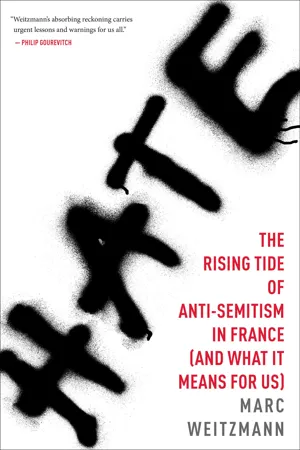
eBook - ePub
Hate
The Rising Tide of Anti-Semitism in France (and What It Means for Us)
- 323 pages
- English
- ePUB (mobile friendly)
- Available on iOS & Android
eBook - ePub
About this book
Information
ONE
The Return of the Repressed
Two Burials
On April 15, 2015, in the paved courtyard of the majestic Hôtel des Invalides, the French state paid the last tribute to my great-uncle Jean-Louis Crémieux-Brilhac, conseiller d’État and war hero of the Resistance, who had just died. The warm light of a Parisian late-morning sun poured in on the crowd—two hundred people, perhaps, among them three sitting government ministers, various leaders of the Jewish community, and members of my great-uncle’s family, enclosed within the ancient freestone walls.
The hotel is the official secular temple of France. Military personalities deemed worthy of the country’s gratitude have been honored in this courtyard since the emperor Napoleon made the first-ever presentations of the Légion d’Honneur in it in 1804. The building was built two centuries earlier by King Louis XIV as a hospital dedicated to the disabled soldiers of the brand-new French Empire. As the first of the French meritocratic decorations, the Légion d’Honneur took the place of the Order of Saint Louis, which until then had been the kingdom’s highest honor, and the exclusive privilege of nobility. Napoleon’s remains are now buried in the hospital’s crypt.
The slow beat of the drums ushered in a Republican Guard officer in full regalia, who slowly walked toward my great-uncle’s coffin, resting on a trestle in the middle of the courtyard, and set down on it a folded French flag. The military orchestra played “Farewell to Arms,” Chopin’s Funeral March, and “La Marseillaise,” and three rifle shots resounded under the empty blue sky. The short silhouette of President Hollande, cramped in a suit, his tie knot askew, crossed the courtyard to reach the white lectern set under a white tent a few feet away from the coffin. The speech he gave was brief, not particularly memorable, and the ceremony ended, the politicians left the scene. My family gathered together for the journey to the Montparnasse cemetery, where Jean-Louis Crémieux was to be buried, and an hour or so later, with the funeral convoy leading the way, we began to proceed, passing by Sartre and Beauvoir’s grave, beneath the deep, shiny green of the leafy trees and the warm sun, up to the vault of the Crémieux family.
That there are two Crémieux vaults—one within the Jewish quarter, and Jean-Louis’s located a few feet outside of it—was a slightly sensitive matter. The presence of Rav Haïm Korsia, head of the Consistory, the religious institution of the Jews of France set up by Napoleon in 1808, had been requested by Jean-Louis’s niece Laurence, but was counterbalanced by the demand by Laurence’s uncompromisingly ultra-secular sister Martine that he not make a speech, let alone say a prayer. As a result, the rabbi was reduced to a mere shadow, if someone who spent his time exchanging gossip with Pierre Nora, Jean-Louis’s publisher and a member of the Académie Française, can be called that.
My great-uncle, who, after retiring, became a historian of the Gaullist Resistance movement during World War II, belonged to the most French branch of our family. He was a Jew from Provence, a community whose settlement in the country can be traced back to the Roman Empire—at a time when Jewish merchants followed the Roman legions as far as Marseille.
Jewish soldiers, some of whom had fought Rome in the two great, doomed Jewish uprisings of the first and second centuries before joining the legions, were posted in southern France, and as far north and east as Cologne. In the Middle Ages, the Jewish community of Provence grew wealthy, and the region became an important spiritual center. This was where Isaac the Blind, born in 1160 in the small village of Posquières (now Vauvert), one hour south of Avignon, wrote the first commentaries on the Sefer Yesira (The Book of Creation) and created some of the most basic notions of what would later become the kabbalistic tradition, such as the En-Sof (the infinite presence of the hidden God) and the Sefirot (the ten spheres of the creation linking the perfect hidden divine language to imperfect human words).
Things being what they are, the Jews of Provence were periodically assaulted and even massacred by Crusaders on their way to the Holy Land and back, or by the population who held them responsible for the Plague. But a defining moment for their ancient community took place in the fourteenth century, when the popes, having deserted Rome and settled in Avignon, enacted special laws to protect them. “In exchange,” as it were, Jews were to wear a special yellow hat and pay extra taxes, and they were forced to attend special sermons in churches calling for conversions. Yet after a decree to expel the Jews from the kingdom of France was issued in 1394, it is thanks to the popes that Provence remained the only region, along with Alsace, in the North, where a Jewish presence was tolerated. Known from then on as les Juifs du pape (“the pope’s Jews”), they were existentially nurtured, so to speak, one century later by the experience of the Marranos, Jews converted by force to Christianity, who were said to Judaize in secret—undoubtedly the first community ever, in the West, to experience the modern feeling of a split conscience and of a double belonging. The Marranos expelled from Spain passed through Provence on their way to exile in Amsterdam or in the Ottoman Empire, and in some cases decided to stay.
Because of that specific story and despite their number—only two thousand people as of the sixteenth century—these Juifs du pape ended up giving birth to a very specific regional form of secular Jewishness in France, one that over time became nearly devoid of any particular religious content and was to have an important influence on that specific form of secularism the French call laïcité, which in 1905 was enshrined in France’s Law on the Separation of Church and State.
With the rise of the Enlightenment in the eighteenth century, the fate of the Jews improved throughout Western Europe, but nowhere better than in Germany and France. Under the French philosophers’ influence—Montesquieu’s in particular—Louis XVI authorized the Jews to farm the land and abolished the extra taxes they had to pay. Yet they still were subjected to daily controls and forbidden to travel freely. Then, in 1791, in the wake of the Declaration of the Rights of Man, which had been issued two years earlier and would so repel Maurras one century later, the representatives of the French National Assembly voted to abolish slavery and emancipate the Jews, thus recognizing them as French citizens.
This was no little matter. Despite the small number of Jews in France at the time—forty thousand people in a total population of 23 million—the National Assembly took up the question of whether they could be citizens no fewer than thirty-two times in two years. According to Professor David Nirenberg, from whom I borrow these numbers, “in the Christian polities of Europe, the right to decide the fate of the Jews . . . was a defining prerogative of the sovereign. In claiming to determine the status of the Jews, the Assembly was therefore asserting its sovereign power.”1 The hothouse debates over the Jews involved questions that would seem shocking today: “I always believed that [Jews] were men,” argued Abbé Henri Grégoire, one of the main advocates of the emancipation, which implied that the humanity of the Jews was not at all obvious. “I had always thought that one could re-create those people,” he added, “bring them to virtue and leave them in good will.”2 (Under the same premises, Abbé Grégoire was also a strong abolitionist.) Jews were thought to be at the limit between humanity and nonhumanity, between reason on the one hand and madness and superstition on the other. For the proponent of the Enlightenment tradition, the question of the limits of reason went hand in hand with the issue of universalism. To be human—to be “a man”—was to be gifted with the powers of reasoning. Women were excluded from the right to vote on the ground that they weren’t human. Secular Voltaire, for one, thought that Jews, having written the Bible—this self-contradictory catalog of superstitions—weren’t, either. By implication, the notion that Jews were crazy and therefore not fully human went together with the idea that Jewish men were not “real men.” Dating from the Middle Ages, a popular tradition had it that Jewish men suffered from the same curse as women: they menstruated. If, on the other hand, Jews were indeed gifted with reason, as Abbé Grégoire advocated, then they were at least potentially full members of the human race—“real men”—and consequently deserved to be citizens. Such reasoning would provide the basis for the concept of “assimilation,” intrinsically linked with the notion of progress, according to which all men are equal, providing they receive the right education in reason and civilization.
Although they did have an impact on the lives of actual Jews in the country, these debates over the regeneration of the Jews and their emancipation were, above all, as David Nirenberg puts it, “a subset and a surrogate for the much larger debate over how to achieve the conversion of tens of millions of French subjects, peasants and princes, peddlers and priests, into citizens.”3 Once passed, the law on the emancipation of the Jews would influence all of Europe and help spread Moses Mendelssohn’s Haskalah, the Jewish Enlightenment, in nearby Prussia and, from there, led to the freeing of European Jewry from the miserable ghettos in which they had been confined for centuries, and to the creation of the secular Jewish world from which sprang the Jewish life of the nineteenth and twentieth centuries in Europe as we remember it. This issue of Jewish manhood and the regeneration of the Jews was furthermore destined to have tremendous repercussions in the modern narratives of anti-Semitism, but also in the way Jews conceived themselves.4
But in the context of the French political implementation of the Enlightenment tradition in the eighteenth century, another development is worth noting in this issue of the link between Jews and reason. Either because of France’s tradition of centralized power or its Cartesian tendencies, or both, the French are inclined to believe that rationality is by nature the source of human behavior and that, conversely, only one type of human behavior—the more rational—will impose itself naturally on people, providing they’re being talked into reason and receive the right education—that, in other words, progress is the natural direction of human affairs. Following this mindset, by the mid-eighteenth century, the current known as the Enlightenment had gained in France a political importance unmatched anywhere else in the West. Even though they disagreed among themselves, French philosophers all concurred that, if correctly applied, the principles of the Enlightenment would solve most political problems, while science would improve human life. At the end of the century, the French Revolution was seen as the ideological translation of these optimistic principles, and for a short while—before the souvenir of the guillotine slowly sank in—France embodied for everyone the best that the Western world could offer. That was when, seven years after the emancipation of the Jews, in 1798, the future emperor Napoleon Bonaparte, then only first consul, launched his expedition in Egypt in what was to become the first cultural confrontation between the Islamic world and the West. To emphasize his point, Napoleon brought with him a delegation of scientists and a delegation of rabbis from Provence.
Of course, there had been encounters between the Muslim world and Western travelers before. But Napoleon’s histrionics collided with the Mediterranean anachronism in a spectacular way. In the Ottoman Empire, typography had appeared in the fifteenth century but was confined, mostly, to the Jewish, Greek, and Armenian communities. The printing press was either forbidden or subject to strict control. Ottoman and Egyptian civil servants were flabbergasted by the number of books Napoleon brought with him. As Christopher de Bellaigue argues in The Islamic Enlightenment, the Sublime Porte was confronted with “the most self-consciously modern society on earth—and its new dynamo, Napoleon. His military brilliance [was] offset by a vast ego and the attention span of an adolescent. Napoleon was not only a general: he was also inspired by the intellectual vigour of the Enlightenment and the transformative potential of the French Revolution. Recently elected to the Institut de France . . . he was an accomplished mathematician and a keen debater on matters ranging from habitable planets to the interpretation of dreams. He also bought enthusiastically, and with characteristic self-interest, into France’s post-revolutionary imperialist doctrine, which would—in the words of his future ally Talleyrand—‘set everything in order . . . in the interest of the human species.’”5
Along with the exhibition of scientific experiences and the philosophical discussions on political freedom and individual rights, which both fascinated and worried the Egyptian imams, Napoleon and the rabbis of Provence also revealed to them a new, developing form of Judaism.
None of this went without opposition. In Cairo, the head of the diwan, Sheikh Abdullah al-Sharqawi, was quick to denounce the French occupiers as “materialist, libertine philosophers who deny the Resurrection and the afterlife and . . . the prophets.”6 During the same period, in Europe, the ultra-conservative Catholic philosopher Joseph de Maistre, a future source for Maurras, was among the first to attack the Declaration of the Rights of Man as the source of all troubles. “This mad pronouncement, ‘Man is born free,’ is the opposite of truth,” he wrote, and the main beneficiaries of this lie were the scientists, the philosophers, the Freemasons, the democrats and the Jews.7 Surely they had plotted a secret “conspiracy” to overthrow the ancient divine order and its aristocracy in France, and now, spreading liberalism, they threatened to do the same with the entire continent and beyond. The improbability that such a small community could have accomplished an event of such magnitude as the Revolution was precisely, for de Maistre, the proof that this was so, for the strength necessary to achieve such a goal as to defy God’s eternal order had nothing to do with numbers. It proved that Jews and Freemasons were nothing less than the Army of Satan and that he marched behind them.
Meanwhile, another Egyptian luminary, Abd al-Rahman al-Jabarti, who was one of the first to fully realize the significance of the wave of modernity breaking on Islam and would soon turn to the nascent current of Wahhabism in reaction, remarked, amazed, that France was “a country without religion but which obeys the judgment of reason.”8 For someone like Jabarti, who believed that reason comes from religion, this was a contradiction in terms. And while his statement was more than exaggerated at the time—despite the Enlightenment, France was deeply Catholic and would remain so until at least the end of the 1950s—it certainly is an apt description of what the Jews of Provence ended up being.
By the end of the nineteenth century, you couldn’t be more a part of the spirit of the French Republic than these Juifs du pape. Often left-leaning, they were widely seen, by their fellow Jews and by others, as the most successful specimens of the unique French-Jewish symbiosis that dominated the end of the nineteenth century. Yet, aside from this symbiosis, and countering it, an anti-modern, anti-Enlightenment current had grown among the best intellectual circles in the country. De Maistre was widely read by Balzac, and above all by Charles Baudelaire, the greatest poet of the era, who borrowed from him much of his dark irony and sharp style. As early as the 1830s, France entered an age of Restoration, marked by a will to restore the kings and the aristocracy (a current from which Maurras would later derive). But because nobody can undo history, the result of those efforts was marked by decades of malaise and restlessness. Now that “real” aristocracy was gone, ambitious people—immortalized by Balzac’s Rastignac—bought or invented for themselves particles such as “de,” giving themselves fake names and fake origins to enter the Parisian salons in which virtually nobody was what he or she pretended to be. While “legitimacy” became the catchword, everyone saw himself as a fraud. That the Industrial Revolution and its corollary, the rise of a corrupt urban life, were decadent and ugly was a commonplace of the times. (De Maistre thought they were produced by God’s wrath as a punishment for the Revolution.) “Real” culture, “real” France, belonged to an idealized past of a pure, romantic world where honor, true love, and knighthood once reigned. With time, this mindset evolved into a toxic atmosphere of intrigue and caste obsession, and the Jews, needless to say—as symbols of new money, of urban life, and of the entrepreneurial spirit—became the appalling embodiment of this untraceable purity of blue blood.
So while law enshrined the French-Jewish symbiosis, in actual practice, the effect was less obvious. Finally, this symbiosis fell into crisis with the Dreyfus affair, described above, before being destroyed beyond repair in 1940 by the war and, above all, by widespread French collaboration with Nazi Germany.
My great-uncle Jean-Louis Crémieux grew up as a perfect representative of the species. Although his grandfather was a rabbi, he owed his early intellectual training not to the Talmud Torah but to his uncle Benjamin Crémieux, a star literary critic of the Parisian early twentieth century, a friend of Proust’s who introduced Pirandello to the French reading audience and died in Buchenwald in 1944, as both a Jew and a member of the Resistance.
At twenty, in 1937, Jean-Louis was the youngest member of the French Comité de Vigilance des Intellectuels Antifascistes (Vigilance Committee of Antifascist Intellectuals). He also entered the prestigious military academy of Saint-Cyr, the French West Point. At the beginning of the war, he was appointed as an officer cadet on the western side of the Maginot Line, the defensive fortifications that were supposed to protect France forever but instead crumbled almost immediately in front of the German army. Captured by the Wehrmacht in 1940, he managed to hide his Jewishness and was sent to a prison camp in Pomerania, from which he escaped after several months. Underground, penniless, on foot, and a Jew, he implausibly managed to cross Germany, walking until he reached the USSR, where the Russians, then Germany’s allies, jailed him in the Lubyanka prison. They most certainly would have sent him back to the Nazis if not for Hitler’s decision to violate the German-Soviet pact and invade Russia—an event that probably saved my great-uncle’s life. Instead, he was given permission and the means to embark for London, where he worked directly with Charles de Gaulle as the chief of the propaganda committee for the French Resistance.
But Resistance fighters in London were not exactly Jew-friendly at the time. Products of the anti-parliamentary atmosphere of the 1930s, they owed their intellectual training to Charles Maurras’s L’Action Française, probably the best-written and most stimulating newspaper in the country, which had framed the best minds of two generations of intellectuals. In the beginning of the wa...
Table of contents
- Title Page
- Contents
- Copyright
- Dedication
- Preface
- The Return of the Repressed
- The Year of the Quenelle
- “The Little Prince of the Maghreb”
- The Algerian Factor
- Words and Blood
- A Revelation and a Denial: The Toulouse and Montauban Killings
- The Terror Wave of 2015–2016: Beyond the Real and the Fake
- The War Within
- Acknowledgments
- Notes
- Bibliography
- About the Author
- Connect with HMH
Trusted by 375,005 students
Access to over 1.5 million titles for a fair monthly price.
Study more efficiently using our study tools.
Frequently asked questions
Yes, you can cancel anytime from the Subscription tab in your account settings on the Perlego website. Your subscription will stay active until the end of your current billing period. Learn how to cancel your subscription
No, books cannot be downloaded as external files, such as PDFs, for use outside of Perlego. However, you can download books within the Perlego app for offline reading on mobile or tablet. Learn how to download books offline
Perlego offers two plans: Essential and Complete
- Essential is ideal for learners and professionals who enjoy exploring a wide range of subjects. Access the Essential Library with 800,000+ trusted titles and best-sellers across business, personal growth, and the humanities. Includes unlimited reading time and Standard Read Aloud voice.
- Complete: Perfect for advanced learners and researchers needing full, unrestricted access. Unlock 1.5M+ books across hundreds of subjects, including academic and specialized titles. The Complete Plan also includes advanced features like Premium Read Aloud and Research Assistant.
We are an online textbook subscription service, where you can get access to an entire online library for less than the price of a single book per month. With over 1.5 million books across 990+ topics, we’ve got you covered! Learn about our mission
Look out for the read-aloud symbol on your next book to see if you can listen to it. The read-aloud tool reads text aloud for you, highlighting the text as it is being read. You can pause it, speed it up and slow it down. Learn more about Read Aloud
Yes! You can use the Perlego app on both iOS and Android devices to read anytime, anywhere — even offline. Perfect for commutes or when you’re on the go.
Please note we cannot support devices running on iOS 13 and Android 7 or earlier. Learn more about using the app
Please note we cannot support devices running on iOS 13 and Android 7 or earlier. Learn more about using the app
Yes, you can access Hate by Marc Weitzmann in PDF and/or ePUB format, as well as other popular books in Social Sciences & French History. We have over 1.5 million books available in our catalogue for you to explore.