A detailed look at the lives of the Scottish tenant farmers and laborers who worked the land from the late 1700s to the early 1900s.
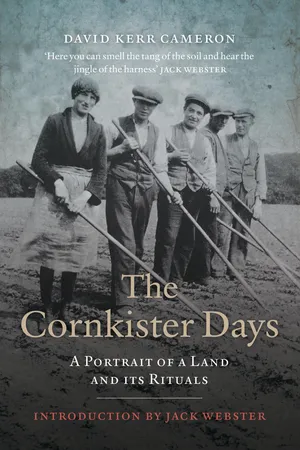
With a knowledge and a skill that reveals his passion for the land and its people, David Kerr Cameron picks his way through the rural upheavals and developments of the late eighteenth and early nineteenth centuries towards the landscape we recognize today. In doing so he provides a wide-sweeping and unforgettable view of our rural history and completes his great rural trilogy portraying the old farming landscapes of Scotland's North-East Lowlands.
Both nostalgia and great understanding are revealed as the author recalls a society based on the plough, a society that moved against the tapestry of the year: "This was the backcloth against which the farmtoun folk lived out their days; its seasons and rituals governed their lives, and ultimately their destinies. Here now is that story, the story of a landscape all but lost before the onward march of agri-business and agri-technology." The days recalled are the days of the Clydesdale horse and the hired man, the cottar and crofter, the farmtoun tenant, and his laird.
Praise for
The Cornkister Days
"Here you can smell the tang of the soil and hear the jingle of the harness. Cameron takes his place among the great Scottish writers of the last century." —Jack Webster
- 320 pages
- English
- ePUB (mobile friendly)
- Available on iOS & Android
eBook - ePub
About this book
Trusted by 375,005 students
Access to over 1.5 million titles for a fair monthly price.
Study more efficiently using our study tools.
Information
Subtopic
19th Century HistoryIndex
History1
The Land and the Folk
They are gone from the land, those men I once knew. They had the old speak and grizzled, five-day beards. They were wiry and argumentative and the years had honed them in bone and sinew. They stood near the end of their days, sunk in the heavy folds of their sleeved waistcoats and in the threadbare corduroys that were the traditional costume of their class, and swore to you through tobacco’d teeth that their beasts were the finest in the parish, their oats without parallel, and that their neeps, their turnips, were still fattening in the drill long after the New Year.
They were, some of them, men of piercing gaze and scarifying wit, respectful neither of man nor beast, the laird included. They ran their small farmtouns through the early Depression years of the century with an iron grip that kept fee’d man and fattening beast in thrall to the seasons. And if they cared so little for appearances it was only that they had long put aside all semblances of vanity. Some were brawny men, whose ponderous movement belied a nimble wit and a native shrewdness. Some were so frail of stature it seemed that only the burning fire of their love for their ‘parks’ kept them alive. Strange their ways may seem to us now these long years after. Yet once, like the generations before them, they imposed their will and a pattern on the farmtoun landscape of Scotland’s North-East Lowlands. Their lives turned with the seasons; only the land possessed them.
Theirs was the society of the Clydesdale horse and the hired man. It was a society of folk dominated by hard work and the six-monthly Sacrament Sunday though, for all that, the man who travelled the stallion round the spring touns crept quietly into the maidservant’s bed and was not made unwelcome.
Its folk were never the dull stoics of Jefferies’ English landscape – ‘not facile at expressions … the flow of language denied to them’. Most, in fact, were damnably contentious, loquacious even within the limits of their own known world, and not a few lifted their horizons beyond it. They were part of a rural society more complex than might now be supposed, one of strange subtleties and almost undetectable nuances: that of the fee’d loon, the wandering cottar, the crofter, the tenant farmer and the landowner, in that relationship of rising order. Its stresses and divisions were at times fearsomely real and sometimes desperate.
The cottar in his tied cottage was a man always at the mercy of his master’s goodwill and the crofter man, for all his talk of liberty, hardly less vulnerable, his freedom a sad, illusory thing, since he was so dependent on the neighbouring big toun for the heavier working of his land. The farmtoun tenant, in his turn, came constantly under the scrutiny of the Big House, where his moral and political stance as well as his agricultural performance could be called into question as the end of his lease drew near. Only the laird dwelt in some peace of mind, though that too would be shaken as the fortunes that had maintained a gracious lifestyle finally began to ebb and the mansion’s occupants became aware that the old social order was foundering.
It was not a polite society. Far from it. Greeting was coarse and often abrasive. Its folk did not praise highly; few were masters of the facile phrase or skilled in that fulsomeness that oils the wheels of self-interest. If that made them more awkward, maybe it also made them more honest, their friendship a finer thing. Their mischief, like their music, was home-made, often pointed and sometimes malicious. A too-persistent suitor, for instance, threatening to queer the pitch for a more favoured contender, would anonymously and hurriedly be sent a discarded pair of grandmother’s steel-rimmed spectacles – to let him see that he was not wanted. If he had any sense of what was good for him he took the hint. Forsaken lasses were as philosophical about the broken bands of love, and rarely long forlorn:
Oh, I’ll put on my goon o’ green,
It’s a forsaken token,
And that will let the young men know
That the bands o’ love are broken.
There’s mony a horse has snappert and fa’en,
And risen and gane fu’ rarely,
There’s mony a lass has lost her lad,
And gotten anither richt early.
There’s as guid fish into the sea
As ever yet was taken,
I’ll cast my line and try again,
I’m only ance forsaken.
Sae I’ll gae doon to Strichen toon
Where I was bred and born,
And there I’ll get anither sweetheart,
Will mairry me the morn.
Sae fare ye well, ye Mormand Braes,
Where aftimes I’ve been cheery,
Fare ye weel, ye Mormand Braes,
For it’s there I’ve lost my dearie.
The song was one of the most popular round the old farmtouns of Buchan and still sung in the cottar’s house of the 1930s.
It was a society, more than now, with its ‘worthies’ – its eccentrics who slotted comfortably into no convenient slot but often travelled the countryside in idleness or in pursuit of some useful trade: the selling of besoms, the mending of pots or cane chairs. In the outliers, those haunted touns that existed away at the back of beyond, out of sight in the landscape and somehow forgotten, there dwelt stranger folk still who in time grew at variance with the world and with themselves. Whole families were raised who had a different outlook on life. Their steadings fell into a bad state of repair and their fences rotted, for they were folk who had little need for demarcations. Some in time had to go from home into a more protective environment; others continued in their ways, harming no one except, maybe finally, themselves.
Overwhelmingly though, it was a society based on the plough that was its most potent symbol, the imagery of its turning furrow analogous to the years unfolding, a poetic and moving metaphor for the life journey itself. Men walked the furrow bottom, holding the stilts in a close and solitary relationship with the soil, the silence broken only by the quiet creak of harness under strain, the muffled hooves of a Clydesdale pair and the mesmeric hiss of stubble as it tumbled into the furrow. It was an all-enclosing world and at its centre stood the ploughman.
In a countryside whose minstrelsy still enshrined a little of the sweetness of life there were lasses who sang their independence of rich wooers and their love of ‘The Ploughman Laddie’:
Oh, I’ve been east, and I’ve been west,
And I’ve been in St Johnstone;
But the bonniest laddie that e’er I saw
Was a ploughman laddie dancin’.
It’s I’ve been east, and I’ve been west,
And I’ve been in Kirkcaldy;
But the bonniest lass that e’er I saw,
She was following the ploughman laddie.
She had silken slippers on her feet,
Her body neat and handsome,
She had sky-blue ribbons on her hair,
And the gowd abeen them glancin’.
‘Faur are ye gaun, my bonnie lass,
And fat is it they ca’ ye?’
‘It’s Bonnie Jeanie Gordon is my name,
And I’m following my ploughman laddie.’
‘I’ll gie ye gowd, love, and I’ll gie ye gear,
And I’ll mak’ you my lady,
I’ll mak’ ye ane o’ higher degree
Than following a ploughman laddie.’
‘I winna hae your gowd nor yet your gear
And I winna be your lady;
But I’ll mak’ my bed in the ploughman’s neuk,
And lie down wi’ my ploughman laddie.’
The men who held the stilts of the farmtouns’ ploughs were hardy men. They cycled the country roads early and late, drunk and sober, their wavering ways lit by the gas-carbide lamp whose essential and often explosive ingredient was bought in tins from the village cycle agent’s, with irreproachable logic often an extension of the shoemaker’s shop. With stockmen and unfortunate orra loons, they filled the squalid bothies of the touns and the cottar houses of that far countryside. The bothy ballad was their song, set to the scraich of a wild fiddle or the clumsily buttoned notes of a melodeon and the rhythmic thump of heavy, tacketed boots. Their song was their own story and the story of the Lowlands farmtouns, satirically rendered. Away from the plough, they sang of it, giving themselves a greater glory than they had. Now much of their repertoire is the stuff of rural history, pinpointing in the bygoing the beliefs and backbreaking work rituals of the old farmtoun life.
It is likely that they had need of their fragile glory, for theirs was a comfortless existence. The crews of unmarried horsemen, as the ploughmen of the North-East were called, lived rough, for a farmtoun bothy was a drear and cheerless place devoid of warmth and often of human kindliness – and maybe not even watertight, into the bargain. They were fed without ceremony and sometimes with an ill grace in the toun’s kitchen or cooked their own monotonous oatmeal-based diet on the bothy fire. Reflecting on bothy society, the region’s greatest writer, Lewis Grassic Gibbon, a man bound closely by childhood ties to the country life, sees in his essay The Land only the bitter servitude of the life:
As I listen to that sleet-drive I can see the wilting hay-ricks under the fall of the sleet and think of the wind ablow on ungarmented floors, ploughmen in sodden bothies on the farms outbye, old, bent and wrinkled people who have mislaid so much of fun and hope and high endeavour in grey servitude to those rigs curling away, only half-inanimate, into the night.
For once, perhaps coloured too much by his politics, Gibbon’s view seems too severe, for there was often a camaraderie in the old bothy life, as old men will tell you, that more than relieved its tedium and at worst gave a concerted front against the poor conditions.
But it was never a life of luxury and the cottar’s case was scarcely better. And for much of the time it could be worse. He had his perquisites (his agreed quantities of oatmeal, milk and potatoes) but with his tied cottage and a numerous family to feed he was even more trapped in the system. His diet was as deeply committed to the endless permutations of oatmeal and water and rustic ingenuity and he wore the same kind of tackety boots he had worn as a halflin. Like his bothy-housed colleagues he went to the farmtoun’s barn each Saturday night after lowsing-time for the only thing the farmer never grudged him: the straw with which he regularly filled his books to comfort his feet against the hardship of wearing them. The old straw he removed from them was thrown, in passing, into the midden: by then it was nearly as ripe as the dung anyway. At home his cottar house was a bare citadel to the thrift of a careful wife who assiduously put patches into every family garment – and between times hooked rag rugs to cheer a world of bare stone floors and the chill of the linoleum square. If their union, as many did, preempted the preacher, it rarely in the end precluded him. They paid tailor, watchmender and souter at the six-monthly terms o...
Table of contents
- Cover
- Title Page
- Copyright Page
- Author’s Note
- Acknowledgements
- Contents
- Introduction
- 1 The Land and the Folk
- 2 The Laird and the Landscape
- 3 End of an Idyll
- 4 Patterns of the Year
- 5 The Ploughs of Winter
- 6 Harrowing Time
- 7 The Ballet of the Hay
- 8 The Rituals of Harvest
- 9 Binder Days
- 10 Old Alignments
- 11 The Gold of Autumn
- 12 When the Potato was King
- 13 The Roots of Wealth
- 14 Marts and Measures
- 15 The Song of the Clydes
- 16 The Horseman’s Word
- 17 The Lore of the Land
- 18 The Mystique of Muck
- 19 Of Byres and Bailies
- 20 Laments for a Lost Landscape
- Select Glossary
Frequently asked questions
Yes, you can cancel anytime from the Subscription tab in your account settings on the Perlego website. Your subscription will stay active until the end of your current billing period. Learn how to cancel your subscription
No, books cannot be downloaded as external files, such as PDFs, for use outside of Perlego. However, you can download books within the Perlego app for offline reading on mobile or tablet. Learn how to download books offline
Perlego offers two plans: Essential and Complete
- Essential is ideal for learners and professionals who enjoy exploring a wide range of subjects. Access the Essential Library with 800,000+ trusted titles and best-sellers across business, personal growth, and the humanities. Includes unlimited reading time and Standard Read Aloud voice.
- Complete: Perfect for advanced learners and researchers needing full, unrestricted access. Unlock 1.5M+ books across hundreds of subjects, including academic and specialized titles. The Complete Plan also includes advanced features like Premium Read Aloud and Research Assistant.
We are an online textbook subscription service, where you can get access to an entire online library for less than the price of a single book per month. With over 1.5 million books across 990+ topics, we’ve got you covered! Learn about our mission
Look out for the read-aloud symbol on your next book to see if you can listen to it. The read-aloud tool reads text aloud for you, highlighting the text as it is being read. You can pause it, speed it up and slow it down. Learn more about Read Aloud
Yes! You can use the Perlego app on both iOS and Android devices to read anytime, anywhere — even offline. Perfect for commutes or when you’re on the go.
Please note we cannot support devices running on iOS 13 and Android 7 or earlier. Learn more about using the app
Please note we cannot support devices running on iOS 13 and Android 7 or earlier. Learn more about using the app
Yes, you can access The Cornkister Days by David Kerr Cameron in PDF and/or ePUB format, as well as other popular books in History & 19th Century History. We have over 1.5 million books available in our catalogue for you to explore.