eBook - ePub
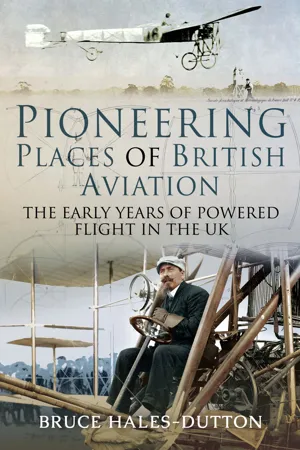
Pioneering Places of British Aviation
The Early Years of Powered Flight in the UK
- 248 pages
- English
- ePUB (mobile friendly)
- Available on iOS & Android
eBook - ePub
About this book
A high-flying tour of British aviation history—and the sites where trials and triumphs took place.
From the beginning of the nineteenth century, Britain was at the forefront of powered flight. Across the country, many places became centers of innovation and experimentation, as increasing numbers of daring men took to the skies.
In 1799, at Brompton Hall, Sir George Cayley Bart put forward ideas that formed the basis of powered flight. There were balloon flights at Hendon from 1862, though attempts at powered flights from the area, later used as the famous airfield, don't seem to have been particularly successful. Despite this, Louis Bleriot established a flying school there in 1910.
It was gliders that Percy Pilcher flew from the grounds of Stamford Hall, Leicestershire, during the 1890s. He was killed in a crash there in 1899, but Pilcher had plans for a powered aircraft which experts believe may well have enabled him to beat the Wright Brothers in becoming the first to make a fixed-wing powered flight. At Brooklands, unsuccessful attempts were made to build and fly a powered aircraft in 1906—but on June 8, 1908, A.V. Roe made what is considered the first powered flight in Britain from there—in reality a short hop—in a machine of his own design and construction, enabling Brooklands to call itself the birthplace of British aviation.
These are just a few of the places investigated in this intriguing look at the early days of British aviation, which includes the first ever aircraft factory in Britain in the railway arches at Battersea; Larkhill on Salisbury Plain, which became the British Army's first airfield; and Barking Creek, where Frederick Handley Page established his first factory.
Information
Chapter 1
The Flying Coachman
In considering the places where the early aviators were active in furthering the development of British aviation you can start pretty much where you like.
In the very earliest days a tall building would do. But those determined to emulate the birds by strapping on a pair of wings, flapping vigorously and jumping, found there was more to it than that. When, in the nineteenth century, careful scientific analysis offered the first glimmerings of understanding the principles underlying sustained and controllable mechanical flight, it became clear that experiments could be conducted more or less anywhere, from the stairwell of a mansion to a disused laceworks.
For thousands of years humankind had dreamed of emulating the birds. Most who attempted to do this are, inevitably, unknown but in the ninth century AD King Bladud was one of those who tried with the aid of a pair of home-made wings. His name is known because he was also the son of King Lear immortalised by Shakespeare. His attempt to fly by jumping off a high building and flapping his wings ended with a heavy landing in the Temple of Apollo in the city of Trinavantum, better known today as London.
This set the fashion for the next 2,000 years. In two millennia of death and injury the most original excuse for failure might have come from John Damian who thought he could fly to France from Scotland. Watched by King James IV and his entourage, he stepped clear of the wreckage to declare that the reason for his fall to earth was that he had used for his wings the feathers of chickens instead of eagles!
It was a Yorkshire baronet who effectively brought years of tower-jumping to an end. In any case, by the beginning of the nineteenth century flight had been possible for fifty years. Man-carrying balloons had become well-established, although they relied too much on the wind to be regarded as a serious means of transportation. Meanwhile a few visionaries were coming to the realisation that the mechanics of sustained and navigable flight were rather more complex and subtle than wing-flapping.
Among them is Sir George Caley, the Yorkshire baronet who conducted most of his experiments at his ancestral home of Brompton Hall in the village of Brompton-by-Sawdon, eight miles west of Scarborough. In the twenty-first century it is a special school for boys between the ages of 8 and 16, which, according to Ofsted, caters for ‘pupils who have struggled previously in other schools and have had to cope with difficulties in their home lives’.
It is perhaps appropriate that Brompton Hall should have become an educational establishment. Two centuries earlier this dignified sandstone mansion was inherited by Caley, who was not quite 19 when, in 1799, he became the sixth baronet. He was a man of wide interests in the fields of science and engineering and one who has since been hailed as a genius.
Among the products of Caley’s restless brain was the design for an artificial hand, a device he patented as the ‘universal railway’ but which would be recognised today as the caterpillar tractor, and forms of internal combustion engines powered by gunpowder and hot air. He co-founded the British Association for the Advancement of Science and founded the Polytechnic Institution which later became the Regent Street Polytechnic and is now part of the University of Westminster.
If these achievements were not enough, Caley is better known for his scientific investigation of the underlying principles and forces of flight and for being the first to develop an understanding of them. This is why he has been called the father of the aeroplane even though his name is scarcely known outside aviation circles.
Caley was born in December 1773 at Scarborough, although the precise location of this event seems to be unknown. A blue plaque puts it at Paradise House close to the old Parish Church of St Mary’s which is also the last resting place of novelist Anne Brontë. Caley, however, spent most of his life at Brompton Hall, often working with a local mechanic called Thomas Vick in a hexagonal stone building set into the wall surrounding the hall beside what is today the Pickering road. Testing of his aeroplanes was often conducted opposite at Brompton Dale.
This may have been the location of what were probably the first ever manned flights by a heavier-than-air aircraft. The first, in 1849, involved a boat-shaped glider suspended from a triplane wing which carried a 10-year-old boy. His identity is not known for certain and nor is that of the occupant of the second, larger machine. It seems most likely, however, that in the days when servants knew their place that it was one of Caley’s employees, most likely his coachman because he is recorded as pleading with his employer: ‘Please, Sir George, I wish to give notice. I was hired to drive, not fly!’
Throughout his life Caley published his ideas in a series of papers and magazine articles but generally they remained obscure and known only within a limited circle. Yet although the full extent of his contribution did not become apparent until the mid-twentieth century with the discovery of key documents, the Wright brothers were certainly aware of Caley and his work. In 1909 Wilbur Wright was quoted as saying,
About 100 years ago an Englishman, Sir George Cayley, carried the science of flying to a point which it had never reached before and which it scarcely reached again during the last century.
Caley began his aeronautical studies in 1796, and in 1799, the last year of the century which had seen the invention of the hot-air balloon and the ascent of the first aviators, he produced illustrations which clearly depicted the forces that apply to flight. In 1804, a year before the Battle of Trafalgar, Caley was sketching out a model glider of strikingly modern appearance, and as early as 1809 he was setting out what today are recognised as the scientific bases of aerodynamics. And all this before railways and the steam locomotive had been invented.
Caley had built his first aerial device in 1796. It was essentially a model helicopter which represented an improved Chinese flying top but it proved that considerable lift and, consequently, thrust could be obtained from an efficient airscrew. As described in a paper dated 1809, it involved two corks mounted at either end of a shaft with four feathers projecting from them like propeller blades. The device was powered by a bow and string which were used to store energy as the bow was tightened. An interesting point about this toy is that, while it served as Cayley’s practical introduction to flight, he largely avoided use of the propeller throughout his subsequent aeroplane experiments.
The shy, chubby country squire also set out to understand the forces that kept birds so effortlessly in the air. Caley was convinced that these forces could be harnessed to mechanical flight and so realise his vision of mass air travel across, as he so eloquently put it, ‘the uninterrupted navigable ocean that comes to the threshold of every man’s door’.
By the age of 26, Caley had divined the physical basis of flight, correctly identifying the fundamental force of lift that had baffled previous generations of experimenters and would-be aviators. Caley saw that the birds he studied achieved their lift from wings which were cambered with convex curves from front to rear. He discovered that a cambered wing’s lifting power was produced by the passage of air flowing over it.
He then took what has come to be regarded as the first step towards the invention of the aeroplane when he engraved an illustration of his ideas on one face of a small silver disc. The key feature is that the propulsion and lifting systems were completely separated. Hitherto, flight had been attempted, unsuccessfully, by the use of flapping wings in a supposed emulation of bird flight. In Cayley’s concept the lifting wing was a stationary low-aspect-ratio sail, its flexible surface cambered taut by the surrounding air pressure field. The separate propulsion system was a pilot-operated flapper arrangement which owed much to the past. A cruciform rudder was provided, presumably to enable the machine to be steered like a boat.
On the obverse Caley inscribed a simple diagram to illustrate the forces of lift and drag. What he failed to do – but what would come later – was to identify the true principal reason for lift by means of the creation of low-pressure ‘suction’ caused by the increased speed of the air rushing over the curved upper surface. Caley located the centre of this elusive force and established the equally crucial importance of the centre of the opposing force of gravity.
Having noticed how gliding birds held their wings in a shallow V to correct lateral rolling, Caley also realised the importance of the feature known as dihedral. When the birds rolled one way, he noticed that their lower wings generated more lift than the upper ones, swinging them back on to an even keel. He observed, too, that birds’ wings were slightly tilted above the horizontal.
To simulate flight Caley built a rotating arm machine. It measured the variations in the force of the lift generated by airflow passing over a wing with its leading edge raised to face the flow, as the birds did, at different angles. Applied to aircraft wings, this would become known as the angle of attack.
Caley mounted his machine on a tripod, setting it at the top of the sweep of the grand baronial stairs at Brompton Hall. The arm was rotated by a chord pulled by a weight which he dangled above the entrance hall. To one side of the arm he attached a flat wing surface exactly a foot square, balancing it on the other with small ounce weights from the Brompton Hall kitchen scales. As the arm rotated, Caley raised the angle of the wing in three-degree increments. As it rose it produced more lift and supported progressively heavier weights.
But the lift only increased up to a point. When the wing was raised too far, its lifting power quite suddenly diminished. Caley had stumbled across the aerodynamic process that follows when an aircraft wing is raised too far – around 12 degrees – the airflow over the top surface breaks up, lift is lost and the wing stalls.
In a major intellectual leap Caley was able to design an aeroplane which, for the first time, would have separate systems for lift, propulsion and control. In the process he produced the cambered aeroplane wing. He also analysed the basis of mechanical flight – to make a surface support a given weight by the application of power to overcome the resistance of air.
Then in 1804 Cayley built the first practical glider. It was little more than a kite with a cruciform tail, but it established the relative positions of wing and tail units as on modern aircraft: and it flew. Five years later, having identified these physical forces, Caley began building gliders to test his theories. He launched them across a shallow valley on his estate. Later he built and flew a pair of man-carrying craft whose flights would seal his place as a giant of aeronautical invention.
These were the world’s first full-sized aeroplanes. They had cambered wings beneath which the pilots sat in a boat-shaped fuselage mounted on three wheels. An adjustable tail unit could be trimmed on the ground, while a separate rudder and elevator were pilot-operated. The only vital control missing was any form of aileron to correct rolling movement. Such devices were not to arrive for another half-century.
In 1816 and 1817 Caley turned his attention to lighter-than-air craft which transformed the familiar balloon into a more sophisticated device that could be steered: an airship, in other words. He proposed a streamlined craft with a tapered envelope built around a semi-rigid structure using separate gas bags to limit loss of lifting gas due to damage. Thrust was to be provided by flappers or propellers. He would return to these ideas in 1843 with a craft powered by a steam engine.
At that stage he seems to have regarded hydrogen-filled airships as more suitable for long-distance air travel. He emphasised the need for streamlining the envelope but like other designers he was prevented from advancing further by lack of a suitable engine. He did, however, indicate the next step in the human conquest of the air – development of a steerable, mechanically-propelled airship.
After 1818 Caley seems to have turned to other fields in which to exercise his inventive talents. He was, for example, concerned about safety on the railways and devoted much of his time to devising ways of making rail travel safer. Cayley’s silence on the aeroplane continued until details of Henson’s design for his ‘Aerial Steam Carriage’ emerged in 1843. This renewed Cayley’s interest and involvement in the aeroplane. By now he was 70 years old yet, even at that advanced age, he had still much to contribute.
The first of Caley’s machines, which also featured hand-pumped flappers protruding from the sides like dragonfly wings to provide forward propulsion, was flown in 1849 with a 10-year old boy as its ‘pilot’. Another four years later Caley’s petrified coachman flew several hundred yards across the valley. It is not clear to what extent the unfortunate man was in control of the device.
In a paper dated 1843 Caley published a description of what in later years would be termed a convertiplane. The lifting surfaces were four circular planform wings superimposed in pairs, each surface being slightly cambered, Caley said, ‘like a very flat umbrella’. To provide lateral stability they were set at a marked angle of dihedral. For ascent or descent, these surfaces would have opened up into eight-bladed rotors, each pair on a common shaft, the latter being driven in contra-rotation by the fuselage-mounted engine. It would also have driven the rear propellers to provide forward motion.
There were no further manned flights, but Caley’s aerodynamic work had taken the development of mechanical flight further than it had travelled in the whole course of human history to that point. Yet when he died in 1857 aged 84, The Times obituary made no mention of these achievements. Even though Caley had published some of his findings during his lifetime, it was to be another seventy years before his genius was to be fully revealed when his private papers were made public.
Although a description of his man-carrying gliders, illustrated with clear sketches, had appeared in a technical magazine in 1852, it seemed to have largely gone unnoticed. In 1960, aviation historian Charles Gibbs-Smith stumbled upon it. ‘Here was the modern aeroplane – except for its engine and ailerons – and nobody noticed,’ Gibbs-Smith observed. The following year more material, Caley’s historically-significant notebooks, were published.
In 1842 a young inventor called Samuel Henson moved the development of the aeroplane a stage further using as his basis Caley’s theories and his own experiments with model gliders. Henson, the son of a Nottingham lace maker, had moved to Chard where he was initially employed as a machinist in the local lacemaking industry, but he soon set up in business on his own.
From 1840 Henson began experiments with model gliders, corresponding with another enthusiast, John Stringfellow, about engine designs. In 1842 Henson submitted a patent application for what he called his Aerial Steam Carriage, which was effectively a steam-powered airliner. Henson and Stringfellow built a 20ft model which they attempted to fly, but without success, at Barlow Down. This can be seen in the Science Museum in South Kensington.
It looks crude by modern standards yet its design is more like that of a modern aeroplane than many which later flew successfully. However, Henson had let his imagination run free by issuing pictures of the aircraft in flight over London, France and even the Pyramids and then getting a Bill passed in Parliament to authorise the establishment of an Aerial Steam Transit company to operate world-wide air services. The whole thing was greeted with ridicule, and when his model failed to work Henson lost heart and in 1847 emigrated to the USA.
Stringfellow, however, carried on alone. He had been born in Sheffield and became a precision engineer specialising in the production of carriages and bobbins for the lace-making industry in Nottingham. To avoid the attentions of the Luddite movement, Stringfellow moved his business to Chard where, together with Henson, he began a study of bird flight.
In 1848 he built another model based on the Aerial Steam Carriage but with many improvements. Smaller than the earlier model, it had a wooden frame covered in silk. The wingspan was 10ft with a chord of 2ft at its widest part, tapering to a point at the tip with a rigid leading edge and a slightly curved upper surface.
The model was powered by a tiny steam engine designed and built by Stringfellow. It was located in a gondola below the wings and fired by a spirit lamp. It had a cylinder diameter of 0.75in and a stroke of 2in. Complete with water and fuel, the engine weighed 6.75lbs and drove two large propellers which rotated in opposite directions to give the machine lateral stability.
It was successfully flown inside a disused lace mill in Chard, and launched from an inclined supporting wire several yards long which ensured that the machine started flying at a reasonable speed and in the right direction. It flew a distance of 40 feet.
Writing in 1892, Stringfellow’s son, also called John, recalled: ‘The steam was successfully got up after a slight mishap; the machine started down the wire and, upon reaching the point of self-detachment, gra...
Table of contents
- Cover
- Title Page
- Copyright
- Contents
- Introduction
- Summary of Key Locations and Events
- Chapter 1 The Flying Coachman
- Chapter 2 Brothers and Balloons at Battersea
- Chapter 3 Buckskins and Bamboo
- Chapter 4 Nearly But Not Quite
- Chapter 5 Success by Inches
- Chapter 6 Showing Off
- Chapter 7 Underneath the Arches
- Chapter 8 The Aviators’ Island
- Chapter 9 London’s Aerodrome
- Chapter 10 Birth Of An Industry
- Chapter 11 Married Officers Need Not Apply
- Chapter 12 Waking Up England
- Chapter 13 Britain’s First Military Airfield
- Chapter 14 The Factory
- Chapter 15 Heading for Glory
- Bibliography
- Plate section
Trusted by 375,005 students
Access to over 1.5 million titles for a fair monthly price.
Study more efficiently using our study tools.
Frequently asked questions
Yes, you can cancel anytime from the Subscription tab in your account settings on the Perlego website. Your subscription will stay active until the end of your current billing period. Learn how to cancel your subscription
No, books cannot be downloaded as external files, such as PDFs, for use outside of Perlego. However, you can download books within the Perlego app for offline reading on mobile or tablet. Learn how to download books offline
Perlego offers two plans: Essential and Complete
- Essential is ideal for learners and professionals who enjoy exploring a wide range of subjects. Access the Essential Library with 800,000+ trusted titles and best-sellers across business, personal growth, and the humanities. Includes unlimited reading time and Standard Read Aloud voice.
- Complete: Perfect for advanced learners and researchers needing full, unrestricted access. Unlock 1.5M+ books across hundreds of subjects, including academic and specialized titles. The Complete Plan also includes advanced features like Premium Read Aloud and Research Assistant.
We are an online textbook subscription service, where you can get access to an entire online library for less than the price of a single book per month. With over 1.5 million books across 990+ topics, we’ve got you covered! Learn about our mission
Look out for the read-aloud symbol on your next book to see if you can listen to it. The read-aloud tool reads text aloud for you, highlighting the text as it is being read. You can pause it, speed it up and slow it down. Learn more about Read Aloud
Yes! You can use the Perlego app on both iOS and Android devices to read anytime, anywhere — even offline. Perfect for commutes or when you’re on the go.
Please note we cannot support devices running on iOS 13 and Android 7 or earlier. Learn more about using the app
Please note we cannot support devices running on iOS 13 and Android 7 or earlier. Learn more about using the app
Yes, you can access Pioneering Places of British Aviation by Bruce Hales-Dutton in PDF and/or ePUB format, as well as other popular books in Technology & Engineering & British History. We have over 1.5 million books available in our catalogue for you to explore.