"Engaging and steeped in years of research . . . a must read for all who care about the intersection of Canadian, American, British, and African history." —Lawrence Hill, award-winning author of
Someone Knows My Name
In an attempt to ruin the American economy during the Revolutionary War, the British government offered freedom to slaves who would desert their rebel masters. Many Black men and women escaped to the British fleet patrolling the East Coast, or to the British armies invading the colonies from Maine to Georgia.
After the final surrender of the British to the Americans, New York City was evacuated by the British Army throughout the summer and fall of 1783. Carried away with them were a vast number of White Loyalists and their families, and over 3,000 Black Loyalists: free, indentured, apprenticed, or still enslaved. More than 2,700 Black people came to Nova Scotia with the fleet from New York City.
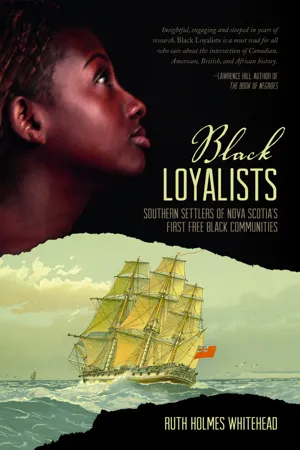
Black Loyalists strives to present hard data about the lives of Nova Scotia Black Loyalists before they escaped slavery in early South Carolina, Georgia, and Florida, and after they settled in Nova Scotia—to tell the little-known story of some very brave and enterprising men and women who survived the chaos of the American Revolution, people who found a way to pass through the heart, ironically, of a War for Liberty, to find their own liberty and human dignity.
Includes historical images and documents
eBook - ePub
Black Loyalists
Southern Settlers of Nova Scotia's First Free Black Communities
- 256 pages
- English
- ePUB (mobile friendly)
- Available on iOS & Android
eBook - ePub
About this book
Information
Part
ONE
ONE
Chapter One
THE SLAVE TRADE AND THE PROVINCE OF CAROLINA
Charlestown Harbour, early December, 1782: The British Navy is loading ship after ship with people who want to leave South Carolina. Those civilians who sided with King George III are all aboard now with their families, their allowance of baggage, their slaves, their dogs, a favourite parrot in a cage. Up the side come the Black Loyalists, freed from slavery by coming in to the British forces, perhaps bringing with them a change of clothes, some bedding, a few tools, a small bag of cornmeal. Then are brought aboard people still technically the property of King George III: the slaves captured in war or taken from the sequestered estates of rebellious Americans. They have almost nothing except the rags on their backs. And lastly, on December 14, the ships begin boarding the regiments of the British Army and their Hessian allies, evacuating a former colony at the tail end of the American Revolution.
For those of African birth — and out of the more than three thousand blacks evacuated, a great many had suffered the experience of the African slave trade first-hand — being taken aboard a troop transport surely brought back the time when they had been brought to the Province of Carolina from West Africa in the hell of a slave ship’s hold. The darkness below decks, the smell of tar and bilge, the sound of water against the hull, the beginnings of seasickness from the heave of the ship and the heat of so many bodies packed together, not to mention their anxiety about the unknown, would have caused a cascade of memories. As their vessels began to make sail down the ship channel, they could see out the gunports Sullivan’s Island, the ground they would have first set foot on to complete quarantine. Many must have sat speechless in those first moments on board, re-experiencing their African past, their capture and forced march to the sea, their placement in irons, the long wait in slave-factory dungeons until the ship arrived that would take them across the ocean. They had been victims of one of the biggest “forced migrations” the world has ever seen, part of a terrible trade in humans already several hundred years old, and one which would continue for nearly a century in South Carolina.5
The fifteenth century saw the first rush of European explorers to Africa south of the Sahara. One of the most fascinating seeds for this interest in exploration originated in the African empire of Mali in the early 1300s. Mali’s ruler, Abu Bakari II, filled with curiosity and the desire for epic adventure that was to win for him the praise name “The Voyager King,” decided to equip a fleet of two thousand ships and sail with them across the Atlantic. He wanted to know what was on the other side. Abu Bakari departed his kingdom from somewhere on the west coast of Africa, and as late as 1324, had not returned, vanishing into speculation. He left his wealth and power, as well as his sense of adventure, to his regent, Mansa Musa (1312–1337), who as a devout Muslim decided in 1324 to make a pilgrimage to Mecca. While passing through Egypt, Mansa Musa astounded the Mediterranean world with the massive amounts of gold he had brought with him from Mali. His huge retinue and his lavish spending turned heads and fired imaginations: there was gold in Africa, south of the Sahara. While in Cairo, this Malian ruler gave an interview to the Arab historian and geographer Shihab al-Umari, who in 1340 preserved for history the account of Abu Bakari and his quest into the South Atlantic.
To men of the Mediterranean littoral, Abu Bakari had done the unthinkable, launching himself due west into the unknown and terrifying World Ocean, following a dream of clouds and birds and land beyond the seas. Mansa Musa gave Europeans other themes to ponder, ideas that amplified the lure of exploration: uncharted regions of Africa as realms of mysteries, of wealth and wilderness. And flowing through all of their imaginings, a river of gold, gold, gold. Eyes and thoughts turned west and south. Europeans took up the story of Mansa Musa and preserved it: an image of the king, for instance, appears on the map of Angelino Dulcert, published in 1375. In the same year, a portrait of Mansa Musa was included in the 1375 Catalan atlas, and — just to make sure no one forgot the salient point — he is portrayed holding an enormous gold nugget.6
Thirty-five years later, intrigued by similar stories of African gold, a prince of Portugal began to push the boundaries of the world as known to Europeans. Dom Infante Henrique, third son of King João I and his English wife, Phillipa of Lancaster, took part in the conquest of North African Ceuta (now a Spanish enclave in northern Morocco). Here, in 1415, he evidently became interested in accounts of Muslim trade with sub-Saharan Africa — a trade that the Portuguese conquest had effectively ended. Prince Henry, as he is referred to in English, went home to Portugal, set himself up at the port of Sagres, and eventually began to finance voyages of exploration down the coast of West Africa. Due to reefs and tricky currents, and the primitive naval technology of the times, it had been thought impossible to pass Cape Bojador, just south of the Canary Islands. Prince Henry persevered, however, sending fifteen expeditions between 1424 and 1434 alone. His support, not only for expeditions but for ship-building innovations and better map-making, eventually enabled Portuguese ships to pass the southernmost tip of Africa and find a way to the Indies. The West African trade was thus fully opened. Gold was now being acquired from Africa in quantities large enough for the royal mint in Lisbon to issue a pure gold coinage, the cruzados. The rest of Europe couldn’t help but notice. Gold, ivory, and slaves began to find their way north from Africa, in ships of other nations.
Rise of the English Slave Trade
The earliest English voyage to West Africa that both engaged in the slave trade and left records got underway nearly a hundred years later, under the command of Captain John Lok: “In the year of Our Lord 1554 the eleventh day of October, we departed the river of Thames with three goodly ships, the one called the Trinity, the other called the Bartholomew, the third was the John Evangelist, the first day of November at nine of the clock at night departing from the coast of England.”7 The captain had set out to trade for gold and ivory; the fact that he brought home slaves appears to have been almost an afterthought. Although Lok seems to have respected the Africans he met, he cautions, “they that shall have to do with them, must use them gently: for they will not traffic or bring in any wares if they be evil used.” His actual trade in slaves is mentioned only briefly: “They brought with them certain black slaves, whereof some were tall and strong.”
Gold and elephant ivory would continue to be part of the cargo of Guinea ships, but Captain Lok’s “gentle usage” would quickly be replaced by cold and pragmatic calculations, as both Africans and Europeans realized the enormous profits to be made by the sale of human beings. Ten years later, the voyage of another Englishman, Sir John Hawkins, proved much more brutal. Accompanied by the Salomon and the Swallow, Hawkins left Plymouth on October 18, 1564 in the Jesus. He reached Madeira by November 4, and by November 25, was off Cabo Blanco, a Portuguese trading station on the coast of Africa, noting, “The people of that part of Africa are tawny, having long hair without any apparel, saving before their privy members. Their weapons in wars are bows and arrows.” At Cape Verde, he observed that “these people are all black, and are called negroes, without any apparel, saving before their privities: of stature goodly men.” Hawkins went into the Callowsa River, “where the Portuguese rode [at anchor], and dispatched his business, and so returned with two caravels, laden with negroes.”8 After a brutal encounter with locals during a second slave raid, he left Sierra Leone with his cargo of slaves and sailed for the West Indies. John Hawkins pioneered the English Triangular Trade: Africa, America, Europe. His snatch-and-grab method of acquiring cargo, if practised in England, would have been considered theft, rapine, and murder. These same practices in Africa, applied to raiding for slaves, were just taking care of business.
In the centuries that followed, however, Englishmen, ever practical, sat back and let African kings and nations do their slave hunting for them. The English made trade alliances, purchased land, built forts, and enlarged these forts into towns, eventually expanding into a full-blown colonialism and taking over huge chunks of the continent — all in the pursuit of marketable human flesh. These men weren’t pirates; they were chairmen of the board. They had paperwork to cover every eventuality: contracts, for example, setting out exactly what they expected of their ships’ captains, whom they required to post bond. They had insurance agents and brokers and lawyers; they commissioned map-makers and surveyors to chart land and sea. In the process, they invented a new meaning for the verb to slave.
The year 1660 is the next important one for this story. The throne of England had been restored to the Stuart line in the aftermath of the English Civil War, and Charles II crowned in London. As Alexander Hewatt wrote a century later, about the Carolina colony’s inception, “Domestic peace being re-established on the solid foundation of regal and constitutional authority, England, amidst other national objects, turned her views toward the improvement of commerce, navigation, and her colonies.”9 The resultant founding of the colony of Carolina in the New World, and the creation of the Royal Company of Adventurers Trading into Africa, later reinvented as the Royal African Company, were a direct result of the Restoration. In 1660, Charles II granted a monopoly on the slave trade to the Company of Royal Adventurers — literally to himself, as he had invested private monies in it — giving the company “the whole, entire and only trade for buying and selling bartering and exchanging of for or with any negroes, slaves, goods, wares, merchandize whatsoever.” His brother James, Duke of York, later James II of England, was one of the directors; his mother also put money into the venture.
Three years later, in 1663, Charles II granted the New World territory that would, in 1729, be divided into North and South Carolina to various Lords Proprietors: Edward Earl of Clarendon, George Duke of Albemarle, William Lord Craven, John Lord Berkeley, Anthony Lord Ashley, Sir George Carteret, Sir William Berkeley, and Sir John Colleton. A new economy began to fall into place. The Company provided slaves and Carolina provided a market, although at first the colony got most of its slaves at one remove, from the West Indies.10
The English slave trade burgeoned. Between 1672 and 1689, the Royal African Company is estimated to have transported ninety thousand to a hundred thousand slaves out of Africa. Royal African profits consolidated English financial power in London, the company’s home base. The company’s insignia was the elephant and castle. All their human merchandise was branded DY, for the Duke of York, or RAC, for the company itself. And their gold underwrote the monarchy. Indeed, between 1668 and 1722, the company even provided gold to the English mint. Coins made with this African gold, which were called “guineas,” bore an elepha...
Table of contents
- Title Page
- Copyright
- Dedication
- Table of Contents
- Introduction
- Part ONE
- Part TWO
- Part THREE
- Acknowledgements
- Abbreviations
- Notes
- Bibliography
- Index
Trusted by 375,005 students
Access to over 1.5 million titles for a fair monthly price.
Study more efficiently using our study tools.
Frequently asked questions
Yes, you can cancel anytime from the Subscription tab in your account settings on the Perlego website. Your subscription will stay active until the end of your current billing period. Learn how to cancel your subscription
No, books cannot be downloaded as external files, such as PDFs, for use outside of Perlego. However, you can download books within the Perlego app for offline reading on mobile or tablet. Learn how to download books offline
Perlego offers two plans: Essential and Complete
- Essential is ideal for learners and professionals who enjoy exploring a wide range of subjects. Access the Essential Library with 800,000+ trusted titles and best-sellers across business, personal growth, and the humanities. Includes unlimited reading time and Standard Read Aloud voice.
- Complete: Perfect for advanced learners and researchers needing full, unrestricted access. Unlock 1.5M+ books across hundreds of subjects, including academic and specialized titles. The Complete Plan also includes advanced features like Premium Read Aloud and Research Assistant.
We are an online textbook subscription service, where you can get access to an entire online library for less than the price of a single book per month. With over 1.5 million books across 990+ topics, we’ve got you covered! Learn about our mission
Look out for the read-aloud symbol on your next book to see if you can listen to it. The read-aloud tool reads text aloud for you, highlighting the text as it is being read. You can pause it, speed it up and slow it down. Learn more about Read Aloud
Yes! You can use the Perlego app on both iOS and Android devices to read anytime, anywhere — even offline. Perfect for commutes or when you’re on the go.
Please note we cannot support devices running on iOS 13 and Android 7 or earlier. Learn more about using the app
Please note we cannot support devices running on iOS 13 and Android 7 or earlier. Learn more about using the app
Yes, you can access Black Loyalists by Ruth Holmes Whithead in PDF and/or ePUB format, as well as other popular books in History & African American History. We have over 1.5 million books available in our catalogue for you to explore.