Twenty chapters present the range of current research into the study of textiles and dress in classical antiquity, stressing the need for cross and inter-disciplinarity study in order to gain the fullest picture of surviving material. Issues addressed include: the importance of studying textiles to understand economy and landscape in the past; different types of embellishments of dress from weaving techniques to the (late introduction) of embroidery; the close links between the language of ancient mathematics and weaving; the relationships of iconography to the realities of clothed bodies including a paper on the ground breaking research on the polychromy of ancient statuary; dye recipes and methods of analysis; case studies of garments in Spanish, Viennese and Greek collections which discuss methods of analysis and conservation; analyses of textile tools from across the Mediterranean; discussions of trade and ethnicity to the workshop relations in Roman fulleries. Multiple aspects of the production of textiles and the social meaning of dress are included here to offer the reader an up-to-date account of the state of current research. The volume opens up the range of questions that can now be answered when looking at fragments of textiles and examining written and iconographic images of dressed individuals in a range of media.
This volume is part of a pair together withPrehistoric, Ancient Near Eastern and Aegean Textiles and Dress: an interdisciplinary anthology edited by Mary Harlow, Cécile Michel and Marie-Louise Nosch, Isbn 9781782977193
eBook - ePub
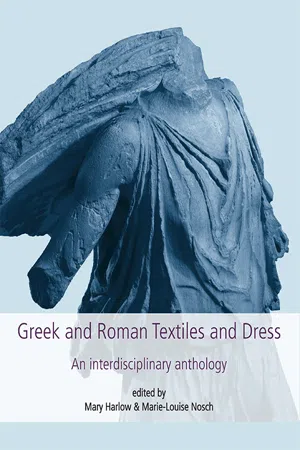
Greek and Roman Textiles and Dress
An Interdisciplinary Anthology
- 320 pages
- English
- ePUB (mobile friendly)
- Available on iOS & Android
eBook - ePub
Greek and Roman Textiles and Dress
An Interdisciplinary Anthology
About this book
Information
Subtopic
Ancient HistoryIndex
Social Sciences1. Weaving the Threads: methodologies in textile and dress research for the Greek and Roman world – the state of the art and the case for cross-disciplinarity
In the recent past the study of textiles and dress has become almost a discipline in its own right.1 The universal character of textiles and clothing invites us to cross traditional disciplinary boundaries, for example, the semi-artificial divisions between prehistoric and classical archaeology, design and textile engineering, or Indo-European and Semitic language studies. Researching dress and textile history in antiquity presents particular methodological challenges. To be really effective and innovative it needs to combine the approaches of academic disciplines often kept separate in university departments. The standard methodologies of the various disciplines that intertwine to explore and create dress and textile history in antiquity (ancient history, art history, archaeology, classical philology, etc.) are well known and we shall not reiterate them here but rather describe the cross- and inter-disciplinary innovations that arise from this new field, and the necessary ventures it requires into more disparate but cognitively linked academic disciplines (e.g. anthropology, ethnography, sociology, cultural studies).2 In consequence, we see dress and textile research as fertile ground for using interpretive frameworks from newer areas of scholarship: e.g. fashion studies, New Institutional Economics, trend theory, literary theory and similar approaches more widely used in the field of cultural studies.3 Another significant institutional characteristic of the field is that textile research is often embedded in museums, departments of conservation, dye analysis laboratories as well as university departments; these represent excellent opportunities to disseminate research and share knowledge not only with other scholars but also to the wider audience of museum visitors.
The scattered and often isolated location of textile researchers in Europe has been partly remedied by two international networks: North European Symposium of Archaeological Textiles (NESAT) which gathers archaeologists and textile craftspeople from Central and Northern Europe; and Centre international d’études de textiles anciens (CIETA) with a focus on historical textiles and scholars from museums and art history. However, the Greek and Roman world is not entirely embraced by either of these although it has an interest in both.
Textile research and dress history are evolving fast. Across Europe a series of research centres frame this progress4 and a multitude of PhD and postdoctoral projects deal with textiles and clothing as a new means of understanding society, culture, identity, ethnicity, economy, and politics. In 2013 two large international European funded projects came to an end: Fashioning the Early Modern and Dress ID. Clothing and Identity in Roman Times.5 These projects brought together scholars from a range of disciplines to share knowledge, create networks and at the same time develop methodologies for this emerging new way of studying the past. Both projects resulted in publications and museum exhibitions. Historians and archaeologists, it seems, are now exploiting the methods that have traditionally been used by anthropologists working with living cultures and, combined with the knowledge they have of their own period of interest, creating new insights and new research questions. In 2012–2013 alone conference themes on textile and clothing in antiquity ranged from the study of the silk trade in antiquity (Harvard, April 2012), textile as metaphor and narrative device (Copenhagen June 2012, 2013, Basel August 2012, Cambridge September 2012), dress and age and gender (Berlin, September 2012), the Bronze Age wool economies in the ancient Near East (Paris, November 2012), to textile trade and distribution (Marburg April 2013), wool on the Silk Road (Hangzhou, China, April 2013), purple dye, sea silk (Lecce, May 2013) and textiles in cult and sanctuaries (November 2013) to name but some in a plethora of relevant gatherings.6 The matter of textiles and dress is now becoming embedded in approaches to antiquity, rather than remaining peripheral. The strength and acceptance in academia of this emerging field is confirmed by a rapid recent accumulation of prestigious European grants from the 7th Framework Programme, on the topic of textile research: the status in 2014 is a series of Marie Curie mobility grants,7 as well as two ERC starting grants8 and one ERC advanced grant.9 In the Humanities section of the European Research Area (HERA) of the European Science Foundation, of the 19 projects funded under the first HERA joint research programme in 2010–2013, two concerned textiles and dress.10
This academic movement is not limited to any single discipline or to a single time frame. Scholars across the world interested in periods as diverse as the early Bronze Age in the Aegean through to classical antiquity and the medieval period to the early modern have all been profoundly impacted upon by recent textile research. It is as if historians had continually and consistently failed to notice how people dressed and used the flexible complex material of clothing and the textiles they are made from, to create individual and group identities, to make statements about status, rank, gender, political and religious affiliation etc.; nor did they take account of the raw materials, labour, time and skill involved in the cultivation and production of textiles and clothing; nor did studies of innovation, technology history, science and engineering etc. explain the role of textiles in technologies, cross-craft movements, or innovations. Such matters were simply not considered of importance alongside the ‘big themes’ of classical history such as political narratives or warfare and even when the focus was on large scale issues such as the environment, landscape, climate or nutrition, little attention was given to the role of textile production. This should surprise us, given that in terms of technological developments societies were producing textiles long before they were producing pottery or metalwork.
What is special about textiles, why do they merit a place among the ‘big themes’?
Outside tropical climate zones the production and use of textiles is absolutely essential for survival for most societies. Even in tropical areas, body adornments of some kind often serve similar purposes to the decorative effects of dress (e.g. feathers, beads, tattooing, etc.). In other climates and cultures, such as peoples living inside the Arctic Circle, the protective nature of clothing is often fulfilled by the use of skins rather than woven textiles. This double function of clothing – physical protection as well as media of communication – is present in all cultures.
Unlike the subjects of other big themes, textiles are the nearest we can come to the human body and therefore have a strong affinity with both group and individual identity and with notions of intimacy and hygiene. ‘You are what you wear’ and the study of clothing is to a large degree the study of the moving body in space. It concerns the relationship of garment to body and of individual body to the social body; this close connection with the person and individual is perhaps one of the reasons it has been omitted from large scale surveys of other aspects of the past. This may be due to an erroneously perceived gender divide in the method of production. Textiles are traditionally assigned to the realm of women, who are also linked more closely to ideas of the body and bodily adornment, and were mostly not deemed worthy of study by 20th-century urban male scholars, who considered the very idea of dress and ornament subjects that academic minds should not waste time on. It was social anthropologists who noted the importance of adornment in creating identity. It has required a cross-disciplinary nudge to make historians of early periods sit up and take notice.
Despite its marginality in the ‘big themes’, textile production, from raw material to finished item, has had a significant impact on society from its earliest history. The production of textiles of quite complex weaves preceded the production of pottery and metals. Thus people spun and wove for many thousands of years before they started to develop and use other technologies, and we must assume that textile technology strongly influenced the emergence of many other later innovations.11 The continuing centrality of textiles to daily life is an essential characteristic of the claim to establish their study as one of the ‘big themes.’ For over 10,000 years textiles have been known to cover the human body and remain relevant to everyone, everyday.12 However, particularly for textiles it is significant that in the last three or four generations the majority of people have become alienated from the craft elements of production. Few Europeans now know how to weave or even understand the principles of weaving, and even fewer of those who do are academic scholars. In the last hundred years in the West, textile crafts have moved from being a fundamental industry to being perceived as a female handicraft and leisure activity: a part of the cultural economy but not highly valued in the wider monetary economy. This attitude probably also partly explains why the field is neglected in academia. In other parts of the world the reverse is happening: textile production in both its traditional and industrialised forms is being seen and exploited as a means of creating an economic base for communities, and sustainable production and corporate social responsibility are becoming themes which shape the new textile consumer literacy.13 In Europe, however, there is a divorce between textile production and textile consumption in the minds of consumers. In this sense, textile production has followed notions of food production and consumption: while cooking may still be a daily activity in the household, many western children do not understand the origin of food beyond the supermarket shelf.14 Likewise for textiles: never have we owned and consumed as much fabric as today, yet we rarely know or question where it comes from, how it is made, and by whom.
One of the key aspects for textile and dress history then, is to (re-)establish the recognition of textiles as essential and present everywhere – in the past and the present. Surprisingly, many publications neglect textiles both as raw materi...
Table of contents
- Cover
- Title Page
- Copyright
- Contents
- Acknowledgements
- Contributors
- Chapter 1: Weaving the Threads: methodologies in textile and dress research for the Greek and Roman world – the state of the art and the case for cross-disciplinarity
- Chapter 2: Embellishment Techniques of Classical Greek Textiles
- Chapter 3: The Importance of Beginnings: gender and reproduction in mathematics and weaving
- Chapter 4: Representation and Realities: fibulas and pins in Greek and Near Eastern iconography
- Chapter 5: Dressing the Citharode: a chapter in Greek musical and cultic imagery
- Chapter 6: Alchemical Textiles: colourful garments, recipes and dyeing techniques in Graeco-Roman Egypt
- Chapter 7: The Conservation of a 5th-Century BC excavated Textile Find from the Kerameikos Cemetery at athens
- Chapter 8: Transport amphoras and Loomweights: integrating elements of ancient Greek economies?
- Chapter 9: The Wool Basket: function, depiction and meaning of the kalathos
- Chapter 10: Unravelling the Tangled Threads of ancient Embroidery: a compilation of written sources and archaeologically preserved textiles
- Chapter 11: New archaeological data for the Understanding of Weaving in Herakleia, Southern Basilicata, italy
- Chapter 12: Roman Art: what can it tell us about dress and textiles? A discussion on the use of visual evidence as sources for textile research
- Chapter 13: Where marble meets Colour: surface texturing of hair, skin and dress on roman marble portraits as support for painted polychromy
- Chapter 14: Dressing the Adulteress
- Chapter 15: Looking Between loom and laundry: vision and communication in ostian fulling workshops
- Chapter 16: Roman Textiles and Barbarians: some observations on textile exchange between the roman Empire and Barbaricum
- Chapter 17: The multiple Functions and lives of a Textile: the reuse of a garment
- Chapter 18: Discovering late Antique Textiles in the Public Collections in Spain: an interdisciplinary research project
- Chapter 19: A New Approach to the Understanding of Historic Textiles
- Chapter 20: Burial Threads: a late antique textile and the iconography of the Virgin Annunciate spinning
Trusted by 375,005 students
Access to over 1.5 million titles for a fair monthly price.
Study more efficiently using our study tools.
Frequently asked questions
Yes, you can cancel anytime from the Subscription tab in your account settings on the Perlego website. Your subscription will stay active until the end of your current billing period. Learn how to cancel your subscription
No, books cannot be downloaded as external files, such as PDFs, for use outside of Perlego. However, you can download books within the Perlego app for offline reading on mobile or tablet. Learn how to download books offline
Perlego offers two plans: Essential and Complete
- Essential is ideal for learners and professionals who enjoy exploring a wide range of subjects. Access the Essential Library with 800,000+ trusted titles and best-sellers across business, personal growth, and the humanities. Includes unlimited reading time and Standard Read Aloud voice.
- Complete: Perfect for advanced learners and researchers needing full, unrestricted access. Unlock 1.5M+ books across hundreds of subjects, including academic and specialized titles. The Complete Plan also includes advanced features like Premium Read Aloud and Research Assistant.
We are an online textbook subscription service, where you can get access to an entire online library for less than the price of a single book per month. With over 1.5 million books across 990+ topics, we’ve got you covered! Learn about our mission
Look out for the read-aloud symbol on your next book to see if you can listen to it. The read-aloud tool reads text aloud for you, highlighting the text as it is being read. You can pause it, speed it up and slow it down. Learn more about Read Aloud
Yes! You can use the Perlego app on both iOS and Android devices to read anytime, anywhere — even offline. Perfect for commutes or when you’re on the go.
Please note we cannot support devices running on iOS 13 and Android 7 or earlier. Learn more about using the app
Please note we cannot support devices running on iOS 13 and Android 7 or earlier. Learn more about using the app
Yes, you can access Greek and Roman Textiles and Dress by Mary Harlow, Marie-Louise Nosch, Mary Harlow,Marie-Louise Nosch in PDF and/or ePUB format, as well as other popular books in Social Sciences & Ancient History. We have over 1.5 million books available in our catalogue for you to explore.