Phenotypic plasticity – the ability of an individual organism to alter its features in direct response to a change in its environment – is ubiquitous. Understanding how and why this phenomenon exists is crucial because it unites all levels of biological inquiry. This book brings together researchers who approach plasticity from diverse perspectives to explore new ideas and recent findings about the causes and consequences of plasticity. Contributors also discuss such controversial topics as how plasticity shapes ecological and evolutionary processes; whether specific plastic responses can be passed to offspring; and whether plasticity has left an important imprint on the history of life. Importantly, each chapter highlights key questions for future research. Drawing on numerous studies of plasticity in natural populations of plants and animals, this book aims to foster greater appreciation for this important, but frequently misunderstood phenomenon.
Key Features
Written in an accessible style with numerous illustrations, including many in color
Reviews the history of the study of plasticity, including Darwin's views
Most chapters conclude with recommendations for future research
8 Buying Time: Plasticity and Population Persistence
Sarah E. Diamond and Ryan A. Martin
Case Western Reserve University
CONTENTS
8.1 Introduction
8.2 A Brief History of Buying Time
8.3 The Theory and Modeling Behind Buying Time
8.4 Criteria and Approaches
8.5 Empirical Evidence of Buying Time
8.6 Buying Time for What?
8.7 New Venues to Test for Buying Time
8.7.1 Evaluating the Pattern of Buying Time Using Field Observations and Common Garden Experiments
8.7.2 Establishing a Causal Link between Plasticity and Persistence Using Reciprocal Transplant Experiments
8.7.3 Assessing the Consequences of Buying Time: Does Plasticity Buy Time for Populations to Adapt to Urbanization?
8.8 Conclusions
Acknowledgments
References
8.1 Introduction
As the environment changes, populations can respond by adapting via evolutionary change. If the rate or magnitude of environmental change is too great for evolution to keep pace, then populations face the risk of extinction (Chevin et al. 2010; Sinervo et al. 2010; Radchuk et al. 2019). While the majority of species that have ever lived have gone extinct, the wealth of extant biodiversity on Earth proves that many lineages have successfully survived and diversified in response to the extensive environmental challenges thrown at them since life began (see Lister 2021 in this volume).
In this chapter, we will evaluate the important role phenotypic plasticity—the ability of a single genotype to produce different phenotypes in response to environmental variation—may play in ‘buying time’ for populations to persist and potentially then evolve when confronted with rapidly changing or novel environments. We briefly describe the history of this concept and review the theoretical predictions regarding when phenotypic plasticity will or will not be able to buffer populations in changing and novel environments. We also review the empirical evidence for plasticity buying time and lay out a framework for future tests focusing on organismal responses to novel urban environments. Finally, we discuss the open questions and future directions for further research.
8.2 A Brief History of Buying Time
Populations can evolve at a remarkably fast pace. Although for a long time, the action of natural selection was thought too slow to be readily observed over the course of a human life, in fact, evolution often occurs at the same timescale as ecological change (Reznick et al. 2019). Even so, adaptive evolutionary change can still be constrained for many reasons (e.g., through a lack of heritable variation, environmental stochasticity, and costs of selection). And, evidence suggests that many species are not evolving fast enough to keep pace with the current rate and magnitude of environmental change caused by a warming climate, habitat alteration, species invasions, and other anthropogenic forces (e.g., Radchuk et al. 2019). For some populations, plastic responses to these environmental challenges might be able to buffer populations from extinction, allowing time for adaptive evolution (Merilä and Hendry 2014; Diamond and Martin 2016; Fox et al. 2019).
The idea that phenotypic plasticity might buy populations the time they need to evolve (and perhaps subsequently shape evolutionary responses) is surprisingly old. Following Darwin’s publication of The Origin of Species, one of the primary criticisms with the theory of natural selection was that the small intraspecific variations viewed as critical by Darwin were too slight for natural selection to effectively work upon (see Costa 2021 in this volume). This criticism led to the promotion of neo-Lamarckian theories of evolution, where in place of natural selection, the acquisition and inheritance of environmentally induced traits was instead the major mechanism of adaptive evolution (Simpson 1953; Crispo et al. 2010; see Bonduriansky 2021 in this volume). As a counterweight, several scientists independently proposed theories incorporating the role of environmentally sensitive traits into the framework of natural selection and Darwinian evolution (Baldwin 1896; Morgan 1896; Osborn 1896). These ideas were most thoroughly developed by James Baldwin and now are collectively known as the ‘Baldwin effect’ (Simpson 1953; see also Futuyma 2021 and Pfennig 2021 in this volume). Baldwin proposed that through the process of ‘organic selection,’ plasticity allows individuals to survive in novel and changing environments. Natural selection can then act either on standing genetic variation or on novel mutations with phenotypic effects along the same direction as the plastic effects, promoting adaptation to the novel environment by the further evolution of plastic or canalized responses. While evolutionary biologists during the modern synthesis, such as G.G. Simpson, considered the Baldwin effect plausible, they also thought it to be of little general importance and often misconstrued aspects of Baldwin’s theory (West-Eberhard 2003; Crispo 2007; Scheiner 2014).
After Baldwin, Gause, Schmalhausen, and Waddington developed their own distinct theories incorporating a role for plasticity in evolution (Gause 1942; Schmalhausen 1949; Waddington 1961). Both Schmalhausen and Waddington were key for initiating the developmental and genetic framework for understanding phenotypic plasticity. Importantly, all of these scientists saw an important role for plasticity preceding and influencing evolutionary change. For a detailed review of the overlap and distinctions among these ideas see West-Eberhard (2003), Pigliucci (2001), Crispo (2007), as well as Futuyma (2021) and Pfennig (2021) in this volume. Nevertheless, for most of their contemporaries, phenotypic plasticity was thought to play little role in evolution overall (Pigliucci 2001; West-Eberhard 2003). While Bradshaw (1965) mentioned that plasticity could help populations with limited genetic variation adapt to strong directional selection, there was otherwise little further research on plasticity’s role in adaptation to novel environments until the 1980s when West-Eberhard (1989) and Wcislo (1989) reviewed and discussed behavioral plasticity’s potential roles in the evolution of novel traits and in adaptation to novel environments. West-Eberhard went on to develop the concepts of phenotypic accommodation (adaptive adjustment to mutational or environmental change among integrated traits via development) and genetic accommodation (adaptive evolution of novel traits induced by mutational or environmental change), building on the theories proposed by Baldwin, Waddington, and others (West-Eberhard 2003; Crispo 2007). Around the same time as these early reviews and verbal models, formal modeling approaches started to explore the evolution of adaptive plasticity (Via and Lande 1985) and the effects of plasticity on the speed of adaptive evolution (Hinton and Nowlan 1987).
8.3 The Theory and Modeling Behind Buying Time
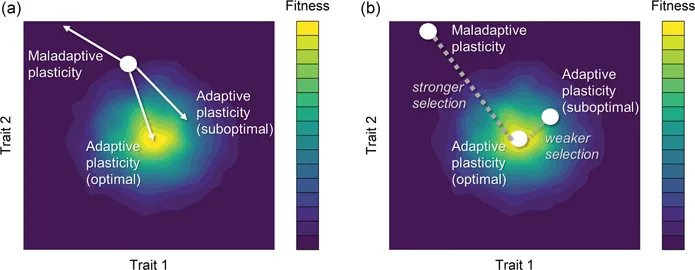
From modeling and theory, how does plasticity buy time for evolution, and what are the conditions under which this will occur? Imagine a population exposed to a novel environment. If the population’s mean phenotype has low fitness in this novel environment, and is not plastic, then the population faces the risk of extinction. However, if fitness-determining traits are plastic in response to the environmental change, then this plasticity could: (a) further push the population away from the new fitness optimum; (b) move the population closer to the new fitness optimum; or (c) place the population directly upon the peak (Figure 8.1). In cases (b) and (c), plasticity in the novel environment can promote population persistence and reduce the intensity of selection (Ghalambor et al. 2007). But what other factors influence the fitness effects of plasticity in novel environments and its impact on future evolutionary change? Mathematical and simulation models provide answers and testable predictions to these questions. The first model to explore this question asked if learning (a common form of plasticity in animals) could accelerate evolution. In this model, only a single phenotype conferred adaptation, while all other phenotypes were equally maladaptive, meaning that there was no slope of increasing fitness approaching the peak in the absence of plasticity. From this model, Hinton and Nowlan (1987) found that learning greatly accelerated the adaptive evolution of the population. Simply put, in this and other models of non-evolving plasticity, phenotypic plasticity smoothed out the fitness landscape by allowing individual genotypes to explore more of the phenotype space. As a consequence, less fit genotypes are able to survive and, in the presence of genetic variation, evolve towards the fitness optimum (Figure 8.2; reviewed in Frank 2011). However, plasticity can also slow the rate of evolution and negatively impact persistence (Ancel 2000; Ghalambor et al. 2007; Paenke et al. 2007). For plasticity to facilitate evolution and persistence, plasticity must be somewhat adaptive in the new environment, although perfect plasticity that matches the fitness optimum will increase persistence but prevent further evolution (Figure 8.1; Price et al. 2003; Ghalambor et al. 2007; Paenke et al. 2007). Moreover, the effects of plasticity on evolution depend on which genotypes benefit. Plasticity positively affecting relatively more-fit genotypes will generally speed evolution but evolution will be impeded if instead less-fit genotypes are more plastic (Paenke et al. 2007).
FIGURE 8.1 Variation in plastic responses to environmental change in a novel environment. In both panels, a fitness landscape for two traits is depicted, with the fitness peak in the center of the heatmap plot (and in warmer colors). (a) The population’s mean phenotype (represented by the p...
Table of contents
Cover
Half Title
Series Page
Title Page
Copyright Page
Table of Contents
Series Preface: Evolutionary Cell Biology
Foreword: perspective on ‘plasticity’
Preface
Editor
Contributors
Section I Plasticity and Evolution: Concepts, Contexts, Questions
Section II Causes of Plasticity: From Genes to Ecology
Section III Consequences of Plasticity: Adaptation, Origination, Diversification
Section IV Plasticity and Evolution: Controversies and Consensus
Index
Trusted by 375,005 students
Access to over 1.5 million titles for a fair monthly price.
Study more efficiently using our study tools.
Frequently asked questions
Yes, you can cancel anytime from the Subscription tab in your account settings on the Perlego website. Your subscription will stay active until the end of your current billing period. Learn how to cancel your subscription
No, books cannot be downloaded as external files, such as PDFs, for use outside of Perlego. However, you can download books within the Perlego app for offline reading on mobile or tablet. Learn how to download books offline
Perlego offers two plans: Essential and Complete
Essential is ideal for learners and professionals who enjoy exploring a wide range of subjects. Access the Essential Library with 800,000+ trusted titles and best-sellers across business, personal growth, and the humanities. Includes unlimited reading time and Standard Read Aloud voice.
Complete: Perfect for advanced learners and researchers needing full, unrestricted access. Unlock 1.5M+ books across hundreds of subjects, including academic and specialized titles. The Complete Plan also includes advanced features like Premium Read Aloud and Research Assistant.
Both plans are available with monthly, semester, or annual billing cycles.
We are an online textbook subscription service, where you can get access to an entire online library for less than the price of a single book per month. With over 1.5 million books across 990+ topics, we’ve got you covered! Learn about our mission
Look out for the read-aloud symbol on your next book to see if you can listen to it. The read-aloud tool reads text aloud for you, highlighting the text as it is being read. You can pause it, speed it up and slow it down. Learn more about Read Aloud
Yes! You can use the Perlego app on both iOS and Android devices to read anytime, anywhere — even offline. Perfect for commutes or when you’re on the go. Please note we cannot support devices running on iOS 13 and Android 7 or earlier. Learn more about using the app
Yes, you can access Phenotypic Plasticity & Evolution by David W. Pfennig in PDF and/or ePUB format, as well as other popular books in Biological Sciences & Ecology. We have over 1.5 million books available in our catalogue for you to explore.