Starting with problems and challenges faced by enterprise WANs, Software-Defined Wide Area Network Architectures and Technologies provides a detailed description of SD-WAN's background and basic features, as well as the system architecture, operating mechanism, and application scenarios of the SD-WAN solution based on the implementation of Huawei SD-WAN Solution. It also explains key SD-WAN technologies and analyzes real SD-WAN deployment cases, affording readers with design methods and deployment suggestions for the SD-WAN solution.
The information presented in this book is easy to understand and very practical. It enables you to become adept in the SD-WAN solution's implementation and design principles. The book is intended for ICT practitioners, such as network technical support engineers, network administrators, and network planning engineers, to use in studying theory. Furthermore, it serves as reference material for network technology enthusiasts.
Authors
Cheng Sheng is the Chief Architect of Huawei's SD-WAN Solution. He has nearly 20 years of experience in network product and solution design, as well as extensive expertise in product design and development, network planning and design, and network engineering project implementation.
Jie Bai is an Architect of Huawei's SD-WAN Solution. He is well versed in Huawei security products and SD-WAN Solution and has written books such as Huawei Firewall Technology Talk as well as Huawei Anti-DDoS Technology Talk.
Qi Sun is a Senior Information Architect of Huawei, and he is knowledgeable in Huawei SD-WAN Solution, CloudVPN Solution, and Cloud Management Solution. He also participated in the information architecture design and delivery of multiple solutions.
FROM THE EARLY DAYS of pigeon post and telegram to today’s telephones and instant messaging, society has always pursued new ways to communicate and collaborate seamlessly beyond geographical boundaries. Over time, technological advances have made it possible for us to interact as if we were face to face, no matter how far apart we are. Such immersive interactions are no longer limited to science fiction — they are already part of our daily lives.
Similarly, enterprises have high demands for truly productive communication and collaboration. As economic globalization and digital transformation take shape, the scale of enterprises is expanding with more branches being dispersed throughout different regions. But despite being so spread out, enterprise headquarters and branches need to be able to seamlessly communicate and collaborate with each other. This is where Wide Area Networks (WANs) come in. WANs are used by enterprises to connect branches that are far apart so as to better roll out services. This is especially true in today’s information society where networks are the root and connections are the foundation.
WANs enable enterprise headquarters and branches thousands of miles apart to connect, share information, and communicate seamlessly with each other. But more importantly, WANs inspire and motivate network vendors to constantly improve connection quality and to create a better network experience. Next, let’s delve into the world of enterprise WANs.
1.1 Evolution of Enterprise WANs
WAN is not a new concept for practitioners in the communications industry. Along with Local Area Network (LAN) and Metropolitan Area Network (MAN), it is one of the first concepts learners of computer networking come across. As Confucius said, “One will get something new in looking over one’s old studies.” In this spirit, let’s first review the development of WANs.
As its name suggests, a WAN is a wide area interconnection network used for long-distance communication between enterprises, organizations, or individuals, and can span multiple countries, regions, or cities. With coverage often ranging from tens to thousands of kilometers, WANs enable information and resource sharing over vast distances. Due to costs and construction difficulties, WANs are generally provided by carriers. The Internet, for example, which is now deeply rooted in our daily lives, is actually a global WAN built by different carriers around the world.
Benefiting from WANs, enterprises can easily connect their geographically dispersed branches and roll out various services, which in turn greatly advance economic globalization.
You may be wondering: How do enterprises get their own WANs? Most enterprises set up their own WANs by leasing WAN private lines from carriers. For example, an enterprise may lease multiple peer-to-peer private lines provided by a carrier to connect its dispersed branches. Alternatively, the enterprise can rent the public network provided by the carrier to establish its own WANs. With the public network, each branch of the enterprise can connect to every other branch through a single link.
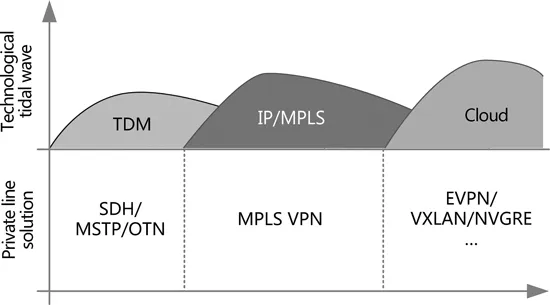
As network technologies are developing at a remarkable pace, enterprise WANs also keep evolving, from the earliest Time Division Multiplexing (TDM) era to the IP/Multi-Protocol Label Switching (MPLS) era, and finally to today’s cloud era. Correspondingly, private lines provided by carriers for constructing enterprise WANs are constantly transforming, as shown in Figure 1.1.
FIGURE 1.1 Evolution of enterprise WANs.
Private lines provided by carriers are primarily classified into two types:
The first type refers to such private lines as TDM-based Synchronous Digital Hierarchy (SDH) and Multi-Service Transport Platform (MSTP), as well as Wavelength Division Multiplexing (WDM)-based Optical Transport Network (OTN). Private lines of this type are traditional point-to-point physical private lines and are highly secure. Users can exclusively occupy private line resources, with high guaranteed bandwidth and Quality of Service (QoS), and therefore costs are inevitably very high. Organizations in the financial services industry prefer to use this type of private line, as they have high requirements on WAN line quality as well as communications security and privacy.
The second type is typified by MPLS Virtual Private Network (VPN) private lines based on Packet Switched Network (PSN) technology. Private lines of this type achieve reachability from any point on the network to any other point. In essence, MPLS VPN private lines are the same as the abovementioned first type of private lines, in the sense that both are provided by carriers. Where they differ is that MPLS VPN private lines offer more networking convenience and lower costs. In particular, MPLS VPN private lines are noted for better bandwidth and reliability assurance, as well as security isolation, to name a few. It is these merits that have led to MPLS VPN private lines being so widely used in the enterprise WAN interconnection market.
With the rapid development of enterprise IT digitization and economic globalization, enterprises are now stepping into the cloud era. In this new era, enterprises will be looking for a more convenient, intelligent, and simplified network connection mode to easily implement ubiquitous, high-quality WAN interconnection anytime, anywhere. In particular, driven by the development of the Internet, IP networks have made great progress in terms of coverage and network quality, making it possible to interconnect enterprise WANs through the Internet.
Against this backdrop, overlay VPN technologies — such as Ethernet Virtual Private Network (EVPN), Virtual eXtensible Local Area Network (VXLAN), and Network Virtualization using Generic Routing Encapsulation (NVGRE) — are emerging as next-generation technologies. Due to their advantages in service provisioning agility, networking flexibility, and interoperability, these up-and-coming technologies are gradually becoming the mainstream for building the next-generation enterprise WAN interconnection.
It should be noted that it isn’t a case of choosing just one of the three phases of enterprise WAN private lines. Rather, in the long run, they should be used in combination to get the best of each. For example, MPLS VPN private lines will be around for a long time due to advantages in networking and reliability. The emerging overlay VPN private lines — which are often regarded as networking options for flexible scheduling — will not replace MPLS VPN private lines. Instead, they will run on top of MPLS VPN private lines, providing the ability to schedule the Internet and offering other WAN capabilities.
1.2 Challenges Facing Enterprise WANs
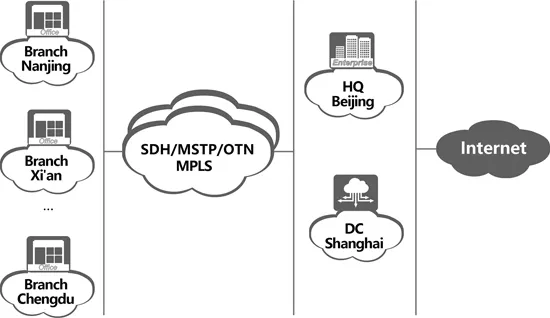
Traditionally, enterprises use WANs to interconnect their organizations that are widely dispersed throughout different regions, as shown in Figure 1.2.
FIGURE 1.2 Traditional enterprise WAN interconnection.
This traditional enterprise WAN interconnection scenario has the following characteristics:
An enterprise typically includes the headquarters, branches, and data centers (DCs).
Enterprises build WANs by purchasing SDH, MSTP, OTN, and MPLS private lines from carriers.
Enterprise branches implement services by communicating with the headquarters or DC, through which they access the Internet.
In this traditional enterprise WAN interconnection scenario, the enterprise WAN architecture is relatively closed due to the following reasons:
Key applications, information, and data are stored inside the enterprise. The demand for WAN bandwidth is low, and services do not change frequently.
Carriers provide only limited choices of private lines. The network topology seldom changes.
Security policies are centrally implemented in the headquarters or DC to ensure security.
For quite some time, this traditional WAN architecture has played an important role in enterprise branch interconnection and, to some extent, met enterprise service requirements.
However, as enterprises further their digital transformation, we are seeing the emergence of new external business and technical factors, including cloud computing, network virtualization, and Network as a Service (NaaS). These new drivers are exerting a profound impact on the service model and network architecture of traditional enterprise WANs. As such, enterprise WANs are being presented with the following new challenges.
1.2.1 Service Cloudification in Full Swing
The rise of cloud computing catalyzes the booming public cloud market. More and more enterprises are choosing to build their IT systems on the public cloud in order to reduce construction costs while accelerating construction. They are also choosing to move their traditional applications to the cloud. In most cases, enterprises are using WANs to access Software as a Service (SaaS) applications, such as office software and databases.
As enterprise services are migrated to the cloud, enterprise WANs are carrying more and more cloud-related application traffic, resulting in WAN traffic surges and therefore far higher demand for WAN bandwidth. Due to this, the traffic transmission quality of enterprise WANs directly impacts enterprises’ cloud application experience. Because of the large latency and high packet loss rate over Internet links, as well as difficult access to the cloud through MPLS private lines, enterprises still find it difficult to implement cloud-network synergy, preventing enterprises from fully enjoying the unprecedented speeds and performance that cloud computing offers.
1.2.2 Network Virtualization Taking Off
Network Functions Virtualization (NFV) is the use of Virtual Machine (VM) or container technology to virtualize traditional network devices, such as routers and firewalls, into software to be run on general-purpose servers. The result is network functions that are decoupled from network devices.
NFV uses software to implement multiple network functions, which has obvious advantages such as reducing hardware spending as well as Operations and Maintenance (O&M) costs and deploying services more flexibly and rapidly. Network virtualization technologies like NFV are accelerating the transformation of enterprise WAN infrastructure deployment and O&M modes toward rapid service provisioning and on-demand simplified deployment.
1.2.3 NaaS as an Inevitable Trend
The fundamental building blocks of today’s enterprise WANs are twofold: network devices (such as routers and switches) and enterprise-class WAN private lines (such as MSTP and MPLS). In essence, both are products. They are sold by equipment vendors or resold by carriers to enterprise customers, with commitments extending only to product functions and performance specifications. That is, vendors and carriers are not responsible for enterprise customers’ IT application experience. As such, if the experience of enterprise WAN applications is poor after enterprises have integrated purchased products, they are left to deal with the problem by themselves.
In stark contrast to product sales, the purpose of service sales is to meet the final service requirements of customers. Services innately offer more direct consumption patterns than products. For example, NaaS enables enterprises to purchase business services and commitments instead of separate product components. Quality is measured according to how satisfied customers are with the obtained services.
Currently, we are seeing network resale evolving from product-oriented to service-oriented. This evolution radically changes carriers’ product sales modes, meaning that enterprises only need to propose their IT requirements as opposed to constructing IT networks themselves, as before. In this way, enterprises are freed from much workload and can redirect their resources to core services, thereby improving production efficiency.
1.2.4 Internet-Based Enterprise Communications on the Rise
In recent years, the Internet improved drastically in terms of coverage and performance, and it is now able to offer network quality closer to that of private lines. Thanks to these advances, more enterprises are able to use the Internet as a network transmission medium in order to realize more effective utilization of network resources. In addition to providing traditional Internet access services, the Internet is playing an ever-more prominent role in the interconnection between enterprise headquarters, branches, and DCs. As such, it has become a viable alternative to traditional private lines provided by carriers in enterprise WAN interconnection scenarios.
In short, enterprise WAN interconnection has changed tremendously, taking on a completely new look. Such change is largely driven by network technology advances and business model transformations.
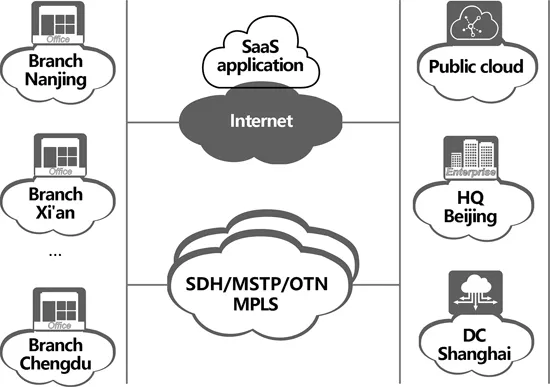
Figure 1.3 shows the current state of enterprise WAN interconnection.
FIGURE 1.3 Current state of enterprise WAN interconnection.
In addition to the headquarters, branches, and DCs that are typical of traditional enterprise WAN interconnection, today’s enterprise WAN interconnection includes public cloud and SaaS applications. The Internet has also become an element that should not be ignored.
Today’s enterprise WAN interconnection scenarios are now more complex than ever, and are facing the following challenges regarding cloud-network synergy, application experience, network performance, and O&M:
Connecting multiple clouds and net...
Table of contents
Cover
Half Title
Series Page
Title Page
Copyright Page
Table of Contents
Summary
Introduction
Acknowledgments
Authors
Chapter 1 WAN Developments
Chapter 2 Emergence of SD-WAN
Chapter 3 Introduction to the SD-WAN Solution
Chapter 4 Starting from Sites
Chapter 5 Site Interconnection
Chapter 6 Guaranteed Application Experience
Chapter 7 Security: Top Priority
Chapter 8 Easy O&M
Chapter 9 SD-WAN Best Practices
Chapter 10 SD-WAN Components
Chapter 11 SD-WAN Outlook
Acronyms and Abbreviations
References
Trusted by 375,005 students
Access to over 1.5 million titles for a fair monthly price.
Study more efficiently using our study tools.
Frequently asked questions
Yes, you can cancel anytime from the Subscription tab in your account settings on the Perlego website. Your subscription will stay active until the end of your current billing period. Learn how to cancel your subscription
No, books cannot be downloaded as external files, such as PDFs, for use outside of Perlego. However, you can download books within the Perlego app for offline reading on mobile or tablet. Learn how to download books offline
Perlego offers two plans: Essential and Complete
Essential is ideal for learners and professionals who enjoy exploring a wide range of subjects. Access the Essential Library with 800,000+ trusted titles and best-sellers across business, personal growth, and the humanities. Includes unlimited reading time and Standard Read Aloud voice.
Complete: Perfect for advanced learners and researchers needing full, unrestricted access. Unlock 1.5M+ books across hundreds of subjects, including academic and specialized titles. The Complete Plan also includes advanced features like Premium Read Aloud and Research Assistant.
Both plans are available with monthly, semester, or annual billing cycles.
We are an online textbook subscription service, where you can get access to an entire online library for less than the price of a single book per month. With over 1.5 million books across 990+ topics, we’ve got you covered! Learn about our mission
Look out for the read-aloud symbol on your next book to see if you can listen to it. The read-aloud tool reads text aloud for you, highlighting the text as it is being read. You can pause it, speed it up and slow it down. Learn more about Read Aloud
Yes! You can use the Perlego app on both iOS and Android devices to read anytime, anywhere — even offline. Perfect for commutes or when you’re on the go. Please note we cannot support devices running on iOS 13 and Android 7 or earlier. Learn more about using the app
Yes, you can access Software-Defined Wide Area Network Architectures and Technologies by Cheng Sheng,Jie Bai,Qi Sun in PDF and/or ePUB format, as well as other popular books in Computer Science & Computer Networking. We have over 1.5 million books available in our catalogue for you to explore.